SUBSCRIBE TO OUR FREE NEWSLETTER
Daily news & progressive opinion—funded by the people, not the corporations—delivered straight to your inbox.
5
#000000
#FFFFFF
To donate by check, phone, or other method, see our More Ways to Give page.
Daily news & progressive opinion—funded by the people, not the corporations—delivered straight to your inbox.
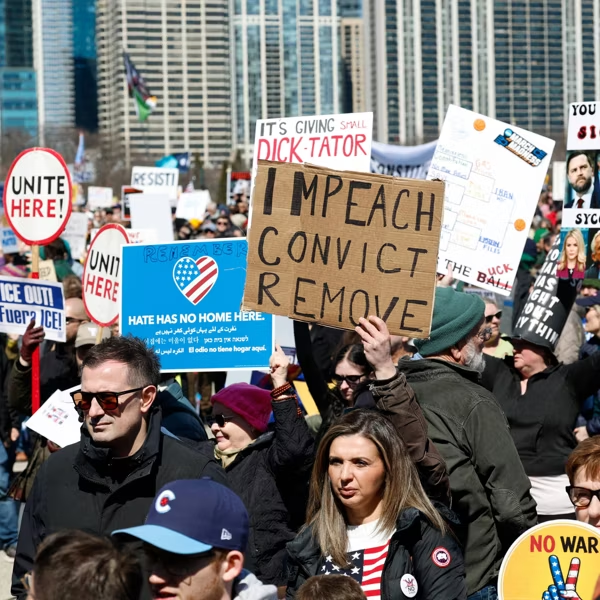
The answer to the question is this: No.
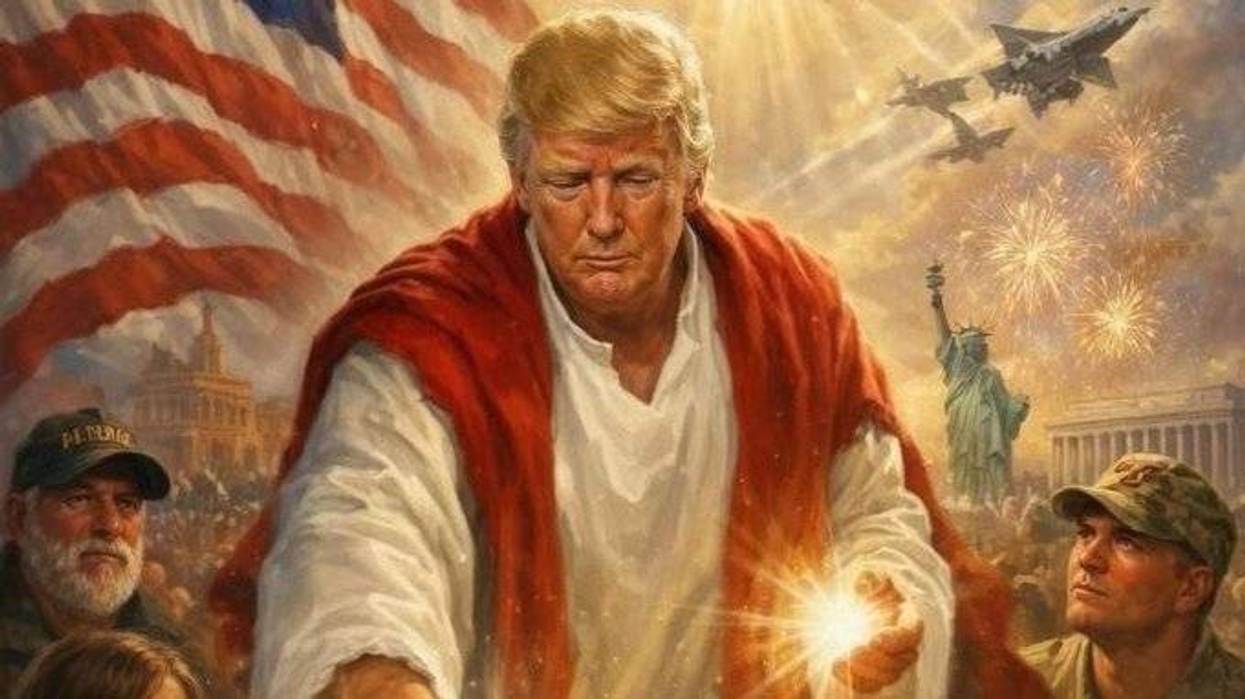
At 9:49 pm on Sunday evening, President Donald Trump posted an AI-generated image (previously shared months ago online by MAGA zealot Nick Adams and others) that depicts him as a healing Jesus Christ-like figure.
Like the president himself, the image is absurd on its face. It is also deeply concerning in terms of the deranged narcissism it represents—not to mention the timing as Trump drags the nation and the world further into ruin with his illegal war of choice against Iran.
Let the record show that Trump is neither holy nor a healer. He's an unrepentant war criminal and a billionaire enemy to the working class.
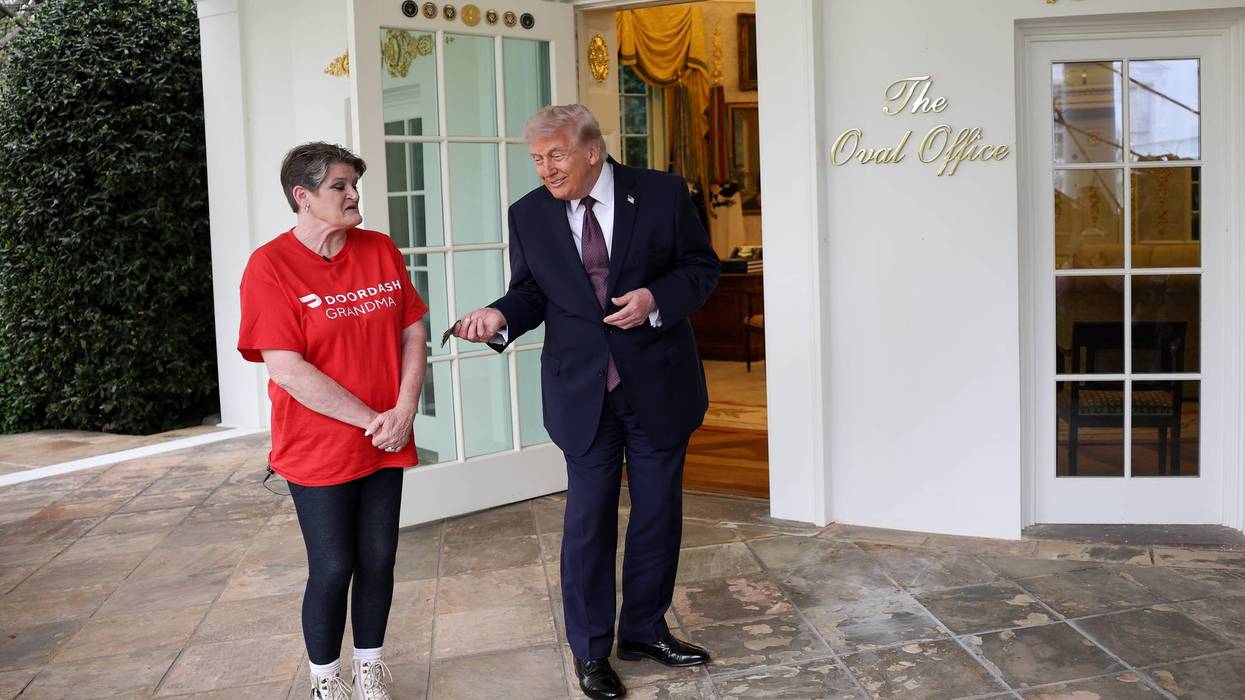
We asked an AI image generator to create a picture of "Trump as a war criminal" but the response was "an error occurred." But that's okay. Every real picture of Trump is a picture of a war criminal and a deceitful, lying, crude, and greedy man. We decided to use one of those instead.
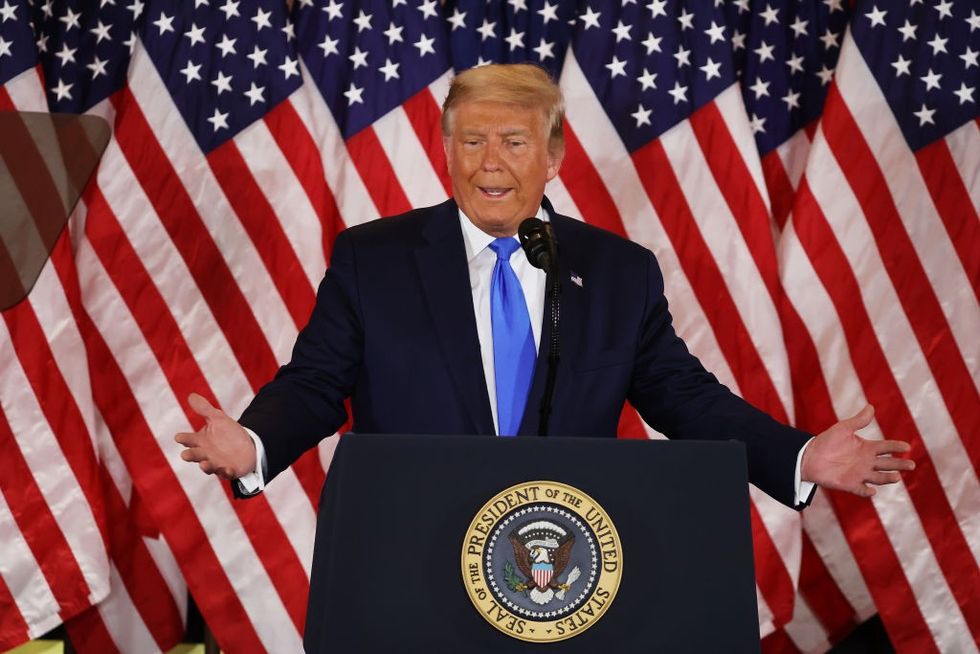
That's better. Though, honestly, no more enjoyable to look at.
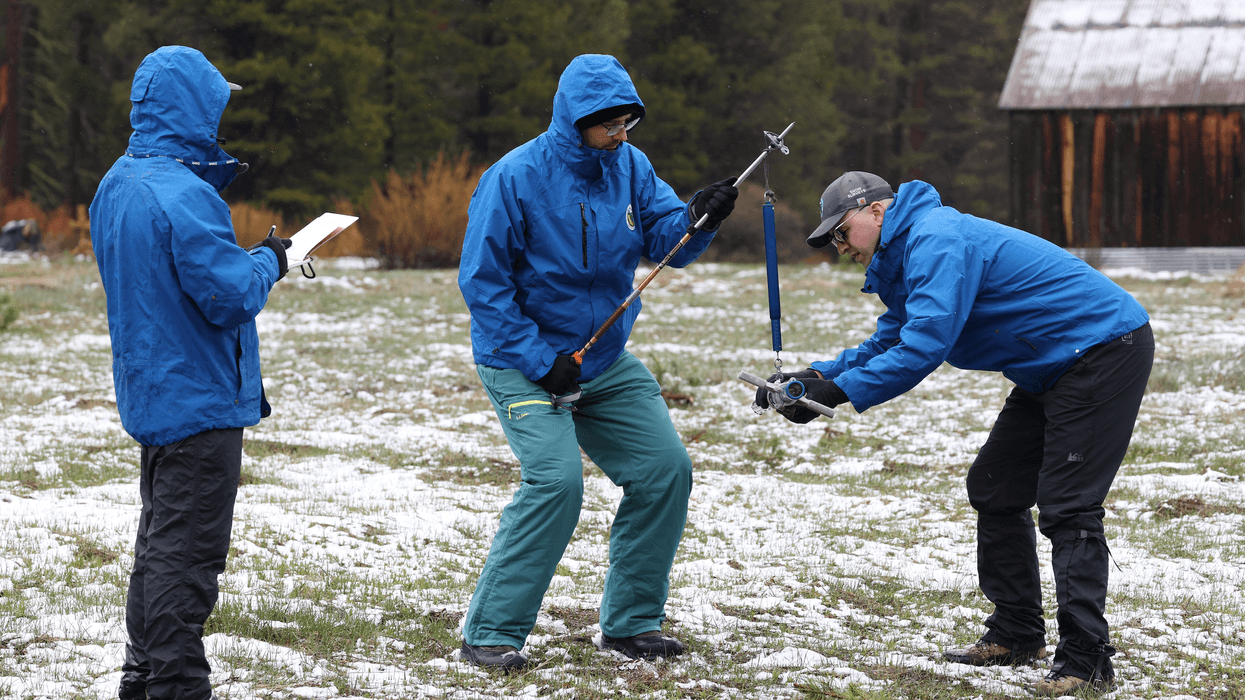
One of the worst Western US snow droughts of the century—exacerbated by a historically warm winter and a record-shattering March heatwave—has experts increasingly worried about wildfire and water supply risks heading into the spring and summer months.
On Wednesday, the California Department of Water Resources reported "no measurable snow" recorded at Phillips Station in the Sierra Nevada range. Because there was some visible snow already on the ground, DWR is calling this the second-lowest April measurement on record.
The agency said this is "a stark indicator of how record‑hot March temperatures and high‑elevation rain have erased the Sierra Nevada snowpack months ahead of schedule."
"The combination of warm storms and unusually hot temperatures rapidly melted what remained of this year’s already sparse snowpack," DWR added. "Statewide, the snowpack is now just 18% of average for this date, according to the automated snow sensor network."
DWR Director Karla Nemeth said that “it feels like we skipped spring this year and dropped straight into a summer heatwave."
“What should be gradual snowmelt happened suddenly weeks ago," Nemeth added. "We’re seeing fewer, warmer storms and shorter wet seasons. Future water supplies will depend upon our ability to capture water when it’s available and manage it more efficiently.”
Jeff Mount, a senior fellow at the Public Policy Institute of California’s Water Policy Center, told the San Francisco Chronicle on Wednesday: "It didn’t snow where we needed it to snow, and where it did snow, it didn’t stick. This is going to be an ugly summer."
Oregon's iconic Crater Lake is experiencing its lowest snow water equivalent levels on record for this time of year, according to the National Weather Service.
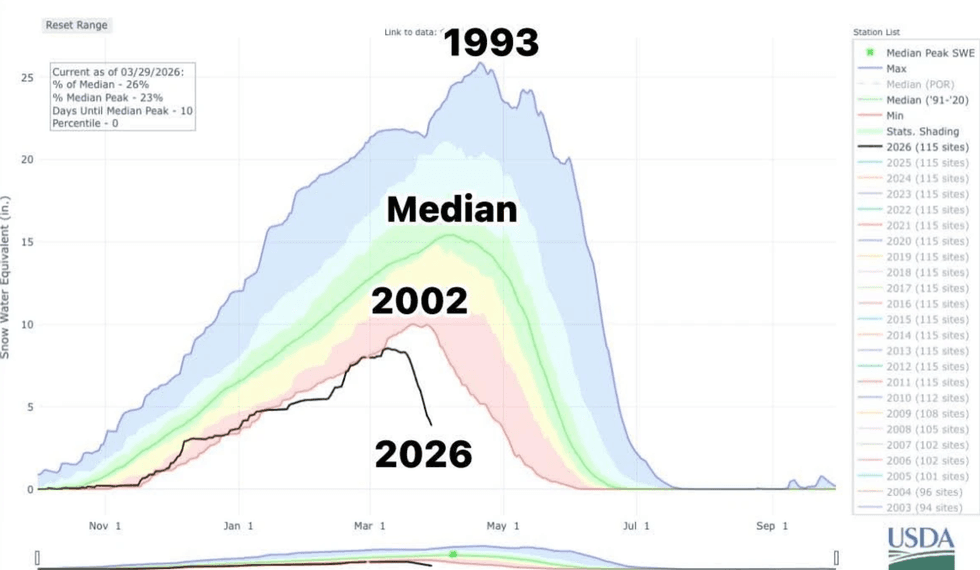
In Colorado, US Department of Agriculture (USDA) data show the statewide snowpack is at just 26% of median levels as of Thursday.
“This year is on a whole other level,” Colorado State University climatologist Russ Schumacher told The Guardian. "Seeing this year so far below any of the other years we have data for is very concerning."
Last week, the Denver Board of Water Commissioners declared Stage 1 drought restrictions, a move that seeks to reduce water use by 20%.
“The snowpack within Denver Water’s collection system has deteriorated significantly and continues to decline,” said Nathan Elder, Denver Water’s manager of water supply. “Snowpack levels in both basins are now the lowest observed in the past 40 years, with accelerated melting underway. The conditions we are experiencing are unprecedented, and we need customers to save water to protect the supply we have right now.”
April measurements of alpine snowpacks—which are sometimes described as water savings accounts—typically indicate peak levels of water that, with spring warming, melt into reservoirs, rivers, and other bodies that help hydrate the West during the parched summer and fall months.
“March is often a big month for snowstorms,” Schumacher said. “Instead of getting snow we would normally expect we got this unprecedented, way-off-the-scale warmth.”
“This year has the potential of being way worse than any of the years we have analogues for in the past,” he added.
As University of California Agriculture and Natural Resources climate scientist Daniel Swain explained last week:
Meteorologically speaking, March 2026 will go down in the record books as the warmest March on record for at least a third, and possibly half or more, of the continental United States. But even more remarkable is the ~10 day window of peak heat during this truly exceptional March heatwave—when many, if not most, locations across the western two thirds of the United States in a broad swath stretching from the Pacific Coast in California eastward past the Mississippi River broke their all-time March monthly heat records. The margin by which March heat records were shattered was so wide that more than a handful of locations also broke their all-time April heat records, and in a few locations even tied or broke their May heat records!
“Beyond the conspicuous ‘weirdness’ of it all, the most consequential impact of our record-shattering March heat will likely be the decimation of the water year 2025-26 snowpack across nearly all of the American west," Swain warned. "The toll wrought on our 'water tower in the sky' is nothing short of shocking."
I agree. This event has been meteorologically astonishing, and its impacts will be felt long after it ends in terms of record low snowpack, sharply increased wildfire risk, and extreme low watershed runoff/streamflow into summer and beyond.
[image or embed]
— Daniel Swain (@weatherwest.bsky.social) March 25, 2026 at 2:25 PM
The National Interagency Fire Center is among those projecting above-normal fire risk throughout the American West in the coming months.
“Unless there’s a major change in the weather patterns and we somehow pull out some sort of miracle springtime precipitation, we’re looking at an extended fire season,” Joel Lisonbee, senior associate scientist at the Cooperative Institute for Research at the University of Colorado Boulder, told The Guardian.
In addition to the risk of drought and wildfire, low water levels threaten wildlife, including California's flagging salmon runs—which are also imperiled by Trump administration actions including habitat disruption caused by water flow manipulation.
“No sooner do we start to gain a little ground back in rebuilding our salmon runs, the federal Bureau of Reclamation is destroying them again,” Vance Staplin, executive director of the Golden State Salmon Association, told The Sacramento Bee last week. "These fish are in big trouble if the bureau doesn’t relent very soon.”
Scientists have long warned that planetary heating driven by human burning of fossil fuels will result in longer and more frequent snow droughts. One 2020 study showed how the Western United States is fast becoming a "global snow drought hot spot," with the length of such dry spells increasing by 28% between 1980 and 2018.
“Climate change is going to result in a lot of these extreme events worsening,” Clark University climatologist Abby Frazier told The Guardian on Thursday. "It is heartbreaking to see it all playing out as we have predicted for so long. The changes we have teed up for ourselves are going to be catastrophic.”
New data from the US Bureau of Labor Statistics showed that inflation soared in March thanks in large part to increased energy costs stemming from President Donald Trump's illegal war with Iran.
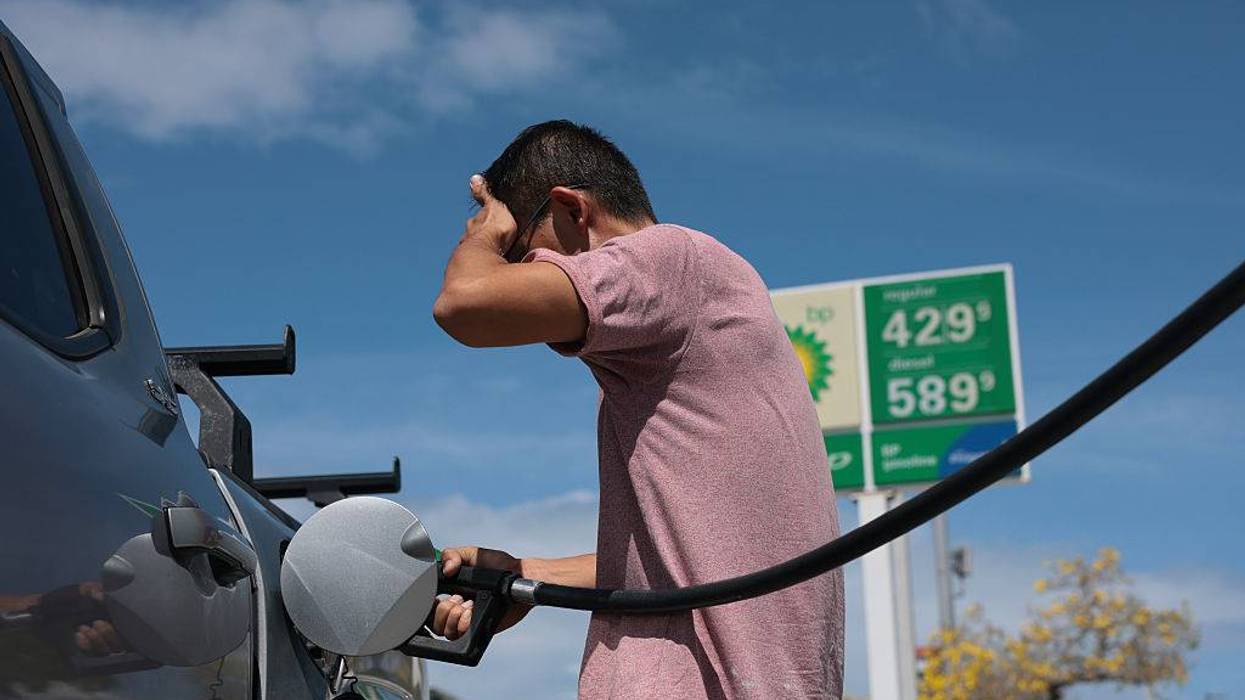
According to the BLS, the Consumer Price Index (CPI) posted a month-over-month gain of 0.9% in March, led by a 10.9% increase in energy prices including a massive 21.2% increase in gasoline.
On a yearly basis, total prices rose by 3.3% from where they were in March 2025—the highest annual inflation rate since April 2024.
University of Michigan economist Justin Wolfers commented in a social media post that inflation in March was "up sharply, and there's more to come," while describing the data as "the first numbers showing economic effects of the war in Iran."
New York Times economics reporter Ben Casselman observed that the 3.3% rise in inflation was "the fastest inflation rate of Trump's second term," and that "the jump was driven almost entirely by higher energy prices, the direct result of the war with Iran."
Heather Long, chief economist at Navy Federal Credit Union, flagged a particularly worrying aspect of the BLS report, which is that "wage growth is almost entirely eaten up by inflation now."
"Wage growth was +3.5% in March for the past 12 months. Inflation was +3.3% in March for the past 12 months," Long explained. "This is the squeeze many households are feeling. Their pay won't be able to keep up with this level of inflation. (And yes it was the same situtation in 2022)."
Elizabeth Pancotti, managing director for policy and advocacy at Groundwork Collaborative, said that the spike in inflation "comes as no shock to anyone who has filled up their gas tank in the past month," and predicted the damage wouldn't be limited to fuel prices.
"The toll of Trump’s war in Iran won’t stop at the pump," Pancotti said. "Price hikes on summer vacations, groceries, and electronics are coming down the pike as his war stokes chaos in supply chains around the world. By pursuing this illegal war, the president has made it clear that he’s putting American families last."
Sen. Chris Murphy (D-Conn.) stated that "between the war and tariffs and general incompetence, Trump is deliberately ruining the economy."
The Republican Party tried to put its best spin on the numbers by boasting that core inflation, which excludes the prices of food and energy, did not rise as much as anticipated.
"Core inflation just came in LOWER than expected for the month of March!" the GOP wrote in a social media post. "President Trump continues defying the 'experts' and beating expectations."
However, the GOP's post got several angry replies from followers who argued that core inflation mattered little when energy prices are spiking and gas prices are averaging $4.15 per gallon.
As Vox senior editor Benji Sarlin noted, former President Joe Biden's White House regularly pointed to core inflation numbers while trying to ease voters' anxiety about rising prices, but with little success.
"Congrats to all the Trump White House folks explaining the difference between topline inflation and core inflation during an oil shock today, I’m sure the Biden WH alums will be very sympathetic," Sarlin wrote. "People on social media also love it when you say inflation is actually pretty good if you just exclude gas, try it out."
US House Republicans thwarted an effort by Democrats to pass a war powers resolution to rein in President Donald Trump's attacks on Iran on Thursday, pushing it off until at least next week.
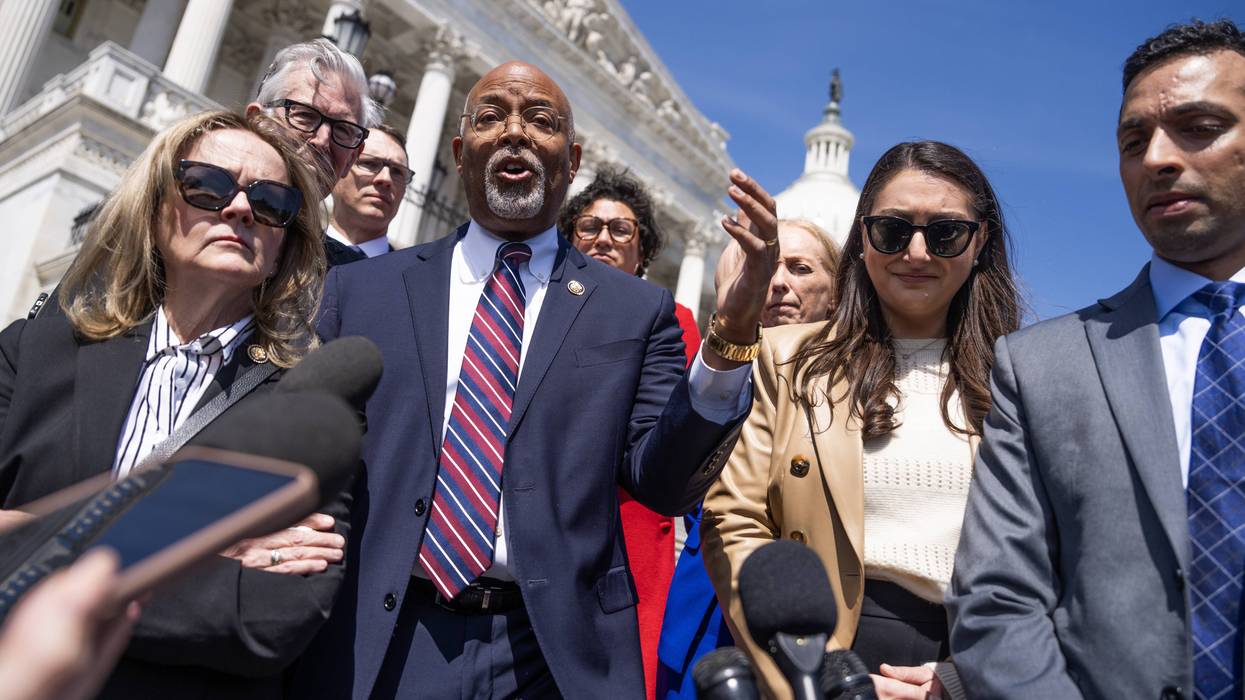
During a pro forma session Thursday morning with most members still out of town on recess, Rep. Glenn Ivey (D-Md.) attempted to bring the resolution to the floor for a vote using unanimous consent—a shortcut allowing legislation to pass instantly if all lawmakers agree.
But with a furious thwack of the gavel, Rep. Chris Smith (R-NJ), the pro forma speaker, abruptly brought the session to a close without allowing him to speak, prompting loud objections from other Democrats in the room.
“End the war. Let us vote,” shouted Rep. James Walkinshaw (D-Va.).
Ivey was attempting a long shot bid to pass a resolution introduced back in March by Rep. Gregory Meeks (D-N.Y.), which Democrats opted to punt until after the recess despite building momentum on Capitol Hill and despite Trump's growing belligerence against Iran, which culminated this week in a threat to wipe out the "whole civilization."
"My Democratic colleagues and I showed up on the House floor today to do our job and defend Congress’s constitutional war powers," said Rep. Don Beyer (D-Va.). "Republicans refused to even recognize our resolution."
"They’re choosing this war, and Trump’s violence and chaos," he said.
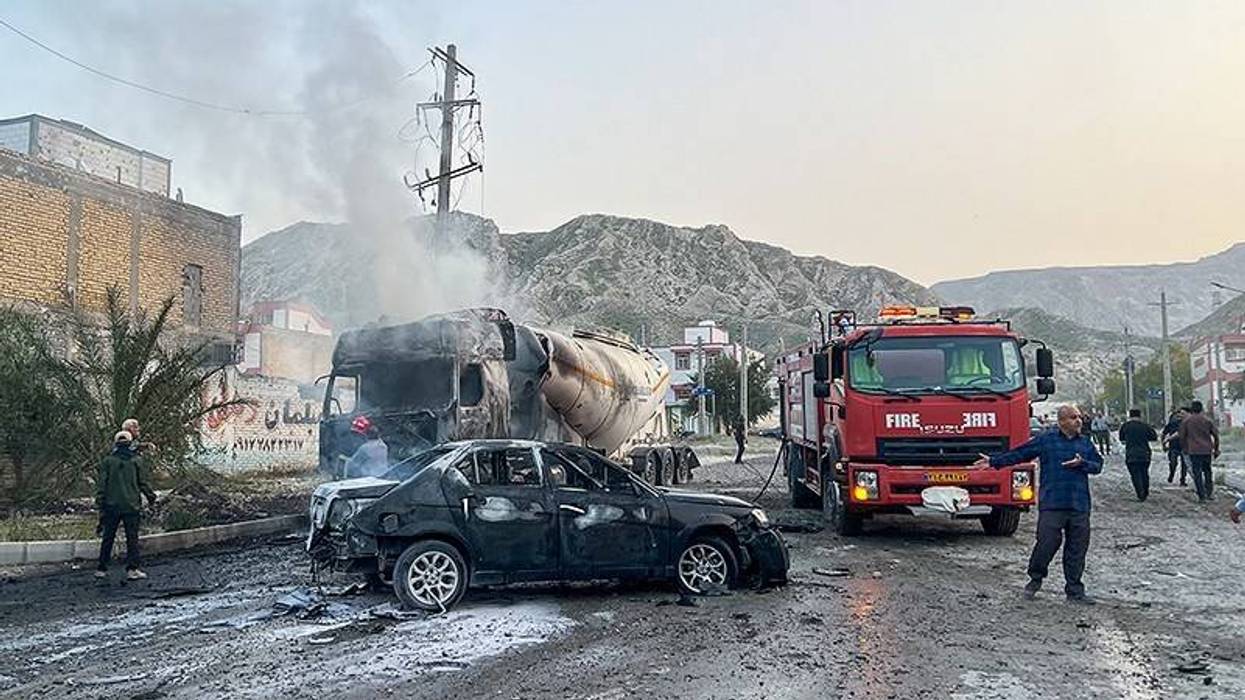
The US and Iran reached a ceasefire on Tuesday night, but it's currently hanging by a thread after Israel launched an unprecedented assault on Lebanon that led Iran to retaliate by once again choking off travel through the critical Strait of Hormuz.
Calls from House Minority Leader Hakeem Jeffries (D-N.Y.) for Speaker Mike Johnson (R-La.) to reconvene the House have fallen on deaf ears. War powers votes are expected to occur in both the House and Senate next week.
Previous measures have failed to pass both chambers. But prior to the recess, it appeared that reluctant House Democrats and at least three Republican defectors had gotten on board, potentially giving the measure enough votes to pass.
The Senate may pose more of an uphill battle. Most of the 47 Democratic Caucus members are expected to be on board, as is Sen. Rand Paul (R-Ky.) But the hawkish Sen. John Fetterman (D-Pa.) has stood in the way of past resolutions, and no other Republicans have signaled solid support.
However, lawmakers voting to continue the war will have to explain that decision to a wary public. An Economist/YouGov poll published Tuesday showed that 53% of Americans oppose the war, while just 34% approve. The prospect of sending ground troops into Iran, which Trump has heavily considered, is even less popular, with just 15% of Americans supporting the idea.
"We need a permanent end to Donald Trump's costly and reckless war of choice," Jeffries said at a press conference Thursday afternoon. "Upon our return, we will force another vote on the House floor around the war powers resolution that will compel the Trump administration to cease military hostilities immediately."
The global anti-poverty group Oxfam International warned this week that US President Donald Trump’s decision to slash foreign aid by more than half could kill nearly 10 million people by the end of the decade.
Responding to new data released Thursday by the Organization for Economic Cooperation and Development (OECD) showing the largest annual drop in the history of official development assistance, Oxfam said “wealthy governments are turning their backs on the lives of millions of women, men, and children in the Global South.”
The OECD released preliminary data on international aid that was provided last year by member countries of the organization's Development Assistance Committee (DAC), finding the largest annual drop in the history of official development assistance.
OECD member countries provided $174.3 billion in aid last year, according to the new data, representing 0.26% of the countries' combined gross national income.
In 2024, the countries sent $215.1 billion, or 0.34% of their gross national income to developing countries, including across the Global South—helping to provide nutritional assistance and healthcare initiatives among other programs.
US foreign aid spending dropped by 56.9% after Trump dismantled the US Agency for International Development, cut smaller aid programs, and pushed Congress to rescind previously approved foreign assistance.
"At a time when aid cuts are already driving instability and fostering greater inequality, government donors are cutting life-saving aid budgets while financing conflict and militarization."
Overall, wealthy OECD countries provided 23.1% less in foreign aid last year than they did in 2024—a greater decline than what the Institute of Global Health in Barcelona projected in February when it released a study in The Lancet, evaluating the impact of development assistance funding declines around the world.
The institute found that aid cuts in 2025 alone, which it assumed would represent a 21% decrease in funding, would lead to 695,238 excess deaths. If cuts continued at the same rate, an estimated 9,416,417 people could die of preventable diseases like malaria and AIDS, starvation, and other impacts by 2030.
The drop in foreign aid spending would suggest even more people could be killed by the cuts over the next four years.
“We are in a time of increasing humanitarian needs; strong pressures on the poorest and most fragile countries; and facing growing global uncertainties and massive insecurity," said Carsten Staur, chair of the OECD's Development Assistance Committee (DAC), which compiled the data. "In this situation, the world needs more ODA, not less—to help fight extreme poverty, improve resilience, and mobilize more private resources."
Trump's cuts helped make Germany the largest provider of development assistance for the first time ever, providing $29.1 billion to countries in need. The US sent $29 billion while the United Kingdom provided $17.2 billion, Japan sent $16.2 billion, and France sent $14.5 billion. All five of the top ODA providers reduced their foreign aid spending, accounting for 95.7% of the total decline.
Eight out of the DAC's 34 member countries either maintained or increased their development aid spending, and four countries—Denmark, Luxembourg, Norway, and Sweden—exceeded the United Nations' target of spending 0.7% of their gross national income on ODA.
Didier Jacobs, development finance lead for Oxfam, emphasized that while "recklessly" cutting foreign aid, "the Trump administration has been preparing to ask Congress for tens of billions in additional funding for bombs, ammunition, and other military equipment relating to its unlawful war against Iran."
"At a time when aid cuts are already driving instability and fostering greater inequality, government donors are cutting life-saving aid budgets while financing conflict and militarization. Cuts from donors including Germany, France and the UK will be felt by the world’s poorest," said Jacobs.
In addition to slashing military spending instead of crucial foreign aid, he said, "there are other ways to find tens of billions, such as by taxing the $2.84 trillions of dollars that the super-rich hide in tax havens.”
"Governments must restore their aid budgets," he said, "and shore up the global humanitarian system that faces its most serious crisis in decades."
New information published Friday by the New York Times further suggests that the US military may have lied when it tried to pin the blame for a February airstrike that killed 21 people in Iran on the Iranian government, with evidence indicating that the US carried out the attack with a new missile designed to inflict maximum casualties.
While much of the world knows about the February 28 massacre of around 175 children and staff at the Shajareh Tayyebeh girls’ elementary school in Minab—and about how President Donald Trump initially blamed Iran for the slaughter—the strike that hit a sports hall and playground in Lamerd on the same day, the first day of the war, received far less media coverage.
Munitions experts and the Times concluded that US-made Precision Strike Missiles, or PrSMs—pronounced "prism"—struck the residential area of the southern Iranian city. Developed by Lockheed Martin, PrSMs are airburst weapons, exploding above their targets and blasting 180,000 lethal tungsten pellets in every direction. Video footage of the Lamerd strike shows multiple airbursts.
Pete Hegseth's Defense Dept appears to be caught in a lie.It involves deaths of 21 people (including at least 5 children), injuring 110 in Lamerd, Iran with sports hall and school.By a U.S. missile (PrSM) never before used in combat.NYT sources include: 3 US officials!1/
[image or embed]
— Ryan Goodman (@rgoodlaw.bsky.social) April 10, 2026 at 5:48 PM
The Times verified the identities of 21 people killed in the strike. At least five victims were children, the youngest of them just 2 years old. Helma Ahmadizadeh, 10, and Elham Zaeri, 11, were attending volleyball practice at the sports hall when it was bombed. Helma survived the strike with no visible injuries. However, she told her coach that she felt something enter her body. A medical examination at a local hospital revealed a small object in her body. She subsequently died.
"A young boy, Ilia Khatami, was killed alongside his coach, Mahmoud Najaf," the newspaper said. "The Times confirmed their deaths, and the death of a second boy, Abdul Mosavar Rahmani, who was from Afghanistan."
The 2-year-old, Avina Barzegar, was mortally wounded by a small object while she was playing outside her home. Video posted on Telegram shows her being treated in a local hospital before she died.
Local officials said 100 other people were injured in the attack.
Pentagon officials previously denied US responsibility for the attack following the March 29 publication of a Times investigation that used video analysis to identify PrSMs as the missiles used in the strike. US Central Command (CENTCOM) spokesperson Capt. Tim Hawkins issued a statement on March 31 calling reports that the US carried out the attack "false" and suggesting that weapon used in the strike was an Iranian Hoveyzeh cruise missile.
The Times' latest analysis is "based on new video footage of detonations, new photo evidence of the damage, a missile-trajectory assessment, and the perspectives of multiple experts, including three US government officials."
Findings include distinctive damage patterns consistent with tungsten pellet dispersion from a PrSM airburst, the discovery of a third detonation site consistent with a PrSM, a strike trajectory indicating the missile was launched from where US forces are based, and the sports hall's proximity to an Islamic Revolutionary Guards Corps base. The Minab girls' school is also located very close to an IRGC base.
Critically, Iran does not have any missiles in its arsenal that function in a similar manner to PrSMs.
“The problem is that CENTCOM chose as an alternative a very identifiable missile,” Amaël Kotlarski, who leads the weapons team at the defense intelligence firm Janes, told the Times. "And the Hoveyzeh’s distinct features aren’t seen in the video."
Shahryar Pasandideh, another military analyst consulted by the Times, said "there is no public information to suggest that Iranian cruise missiles, including the Hoveyzeh, are equipped with an airburst fuse, let alone an airburst fuse and pre-formed tungsten pellets."
After the Minab massacre, Trump claimed that Iran had somehow acquired a US Tomahawk missile and used it to blow up the school.
An earlier investigation by the BBC Verify also concluded that the Lamerd strike was carried out using US PrSM missiles.
VIDEO | According to a report from BBC Verify, video evidence and expert assessment suggest a US Precision Strike Missile (PrSM) was likely involved in an attack on a sports hall in Lamerd, southwestern Iran on 28 February. The attack killed at least 21 people, including… pic.twitter.com/alZ25dVMl6
— The Cradle (@TheCradleMedia) March 29, 2026
More than 3,000 people have been killed over 42 days of US and Israeli strikes on Iran, according to medical officials there. This figure reportedly includes over 1,300 civilians, hundreds of whom are women and children.
Crystal Carey, general counsel at the National Labor Relations Board, represented Amazon during her time at one of the biggest management-side law firms in the country.
National Labor Relations Board General Counsel Crystal Carey proposed a settlement on Sunday that would unwind a major case against the e-commerce behemoth Amazon—a company that Carey represented when she worked in the private sector for corporate clients.
Carey, whom President Donald Trump nominated after firing the Biden-era NLRB general counsel last year, sent her proposed settlement terms to the judge overseeing the labor agency's case against Amazon, which originated in the final year of the Biden administration. According to Bloomberg, Carey proposed that Amazon provide two weeks' worth of pay to dozens of drivers who were previously employed by Battle-Tested Strategies (BTS), formerly one of Amazon's delivery service partners (DSPs).
Amazon, in turn, would not be required to admit to unfair labor practices or be "found liable as a joint employer." The Biden-era NLRB argued that Amazon was a joint employer of the BTS delivery drivers and thus required to recognize and collectively bargain with their union—something Amazon has refused to do.
Bloomberg noted that, if decided against Amazon, the case Carey wants to settle "could have led for the first time to an agency judge, the NLRB members in Washington, and, eventually, federal appeals court judges ruling that Amazon was the joint employer of drivers for one of its delivery service partners."
"Amazon contracts with thousands of such partners to manage hundreds of thousands of delivery workers," Bloomberg observed.
Before Trump nominated her to replace labor champion Jennifer Abruzzo as general counsel of the NLRB, Carey was a partner at Morgan Lewis, one of the biggest management-side law firms in the country. The Economic Policy Institute noted following Carey's Senate confirmation last year that Morgan Lewis "represents corporations known for violating workers’ rights, including Amazon, SpaceX, Apple, and Tesla."
"Morgan Lewis is also pursuing the legal challenge that the NLRB is unconstitutional, despite several former NLRB members being employed at the firm," EPI noted. (Amazon has also argued in court that the labor board is unconstitutional.)
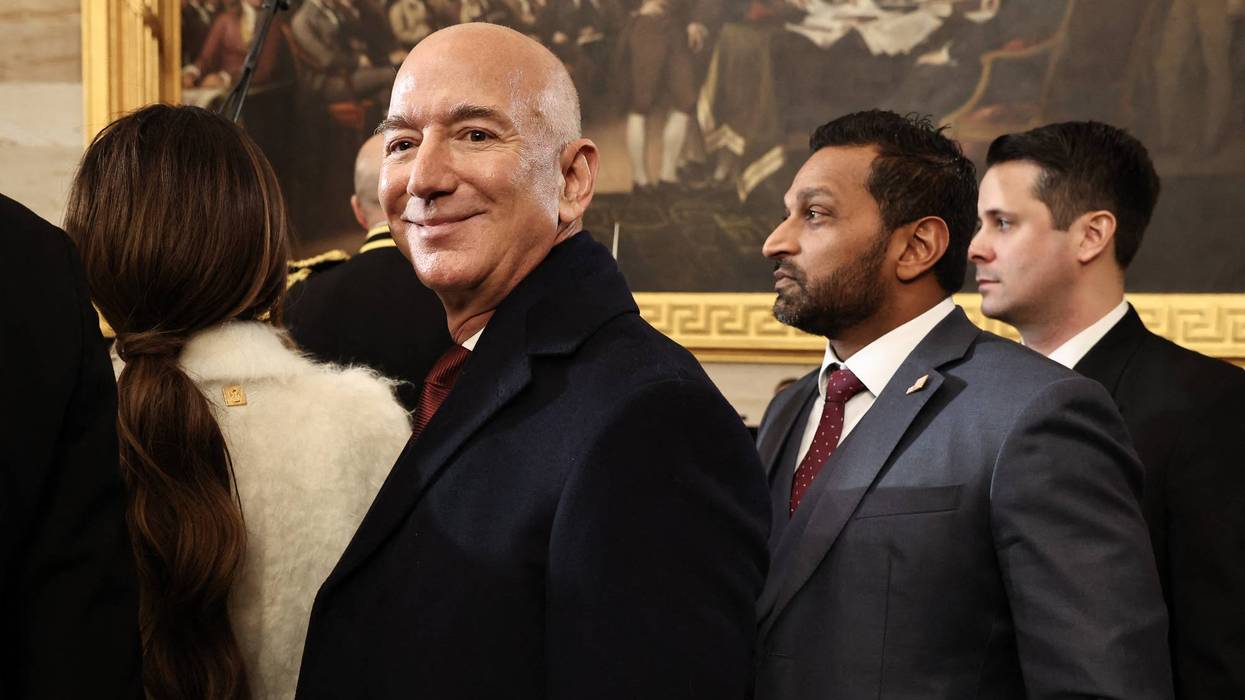
Amazon donated $1 million to Trump's inaugural fund, and the company's founder, mega-billionaire Jeff Bezos, attended the inauguration ceremony alongside other big-name tech executives.
Despite her ties to Amazon via her tenure at Morgan Lewis, Carey argued that she was not required to recuse herself from the case she's working to settle. According to Bloomberg, Carey said in an interview that "because a year had passed since she herself represented Amazon and because Morgan Lewis wasn’t representing the company in the [ongoing joint employer] case, she didn’t need to recuse herself."
"The result will be fewer opportunities for creators, fewer jobs across the production ecosystem, higher costs, and less choice for audiences."
A group of Hollywood actors, directors, and producers on Monday published an open letter demanding the proposed merger between Paramount and Warner Bros. Discovery be blocked.
In their letter, the Hollywood heavyweights outlined the harms that would come from allowing Paramount—which is owned by David Ellison, son of billionaire Trump donor Larry Ellison—to acquire Warner Bros. Discovery.
"This transaction would further consolidate an already concentrated media landscape, reducing competition at a moment when our industries—and the audiences we serve—can least afford it," the letter states. "The result will be fewer opportunities for creators, fewer jobs across the production ecosystem, higher costs, and less choice for audiences in the United States and around the world. Alarmingly, this merger would reduce the number of major US film studios to just four."
The letter goes on to describe how consolidation in the entertainment industry has already "accelerated the disappearance of the mid-budget film, the erosion of independent distribution, the collapse of the international sales market, the elimination of meaningful profit participation, and the weakening of screen credit integrity."
Looking at the bigger picture, the letter notes that "competition is essential for a healthy economy and a healthy democracy," then goes on to praise California Attorney General Rob Bonta and other state AGs for filing legal actions aimed at blocking the merger amid fears that the Trump administration could rubber-stamp it.
"We are grateful for their leadership," the letter concludes, "and stand ready to support all efforts to preserve competition, protect jobs, and ensure a vibrant future for our industry, for American culture, and for our single most significant export."
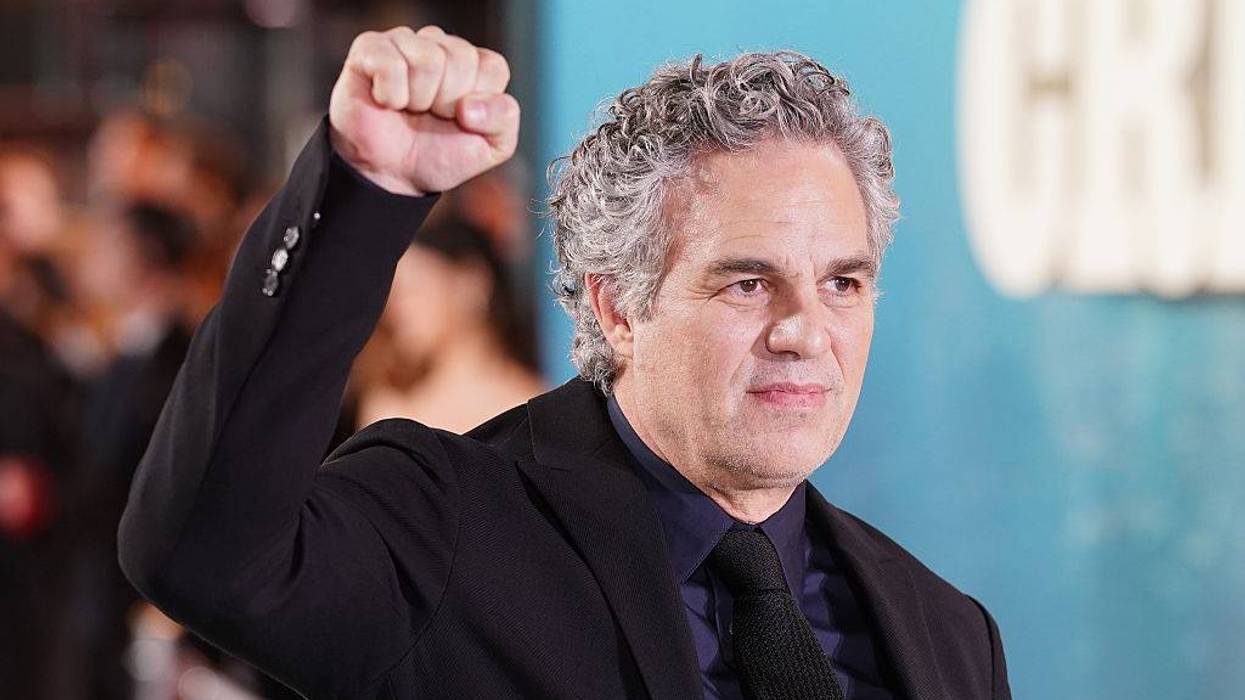
Actor Mark Ruffalo, a signatory of the letter, published an article on his Substack page outlining his own reasons for opposing the merger, which he described as "the epitome of crony capitalism and the oligarchs consolidating more corporations and media power to shape the outcome of their business interests."
Ruffalo also said he's spoken with others in Hollywood who were reluctant to sign the letter over concerns about retaliation from Trump or Ellison should the attempt to block the merger fail.
"The people pushing monopolies such as this one use fear to keep the workers in line," Ruffalo said. "I have heard it time and time again from my fellows, they are afraid of retribution. Some didn’t want to sign because they are afraid. How sad is that? In America the artists are afraid to speak out against power."
Actress Jane Fonda, founder of the modern Committee for the First Amendment, said that the proposed Paramount-Warner Bros. merger "would be one of the most destructive threats to free speech and creative expression in our history," because it would put "unprecedented power in the hands of a single corporation that already appears to have proven itself willing to sacrifice integrity for political favor."
The letter earned praise from democracy and antitrust advocates, who argued that blocking the merger was necessary to stopping President Donald Trump's ambitions for a right-wing takeover of US media.
“The future of free media and a strong entertainment industry in America is at stake here,” said Norm Eisen, co-founder and executive chair of Democracy Defenders Fund. “This proposed merger would not only harm competition and creativity, it would erode the very bedrock of our democracy."
Matt Stoller, director of research at the American Economic Liberties Project, noted that "consolidation in Hollywood has been a disaster, and has led to the weak state of the industry," and said the Paramount-Warner Bros. merger needed to be blocked to prevent further damage.
"Not only does this kind of concentration hollow out creative markets," said Stoller, "it concentrates control over culture and information in the hands of a few unaccountable executives, and in this case totalitarian Gulf countries, undermining a free and pluralistic media ecosystem that democracy depends on."
The fight seemingly isn't over, with a spokesperson for the president pledging that he will "refile this powerhouse lawsuit," which critics have called part of his war on free speech.
A Florida-based federal judge on Monday dismissed President Donald Trump's $10 billion lawsuit against The Wall Street Journal over its reporting on a "bawdy" birthday letter the Republican allegedly gave to the late convicted sex offender Jeffrey Epstein.
Trump denies writing the letter or drawing the outline of a naked woman around the text. He sued the journalists behind the July report—Joseph Palazzolo and Khadeeja Safdar—and the newspaper, plus its parent company News Corp, chief executive Robert Thomson, and founder Rupert Murdoch.
The US House Committee on Oversight and Government Reform subsequently subpoenaed the Epstein estate for all materials that now-imprisoned co-conspirator Ghislaine Maxwell allegedly compiled for the dead financier's birthday book, including the letter attributed to Trump—and in September, the panel published those documents online.
US District Judge Darrin P. Gayles, an appointee of former President Barack Obama, found on Monday that Trump's "complaint fails to adequately allege actual malice." However, Gayles also gave Trump the opportunity to amend his filing within the next two weeks.
While The Wall Street Journal did not immediately respond to CNN's request for comment, a spokesperson for Trump's legal team said in a statement that the president intends to continue the case.
"President Trump will follow Judge Gayles' ruling and guidance to refile this powerhouse lawsuit against The Wall Street Journal and all of the other defendants," the spokesperson said. "The president will continue to hold accountable those who traffic in Fake News to mislead the American People."
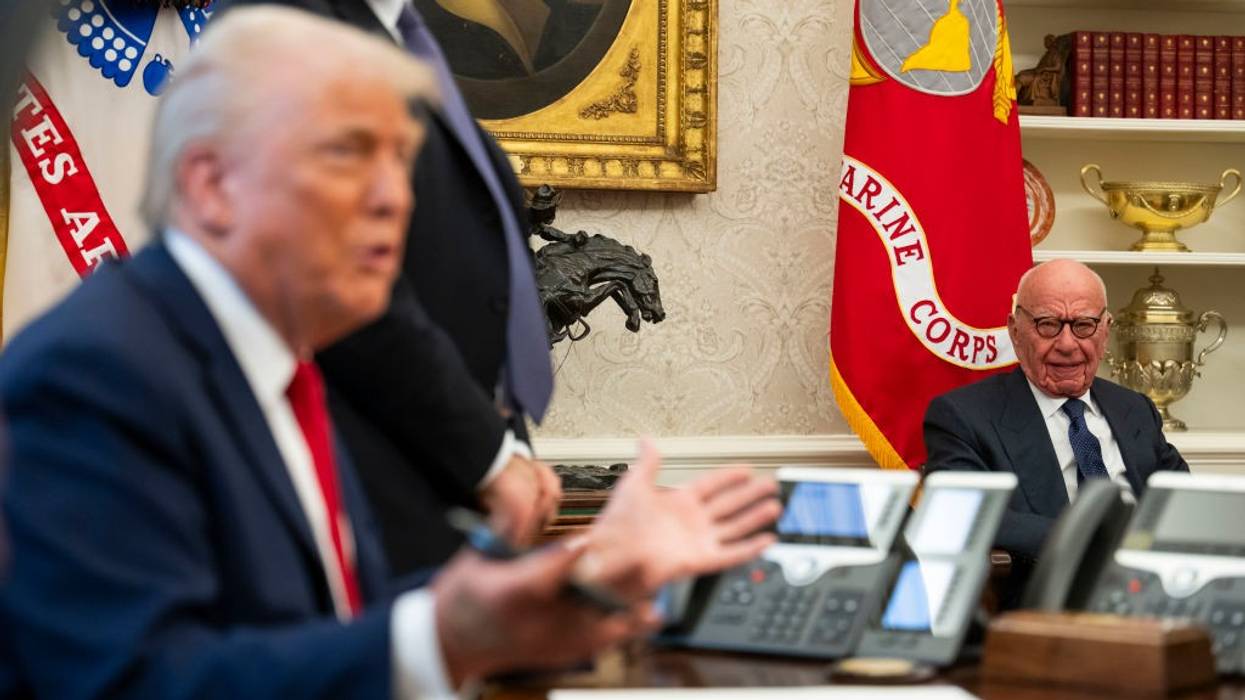
CNN noted that despite the legal battle, "the 95-year-old Murdoch has maintained a cozy if complicated relationship with the president, including multiple meetings at the White House in recent months."
The suit over the birthday letter to Epstein—whom Trump was publicly friends with in the 1980s and '90s until a reported falling out in the early 2000s—is just part of a sweeping effort by the president and his political enablers "to undermine and chill the most basic freedoms protected under the First Amendment," as the advocacy group Free Press put it in a December analysis.
In addition to the Journal case, examples included Trump's legal battles with the BBC and The New York Times, the White House taking control of the presidential press pool, the administration blocking The Associated Press from the Oval Office over its refusal to refer to the Gulf of Mexico as the Gulf of America, ABC temporarily suspending late-night host Jimmy Kimmel following comments from Trump's Federal Communications Commission chair, and the Pentagon's legally contested media policy.
Such attacks continue. Last month, as the costs of his unconstitutional war on Iran mounted, Trump floated "treason" charges against media outlets that he accused of reporting false information about the conflict.