

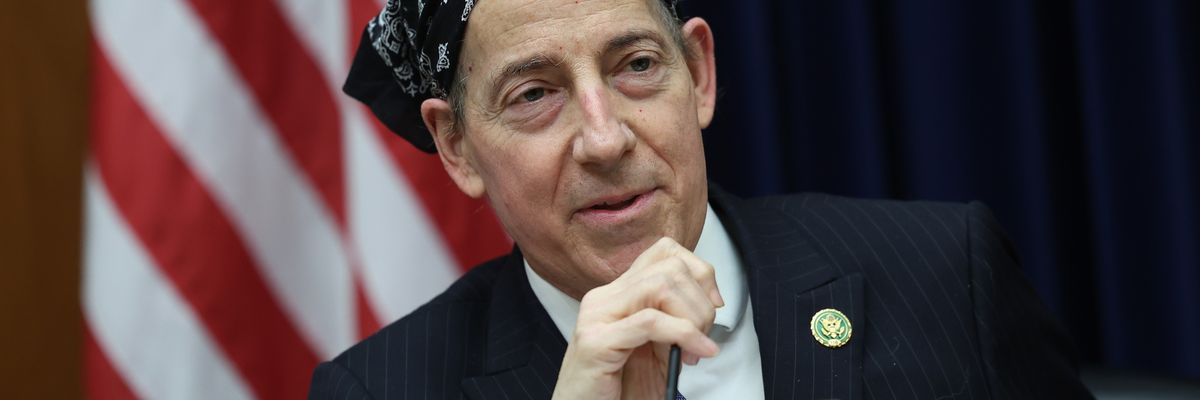
U.S. Rep. Jamie Raskin (D-Md.) attends a hearing in the Rayburn House Office Building on January 31, 2023 in Washington, D.C.
Biden Can 'Absolutely' Invoke 14th Amendment Over Debt Ceiling, Says Raskin
Members of Congress, legal scholars, and even the union representing federal workers are calling on the White House to answer the GOP's economic hostage-taking with unilateral action to prevent a default.
As congressional leaders prepare for a Tuesday meeting at the White House, Congressman Jamie Raskin, a constitutional scholar, affirmed Sunday that if GOP lawmakers won't raise the debt ceiling without major spending cuts, President Joe Biden can invoke the 14th Amendment to keep borrowing and avert a catastrophic first-ever U.S. default.
Section 4 of the 14th Amendment to the U.S. Constitution says in part, "The validity of the public debt of the United States, authorized by law... shall not be questioned."
Asked whether the president could and should use that part of the amendment to combat Republican efforts to hold the global economy hostage, Raskin (D-Md.) told MSNBC's Jen Pskai—Biden's former press secretary—that "I think he has that authority under these circumstances, absolutely, because the Congress has put him in a constitutionally untenable position."
"If he decides to default for the country, he's... violating the Constitution, because the 14th Amendment says you can't do that," Raskin said of Biden, pointing to a New York Times opinion piece by Harvard University professor emeritus Laurence Tribe.
Tribe—whose previous students include Raskin along with former President Barack Obama, U.S. Attorney General Merrick Garland, and Supreme Court Justices John Roberts and Elena Kagan—detailed why he has changed his mind on the debt limit argument.
"The question isn't whether the president can tear up the debt limit statute to ensure that the Treasury Department can continue paying bills submitted by veterans' hospitals or military contractors or even pension funds that purchased government bonds," he wrote Sunday. "The question isn't whether the president can in effect become a one-person Supreme Court, striking down laws passed by Congress."
Tribe continued:
The right question is whether Congress—after passing the spending bills that created these debts in the first place—can invoke an arbitrary dollar limit to force the president and his administration to do its bidding.
There is only one right answer to that question, and it is no.
And there is only one person with the power to give Congress that answer: the president of the United States. As a practical matter, what that means is this: Mr. Biden must tell Congress in no uncertain terms—and as soon as possible, before it's too late to avert a financial crisis—that the United States will pay all its bills as they come due, even if the Treasury Department must borrow more than Congress has said it can.
Praising Tribe's piece for the Times, Rep. Ro Khanna (D-Calif.) tweeted early Monday: "The Treasury has the [constitutional] obligation to pay our debts and spend the money Congress has already directed it to do. It really is that straightforward."
Treasury Secretary Janet Yellen warned in a letter to House Speaker Kevin McCarthy (R-Calif.) last week that "our best estimate is that we will be unable to continue to satisfy all of the government's obligations by early June, and potentially as early as June 1."
Appearing on ABC's "The Week" Sunday, Yellen confirmed the timeline she laid out for the speaker is "still our current thinking" and explained that "we've been using extraordinary measures for several months now, and our ability to do that is running out."
While acknowledging that Biden said Friday he was not yet ready to invoke the 14th Amendment, ABC's George Stephanopoulos asked Yellen if it was still a possibility. She would not explicitly address whether the White House is considering the move, instead stressing that "our priority is to make sure that Congress does its job."
"There is no way to protect our financial system and our economy other than Congress doing its job and raising the debt ceiling and enabling us to pay our bills," Yellen said. "And we should not get to the point where we need to consider whether the president can go on issuing debt. This would be a constitutional crisis."
Led by McCarthy, House Republicans last month passed their so-called Limit, Save, Grow Act, which would raise the debt ceiling by $1.5 trillion or until March 31, 2024—whichever comes first—but also impose dramatic cuts that would notably impact lower-income households. Senate Majority Leader Chuck Schumer (D-N.Y.) has repeatedly called the bill "dead on arrival."
House Minority Leader Hakeem Jeffries (D-N.Y.) and fellow Democrats are working on a "discharge petition" effort to force a vote on a clean bill raising the debt limit, but doing so would require support from at least five Republicans, which is unlikely.
In a Monday letter to Schumer, 43 GOP senators made clear that they are "united behind the House Republican conference in support of spending cuts and structural budget reform as a starting point for negotiations on the debt ceiling."
Meanwhile, Schumer, Jeffries, and other Democratic leaders on Monday released an updated version of their recent report warning that Republicans forcing a default would be catastrophic, "but even the threat of breaching the debt ceiling can have serious economic consequences for families."
Biden is set to meet with McCarthy, Jeffries, Schumer, and Senate Minority Leader Mitch McConnell (R-Ky.) Tuesday "for what he called a separate negotiation on fiscal policy—even though it is effectively linked to the debt limit drama," the Times noted Monday.
The newspaper added:
White House officials said this weekend that Mr. Biden has been publicly and privately adamant that he will not bargain with Republicans over raising the limit. "Let's get it straight: They're trying to hold the debt hostage to get us to agree to some draconian cuts, magnificently difficult and damaging cuts," Mr. Biden told a meeting of cabinet members and other economic officials on Friday.
Citing three unnamed sources with knowledge of internal conversations, The Washington Post reported Monday that White House officials see unilateral actions—from invoking the 14th Amendment to minting a platinum coin worth $1 trillion—as "risky choices that could cause lasting economic damage" but also "do not want to take the proposals completely off the table."
The National Association of Government Employees (NAGE), which represents about 75,000 federal employees, cited the 14th Amendment in a federal lawsuit filed Monday that seeks to have the debt limit law declared unconstitutional.
NAGE's complaint, which names Biden and Yellen as defendants, argues the debt limit statute "is unconstitutional because it puts the president in a quandary to exercise discretion to continue borrowing to pay for the programs which Congress has heretofore duly authorized and for which Congress has appropriated funds or to stop borrowing and to determine which of these programs the president, and not the Congress, will suspend, curtail, or cancel altogether."
The filing adds that NAGE "seeks to protect all its members from additional extraordinary measures as well as major spending-related actions that will necessarily be taken without approval of Congress and that result in layoffs, furloughs, requirements for unpaid work, and loss of funding of the pensions and retirement plans of its members."
We are at a crossroads
This country and this world are at a monumental crossroads. In a few short weeks, US voters will have an opportunity to beat back the forces of fascism and confront the billionaires who are rigging the economy, our media system, and our democracy, making it increasingly impossible for ordinary people to get by. We’re not just talking about the election. We’re talking about what must be done once these fascist elements are vanquished from power. We need a bolder set of solutions than what either major party has so far been willing to offer and a working-class movement ready to fight like hell for it. Trump didn't emerge from nowhere. The conditions that fueled MAGA authoritarianism were created by decades of radical neoliberal economic policies and a corrupt political system dominated by corporate interests. They slashed taxes on the super-rich, promising that the benefits would trickle down. They said giveaways to the corporate titans would make life more affordable for the rest of us. It was all bullshit. And when a bitter, betrayed populace searches for someone to blame, right-wing demagogues have little trouble finding scapegoats. People know when they're being lied to, but you won't hear any of this from the corporate media. Only independent journalism—powered and funded by people who believe in building a better world—can deliver truly trustworthy daily news. Our Fall Campaign is underway, and we need your help. To power our newsroom through the rest of the year, we need to raise $125,000 by midnight on October 31. So if you share our vision, please contribute whatever you can to sustain our work. |
As congressional leaders prepare for a Tuesday meeting at the White House, Congressman Jamie Raskin, a constitutional scholar, affirmed Sunday that if GOP lawmakers won't raise the debt ceiling without major spending cuts, President Joe Biden can invoke the 14th Amendment to keep borrowing and avert a catastrophic first-ever U.S. default.
Section 4 of the 14th Amendment to the U.S. Constitution says in part, "The validity of the public debt of the United States, authorized by law... shall not be questioned."
Asked whether the president could and should use that part of the amendment to combat Republican efforts to hold the global economy hostage, Raskin (D-Md.) told MSNBC's Jen Pskai—Biden's former press secretary—that "I think he has that authority under these circumstances, absolutely, because the Congress has put him in a constitutionally untenable position."
"If he decides to default for the country, he's... violating the Constitution, because the 14th Amendment says you can't do that," Raskin said of Biden, pointing to a New York Times opinion piece by Harvard University professor emeritus Laurence Tribe.
Tribe—whose previous students include Raskin along with former President Barack Obama, U.S. Attorney General Merrick Garland, and Supreme Court Justices John Roberts and Elena Kagan—detailed why he has changed his mind on the debt limit argument.
"The question isn't whether the president can tear up the debt limit statute to ensure that the Treasury Department can continue paying bills submitted by veterans' hospitals or military contractors or even pension funds that purchased government bonds," he wrote Sunday. "The question isn't whether the president can in effect become a one-person Supreme Court, striking down laws passed by Congress."
Tribe continued:
The right question is whether Congress—after passing the spending bills that created these debts in the first place—can invoke an arbitrary dollar limit to force the president and his administration to do its bidding.
There is only one right answer to that question, and it is no.
And there is only one person with the power to give Congress that answer: the president of the United States. As a practical matter, what that means is this: Mr. Biden must tell Congress in no uncertain terms—and as soon as possible, before it's too late to avert a financial crisis—that the United States will pay all its bills as they come due, even if the Treasury Department must borrow more than Congress has said it can.
Praising Tribe's piece for the Times, Rep. Ro Khanna (D-Calif.) tweeted early Monday: "The Treasury has the [constitutional] obligation to pay our debts and spend the money Congress has already directed it to do. It really is that straightforward."
Treasury Secretary Janet Yellen warned in a letter to House Speaker Kevin McCarthy (R-Calif.) last week that "our best estimate is that we will be unable to continue to satisfy all of the government's obligations by early June, and potentially as early as June 1."
Appearing on ABC's "The Week" Sunday, Yellen confirmed the timeline she laid out for the speaker is "still our current thinking" and explained that "we've been using extraordinary measures for several months now, and our ability to do that is running out."
While acknowledging that Biden said Friday he was not yet ready to invoke the 14th Amendment, ABC's George Stephanopoulos asked Yellen if it was still a possibility. She would not explicitly address whether the White House is considering the move, instead stressing that "our priority is to make sure that Congress does its job."
"There is no way to protect our financial system and our economy other than Congress doing its job and raising the debt ceiling and enabling us to pay our bills," Yellen said. "And we should not get to the point where we need to consider whether the president can go on issuing debt. This would be a constitutional crisis."
Led by McCarthy, House Republicans last month passed their so-called Limit, Save, Grow Act, which would raise the debt ceiling by $1.5 trillion or until March 31, 2024—whichever comes first—but also impose dramatic cuts that would notably impact lower-income households. Senate Majority Leader Chuck Schumer (D-N.Y.) has repeatedly called the bill "dead on arrival."
House Minority Leader Hakeem Jeffries (D-N.Y.) and fellow Democrats are working on a "discharge petition" effort to force a vote on a clean bill raising the debt limit, but doing so would require support from at least five Republicans, which is unlikely.
In a Monday letter to Schumer, 43 GOP senators made clear that they are "united behind the House Republican conference in support of spending cuts and structural budget reform as a starting point for negotiations on the debt ceiling."
Meanwhile, Schumer, Jeffries, and other Democratic leaders on Monday released an updated version of their recent report warning that Republicans forcing a default would be catastrophic, "but even the threat of breaching the debt ceiling can have serious economic consequences for families."
Biden is set to meet with McCarthy, Jeffries, Schumer, and Senate Minority Leader Mitch McConnell (R-Ky.) Tuesday "for what he called a separate negotiation on fiscal policy—even though it is effectively linked to the debt limit drama," the Times noted Monday.
The newspaper added:
White House officials said this weekend that Mr. Biden has been publicly and privately adamant that he will not bargain with Republicans over raising the limit. "Let's get it straight: They're trying to hold the debt hostage to get us to agree to some draconian cuts, magnificently difficult and damaging cuts," Mr. Biden told a meeting of cabinet members and other economic officials on Friday.
Citing three unnamed sources with knowledge of internal conversations, The Washington Post reported Monday that White House officials see unilateral actions—from invoking the 14th Amendment to minting a platinum coin worth $1 trillion—as "risky choices that could cause lasting economic damage" but also "do not want to take the proposals completely off the table."
The National Association of Government Employees (NAGE), which represents about 75,000 federal employees, cited the 14th Amendment in a federal lawsuit filed Monday that seeks to have the debt limit law declared unconstitutional.
NAGE's complaint, which names Biden and Yellen as defendants, argues the debt limit statute "is unconstitutional because it puts the president in a quandary to exercise discretion to continue borrowing to pay for the programs which Congress has heretofore duly authorized and for which Congress has appropriated funds or to stop borrowing and to determine which of these programs the president, and not the Congress, will suspend, curtail, or cancel altogether."
The filing adds that NAGE "seeks to protect all its members from additional extraordinary measures as well as major spending-related actions that will necessarily be taken without approval of Congress and that result in layoffs, furloughs, requirements for unpaid work, and loss of funding of the pensions and retirement plans of its members."
- House Dems Unveil Hail Mary Plan to Defuse GOP's Debt Ceiling 'Ticking Time Bomb' ›
- My Advice to Biden on Debt Ceiling Faceoff With GOP: Play Hard Ball ›
- A Biden Strategy to Get Debt Ceiling Ruled Unconstitutional ›
- 'End the Absurdity': Experts Say Biden Must Not Let GOP Force 'Catastrophic' Default ›
- Biden 'Considering' 14th Amendment But Downplays Using It to End Debt Limit Fight ›
- Opinion | A Legal Exploration—and An Answer—to the Debt Ceiling Crisis | Common Dreams ›
- 'Debt Limit Chicken' Is a Direct Result of Anti-Democratic US House Elections ›
- As GOP Aims to Punish Poor, CBO Says Extending Trump Tax Cuts for Rich Would Add $3.5 Trillion to Deficit ›
- Progressive Senators Tell Biden: Prepare to Invoke 14th Amendment to Prevent Default ›
- 66 House Progressives Call On Biden to Invoke 14th Amendment to Thwart GOP 'Hostage-Taking' ›
- With No Deal on Debt Ceiling Hike, Federal Workers Union Asks US Court to Intervene ›
- Federal Workers Union Urges Biden to Reject GOP Austerity, Invoke 14th Amendment Over Debt Limit ›
- US Judge Sets Hearing for 14th Amendment Case on Eve of Debt Limit X-Date ›
- Opinion | How the US Could Solve the Federal Debt Trap | Common Dreams ›
- Watchdog Slams Biden DOJ's Push to Preserve Debt Ceiling as Another Crisis Looms ›
- Treasury Chief Warns US Could Hit Debt Limit in Mid-January | Common Dreams ›
- 14th Amendment: Can Biden declare the debt ceiling unconstitutional? ›
- Yellen calls invoking 14th Amendment a 'constitutional crisis' | The Hill ›
- Biden says not yet ready to invoke 14th Amendment to avoid debt ... ›
- The Constitution Has a 155-Year-Old Answer to the Debt Ceiling ... ›
- Using 14th Amendment to solve debt ceiling would risk ... ›
- 14th Amendment debt ceiling strategy could be risky, Biden aides ... ›
- Debt limit options narrowing, 14th Amendment chatter returns - Roll ... ›
As congressional leaders prepare for a Tuesday meeting at the White House, Congressman Jamie Raskin, a constitutional scholar, affirmed Sunday that if GOP lawmakers won't raise the debt ceiling without major spending cuts, President Joe Biden can invoke the 14th Amendment to keep borrowing and avert a catastrophic first-ever U.S. default.
Section 4 of the 14th Amendment to the U.S. Constitution says in part, "The validity of the public debt of the United States, authorized by law... shall not be questioned."
Asked whether the president could and should use that part of the amendment to combat Republican efforts to hold the global economy hostage, Raskin (D-Md.) told MSNBC's Jen Pskai—Biden's former press secretary—that "I think he has that authority under these circumstances, absolutely, because the Congress has put him in a constitutionally untenable position."
"If he decides to default for the country, he's... violating the Constitution, because the 14th Amendment says you can't do that," Raskin said of Biden, pointing to a New York Times opinion piece by Harvard University professor emeritus Laurence Tribe.
Tribe—whose previous students include Raskin along with former President Barack Obama, U.S. Attorney General Merrick Garland, and Supreme Court Justices John Roberts and Elena Kagan—detailed why he has changed his mind on the debt limit argument.
"The question isn't whether the president can tear up the debt limit statute to ensure that the Treasury Department can continue paying bills submitted by veterans' hospitals or military contractors or even pension funds that purchased government bonds," he wrote Sunday. "The question isn't whether the president can in effect become a one-person Supreme Court, striking down laws passed by Congress."
Tribe continued:
The right question is whether Congress—after passing the spending bills that created these debts in the first place—can invoke an arbitrary dollar limit to force the president and his administration to do its bidding.
There is only one right answer to that question, and it is no.
And there is only one person with the power to give Congress that answer: the president of the United States. As a practical matter, what that means is this: Mr. Biden must tell Congress in no uncertain terms—and as soon as possible, before it's too late to avert a financial crisis—that the United States will pay all its bills as they come due, even if the Treasury Department must borrow more than Congress has said it can.
Praising Tribe's piece for the Times, Rep. Ro Khanna (D-Calif.) tweeted early Monday: "The Treasury has the [constitutional] obligation to pay our debts and spend the money Congress has already directed it to do. It really is that straightforward."
Treasury Secretary Janet Yellen warned in a letter to House Speaker Kevin McCarthy (R-Calif.) last week that "our best estimate is that we will be unable to continue to satisfy all of the government's obligations by early June, and potentially as early as June 1."
Appearing on ABC's "The Week" Sunday, Yellen confirmed the timeline she laid out for the speaker is "still our current thinking" and explained that "we've been using extraordinary measures for several months now, and our ability to do that is running out."
While acknowledging that Biden said Friday he was not yet ready to invoke the 14th Amendment, ABC's George Stephanopoulos asked Yellen if it was still a possibility. She would not explicitly address whether the White House is considering the move, instead stressing that "our priority is to make sure that Congress does its job."
"There is no way to protect our financial system and our economy other than Congress doing its job and raising the debt ceiling and enabling us to pay our bills," Yellen said. "And we should not get to the point where we need to consider whether the president can go on issuing debt. This would be a constitutional crisis."
Led by McCarthy, House Republicans last month passed their so-called Limit, Save, Grow Act, which would raise the debt ceiling by $1.5 trillion or until March 31, 2024—whichever comes first—but also impose dramatic cuts that would notably impact lower-income households. Senate Majority Leader Chuck Schumer (D-N.Y.) has repeatedly called the bill "dead on arrival."
House Minority Leader Hakeem Jeffries (D-N.Y.) and fellow Democrats are working on a "discharge petition" effort to force a vote on a clean bill raising the debt limit, but doing so would require support from at least five Republicans, which is unlikely.
In a Monday letter to Schumer, 43 GOP senators made clear that they are "united behind the House Republican conference in support of spending cuts and structural budget reform as a starting point for negotiations on the debt ceiling."
Meanwhile, Schumer, Jeffries, and other Democratic leaders on Monday released an updated version of their recent report warning that Republicans forcing a default would be catastrophic, "but even the threat of breaching the debt ceiling can have serious economic consequences for families."
Biden is set to meet with McCarthy, Jeffries, Schumer, and Senate Minority Leader Mitch McConnell (R-Ky.) Tuesday "for what he called a separate negotiation on fiscal policy—even though it is effectively linked to the debt limit drama," the Times noted Monday.
The newspaper added:
White House officials said this weekend that Mr. Biden has been publicly and privately adamant that he will not bargain with Republicans over raising the limit. "Let's get it straight: They're trying to hold the debt hostage to get us to agree to some draconian cuts, magnificently difficult and damaging cuts," Mr. Biden told a meeting of cabinet members and other economic officials on Friday.
Citing three unnamed sources with knowledge of internal conversations, The Washington Post reported Monday that White House officials see unilateral actions—from invoking the 14th Amendment to minting a platinum coin worth $1 trillion—as "risky choices that could cause lasting economic damage" but also "do not want to take the proposals completely off the table."
The National Association of Government Employees (NAGE), which represents about 75,000 federal employees, cited the 14th Amendment in a federal lawsuit filed Monday that seeks to have the debt limit law declared unconstitutional.
NAGE's complaint, which names Biden and Yellen as defendants, argues the debt limit statute "is unconstitutional because it puts the president in a quandary to exercise discretion to continue borrowing to pay for the programs which Congress has heretofore duly authorized and for which Congress has appropriated funds or to stop borrowing and to determine which of these programs the president, and not the Congress, will suspend, curtail, or cancel altogether."
The filing adds that NAGE "seeks to protect all its members from additional extraordinary measures as well as major spending-related actions that will necessarily be taken without approval of Congress and that result in layoffs, furloughs, requirements for unpaid work, and loss of funding of the pensions and retirement plans of its members."
- House Dems Unveil Hail Mary Plan to Defuse GOP's Debt Ceiling 'Ticking Time Bomb' ›
- My Advice to Biden on Debt Ceiling Faceoff With GOP: Play Hard Ball ›
- A Biden Strategy to Get Debt Ceiling Ruled Unconstitutional ›
- 'End the Absurdity': Experts Say Biden Must Not Let GOP Force 'Catastrophic' Default ›
- Biden 'Considering' 14th Amendment But Downplays Using It to End Debt Limit Fight ›
- Opinion | A Legal Exploration—and An Answer—to the Debt Ceiling Crisis | Common Dreams ›
- 'Debt Limit Chicken' Is a Direct Result of Anti-Democratic US House Elections ›
- As GOP Aims to Punish Poor, CBO Says Extending Trump Tax Cuts for Rich Would Add $3.5 Trillion to Deficit ›
- Progressive Senators Tell Biden: Prepare to Invoke 14th Amendment to Prevent Default ›
- 66 House Progressives Call On Biden to Invoke 14th Amendment to Thwart GOP 'Hostage-Taking' ›
- With No Deal on Debt Ceiling Hike, Federal Workers Union Asks US Court to Intervene ›
- Federal Workers Union Urges Biden to Reject GOP Austerity, Invoke 14th Amendment Over Debt Limit ›
- US Judge Sets Hearing for 14th Amendment Case on Eve of Debt Limit X-Date ›
- Opinion | How the US Could Solve the Federal Debt Trap | Common Dreams ›
- Watchdog Slams Biden DOJ's Push to Preserve Debt Ceiling as Another Crisis Looms ›
- Treasury Chief Warns US Could Hit Debt Limit in Mid-January | Common Dreams ›
- 14th Amendment: Can Biden declare the debt ceiling unconstitutional? ›
- Yellen calls invoking 14th Amendment a 'constitutional crisis' | The Hill ›
- Biden says not yet ready to invoke 14th Amendment to avoid debt ... ›
- The Constitution Has a 155-Year-Old Answer to the Debt Ceiling ... ›
- Using 14th Amendment to solve debt ceiling would risk ... ›
- 14th Amendment debt ceiling strategy could be risky, Biden aides ... ›
- Debt limit options narrowing, 14th Amendment chatter returns - Roll ... ›