
SUBSCRIBE TO OUR FREE NEWSLETTER
Daily news & progressive opinion—funded by the people, not the corporations—delivered straight to your inbox.
5
#000000
#FFFFFF
To donate by check, phone, or other method, see our More Ways to Give page.


Daily news & progressive opinion—funded by the people, not the corporations—delivered straight to your inbox.
One analyst noted that Section 224 of the National Defense Authorization Act would "provide a higher level of military-industrial integration than the US has with any other country in the world."
US Rep. Ro Khanna on Sunday said he will introduce an amendment to kill a provision tucked inside the sprawling 2027 National Defense Authorization Act that would deepen ties between the American and Israeli militaries.
Khanna (D-Calif.) wrote on social media that he would work to ensure the provision, Section 224 of the NDAA, is removed from the bill in the House Armed Services Committee, which is set to mark up the $1.15 trillion legislation on Thursday. The provision, according to legislative text unveiled last week, would "require the secretary of defense to designate an executive agent responsible for synchronizing cooperative efforts between the United States and Israel, including bilateral defense technology research, development, testing, evaluation, integration, and industrial cooperation."
Khanna's pledge to spearhead committee efforts to remove the provision came after Rep. Thomas Massie (R-Ky.)—who has partnered with the California Democrat in pushing for the full release of the Epstein files—condemned Section 224 on social media and vowed to "offer an amendment to strip it from the bill on the floor" if it survives the House Armed Services Committee.
"We are a sovereign country," Massie wrote.
And I will be offering an amendment in the committee itself to strip section 224 out, @RepThomasMassie.
Trump can't kill the Massie/Khanna partnership no matter how much he posts on Truth Social. https://t.co/4Dz4ks84XH
— Ro Khanna (@RoKhanna) May 31, 2026
Ben Freeman, director of the Democratizing Foreign Policy program at the Quincy Institute for Responsible Statecraft, noted last week that while the US and Israel "already work together heavily on missile defense," Section 224 "would greatly expand coordination to seemingly every area of defense tech, including AI, quantum, autonomous systems, directed energy, cyber, biotech, and many more."
"It also proposes 'network integration' and 'data fusion.' In other words, the US military’s data could soon be the Israeli military’s data. If fully enacted, this proposal would provide a higher level of military-industrial integration than the US has with any other country in the world," Freeman wrote. "The result could well be a US political system even more susceptible to the whims of an Israeli government that seemingly has no qualms about drawing the US into military conflicts in the Middle East."
The NDAA provision has drawn outrage from anti-war groups that are pushing American lawmakers to cut off military assistance to Israel over its genocidal assault on Gaza, which has been carried out with the help of US weaponry. Last month, the Trump administration fast-tracked the approval of a transfer of American rockets to the Israeli military, which receives around $4 billion per year in aid from the US.
"While Americans oppose more military aid to Israel, Congress is inserting something even deeper and more insidious into the US military budget (NDAA): US integration with the Israeli military!" Medea Benjamin, co-founder of the peace group CodePink, said last week. "Tell Congress: Reject Section 224 of the NDAA. No military integration. No weapons and AI partnerships."
Section 224 is crammed into legislation that, if passed, would authorize more than $1 trillion in military spending for the coming fiscal year—part of President Donald Trump's push for an unprecedented $1.5 trillion military budget for 2027.
Experts at the Center for American Progress (CAP) noted in a Monday analysis that "while the recently released chairman’s mark of the NDAA does moderate some aspects of the budget—such as introducing guardrails on the 'Trump-class' battleship program—it does not go nearly far enough."
"Congress should refuse to authorize the president’s unjustifiable increase request," CAP argued. "Instead, lawmakers should insist on a disciplined defense budget that makes sense, ensuring that funds are spent on programs critical for the well-being of American servicemembers and modern defense needs—not vanity projects with limited military utility."
"Israel is doing everything it can to derail diplomacy by turning southern Lebanon into another Gaza," said one foreign policy expert.
Shortly after reporting emerged Monday that Iran was suspending talks with the United States over Israel's ramped up assault on Lebanon, President Donald Trump claimed that Israeli forces headed toward Beirut have "turned back" and that Hezbollah has agreed that "all shooting will stop" following separate phone calls with representatives from the two warring sides.
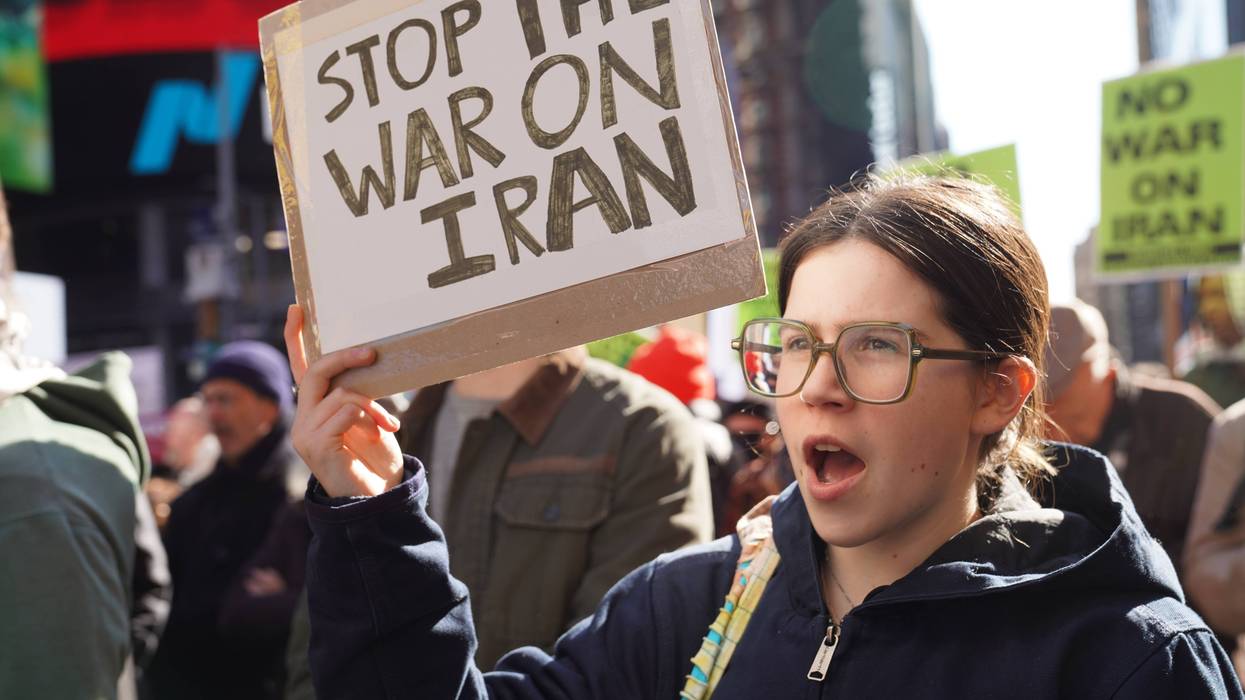
Since Trump and Israeli Prime Minister Benjamin Netanyahu began bombing Iran on February 28, Iranian officials and global experts have repeatedly accused the Israeli government of trying to sabotage any path to peace.
Iran's Tasnim News Agency reported Monday that "given the continuation of the Israeli regime's attacks in Lebanon, and considering that Lebanon had been one of the preconditions for a ceasefire—which has now been violated on all fronts, including Lebanon—the Iranian negotiating team is suspending 'talks and exchanges of texts through mediators.'"
According to Islamic Revolutionary Guard Corps-affiliated news agency, the IRGC said in a statement that Iran considers "the crossing of red lines in Lebanon and Gaza to mean direct war and the imposition of costs on its national security and the Islamic Resistance," and in response, it will "undertake defensive operations through unconventional measures, opening new fronts and maintaining the Strait of Hormuz equation."
Iran has responded to the US-Israeli assault by restricting traffic through the waterway, a key trade route, particularly for fossil fuels and fertilizer. As oil prices around the world have soared, Trump has imposed a naval blockade that he has maintained despite the April ceasefire agreement—which Israel initially claimed did not include Lebanon.
In a brief phone call on Monday, Trump told NBC News that he had not been informed of Iran's reported decision to suspend negotiations over Israel's escalation in Lebanon, but "I think it's fine if they're done talking."
"It's an appropriate thing to say, because they're better negotiators than they are fighters... But they haven't informed us of that," he continued. "It doesn't mean we're going to go and start dropping bombs all over there."
That comment notably came after the Trump administration launched new strikes against Iran over the weekend, and the Iranians attacked US military installations in the Middle East.
"We'll keep the blockade," Trump told NBC. "If they don't want to talk, that's OK with me. I think it's fine. I don't particularly want to talk either. We talk too much."
However, shortly after that, Trump said on his Truth Social platform that he "had a very productive call" with Netanyahu, "and there will be no Troops going to Beirut, and any Troops that are on their way, have already been turned back."
"Likewise, through highly placed Representatives, I had a very good call with Hezbollah, and they agreed that all shooting will stop—That Israel will not attack them, and they will not attack Israel," Trump continued. Less than 15 minutes later, he added that "talks are continuing, at a rapid pace, with the Islamic Republic of Iran."
While Iran's leadership had not publicly confirmed that talks were halted on Monday, Iranian Foreign Minister Abbas Araghchi wrote on social media that "the ceasefire between Iran and the US is unequivocally a ceasefire on all fronts, including in Lebanon. Its violation on one front is a violation of the ceasefire on all fronts. The US and Israel are responsible for the consequences of any violation."
Iran's chief negotiator, Parliament Speaker Mohammad Bagher Ghalibaf, similarly said: "The naval blockade and escalation of war crimes in Lebanon by the genocidal Zionist regime are clear evidence of US noncompliance with the ceasefire. Every choice has a price, and the bill comes due. It will all fall into place."
Responding to Israel "dramatically escalating its military campaign" in southern Lebanon and Tasnim's reporting on negotiations, Sina Toossi, a senior nonresident fellow at the Center for International Policy in Washington, DC, concluded that "the Iranian message is increasingly clear: no Lebanon ceasefire, no broader framework, and potentially no talks at all."
"The talks are in a vicious cycle: progress, escalation, backtracking," he noted. "Many in Iran suspect Trump is trying to bring down the 'floor' for oil prices ahead of more war. And Israel is doing everything it can to derail diplomacy by turning southern Lebanon into another Gaza."
The "Gaza playbook" Israel is now using in Lebanon, Toossi said, features "scorched-earth tactics, mass displacement, and the ethnic cleansing" of its neighboring nation.
Other experts also pointed to Gaza, where Israel is widely accused of pursuing a genocide against Palestinians in the besieged exclave. Calling out Reuters reporting on Israel's escalation in Lebanon, Arab Center Washington DC fellow Assal Rad said that "like 'targeting Hamas' in Gaza, 'Hezbollah-controlled' is used to justify Israel flattening entire neighborhoods in Lebanon. This isn't journalism, it's stenography."
"This is what Israel's total destruction of southern Lebanon looks like, deliberately destroying people’s homes so they have nothing to return to," she added, sharing satellite images of the destruction.
Mohamad Safa, who earlier this year resigned as a representative for the nongovernmental organization Patriotic Vision Association at the United Nations, on Monday accused Israel of "committing another genocide in real time in Lebanon with complete impunity."
Former US Department of Defense adviser Jasmine El-Gamal, who now leads the consulting firm Averos Strategies, said early Monday: "Early in the Iran war, I warned that US and Israeli interests would inevitably diverge and that President Trump would have to make a choice: to actually put America first, or to continue to allow Netanyahu to threaten our interests. Lebanon is the epitome of this choice."
Israeli Finance Minister Bezalel Smotrich has called for the "annihilation" of Gaza and has led forced displacement efforts in the West Bank.
Numerous headlines over the weekend focused on New York City Mayor Zohran Mamdani's decision not to attend the city's Israel Day Parade on Sunday, with Israeli officials condemning his absence and outlets emphasizing that he was breaking "with a decades-long political custom because of his support of Palestinian rights."
But with the Israeli government's approval rating plummeting among the US public, including Jewish Americans, since Israel began its US-backed assault on Gaza more than two-and-a-half years ago, progressives were asking not why Mamdani skipped the parade—but why top Democratic officials such as Senate Minority Leader Chuck Schumer (NY) chose to take part in it, especially considering the involvement of Israeli Finance Minister Bezalel Smotrich.
The International Criminal Court requested a warrant for Smotrich's arrest last month over his efforts to forcibly expel thousands of Palestinians from their homes in the West Bank, a violation of international law. He has played a key role in efforts to expand Israeli settlements in the West Bank, which have ramped up since October 2023, when Israel began attacking Gaza's entire population of over 2 million Palestinians in retaliation for a Hamas-led attack. He also publicly called for the "annihilation" of Gaza in 2024.
The New York Times reported that Smotrich was not part of Israel's official delegation that was sent to take part in the annual parade, whose theme this year was "Proud Americans, Proud Zionists," but he marched nonetheless.
The Israeli government sent about 10 members of the Israeli Knesset to take part in the event, including two members of National Security Minister Itamar Ben-Gvir's ultranationalist Otzma Yehudit Party. Heritage Minister Amichai Eliyahu, who said last year that Israel was “rushing toward Gaza being wiped out," was also part of the delegation.
As Smotrich was joining establishment Democratic figures from New York state in the parade—including New York Gov. Kathy Hochul, US Rep. Dan Goldman, Attorney General Letitia James, and New York City Council Speaker Julie Menin—Ben-Gvir on Sunday was publicly calling for the Israel Defense Forces to "flatten" Beirut's suburbs in the IDF's incursion into Lebanon—"a direct incitement to mass civilian destruction," according to Middle East Eye.
"Why is it controversial for Zohran to skip a parade because of his principles but not for Democratic politicians to march with a fascist bigot like Smotrich?" asked Ben Rhodes, a former national security official under the Obama administration.
At the parade, Schumer spoke about his view that Jewish Americans' "security and our safety is never safe as long as we lack a place of refuge, a homeland," but Ali Abunimah, director of Electronic Intifada, wondered how the Senate leader's involvement in a parade with officials who have openly called for ethnic cleansing would make hundreds of thousands of Muslim New Yorkers, including thousands of Palestinian Americans, feel about their own safety.
"How can all New Yorkers feel safe, especially Muslims and Palestinians, when the New York City police commissioner marches with genocidal criminals like Smotrich for the same supremacist cause?" said Abunimah, suggesting Commissioner Jessica Tisch should be removed for her involvement in the parade. "Would Mayor Zohran Mamdani keep a police chief who marched with [the Ku Klux Klan]?"
The city's Democratic Socialists of America chapter called for Smotrich to "be arrested to face justice for his horrific crimes against Palestinians and humanity," and said that "every politician who marched with him aligned themselves with Israel’s crimes."
Along with the participation of Smotrich and Eliyahu, Palestinian journalist Abubaker Abed noted that at the parade, the flag of the IDF's Golani Battalion, which was behind the killing of 15 Palestinian paramedics in Rafah last year, was displayed at the event.
Beth Miller, the political director for Jewish Voice for Peace, took issue with a statement by the Anti-Defamation League (ADL) that condemned Mamdani for not taking part in the parade, calling it "the city's largest and most visible Jewish celebration."
"It's antisemitic to conflate Jews and Israel. Which is exactly what the ADL is doing by calling the 'Israel Day Parade' a 'Jewish celebration,'" said Miller. "As a Jewish person who lives here, I'm pretty fucking glad we finally have a mayor who isn't at a parade celebrating atrocity crimes."
Ryan Grim of Drop Site News pointed out that while New York City was welcoming the Israeli delegation, including officials from the country's extreme right, commentators Hasan Piker and Cenk Uygur were barred from entering the United Kingdom. Both have vehemently criticized Israel and were flagged as potentially not being "conducive to the public good.”
Journalist Krystal Ball of the online show "Breaking Points" said sardonically that the two concurrent events displayed "Western values."
A spokesperson for Iran's Foreign Ministry slammed the leadership of the European Union for "blaming Iran for exercising its right to self-defense against US aggression launched from bases in neighboring countries."
Iran's government on Monday condemned the European Union's response to Iranian attacks on US military installations in the Middle East as "a masterclass in selective moral outrage" as the Trump administration launched new strikes against Iran over the weekend, with peace talks still at an impasse.
Esmaeil Baqaei, a spokesperson for the Iranian Foreign Ministry, accused EU leaders of "blaming Iran for exercising its right to self-defense against US aggression launched from bases in neighboring countries," referring to Iran's attacks on US air bases in Kuwait. Baqaei said Iran's strikes "against those bases and assets that are used to launch unlawful attacks against Iran are a lawful exercise of self-defense."
"The EU must remain faithful to the rule of law and the principles of the UN Charter that it has long claimed to uphold. It must stop appeasing aggressors while blaming those who respond to unlawful attacks," Baqaei added. "States have an established legal obligation not to allow their territory or assets to be used for invading other countries."
Baqaei's statement came in response to remarks from a European Commission spokesperson condemning an Iranian attack on a US air base in Kuwait last week, calling it a violation of Kuwait's sovereignty. The attack reportedly injured at least four US servicemembers and several American contractors.
The Iranian military said it targeted another US air base on Sunday in response to new attacks by the Trump administration, which launched its illegal war against Iran in late February. While Iran did not specify the location of its target, Kuwait said late Sunday that its "air defenses are currently confronting hostile missile and drone attacks."
The Iranian attacks followed the US military's announcement that it carried out strikes on "Iranian radar and command and control sites for drones" over the weekend. The US Central Command (CENTCOM) described the attacks as "self-defense strikes" and as a "measured and deliberate response" to "aggressive Iranian actions."
Brian Finucane, a senior adviser to the US Program at the International Crisis Group, wrote in response to CENTCOM's statement that "this administration’s use of the terms 'aggression' and 'self-defense' [is] thoroughly in 'war is peace' territory."
The US military also attacked a Gambia-flagged commercial ship in the Gulf of Oman over the weekend, enforcing a Trump administration naval blockade that Iran has condemned as illegal and said must be lifted as part of any peace agreement.
CBS News reported Saturday that "the broad strokes" of a peace deal under consideration "include a 60-day cessation of violence, along with clauses that call for reopening the strait and a framework to reopen negotiations on Iran's nuclear program."
"Multiple sources told CBS that the arrangement also involves the potential of waivers or sanctions relief to Iran that could allow it to access billions in frozen assets depending on the progress of the diplomacy," the outlet added.
Mohammad Bagher Ghalibaf, Iran's top negotiator, said early Monday that the Trump administration's naval blockade and Israel's "escalation of war crimes in Lebanon" represent "clear evidence of US noncompliance with the ceasefire."
"Every choice has a price, and the bill comes due," he added. "It will all fall into place."
US President Donald Trump, meanwhile, wrote on his social media platform that "Iran really wants to make a deal, and it will be a good one for the USA and those that are with us."
"Just sit back and relax, it will all work out well in the end," Trump declared.