

SUBSCRIBE TO OUR FREE NEWSLETTER
Daily news & progressive opinion—funded by the people, not the corporations—delivered straight to your inbox.
5
#000000
#FFFFFF
To donate by check, phone, or other method, see our More Ways to Give page.
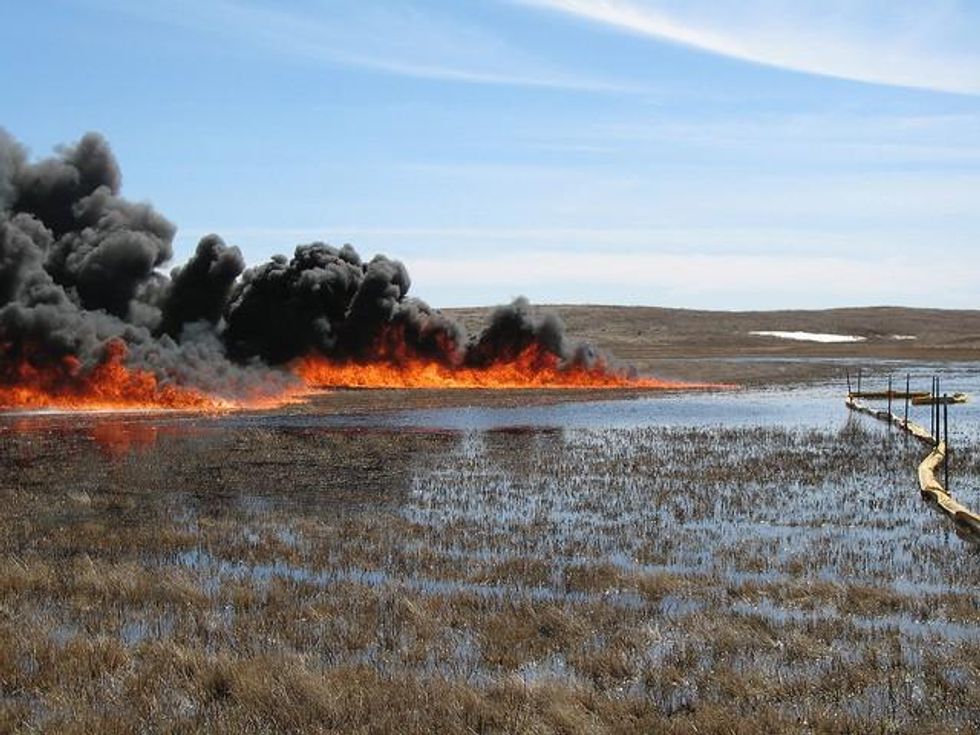
This fact--that on-shore oil spills occur all the time, with little notice or fanfare--has come under increased scrutiny since the disclosure last month that the government failed for weeks to report a spill of over 865,200 gallons of crude, fracked oil in Tioga, North Dakota--one of the largest on-shore oil spills in recent U.S. history.
AP reported Friday:
Records obtained by the AP show that so far this year, North Dakota has recorded 139 pipeline leaks that spilled a total of 735 barrels of oil. In 2012, there were 153 pipeline leaks that spilled 495 barrels of oil, data show. A little more than half of the spills companies reported to North Dakota occurred "on-site," where a well is connected to a pipeline, and most were fewer than 10 barrels. The remainder of the spills occurred along the state's labyrinth of pipelines.
Further AP notes that under state law North Dakota regulators are not obliged to tell the public about oil spills.
In a state that's producing a million barrels of oil a day with nearly 17,500 miles of pipelines, the risk of spills are likely to increase posing untold risk to the region's water and farmland.
"If there is a spill, sometimes a landowner may not even know about it. And if they do, people think it's an isolated incident that's only happening to them," said Don Morrison, director of landowner group, the Dakota Resource Council.
_____________________
This fact--that on-shore oil spills occur all the time, with little notice or fanfare--has come under increased scrutiny since the disclosure last month that the government failed for weeks to report a spill of over 865,200 gallons of crude, fracked oil in Tioga, North Dakota--one of the largest on-shore oil spills in recent U.S. history.
AP reported Friday:
Records obtained by the AP show that so far this year, North Dakota has recorded 139 pipeline leaks that spilled a total of 735 barrels of oil. In 2012, there were 153 pipeline leaks that spilled 495 barrels of oil, data show. A little more than half of the spills companies reported to North Dakota occurred "on-site," where a well is connected to a pipeline, and most were fewer than 10 barrels. The remainder of the spills occurred along the state's labyrinth of pipelines.
Further AP notes that under state law North Dakota regulators are not obliged to tell the public about oil spills.
In a state that's producing a million barrels of oil a day with nearly 17,500 miles of pipelines, the risk of spills are likely to increase posing untold risk to the region's water and farmland.
"If there is a spill, sometimes a landowner may not even know about it. And if they do, people think it's an isolated incident that's only happening to them," said Don Morrison, director of landowner group, the Dakota Resource Council.
_____________________
This fact--that on-shore oil spills occur all the time, with little notice or fanfare--has come under increased scrutiny since the disclosure last month that the government failed for weeks to report a spill of over 865,200 gallons of crude, fracked oil in Tioga, North Dakota--one of the largest on-shore oil spills in recent U.S. history.
AP reported Friday:
Records obtained by the AP show that so far this year, North Dakota has recorded 139 pipeline leaks that spilled a total of 735 barrels of oil. In 2012, there were 153 pipeline leaks that spilled 495 barrels of oil, data show. A little more than half of the spills companies reported to North Dakota occurred "on-site," where a well is connected to a pipeline, and most were fewer than 10 barrels. The remainder of the spills occurred along the state's labyrinth of pipelines.
Further AP notes that under state law North Dakota regulators are not obliged to tell the public about oil spills.
In a state that's producing a million barrels of oil a day with nearly 17,500 miles of pipelines, the risk of spills are likely to increase posing untold risk to the region's water and farmland.
"If there is a spill, sometimes a landowner may not even know about it. And if they do, people think it's an isolated incident that's only happening to them," said Don Morrison, director of landowner group, the Dakota Resource Council.
_____________________

