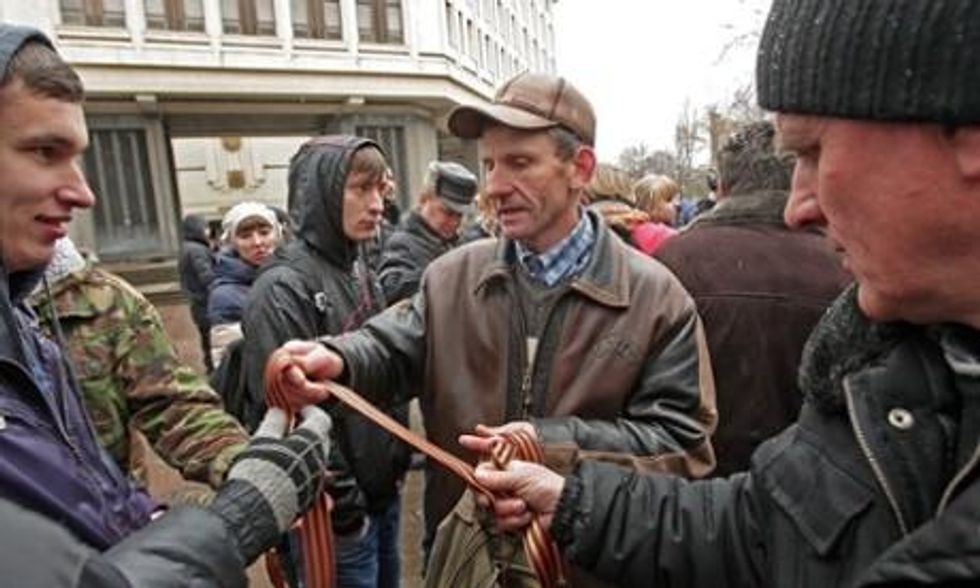
On Thursday morning, armed men stormed the Crimean parliament building in the city of Simferopol. After seizing the adminstrative buildings a Russian flag was raised and large crowds were reported gathering outside, voicing pro-Russian sentiments and decrying the ouster of the democratically-elected Yanukovych.
Harriet Salem, reporting for the Guardian in Simferopol, said pro-Russian supporters gathered to show support for the gunmen who seized the parliament buildings. She said:
The police have left the outside of the buildings and a pro-Russian leader gave a speech, which was shown on TV, mobilising people to come to the parliament. There are a lot of Russian flags, about 100 people outside and more and more arriving.
Later, the Guardian, which continues its live coverage here, updated their reporting to say the crowd had grown to more than 1,000 people and was still increasing.
As this tweet from ITV foreign editor James Mates shows:
Polish Foreign Minister Radoslaw Sikorski, according to Reuters, called the seizure of government buildings in the Crimea a "very dangerous game".
"This is a drastic step, and I'm warning those who did this and those who allowed them to do this, because this is how regional conflicts begin," he told a news conference.
Meanwhile, separate news reports indicated Yanukovych, who has not been seen since last weekend when he fled Kiev and was last spotted on the Crimean peninsula, is now in Russia.
According to the Associated Press:
A Russian official is quoted as saying that Moscow has accepted the plea of fugitive Ukrainian President Viktor Yanukovych who had asked for protection.
Three Russian news agencies quoted the unnamed official saying that Yanukovych's request for protection "was satisfied on the territory of Russia."
Yanukovych, who fled from Ukraine's capital Kiev last week, said in the Thursday statement that he still considers himself to be the legitimate leader.
In Kiev, the latest news was that Arseniy Yatseniuk, a leader member of the opposition coalition that ousted Yanukovych, has been appointed as Ukraine's new prime minister by the interim government. And fellow opposition leader, Vitali Klitschko, has said he will stand for presidential elections set by the opposition forces that have now assumed control.
Lastly, as events unfold and many continue to criticize western media outlets for mischaracterizing or over-simplifying the events in Ukraine, long-time investigative journalist Robert Parry writes that the mainstream press in the U.S. has followed a familiar and troubling pattern with its coverage:
Though the U.S. news media did show scenes of [the violent melees that led to his ouster], the U.S. press almost universally blamed [the violence] Yanukovych - and took almost gleeful pleasure as his elected government collapsed and was replaced by thuggish right-wing militias "guarding" government buildings.
With Yanukovych and many of his supporters fleeing for their lives, the opposition parties seized control of parliament and began passing draconian new laws often unanimously, as neo-Nazi thugs patrolled the scene. Amazingly, the U.S. news media treated all this as uplifting, a popular uprising against a tyrant, not a case of a coup government operating in collusion with violent extremists.
In the upside-down world that has become the U.S. news media, the democratically elected president was a dictator and the coup makers who overthrew the popularly chosen leader were "pro-democracy" activists.
What events now unfolding in Crimea seem to represent, is that Ukrainians there are also willing to pick up arms in order to defend their sense of what their country should be. What happens next has become a guessing games with enormous implications.
_________________________________________________
On Thursday morning, armed men stormed the Crimean parliament building in the city of Simferopol. After seizing the adminstrative buildings a Russian flag was raised and large crowds were reported gathering outside, voicing pro-Russian sentiments and decrying the ouster of the democratically-elected Yanukovych.
Harriet Salem, reporting for the Guardian in Simferopol, said pro-Russian supporters gathered to show support for the gunmen who seized the parliament buildings. She said:
The police have left the outside of the buildings and a pro-Russian leader gave a speech, which was shown on TV, mobilising people to come to the parliament. There are a lot of Russian flags, about 100 people outside and more and more arriving.
Later, the Guardian, which continues its live coverage here, updated their reporting to say the crowd had grown to more than 1,000 people and was still increasing.
As this tweet from ITV foreign editor James Mates shows:
Polish Foreign Minister Radoslaw Sikorski, according to Reuters, called the seizure of government buildings in the Crimea a "very dangerous game".
"This is a drastic step, and I'm warning those who did this and those who allowed them to do this, because this is how regional conflicts begin," he told a news conference.
Meanwhile, separate news reports indicated Yanukovych, who has not been seen since last weekend when he fled Kiev and was last spotted on the Crimean peninsula, is now in Russia.
According to the Associated Press:
A Russian official is quoted as saying that Moscow has accepted the plea of fugitive Ukrainian President Viktor Yanukovych who had asked for protection.
Three Russian news agencies quoted the unnamed official saying that Yanukovych's request for protection "was satisfied on the territory of Russia."
Yanukovych, who fled from Ukraine's capital Kiev last week, said in the Thursday statement that he still considers himself to be the legitimate leader.
In Kiev, the latest news was that Arseniy Yatseniuk, a leader member of the opposition coalition that ousted Yanukovych, has been appointed as Ukraine's new prime minister by the interim government. And fellow opposition leader, Vitali Klitschko, has said he will stand for presidential elections set by the opposition forces that have now assumed control.
Lastly, as events unfold and many continue to criticize western media outlets for mischaracterizing or over-simplifying the events in Ukraine, long-time investigative journalist Robert Parry writes that the mainstream press in the U.S. has followed a familiar and troubling pattern with its coverage:
Though the U.S. news media did show scenes of [the violent melees that led to his ouster], the U.S. press almost universally blamed [the violence] Yanukovych - and took almost gleeful pleasure as his elected government collapsed and was replaced by thuggish right-wing militias "guarding" government buildings.
With Yanukovych and many of his supporters fleeing for their lives, the opposition parties seized control of parliament and began passing draconian new laws often unanimously, as neo-Nazi thugs patrolled the scene. Amazingly, the U.S. news media treated all this as uplifting, a popular uprising against a tyrant, not a case of a coup government operating in collusion with violent extremists.
In the upside-down world that has become the U.S. news media, the democratically elected president was a dictator and the coup makers who overthrew the popularly chosen leader were "pro-democracy" activists.
What events now unfolding in Crimea seem to represent, is that Ukrainians there are also willing to pick up arms in order to defend their sense of what their country should be. What happens next has become a guessing games with enormous implications.
_________________________________________________
On Thursday morning, armed men stormed the Crimean parliament building in the city of Simferopol. After seizing the adminstrative buildings a Russian flag was raised and large crowds were reported gathering outside, voicing pro-Russian sentiments and decrying the ouster of the democratically-elected Yanukovych.
Harriet Salem, reporting for the Guardian in Simferopol, said pro-Russian supporters gathered to show support for the gunmen who seized the parliament buildings. She said:
The police have left the outside of the buildings and a pro-Russian leader gave a speech, which was shown on TV, mobilising people to come to the parliament. There are a lot of Russian flags, about 100 people outside and more and more arriving.
Later, the Guardian, which continues its live coverage here, updated their reporting to say the crowd had grown to more than 1,000 people and was still increasing.
As this tweet from ITV foreign editor James Mates shows:
Polish Foreign Minister Radoslaw Sikorski, according to Reuters, called the seizure of government buildings in the Crimea a "very dangerous game".
"This is a drastic step, and I'm warning those who did this and those who allowed them to do this, because this is how regional conflicts begin," he told a news conference.
Meanwhile, separate news reports indicated Yanukovych, who has not been seen since last weekend when he fled Kiev and was last spotted on the Crimean peninsula, is now in Russia.
According to the Associated Press:
A Russian official is quoted as saying that Moscow has accepted the plea of fugitive Ukrainian President Viktor Yanukovych who had asked for protection.
Three Russian news agencies quoted the unnamed official saying that Yanukovych's request for protection "was satisfied on the territory of Russia."
Yanukovych, who fled from Ukraine's capital Kiev last week, said in the Thursday statement that he still considers himself to be the legitimate leader.
In Kiev, the latest news was that Arseniy Yatseniuk, a leader member of the opposition coalition that ousted Yanukovych, has been appointed as Ukraine's new prime minister by the interim government. And fellow opposition leader, Vitali Klitschko, has said he will stand for presidential elections set by the opposition forces that have now assumed control.
Lastly, as events unfold and many continue to criticize western media outlets for mischaracterizing or over-simplifying the events in Ukraine, long-time investigative journalist Robert Parry writes that the mainstream press in the U.S. has followed a familiar and troubling pattern with its coverage:
Though the U.S. news media did show scenes of [the violent melees that led to his ouster], the U.S. press almost universally blamed [the violence] Yanukovych - and took almost gleeful pleasure as his elected government collapsed and was replaced by thuggish right-wing militias "guarding" government buildings.
With Yanukovych and many of his supporters fleeing for their lives, the opposition parties seized control of parliament and began passing draconian new laws often unanimously, as neo-Nazi thugs patrolled the scene. Amazingly, the U.S. news media treated all this as uplifting, a popular uprising against a tyrant, not a case of a coup government operating in collusion with violent extremists.
In the upside-down world that has become the U.S. news media, the democratically elected president was a dictator and the coup makers who overthrew the popularly chosen leader were "pro-democracy" activists.
What events now unfolding in Crimea seem to represent, is that Ukrainians there are also willing to pick up arms in order to defend their sense of what their country should be. What happens next has become a guessing games with enormous implications.
_________________________________________________