SUBSCRIBE TO OUR FREE NEWSLETTER
Daily news & progressive opinion—funded by the people, not the corporations—delivered straight to your inbox.
5
#000000
#FFFFFF
To donate by check, phone, or other method, see our More Ways to Give page.
Daily news & progressive opinion—funded by the people, not the corporations—delivered straight to your inbox.
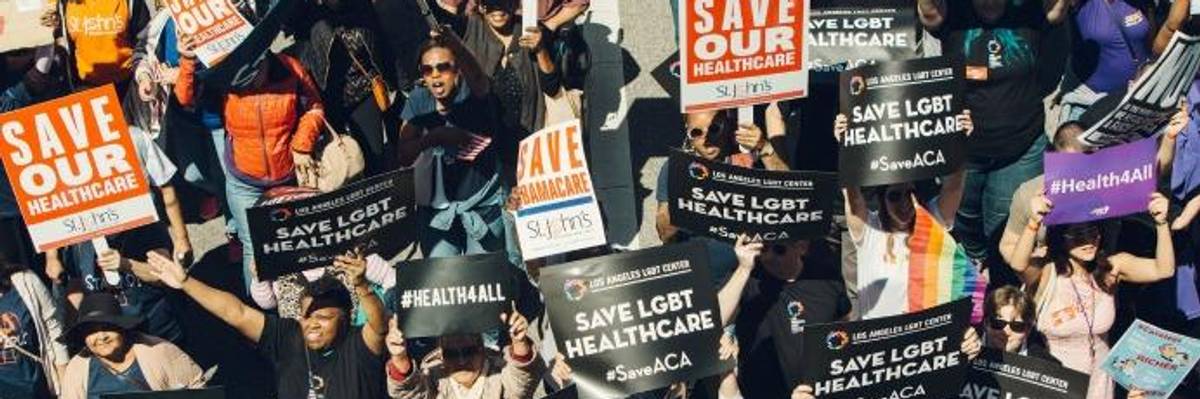
"Republican leaders in Congress originally wanted President Trump to sign their health care repeal on January 20. We're more than five months past that date. This means grassroots activism is working," writes Sarah Chaisson-Warner of People's Action. (Photo: Molly Adams/Flickr/cc)
As Senate Majority Leader Mitch McConnell (R-Ky.) gears up to bring the Senate Trumpcare bill to a vote by mid-month, resistance groups across the country are preparing to rally and confront their lawmakers over the July 4th holiday.
"If these moderates don't feel the heat over recess, guess what? They'll cave in no time."
--Topher Spiro, Center for American ProgressCelebration followed McConnell's decision last week to delay a vote on the legislation, a move interpreted by activists as a sign that their anti-Trumpcare efforts are paying off. Many pointed out, however, that the bill is far from dead, and that lawmakers should be pressured until the bill is scrapped entirely.
Some commentators have worried that despite the outward appearance of disarray--including President Donald Trump's recent call to drop efforts to replace Obamacare in favor of "repeal now, replace later"--McConnell is getting closer to striking a deal with lawmakers who expressed their opposition to the bill after the Congressional Budget Office (CBO) projected it would strip insurance from 22 million Americans.
Topher Spiro, a senior fellow at the Center for American Progress, pointed to reports that McConnell has sent another version of Trumpcare to the CBO as an indication that Senate Republicans are "close to a deal."
"If these moderates don't feel the heat over recess, guess what? They'll cave in no time," Spiro wrote, referring to the the several Republicans--from Susan Collins of Maine to Rob Portman of Ohio--who have said they cannot support the bill in its current form. "This revised bill is probably McConnell's last shot. He has no time for CBO to score one after this."
Activist groups like MoveOn.org and Indivisible--along with many others--have organized protest efforts accordingly, acknowledging the urgency of the current recess and the necessity of ensuring Trumpcare remains at the center of public attention.
The Washington Post observed that Republican lawmakers "are not exactly rushing into the public spotlight to engage their constituents on the controversial plan and their own decision-making about the [healthcare] proposal." As such, organizers have emphasized the importance of confronting lawmakers as they attend parades and events on Independence Day.
"Local pressure now determines what's politically possible," noted Ezra Levin, co-executive director of Indivisible. "July 4th is a good opportunity. Senators will be out at parades and fairs. They may not be holding town halls, but they're accessible there."
As Axios's Jonathan Swan reported on Sunday, "Activists are publicizing at least 5 progressive health care rallies in Alaska to pressure Lisa Murkowski, 5 in Jeff Flake's Arizona, 8 in Cory Gardner's Colorado, 7 in Bill Cassidy's Louisiana, 9 in Susan Collins' Maine, 3 in Dean Heller's Nevada, 3 in Rob Portman's Ohio, 1 in Pat Toomey's Pennsylvania, and 3 in Shelley Moore Capito's West Virginia."
The website Resistance Near Me was established--in partnership with the Town Hall Project--to help protestors coordinate and find events taking place in their vicinity.
"Republican leaders in Congress originally wanted President Trump to sign their health care repeal on January 20. We're more than five months past that date. This means grassroots activism is working," writes Sarah Chaisson-Warner of People's Action. "Whatever it promises in the short-term, this bill still violates the promise of better, more affordable health care for all. Real fixes are available. Our lawmakers know this. This Independence Day, let's make sure they know that we know this, too."
Dear Common Dreams reader, It’s been nearly 30 years since I co-founded Common Dreams with my late wife, Lina Newhouser. We had the radical notion that journalism should serve the public good, not corporate profits. It was clear to us from the outset what it would take to build such a project. No paid advertisements. No corporate sponsors. No millionaire publisher telling us what to think or do. Many people said we wouldn't last a year, but we proved those doubters wrong. Together with a tremendous team of journalists and dedicated staff, we built an independent media outlet free from the constraints of profits and corporate control. Our mission has always been simple: To inform. To inspire. To ignite change for the common good. Building Common Dreams was not easy. Our survival was never guaranteed. When you take on the most powerful forces—Wall Street greed, fossil fuel industry destruction, Big Tech lobbyists, and uber-rich oligarchs who have spent billions upon billions rigging the economy and democracy in their favor—the only bulwark you have is supporters who believe in your work. But here’s the urgent message from me today. It's never been this bad out there. And it's never been this hard to keep us going. At the very moment Common Dreams is most needed, the threats we face are intensifying. We need your support now more than ever. We don't accept corporate advertising and never will. We don't have a paywall because we don't think people should be blocked from critical news based on their ability to pay. Everything we do is funded by the donations of readers like you. When everyone does the little they can afford, we are strong. But if that support retreats or dries up, so do we. Will you donate now to make sure Common Dreams not only survives but thrives? —Craig Brown, Co-founder |
As Senate Majority Leader Mitch McConnell (R-Ky.) gears up to bring the Senate Trumpcare bill to a vote by mid-month, resistance groups across the country are preparing to rally and confront their lawmakers over the July 4th holiday.
"If these moderates don't feel the heat over recess, guess what? They'll cave in no time."
--Topher Spiro, Center for American ProgressCelebration followed McConnell's decision last week to delay a vote on the legislation, a move interpreted by activists as a sign that their anti-Trumpcare efforts are paying off. Many pointed out, however, that the bill is far from dead, and that lawmakers should be pressured until the bill is scrapped entirely.
Some commentators have worried that despite the outward appearance of disarray--including President Donald Trump's recent call to drop efforts to replace Obamacare in favor of "repeal now, replace later"--McConnell is getting closer to striking a deal with lawmakers who expressed their opposition to the bill after the Congressional Budget Office (CBO) projected it would strip insurance from 22 million Americans.
Topher Spiro, a senior fellow at the Center for American Progress, pointed to reports that McConnell has sent another version of Trumpcare to the CBO as an indication that Senate Republicans are "close to a deal."
"If these moderates don't feel the heat over recess, guess what? They'll cave in no time," Spiro wrote, referring to the the several Republicans--from Susan Collins of Maine to Rob Portman of Ohio--who have said they cannot support the bill in its current form. "This revised bill is probably McConnell's last shot. He has no time for CBO to score one after this."
Activist groups like MoveOn.org and Indivisible--along with many others--have organized protest efforts accordingly, acknowledging the urgency of the current recess and the necessity of ensuring Trumpcare remains at the center of public attention.
The Washington Post observed that Republican lawmakers "are not exactly rushing into the public spotlight to engage their constituents on the controversial plan and their own decision-making about the [healthcare] proposal." As such, organizers have emphasized the importance of confronting lawmakers as they attend parades and events on Independence Day.
"Local pressure now determines what's politically possible," noted Ezra Levin, co-executive director of Indivisible. "July 4th is a good opportunity. Senators will be out at parades and fairs. They may not be holding town halls, but they're accessible there."
As Axios's Jonathan Swan reported on Sunday, "Activists are publicizing at least 5 progressive health care rallies in Alaska to pressure Lisa Murkowski, 5 in Jeff Flake's Arizona, 8 in Cory Gardner's Colorado, 7 in Bill Cassidy's Louisiana, 9 in Susan Collins' Maine, 3 in Dean Heller's Nevada, 3 in Rob Portman's Ohio, 1 in Pat Toomey's Pennsylvania, and 3 in Shelley Moore Capito's West Virginia."
The website Resistance Near Me was established--in partnership with the Town Hall Project--to help protestors coordinate and find events taking place in their vicinity.
"Republican leaders in Congress originally wanted President Trump to sign their health care repeal on January 20. We're more than five months past that date. This means grassroots activism is working," writes Sarah Chaisson-Warner of People's Action. "Whatever it promises in the short-term, this bill still violates the promise of better, more affordable health care for all. Real fixes are available. Our lawmakers know this. This Independence Day, let's make sure they know that we know this, too."
As Senate Majority Leader Mitch McConnell (R-Ky.) gears up to bring the Senate Trumpcare bill to a vote by mid-month, resistance groups across the country are preparing to rally and confront their lawmakers over the July 4th holiday.
"If these moderates don't feel the heat over recess, guess what? They'll cave in no time."
--Topher Spiro, Center for American ProgressCelebration followed McConnell's decision last week to delay a vote on the legislation, a move interpreted by activists as a sign that their anti-Trumpcare efforts are paying off. Many pointed out, however, that the bill is far from dead, and that lawmakers should be pressured until the bill is scrapped entirely.
Some commentators have worried that despite the outward appearance of disarray--including President Donald Trump's recent call to drop efforts to replace Obamacare in favor of "repeal now, replace later"--McConnell is getting closer to striking a deal with lawmakers who expressed their opposition to the bill after the Congressional Budget Office (CBO) projected it would strip insurance from 22 million Americans.
Topher Spiro, a senior fellow at the Center for American Progress, pointed to reports that McConnell has sent another version of Trumpcare to the CBO as an indication that Senate Republicans are "close to a deal."
"If these moderates don't feel the heat over recess, guess what? They'll cave in no time," Spiro wrote, referring to the the several Republicans--from Susan Collins of Maine to Rob Portman of Ohio--who have said they cannot support the bill in its current form. "This revised bill is probably McConnell's last shot. He has no time for CBO to score one after this."
Activist groups like MoveOn.org and Indivisible--along with many others--have organized protest efforts accordingly, acknowledging the urgency of the current recess and the necessity of ensuring Trumpcare remains at the center of public attention.
The Washington Post observed that Republican lawmakers "are not exactly rushing into the public spotlight to engage their constituents on the controversial plan and their own decision-making about the [healthcare] proposal." As such, organizers have emphasized the importance of confronting lawmakers as they attend parades and events on Independence Day.
"Local pressure now determines what's politically possible," noted Ezra Levin, co-executive director of Indivisible. "July 4th is a good opportunity. Senators will be out at parades and fairs. They may not be holding town halls, but they're accessible there."
As Axios's Jonathan Swan reported on Sunday, "Activists are publicizing at least 5 progressive health care rallies in Alaska to pressure Lisa Murkowski, 5 in Jeff Flake's Arizona, 8 in Cory Gardner's Colorado, 7 in Bill Cassidy's Louisiana, 9 in Susan Collins' Maine, 3 in Dean Heller's Nevada, 3 in Rob Portman's Ohio, 1 in Pat Toomey's Pennsylvania, and 3 in Shelley Moore Capito's West Virginia."
The website Resistance Near Me was established--in partnership with the Town Hall Project--to help protestors coordinate and find events taking place in their vicinity.
"Republican leaders in Congress originally wanted President Trump to sign their health care repeal on January 20. We're more than five months past that date. This means grassroots activism is working," writes Sarah Chaisson-Warner of People's Action. "Whatever it promises in the short-term, this bill still violates the promise of better, more affordable health care for all. Real fixes are available. Our lawmakers know this. This Independence Day, let's make sure they know that we know this, too."