SUBSCRIBE TO OUR FREE NEWSLETTER
Daily news & progressive opinion—funded by the people, not the corporations—delivered straight to your inbox.
5
#000000
#FFFFFF
To donate by check, phone, or other method, see our More Ways to Give page.
Daily news & progressive opinion—funded by the people, not the corporations—delivered straight to your inbox.
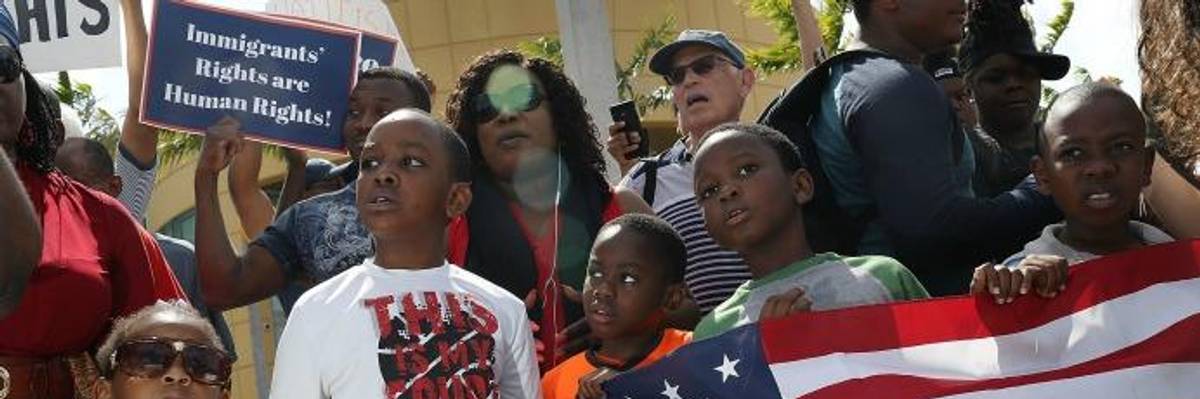
In May 2017, people protested the possibility that the Trump administration may overturn the Temporary Protected Status for Haitians in front of the U.S. Citizenship and Immigration Services office in Miami, Florida. (Photo: Joe Raedle/Getty Images)
Immigrant rights advocates are outraged after the Trump administration announced its "cruel and shameful" decision to end a program that has allowed some 59,000 Haitians to temporarily live and work in the United States since a catastrophic magnitude 7 earthquake ravaged the island nation in 2010.
"America will not be greater or safer by ending this program and attempting to deport those who have made their lives here and are part of the state's economic and social fabric."
--Steven Choi, New York Immigration Coalition
"America will not be greater or safer by ending this program and attempting to deport those who have made their lives here and are part of the state's economic and social fabric," said New York Immigration Coalition executive director Steven Choi, who called the decision "cruel and shameful."
Vanita Gupta, president and CEO of the Leadership Conference on Civil and Human Rights, said this "is another example of the cruel indifference of the Trump administration and its continued efforts to abandon our country's history as a nation of immigrants."
"The country is still struggling to recover from the earthquake and is in no position to receive these individuals who are already making enormous contributions to our country," Gupta added. "Congress must lead where the president has failed and find a permanent solution for Haitians, and other TPS holders, living in our country that allows them to continue contributing to the fabric of our democracy."
Elaine Duke, acting secretary of the Department of Homeland Security (DHS), said in a statement that "extraordinary but temporary conditions caused by the 2010 earthquake no longer exist," and Haitians who have been living in the United States under the Temporary Protected Status (TPS) program have until July 22, 2019 to leave the country, or they will face deportation. The announcement follows a decision earlier this month to revoke TPS from about 2,500 Nicaraguans.
It also confirms concerns about the program that have been growing since earlier this year, when the head of U.S. Citizenship and Immigration Services, an arm of DHS, concluded that protections for Haitians were no longer necessary, and former DHS Secretary John Kelly renewed their protected status for a shorter term than normal, warning them to prepare to return to Haiti. These moves by the Trump administration have caused thousands of Haitians to unlawfully cross the border to seek asylum in Canada.
Since the program was established in 1990, the U.S. has granted protections to foreign nationals for a variety of reasons, including ongoing armed conflicts, environmental disasters such as earthquakes or hurricanes, and epidemics. About 300,000 people are currently living in the U.S. with TPS, and the countries currently designated for its protections, according to the DHS website, are El Salvador, Honduras, Nepal, Somalia, Sudan, South Sudan, Syria, and Yemen.
Several advocates for the rights of immigrants and people of color denounced the decision on Twitter:
Dear Common Dreams reader, It’s been nearly 30 years since I co-founded Common Dreams with my late wife, Lina Newhouser. We had the radical notion that journalism should serve the public good, not corporate profits. It was clear to us from the outset what it would take to build such a project. No paid advertisements. No corporate sponsors. No millionaire publisher telling us what to think or do. Many people said we wouldn't last a year, but we proved those doubters wrong. Together with a tremendous team of journalists and dedicated staff, we built an independent media outlet free from the constraints of profits and corporate control. Our mission has always been simple: To inform. To inspire. To ignite change for the common good. Building Common Dreams was not easy. Our survival was never guaranteed. When you take on the most powerful forces—Wall Street greed, fossil fuel industry destruction, Big Tech lobbyists, and uber-rich oligarchs who have spent billions upon billions rigging the economy and democracy in their favor—the only bulwark you have is supporters who believe in your work. But here’s the urgent message from me today. It's never been this bad out there. And it's never been this hard to keep us going. At the very moment Common Dreams is most needed, the threats we face are intensifying. We need your support now more than ever. We don't accept corporate advertising and never will. We don't have a paywall because we don't think people should be blocked from critical news based on their ability to pay. Everything we do is funded by the donations of readers like you. When everyone does the little they can afford, we are strong. But if that support retreats or dries up, so do we. Will you donate now to make sure Common Dreams not only survives but thrives? —Craig Brown, Co-founder |
Immigrant rights advocates are outraged after the Trump administration announced its "cruel and shameful" decision to end a program that has allowed some 59,000 Haitians to temporarily live and work in the United States since a catastrophic magnitude 7 earthquake ravaged the island nation in 2010.
"America will not be greater or safer by ending this program and attempting to deport those who have made their lives here and are part of the state's economic and social fabric."
--Steven Choi, New York Immigration Coalition
"America will not be greater or safer by ending this program and attempting to deport those who have made their lives here and are part of the state's economic and social fabric," said New York Immigration Coalition executive director Steven Choi, who called the decision "cruel and shameful."
Vanita Gupta, president and CEO of the Leadership Conference on Civil and Human Rights, said this "is another example of the cruel indifference of the Trump administration and its continued efforts to abandon our country's history as a nation of immigrants."
"The country is still struggling to recover from the earthquake and is in no position to receive these individuals who are already making enormous contributions to our country," Gupta added. "Congress must lead where the president has failed and find a permanent solution for Haitians, and other TPS holders, living in our country that allows them to continue contributing to the fabric of our democracy."
Elaine Duke, acting secretary of the Department of Homeland Security (DHS), said in a statement that "extraordinary but temporary conditions caused by the 2010 earthquake no longer exist," and Haitians who have been living in the United States under the Temporary Protected Status (TPS) program have until July 22, 2019 to leave the country, or they will face deportation. The announcement follows a decision earlier this month to revoke TPS from about 2,500 Nicaraguans.
It also confirms concerns about the program that have been growing since earlier this year, when the head of U.S. Citizenship and Immigration Services, an arm of DHS, concluded that protections for Haitians were no longer necessary, and former DHS Secretary John Kelly renewed their protected status for a shorter term than normal, warning them to prepare to return to Haiti. These moves by the Trump administration have caused thousands of Haitians to unlawfully cross the border to seek asylum in Canada.
Since the program was established in 1990, the U.S. has granted protections to foreign nationals for a variety of reasons, including ongoing armed conflicts, environmental disasters such as earthquakes or hurricanes, and epidemics. About 300,000 people are currently living in the U.S. with TPS, and the countries currently designated for its protections, according to the DHS website, are El Salvador, Honduras, Nepal, Somalia, Sudan, South Sudan, Syria, and Yemen.
Several advocates for the rights of immigrants and people of color denounced the decision on Twitter:
Immigrant rights advocates are outraged after the Trump administration announced its "cruel and shameful" decision to end a program that has allowed some 59,000 Haitians to temporarily live and work in the United States since a catastrophic magnitude 7 earthquake ravaged the island nation in 2010.
"America will not be greater or safer by ending this program and attempting to deport those who have made their lives here and are part of the state's economic and social fabric."
--Steven Choi, New York Immigration Coalition
"America will not be greater or safer by ending this program and attempting to deport those who have made their lives here and are part of the state's economic and social fabric," said New York Immigration Coalition executive director Steven Choi, who called the decision "cruel and shameful."
Vanita Gupta, president and CEO of the Leadership Conference on Civil and Human Rights, said this "is another example of the cruel indifference of the Trump administration and its continued efforts to abandon our country's history as a nation of immigrants."
"The country is still struggling to recover from the earthquake and is in no position to receive these individuals who are already making enormous contributions to our country," Gupta added. "Congress must lead where the president has failed and find a permanent solution for Haitians, and other TPS holders, living in our country that allows them to continue contributing to the fabric of our democracy."
Elaine Duke, acting secretary of the Department of Homeland Security (DHS), said in a statement that "extraordinary but temporary conditions caused by the 2010 earthquake no longer exist," and Haitians who have been living in the United States under the Temporary Protected Status (TPS) program have until July 22, 2019 to leave the country, or they will face deportation. The announcement follows a decision earlier this month to revoke TPS from about 2,500 Nicaraguans.
It also confirms concerns about the program that have been growing since earlier this year, when the head of U.S. Citizenship and Immigration Services, an arm of DHS, concluded that protections for Haitians were no longer necessary, and former DHS Secretary John Kelly renewed their protected status for a shorter term than normal, warning them to prepare to return to Haiti. These moves by the Trump administration have caused thousands of Haitians to unlawfully cross the border to seek asylum in Canada.
Since the program was established in 1990, the U.S. has granted protections to foreign nationals for a variety of reasons, including ongoing armed conflicts, environmental disasters such as earthquakes or hurricanes, and epidemics. About 300,000 people are currently living in the U.S. with TPS, and the countries currently designated for its protections, according to the DHS website, are El Salvador, Honduras, Nepal, Somalia, Sudan, South Sudan, Syria, and Yemen.
Several advocates for the rights of immigrants and people of color denounced the decision on Twitter: