SUBSCRIBE TO OUR FREE NEWSLETTER
Daily news & progressive opinion—funded by the people, not the corporations—delivered straight to your inbox.
5
#000000
#FFFFFF
To donate by check, phone, or other method, see our More Ways to Give page.
Daily news & progressive opinion—funded by the people, not the corporations—delivered straight to your inbox.
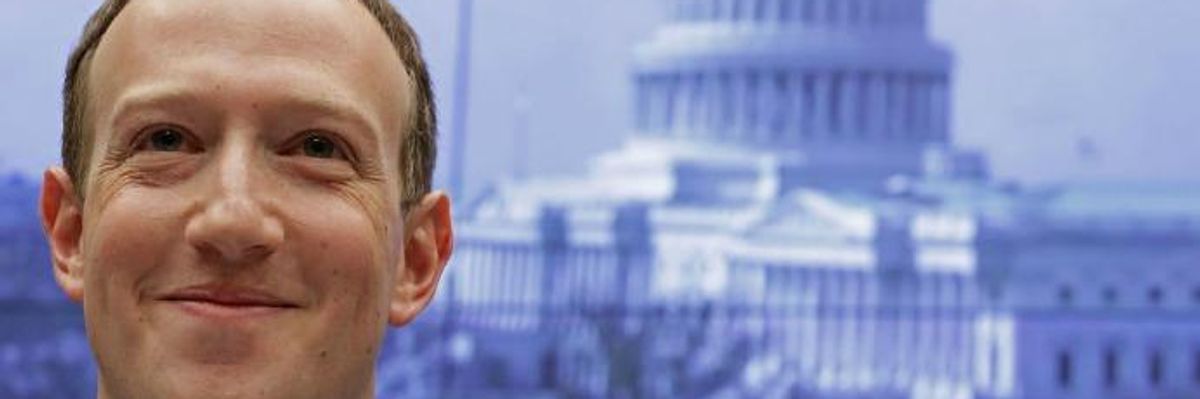
Facebook co-founder, Chairman and CEO Mark Zuckerberg testifies before the House Energy and Commerce Committee in the Rayburn House Office Building on Capitol Hill April 11, 2018 in Washington, D.C. (Photo: Chip Somodevilla/Getty Images)
Facebook CEO Mark Zuckerberg spent several hours of congressional testimony this month insisting that his company is seriously dedicated to improving user privacy protections in the aftermath of the Cambridge Analytica scandal, but these rhetorical gestures have been undermined by the social media giant's ongoing efforts to deny privacy protections to a staggering 70 percent of its users worldwide.
"If the company succeeds in dodging the GDPR outside the E.U., users will be subject to lax U.S. privacy standards, which would allow the company to continue collecting data."
--Tom McKay, Gizmodo
According to a Reuters report on Wednesday, Facebook is changing its terms of service to "put 1.5 billion users out of reach" of the European Union's sweeping new privacy law, which will require companies to receive clear consent from users before mining their data and impose hefty fines on companies that violate the strict standards.
"Facebook members outside the United States and Canada, whether they know it or not, are currently governed by terms of service agreed with the company's international headquarters in Ireland," Reuters explains. "Next month, Facebook is planning to make that the case for only European users, meaning 1.5 billion members in Africa, Asia, Australia, and Latin America will not fall under the European Union's General Data Protection Regulation (GDPR), which takes effect on May 25."
As for the hundreds of millions of Facebook users in the U.S. and Canada, they will benefit from the E.U.'s new privacy standards only if the company decides to extend them to North America.
In an interview with Reuters earlier this month, Zuckerberg provoked ridicule by declaring that his company will only adhere to the stringent new standards outside of Europe "in spirit."
""People's lives are [Facebook's] product. That's why Zuckerberg couldn't tell U.S. lawmakers to hurry up and draft their own GDPR. He's the CEO saddled with trying to sell an anti-privacy, anti-transparency position."
"If the company succeeds in dodging the GDPR outside the E.U., users will be subject to lax U.S. privacy standards, which would allow the company to continue collecting data," notes Gizmodo's Tom McKay. "(Given that Congress is currently controlled by Republicans allergic to regulation, it seems unlikely anything about that is going to change on a legislative level following Zuckerberg's testimony before them earlier this month.)"
Facebook's terms of service change comes as the company is still under intense scrutiny following the Cambridge Analytica data breach scandal, which exposed the personal data of more than 80 million users. Additionally, as Common Dreams reported earlier this month, Facebook admitted that "malicious actors" have mined the personal information of most of its two billion users.
In an article on Wednesday, Natasha Lomas of Techcrunch notes that the heightened attention to Facebook's lax privacy standards has highlighted the "ugly underlying truth of Facebook's business," which is that it "relies on surveillance to function."
"People's lives are its product," Lomas writes. "That's why Zuckerberg couldn't tell U.S. lawmakers to hurry up and draft their own GDPR. He's the CEO saddled with trying to sell an anti-privacy, anti-transparency position--just as policymakers are waking up to what that really means."
Dear Common Dreams reader, It’s been nearly 30 years since I co-founded Common Dreams with my late wife, Lina Newhouser. We had the radical notion that journalism should serve the public good, not corporate profits. It was clear to us from the outset what it would take to build such a project. No paid advertisements. No corporate sponsors. No millionaire publisher telling us what to think or do. Many people said we wouldn't last a year, but we proved those doubters wrong. Together with a tremendous team of journalists and dedicated staff, we built an independent media outlet free from the constraints of profits and corporate control. Our mission has always been simple: To inform. To inspire. To ignite change for the common good. Building Common Dreams was not easy. Our survival was never guaranteed. When you take on the most powerful forces—Wall Street greed, fossil fuel industry destruction, Big Tech lobbyists, and uber-rich oligarchs who have spent billions upon billions rigging the economy and democracy in their favor—the only bulwark you have is supporters who believe in your work. But here’s the urgent message from me today. It's never been this bad out there. And it's never been this hard to keep us going. At the very moment Common Dreams is most needed, the threats we face are intensifying. We need your support now more than ever. We don't accept corporate advertising and never will. We don't have a paywall because we don't think people should be blocked from critical news based on their ability to pay. Everything we do is funded by the donations of readers like you. When everyone does the little they can afford, we are strong. But if that support retreats or dries up, so do we. Will you donate now to make sure Common Dreams not only survives but thrives? —Craig Brown, Co-founder |
Facebook CEO Mark Zuckerberg spent several hours of congressional testimony this month insisting that his company is seriously dedicated to improving user privacy protections in the aftermath of the Cambridge Analytica scandal, but these rhetorical gestures have been undermined by the social media giant's ongoing efforts to deny privacy protections to a staggering 70 percent of its users worldwide.
"If the company succeeds in dodging the GDPR outside the E.U., users will be subject to lax U.S. privacy standards, which would allow the company to continue collecting data."
--Tom McKay, Gizmodo
According to a Reuters report on Wednesday, Facebook is changing its terms of service to "put 1.5 billion users out of reach" of the European Union's sweeping new privacy law, which will require companies to receive clear consent from users before mining their data and impose hefty fines on companies that violate the strict standards.
"Facebook members outside the United States and Canada, whether they know it or not, are currently governed by terms of service agreed with the company's international headquarters in Ireland," Reuters explains. "Next month, Facebook is planning to make that the case for only European users, meaning 1.5 billion members in Africa, Asia, Australia, and Latin America will not fall under the European Union's General Data Protection Regulation (GDPR), which takes effect on May 25."
As for the hundreds of millions of Facebook users in the U.S. and Canada, they will benefit from the E.U.'s new privacy standards only if the company decides to extend them to North America.
In an interview with Reuters earlier this month, Zuckerberg provoked ridicule by declaring that his company will only adhere to the stringent new standards outside of Europe "in spirit."
""People's lives are [Facebook's] product. That's why Zuckerberg couldn't tell U.S. lawmakers to hurry up and draft their own GDPR. He's the CEO saddled with trying to sell an anti-privacy, anti-transparency position."
"If the company succeeds in dodging the GDPR outside the E.U., users will be subject to lax U.S. privacy standards, which would allow the company to continue collecting data," notes Gizmodo's Tom McKay. "(Given that Congress is currently controlled by Republicans allergic to regulation, it seems unlikely anything about that is going to change on a legislative level following Zuckerberg's testimony before them earlier this month.)"
Facebook's terms of service change comes as the company is still under intense scrutiny following the Cambridge Analytica data breach scandal, which exposed the personal data of more than 80 million users. Additionally, as Common Dreams reported earlier this month, Facebook admitted that "malicious actors" have mined the personal information of most of its two billion users.
In an article on Wednesday, Natasha Lomas of Techcrunch notes that the heightened attention to Facebook's lax privacy standards has highlighted the "ugly underlying truth of Facebook's business," which is that it "relies on surveillance to function."
"People's lives are its product," Lomas writes. "That's why Zuckerberg couldn't tell U.S. lawmakers to hurry up and draft their own GDPR. He's the CEO saddled with trying to sell an anti-privacy, anti-transparency position--just as policymakers are waking up to what that really means."
Facebook CEO Mark Zuckerberg spent several hours of congressional testimony this month insisting that his company is seriously dedicated to improving user privacy protections in the aftermath of the Cambridge Analytica scandal, but these rhetorical gestures have been undermined by the social media giant's ongoing efforts to deny privacy protections to a staggering 70 percent of its users worldwide.
"If the company succeeds in dodging the GDPR outside the E.U., users will be subject to lax U.S. privacy standards, which would allow the company to continue collecting data."
--Tom McKay, Gizmodo
According to a Reuters report on Wednesday, Facebook is changing its terms of service to "put 1.5 billion users out of reach" of the European Union's sweeping new privacy law, which will require companies to receive clear consent from users before mining their data and impose hefty fines on companies that violate the strict standards.
"Facebook members outside the United States and Canada, whether they know it or not, are currently governed by terms of service agreed with the company's international headquarters in Ireland," Reuters explains. "Next month, Facebook is planning to make that the case for only European users, meaning 1.5 billion members in Africa, Asia, Australia, and Latin America will not fall under the European Union's General Data Protection Regulation (GDPR), which takes effect on May 25."
As for the hundreds of millions of Facebook users in the U.S. and Canada, they will benefit from the E.U.'s new privacy standards only if the company decides to extend them to North America.
In an interview with Reuters earlier this month, Zuckerberg provoked ridicule by declaring that his company will only adhere to the stringent new standards outside of Europe "in spirit."
""People's lives are [Facebook's] product. That's why Zuckerberg couldn't tell U.S. lawmakers to hurry up and draft their own GDPR. He's the CEO saddled with trying to sell an anti-privacy, anti-transparency position."
"If the company succeeds in dodging the GDPR outside the E.U., users will be subject to lax U.S. privacy standards, which would allow the company to continue collecting data," notes Gizmodo's Tom McKay. "(Given that Congress is currently controlled by Republicans allergic to regulation, it seems unlikely anything about that is going to change on a legislative level following Zuckerberg's testimony before them earlier this month.)"
Facebook's terms of service change comes as the company is still under intense scrutiny following the Cambridge Analytica data breach scandal, which exposed the personal data of more than 80 million users. Additionally, as Common Dreams reported earlier this month, Facebook admitted that "malicious actors" have mined the personal information of most of its two billion users.
In an article on Wednesday, Natasha Lomas of Techcrunch notes that the heightened attention to Facebook's lax privacy standards has highlighted the "ugly underlying truth of Facebook's business," which is that it "relies on surveillance to function."
"People's lives are its product," Lomas writes. "That's why Zuckerberg couldn't tell U.S. lawmakers to hurry up and draft their own GDPR. He's the CEO saddled with trying to sell an anti-privacy, anti-transparency position--just as policymakers are waking up to what that really means."