

SUBSCRIBE TO OUR FREE NEWSLETTER
Daily news & progressive opinion—funded by the people, not the corporations—delivered straight to your inbox.
5
#000000
#FFFFFF
To donate by check, phone, or other method, see our More Ways to Give page.
Daily news & progressive opinion—funded by the people, not the corporations—delivered straight to your inbox.
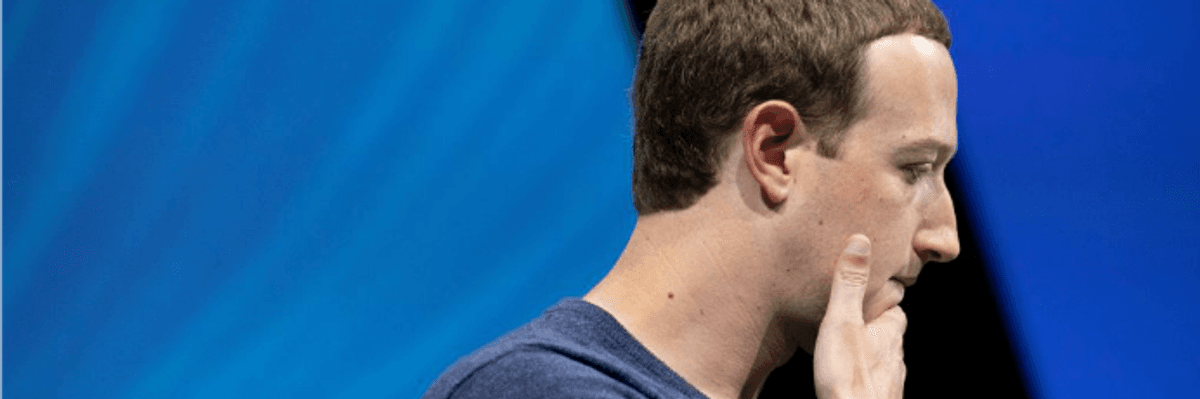
Mark Zuckerberg, chief executive officer and founder of Facebook, attends the Viva Tech start-up and technology gathering at Parc des Expositions Porte de Versailles on May 24, 2018 in Paris, France. (Photo: Christophe Morin/IP3/Getty Images)
Less than a week after the New York Times revealed in an explosive report that Facebook formed agreements with a number of major device-makers that gave them vast access to users' personal data without their consent, yet another report--this time by the Wall Street Journal--alleged on Friday that the social media giant gave a select list of companies "special access" to user data after it claimed to have "walled off" such information.
Internally called "whitelists," these secretive deals "allowed certain companies to access additional information about a user's Facebook friends," the Journal reported, citing court documents and anonymous Facebook officials. "That included information like phone numbers and a metric called 'friend link' that measured the degree of closeness between users and others in their network."
The Journal continued:
The whitelist deals were struck with companies including Royal Bank of Canada and Nissan Motor Co. , who advertised on Facebook or were valuable for other reasons, according to some of the people familiar with the matter. They show that Facebook gave special data access to a broader universe of companies than was previously disclosed. They also raise further questions about who has access to the data of billions of Facebook users and why they had access, at a time when Congress is demanding the company be held accountable for the flow of that data.
The secret access Facebook granted to this limited group of companies came after the tech giant claimed in 2015 that it had stopped granting access to such a broad range of user data.
But, as Gizmodo's AJ Dellinger noted on Friday, "Access is never truly cut off if you have some money to throw around."
As Common Dreams reported on Monday, the report showing that Facebook cut deals with device-makers appeared to show that CEO Mark Zuckerberg flat-out lied to Congress when he asserted that users of the platform have "complete control" of who can and can't see their personal data.
The Journal's report appears to add to Facebook's ever-growing list of lies, deceptions, and extreme violations of privacy, Dellinger concluded.
"Disclosure of the deals punctures a hole in the picture Facebook has tried to paint as a suddenly user-friendly, privacy-minded company after 2014--not that anyone was buying that image anyway," Dellinger wrote.
Dear Common Dreams reader, It’s been nearly 30 years since I co-founded Common Dreams with my late wife, Lina Newhouser. We had the radical notion that journalism should serve the public good, not corporate profits. It was clear to us from the outset what it would take to build such a project. No paid advertisements. No corporate sponsors. No millionaire publisher telling us what to think or do. Many people said we wouldn't last a year, but we proved those doubters wrong. Together with a tremendous team of journalists and dedicated staff, we built an independent media outlet free from the constraints of profits and corporate control. Our mission has always been simple: To inform. To inspire. To ignite change for the common good. Building Common Dreams was not easy. Our survival was never guaranteed. When you take on the most powerful forces—Wall Street greed, fossil fuel industry destruction, Big Tech lobbyists, and uber-rich oligarchs who have spent billions upon billions rigging the economy and democracy in their favor—the only bulwark you have is supporters who believe in your work. But here’s the urgent message from me today. It's never been this bad out there. And it's never been this hard to keep us going. At the very moment Common Dreams is most needed, the threats we face are intensifying. We need your support now more than ever. We don't accept corporate advertising and never will. We don't have a paywall because we don't think people should be blocked from critical news based on their ability to pay. Everything we do is funded by the donations of readers like you. When everyone does the little they can afford, we are strong. But if that support retreats or dries up, so do we. Will you donate now to make sure Common Dreams not only survives but thrives? —Craig Brown, Co-founder |
Less than a week after the New York Times revealed in an explosive report that Facebook formed agreements with a number of major device-makers that gave them vast access to users' personal data without their consent, yet another report--this time by the Wall Street Journal--alleged on Friday that the social media giant gave a select list of companies "special access" to user data after it claimed to have "walled off" such information.
Internally called "whitelists," these secretive deals "allowed certain companies to access additional information about a user's Facebook friends," the Journal reported, citing court documents and anonymous Facebook officials. "That included information like phone numbers and a metric called 'friend link' that measured the degree of closeness between users and others in their network."
The Journal continued:
The whitelist deals were struck with companies including Royal Bank of Canada and Nissan Motor Co. , who advertised on Facebook or were valuable for other reasons, according to some of the people familiar with the matter. They show that Facebook gave special data access to a broader universe of companies than was previously disclosed. They also raise further questions about who has access to the data of billions of Facebook users and why they had access, at a time when Congress is demanding the company be held accountable for the flow of that data.
The secret access Facebook granted to this limited group of companies came after the tech giant claimed in 2015 that it had stopped granting access to such a broad range of user data.
But, as Gizmodo's AJ Dellinger noted on Friday, "Access is never truly cut off if you have some money to throw around."
As Common Dreams reported on Monday, the report showing that Facebook cut deals with device-makers appeared to show that CEO Mark Zuckerberg flat-out lied to Congress when he asserted that users of the platform have "complete control" of who can and can't see their personal data.
The Journal's report appears to add to Facebook's ever-growing list of lies, deceptions, and extreme violations of privacy, Dellinger concluded.
"Disclosure of the deals punctures a hole in the picture Facebook has tried to paint as a suddenly user-friendly, privacy-minded company after 2014--not that anyone was buying that image anyway," Dellinger wrote.
Less than a week after the New York Times revealed in an explosive report that Facebook formed agreements with a number of major device-makers that gave them vast access to users' personal data without their consent, yet another report--this time by the Wall Street Journal--alleged on Friday that the social media giant gave a select list of companies "special access" to user data after it claimed to have "walled off" such information.
Internally called "whitelists," these secretive deals "allowed certain companies to access additional information about a user's Facebook friends," the Journal reported, citing court documents and anonymous Facebook officials. "That included information like phone numbers and a metric called 'friend link' that measured the degree of closeness between users and others in their network."
The Journal continued:
The whitelist deals were struck with companies including Royal Bank of Canada and Nissan Motor Co. , who advertised on Facebook or were valuable for other reasons, according to some of the people familiar with the matter. They show that Facebook gave special data access to a broader universe of companies than was previously disclosed. They also raise further questions about who has access to the data of billions of Facebook users and why they had access, at a time when Congress is demanding the company be held accountable for the flow of that data.
The secret access Facebook granted to this limited group of companies came after the tech giant claimed in 2015 that it had stopped granting access to such a broad range of user data.
But, as Gizmodo's AJ Dellinger noted on Friday, "Access is never truly cut off if you have some money to throw around."
As Common Dreams reported on Monday, the report showing that Facebook cut deals with device-makers appeared to show that CEO Mark Zuckerberg flat-out lied to Congress when he asserted that users of the platform have "complete control" of who can and can't see their personal data.
The Journal's report appears to add to Facebook's ever-growing list of lies, deceptions, and extreme violations of privacy, Dellinger concluded.
"Disclosure of the deals punctures a hole in the picture Facebook has tried to paint as a suddenly user-friendly, privacy-minded company after 2014--not that anyone was buying that image anyway," Dellinger wrote.

