
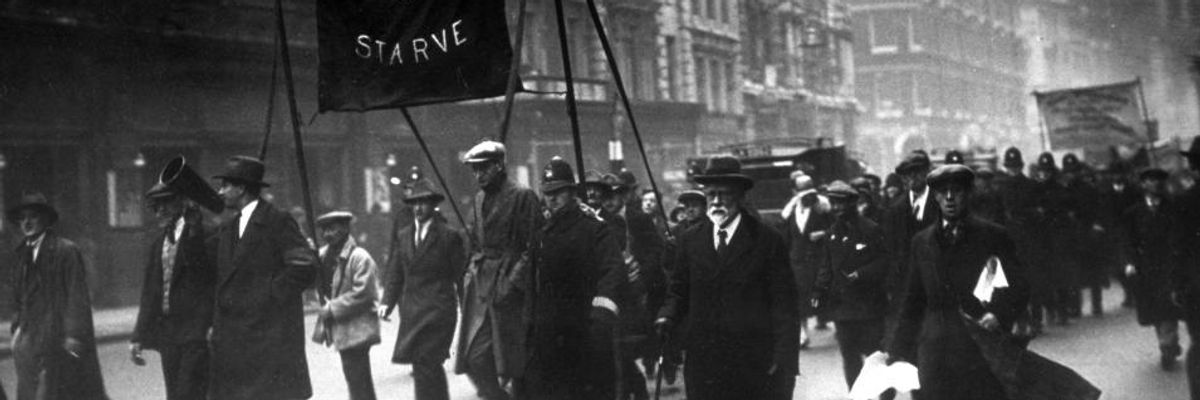
Unemployed men marching along the Thames embankment in 1930, carrying a banner reading "Organise or Starve." (Photo by Topical Press Agency/Getty Images)
Fed Economists Warn US Unemployment Rate Could Soon Reach 32%--During Great Depression It Peaked at 25%
"These are very large numbers by historical standards, but this is a rather unique shock that is unlike any other experienced by the U.S. economy in the last 100 years."
Economists at the Federal Reserve Bank of St. Louis are warning that if the current rate of U.S. job losses continues, the country's unemployment rate could reach a staggering 32.1% by the end of June as the coronavirus pandemic-induced downturn sparks mass layoffs across the nation.
Miguel Faria-e-Castro, an economist with the St. Louis Fed, wrote in an analysis last week that 47 million more workers could lose their jobs by the end of the second quarter of 2020, bringing the total number of unemployed people in the U.S. to 52.8 million. As CNBC noted, that number would be "more than three times worse than the peak of the Great Recession."
Faria-e-Castro's projection of 32.1% unemployment would put the U.S. jobless rate significantly higher than the Depression-era peak of 24.9%.
"The projections are even worse than St. Louis Fed President James Bullard's much-publicized estimate of 30% [unemployment]," CNBC reported. "They reflect the high nature of at-risk jobs that ultimately could be lost."
Faria-e-Castro stressed that "the expected duration of unemployment" could matter more "than the unemployment rate itself, especially if the recovery is quick (and so duration is short)."
"These are very large numbers by historical standards," Faria-e-Castro wrote, "but this is a rather unique shock that is unlike any other experienced by the U.S. economy in the last 100 years."
In response to the St. Louis Fed analysis, HuffPost senior reporter Zach Carter tweeted, "It remains simply incredible that Congress is not even in town during a crisis of this magnitude."
"An astonishing, bipartisan failure of government," Carter added.
As Common Dreams reported last Friday, 3.3 million people filed jobless claims two weeks ago, shattering the previous record of 695,000 set in 1982.
"I have been a labor economist for a very long time and I have never seen anything like this," Heidi Shierholz of the Economic Policy Institute wrote in a blog post last week. "Furthermore, this is just the tip of the iceberg."
More than 40 economists surveyed by Bloomberg on Monday said they believe new Labor Department unemployment numbers set for release Thursday will be even higher.
Thomas Costerg, an economist at the investment firm Pictet Wealth Management, predicted that new jobless claims could be as high as 6.5 million while Goldman Sachs estimated 5.25 million.
New York magazine's Eric Levitz wrote Monday that while the "St. Louis Fed's projection is just a rough estimate... there's reason to think its catastrophic prediction is in the right ballpark."
"It's hard not to suspect that most every part of our economic life is going to get worse before it gets better," Levitz added.
We are at a crossroads
This country and this world are at a monumental crossroads. In a few short weeks, US voters will have an opportunity to beat back the forces of fascism and confront the billionaires who are rigging the economy, our media system, and our democracy, making it increasingly impossible for ordinary people to get by. We’re not just talking about the election. We’re talking about what must be done once these fascist elements are vanquished from power. We need a bolder set of solutions than what either major party has so far been willing to offer and a working-class movement ready to fight like hell for it. Trump didn't emerge from nowhere. The conditions that fueled MAGA authoritarianism were created by decades of radical neoliberal economic policies and a corrupt political system dominated by corporate interests. They slashed taxes on the super-rich, promising that the benefits would trickle down. They said giveaways to the corporate titans would make life more affordable for the rest of us. It was all bullshit. And when a bitter, betrayed populace searches for someone to blame, right-wing demagogues have little trouble finding scapegoats. People know when they're being lied to, but you won't hear any of this from the corporate media. Only independent journalism—powered and funded by people who believe in building a better world—can deliver truly trustworthy daily news. Our Fall Campaign is underway, and we need your help. To power our newsroom through the rest of the year, we need to raise $125,000 by midnight on October 31. So if you share our vision, please contribute whatever you can to sustain our work. |
Economists at the Federal Reserve Bank of St. Louis are warning that if the current rate of U.S. job losses continues, the country's unemployment rate could reach a staggering 32.1% by the end of June as the coronavirus pandemic-induced downturn sparks mass layoffs across the nation.
Miguel Faria-e-Castro, an economist with the St. Louis Fed, wrote in an analysis last week that 47 million more workers could lose their jobs by the end of the second quarter of 2020, bringing the total number of unemployed people in the U.S. to 52.8 million. As CNBC noted, that number would be "more than three times worse than the peak of the Great Recession."
Faria-e-Castro's projection of 32.1% unemployment would put the U.S. jobless rate significantly higher than the Depression-era peak of 24.9%.
"The projections are even worse than St. Louis Fed President James Bullard's much-publicized estimate of 30% [unemployment]," CNBC reported. "They reflect the high nature of at-risk jobs that ultimately could be lost."
Faria-e-Castro stressed that "the expected duration of unemployment" could matter more "than the unemployment rate itself, especially if the recovery is quick (and so duration is short)."
"These are very large numbers by historical standards," Faria-e-Castro wrote, "but this is a rather unique shock that is unlike any other experienced by the U.S. economy in the last 100 years."
In response to the St. Louis Fed analysis, HuffPost senior reporter Zach Carter tweeted, "It remains simply incredible that Congress is not even in town during a crisis of this magnitude."
"An astonishing, bipartisan failure of government," Carter added.
As Common Dreams reported last Friday, 3.3 million people filed jobless claims two weeks ago, shattering the previous record of 695,000 set in 1982.
"I have been a labor economist for a very long time and I have never seen anything like this," Heidi Shierholz of the Economic Policy Institute wrote in a blog post last week. "Furthermore, this is just the tip of the iceberg."
More than 40 economists surveyed by Bloomberg on Monday said they believe new Labor Department unemployment numbers set for release Thursday will be even higher.
Thomas Costerg, an economist at the investment firm Pictet Wealth Management, predicted that new jobless claims could be as high as 6.5 million while Goldman Sachs estimated 5.25 million.
New York magazine's Eric Levitz wrote Monday that while the "St. Louis Fed's projection is just a rough estimate... there's reason to think its catastrophic prediction is in the right ballpark."
"It's hard not to suspect that most every part of our economic life is going to get worse before it gets better," Levitz added.
Economists at the Federal Reserve Bank of St. Louis are warning that if the current rate of U.S. job losses continues, the country's unemployment rate could reach a staggering 32.1% by the end of June as the coronavirus pandemic-induced downturn sparks mass layoffs across the nation.
Miguel Faria-e-Castro, an economist with the St. Louis Fed, wrote in an analysis last week that 47 million more workers could lose their jobs by the end of the second quarter of 2020, bringing the total number of unemployed people in the U.S. to 52.8 million. As CNBC noted, that number would be "more than three times worse than the peak of the Great Recession."
Faria-e-Castro's projection of 32.1% unemployment would put the U.S. jobless rate significantly higher than the Depression-era peak of 24.9%.
"The projections are even worse than St. Louis Fed President James Bullard's much-publicized estimate of 30% [unemployment]," CNBC reported. "They reflect the high nature of at-risk jobs that ultimately could be lost."
Faria-e-Castro stressed that "the expected duration of unemployment" could matter more "than the unemployment rate itself, especially if the recovery is quick (and so duration is short)."
"These are very large numbers by historical standards," Faria-e-Castro wrote, "but this is a rather unique shock that is unlike any other experienced by the U.S. economy in the last 100 years."
In response to the St. Louis Fed analysis, HuffPost senior reporter Zach Carter tweeted, "It remains simply incredible that Congress is not even in town during a crisis of this magnitude."
"An astonishing, bipartisan failure of government," Carter added.
As Common Dreams reported last Friday, 3.3 million people filed jobless claims two weeks ago, shattering the previous record of 695,000 set in 1982.
"I have been a labor economist for a very long time and I have never seen anything like this," Heidi Shierholz of the Economic Policy Institute wrote in a blog post last week. "Furthermore, this is just the tip of the iceberg."
More than 40 economists surveyed by Bloomberg on Monday said they believe new Labor Department unemployment numbers set for release Thursday will be even higher.
Thomas Costerg, an economist at the investment firm Pictet Wealth Management, predicted that new jobless claims could be as high as 6.5 million while Goldman Sachs estimated 5.25 million.
New York magazine's Eric Levitz wrote Monday that while the "St. Louis Fed's projection is just a rough estimate... there's reason to think its catastrophic prediction is in the right ballpark."
"It's hard not to suspect that most every part of our economic life is going to get worse before it gets better," Levitz added.