SUBSCRIBE TO OUR FREE NEWSLETTER
Daily news & progressive opinion—funded by the people, not the corporations—delivered straight to your inbox.
5
#000000
#FFFFFF
To donate by check, phone, or other method, see our More Ways to Give page.
Daily news & progressive opinion—funded by the people, not the corporations—delivered straight to your inbox.
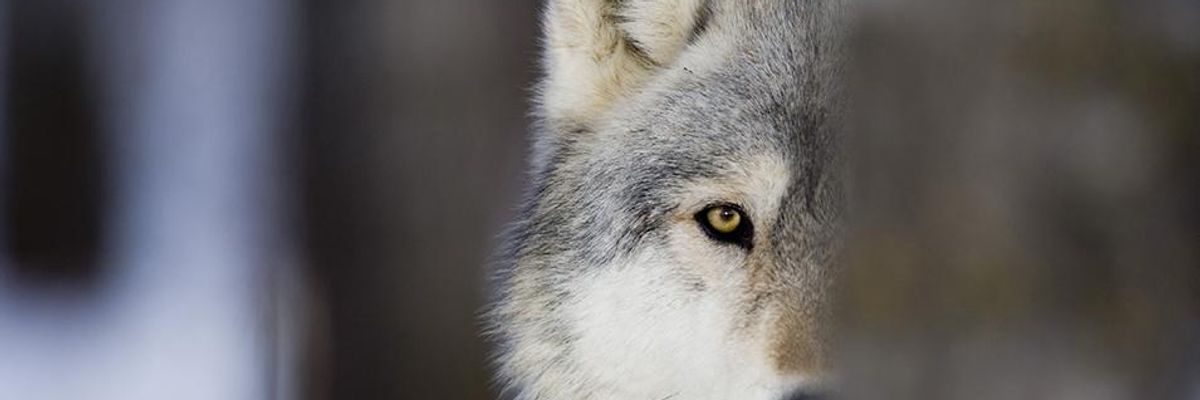
Wolf, Canis lupus, Minnesota, North America. (Photo: David Tipling/Universal Images Group via Getty Images)
"If this proposal and the others put forward by the Trump administration are allowed to stand, it will be death by a thousand cuts for endangered wildlife across the country," Bonnie Rice, a senior campaigner for Sierra Club, said in a statement Friday. "Critical habitat is just that--critical for species' survival and recovery. In the face of mass extinction, and climate and health crises worsened by habitat destruction and loss of nature, it's essential that we protect more habitat, not less."
Democrats on the Senate Environment and Public Works Committee called the decision "misguided."
"Developers and polluters could basically veto any critical habitat protections for endangered species by claiming economic impacts, even without proof," said Noah Greenwald, endangered species program director at the Center for Biological Diversity. "Wildlife simply can't survive or recover if they have no place to live, but that's exactly what will happen if the Trump administration succeeds in turning over the critical habitat designation process to industry."
These warnings are the latest against continuing moves by the Trump administration to roll back environmental regulations. Environmental Protection Agency Administrator Andrew Wheeler came under fire Thursday for a speech in which he outlined further plans to gut regulations of the fossil fuel industry should President Donald Trump win a second term.
"Added together, these rules are a disaster for endangered species and the natural world," said Greenwald. "This administration doesn't care about anything but money, and wildlife will suffer."
Rice of the Sierra Club noted the urgency of the climate crisis and species loss as she called for resistance to the administration's proposed changes.
"The science is clear that we need to protect 30% of lands and waters by 2030 to avoid the worst of the climate and extinction crises," she said. "We cannot afford to continue ignoring science by allowing the Trump administration's misguided and reckless attacks on the Endangered Species Act to move forward."
Once the proposed regulations are in the Federal Register, they'll be open for public comment.
Dear Common Dreams reader, It’s been nearly 30 years since I co-founded Common Dreams with my late wife, Lina Newhouser. We had the radical notion that journalism should serve the public good, not corporate profits. It was clear to us from the outset what it would take to build such a project. No paid advertisements. No corporate sponsors. No millionaire publisher telling us what to think or do. Many people said we wouldn't last a year, but we proved those doubters wrong. Together with a tremendous team of journalists and dedicated staff, we built an independent media outlet free from the constraints of profits and corporate control. Our mission has always been simple: To inform. To inspire. To ignite change for the common good. Building Common Dreams was not easy. Our survival was never guaranteed. When you take on the most powerful forces—Wall Street greed, fossil fuel industry destruction, Big Tech lobbyists, and uber-rich oligarchs who have spent billions upon billions rigging the economy and democracy in their favor—the only bulwark you have is supporters who believe in your work. But here’s the urgent message from me today. It's never been this bad out there. And it's never been this hard to keep us going. At the very moment Common Dreams is most needed, the threats we face are intensifying. We need your support now more than ever. We don't accept corporate advertising and never will. We don't have a paywall because we don't think people should be blocked from critical news based on their ability to pay. Everything we do is funded by the donations of readers like you. When everyone does the little they can afford, we are strong. But if that support retreats or dries up, so do we. Will you donate now to make sure Common Dreams not only survives but thrives? —Craig Brown, Co-founder |
"If this proposal and the others put forward by the Trump administration are allowed to stand, it will be death by a thousand cuts for endangered wildlife across the country," Bonnie Rice, a senior campaigner for Sierra Club, said in a statement Friday. "Critical habitat is just that--critical for species' survival and recovery. In the face of mass extinction, and climate and health crises worsened by habitat destruction and loss of nature, it's essential that we protect more habitat, not less."
Democrats on the Senate Environment and Public Works Committee called the decision "misguided."
"Developers and polluters could basically veto any critical habitat protections for endangered species by claiming economic impacts, even without proof," said Noah Greenwald, endangered species program director at the Center for Biological Diversity. "Wildlife simply can't survive or recover if they have no place to live, but that's exactly what will happen if the Trump administration succeeds in turning over the critical habitat designation process to industry."
These warnings are the latest against continuing moves by the Trump administration to roll back environmental regulations. Environmental Protection Agency Administrator Andrew Wheeler came under fire Thursday for a speech in which he outlined further plans to gut regulations of the fossil fuel industry should President Donald Trump win a second term.
"Added together, these rules are a disaster for endangered species and the natural world," said Greenwald. "This administration doesn't care about anything but money, and wildlife will suffer."
Rice of the Sierra Club noted the urgency of the climate crisis and species loss as she called for resistance to the administration's proposed changes.
"The science is clear that we need to protect 30% of lands and waters by 2030 to avoid the worst of the climate and extinction crises," she said. "We cannot afford to continue ignoring science by allowing the Trump administration's misguided and reckless attacks on the Endangered Species Act to move forward."
Once the proposed regulations are in the Federal Register, they'll be open for public comment.
"If this proposal and the others put forward by the Trump administration are allowed to stand, it will be death by a thousand cuts for endangered wildlife across the country," Bonnie Rice, a senior campaigner for Sierra Club, said in a statement Friday. "Critical habitat is just that--critical for species' survival and recovery. In the face of mass extinction, and climate and health crises worsened by habitat destruction and loss of nature, it's essential that we protect more habitat, not less."
Democrats on the Senate Environment and Public Works Committee called the decision "misguided."
"Developers and polluters could basically veto any critical habitat protections for endangered species by claiming economic impacts, even without proof," said Noah Greenwald, endangered species program director at the Center for Biological Diversity. "Wildlife simply can't survive or recover if they have no place to live, but that's exactly what will happen if the Trump administration succeeds in turning over the critical habitat designation process to industry."
These warnings are the latest against continuing moves by the Trump administration to roll back environmental regulations. Environmental Protection Agency Administrator Andrew Wheeler came under fire Thursday for a speech in which he outlined further plans to gut regulations of the fossil fuel industry should President Donald Trump win a second term.
"Added together, these rules are a disaster for endangered species and the natural world," said Greenwald. "This administration doesn't care about anything but money, and wildlife will suffer."
Rice of the Sierra Club noted the urgency of the climate crisis and species loss as she called for resistance to the administration's proposed changes.
"The science is clear that we need to protect 30% of lands and waters by 2030 to avoid the worst of the climate and extinction crises," she said. "We cannot afford to continue ignoring science by allowing the Trump administration's misguided and reckless attacks on the Endangered Species Act to move forward."
Once the proposed regulations are in the Federal Register, they'll be open for public comment.