
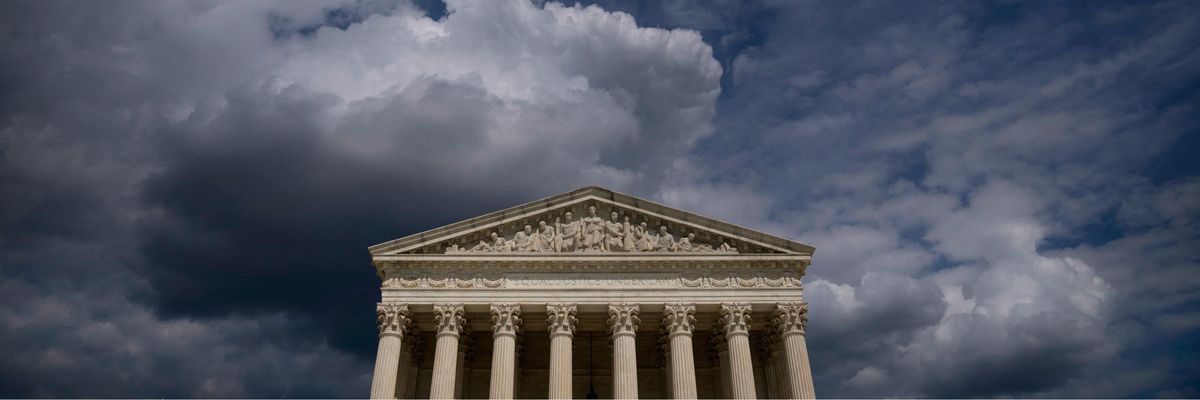
Clouds are seen above The U.S. Supreme Court building on May 17, 2021 in Washington, D.C. The Supreme Court Monday said that on December 1, it will hear a Mississippi abortion case that challenges Roe v. Wade. (Photo: Drew Angerer/Getty Images)
Supreme Court Announces Date for Case Directly Challenging Roe v. Wade
"The fate of Roe v. Wade and legal abortion is on the line."
Abortion rights advocates geared up for a major fight as the U.S. Supreme Court announced Monday it will soon hear arguments in Dobbs v. Jackson Women's Health Organization, a case in Mississippi which poses a direct challenge to Roe vs. Wade.
The high court confirmed it will consider the case December 1 after months of speculation regarding when it would take up the dispute over Mississippi's ban on most abortion care after 15 weeks of pregnancy.
The question before the court, as the Center for Reproductive Rights explains, is "whether all pre-viability prohibitions on elective abortion are unconstitutional." In the landmark 1973 Roe decision, the Supreme Court affirmed the right to abortion care before fetal viability, usually around 24 weeks.
"The fate of Roe v. Wade and legal abortion is on the line," tweeted Rewire News Group, which reports on reproductive rights.
Mississippi's restriction makes no exception for pregnancies that result from rape or incest, only allowing abortion care "in medical emergencies or for severe fetal abnormality." Providers who administer abortions in violation of the law could have their medical licenses revoked and face fines.
The court will hear the case three months after it refused to intervene in Texas, allowing that state's six-week abortion ban to take effect at the beginning of September. The Texas law allows private citizens to take legal action against anyone who helps a person to obtain abortion care after that point, with plaintiffs who prevail in court entitled to $10,000 and recovery of their legal fees. Republican governors in several other states have said since the Texas law was permitted to go into effect that they plan to seek similar legislation.
The Texas case has led reproductive rights advocates to warn that the Supreme Court cannot be counted on to protect Roe.
NARAL Pro-Choice America noted that the Mississippi case will be the first abortion case the court hears since Justice Amy Coney Barrett--one of three anti-choice judges appointed by former President Donald Trump--joined the court, resulting in a 6-3 right-wing majority.
The court's announcement on Monday followed the filing of an amicus brief in the Mississippi case by nearly 900 state legislators who support reproductive rights and justice.
"Since so many state legislators have been leading the assault on reproductive rights, it only makes sense that state legislators be the first to defend them," Arizona Democratic Rep. Athena Salman said in a statement. "By adding my name to this amicus brief, I join hundreds of powerful, strong reproductive freedom champions standing up for the rights of all."
The National Women's Law Center (NWLC). was among 72 organizations that filed a separate amicus brief following the Supreme Court's announcement.
"In our brief, we explain that the devastating impact of allowing a pre-viability abortion ban to stand--or overturning the right to abortion explicitly--denies the liberty and equality of women and all people who can become pregnant," NWLC said.
We are at a crossroads
This country and this world are at a monumental crossroads. In a few short weeks, US voters will have an opportunity to beat back the forces of fascism and confront the billionaires who are rigging the economy, our media system, and our democracy, making it increasingly impossible for ordinary people to get by. We’re not just talking about the election. We’re talking about what must be done once these fascist elements are vanquished from power. We need a bolder set of solutions than what either major party has so far been willing to offer and a working-class movement ready to fight like hell for it. Trump didn't emerge from nowhere. The conditions that fueled MAGA authoritarianism were created by decades of radical neoliberal economic policies and a corrupt political system dominated by corporate interests. They slashed taxes on the super-rich, promising that the benefits would trickle down. They said giveaways to the corporate titans would make life more affordable for the rest of us. It was all bullshit. And when a bitter, betrayed populace searches for someone to blame, right-wing demagogues have little trouble finding scapegoats. People know when they're being lied to, but you won't hear any of this from the corporate media. Only independent journalism—powered and funded by people who believe in building a better world—can deliver truly trustworthy daily news. Our Fall Campaign is underway, and we need your help. To power our newsroom through the rest of the year, we need to raise $125,000 by midnight on October 31. So if you share our vision, please contribute whatever you can to sustain our work. |
Abortion rights advocates geared up for a major fight as the U.S. Supreme Court announced Monday it will soon hear arguments in Dobbs v. Jackson Women's Health Organization, a case in Mississippi which poses a direct challenge to Roe vs. Wade.
The high court confirmed it will consider the case December 1 after months of speculation regarding when it would take up the dispute over Mississippi's ban on most abortion care after 15 weeks of pregnancy.
The question before the court, as the Center for Reproductive Rights explains, is "whether all pre-viability prohibitions on elective abortion are unconstitutional." In the landmark 1973 Roe decision, the Supreme Court affirmed the right to abortion care before fetal viability, usually around 24 weeks.
"The fate of Roe v. Wade and legal abortion is on the line," tweeted Rewire News Group, which reports on reproductive rights.
Mississippi's restriction makes no exception for pregnancies that result from rape or incest, only allowing abortion care "in medical emergencies or for severe fetal abnormality." Providers who administer abortions in violation of the law could have their medical licenses revoked and face fines.
The court will hear the case three months after it refused to intervene in Texas, allowing that state's six-week abortion ban to take effect at the beginning of September. The Texas law allows private citizens to take legal action against anyone who helps a person to obtain abortion care after that point, with plaintiffs who prevail in court entitled to $10,000 and recovery of their legal fees. Republican governors in several other states have said since the Texas law was permitted to go into effect that they plan to seek similar legislation.
The Texas case has led reproductive rights advocates to warn that the Supreme Court cannot be counted on to protect Roe.
NARAL Pro-Choice America noted that the Mississippi case will be the first abortion case the court hears since Justice Amy Coney Barrett--one of three anti-choice judges appointed by former President Donald Trump--joined the court, resulting in a 6-3 right-wing majority.
The court's announcement on Monday followed the filing of an amicus brief in the Mississippi case by nearly 900 state legislators who support reproductive rights and justice.
"Since so many state legislators have been leading the assault on reproductive rights, it only makes sense that state legislators be the first to defend them," Arizona Democratic Rep. Athena Salman said in a statement. "By adding my name to this amicus brief, I join hundreds of powerful, strong reproductive freedom champions standing up for the rights of all."
The National Women's Law Center (NWLC). was among 72 organizations that filed a separate amicus brief following the Supreme Court's announcement.
"In our brief, we explain that the devastating impact of allowing a pre-viability abortion ban to stand--or overturning the right to abortion explicitly--denies the liberty and equality of women and all people who can become pregnant," NWLC said.