SUBSCRIBE TO OUR FREE NEWSLETTER
Daily news & progressive opinion—funded by the people, not the corporations—delivered straight to your inbox.
5
#000000
#FFFFFF
To donate by check, phone, or other method, see our More Ways to Give page.
Daily news & progressive opinion—funded by the people, not the corporations—delivered straight to your inbox.
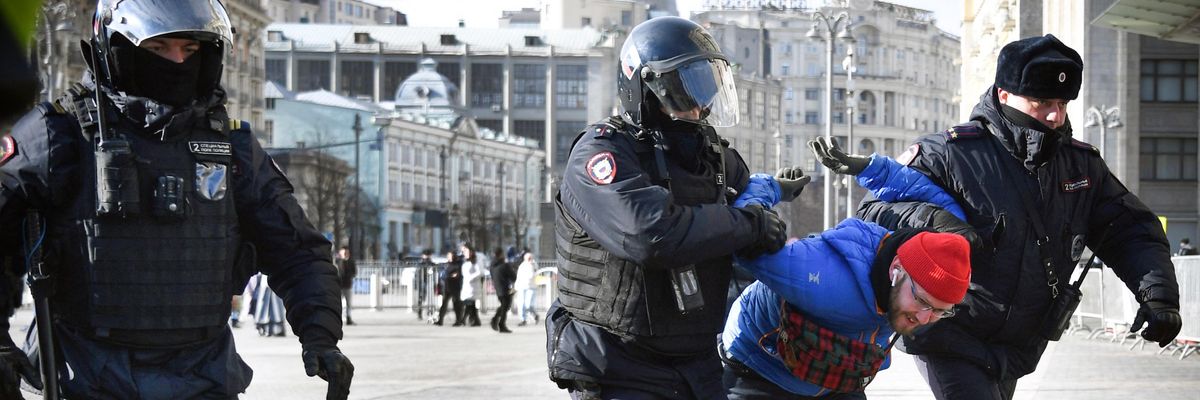
Police officers detain a man during a protest against Russia's invasion of Ukraine, in Manezhnaya square in central Moscow on March 13, 2022. (Photo: AFP via Getty Images)
The Moscow offices of Amnesty International, Human Rights Watch, and other groups were shuttered by the Kremlin on Friday--a move that comes amid widespread condemnation of abuses and possible war crimes that have taken place during Russia's ongoing attack on Ukraine.
"Amnesty's closing down in Russia is only the latest in a long list of organizations that have been punished for defending human rights and speaking the truth to the Russian authorities," said Agnes Callamard, secretary-general of Amnesty International, in a statement.
"You must be doing something right if the Kremlin tries to shut you up."
"In a country where scores of activists and dissidents have been imprisoned, killed, or exiled, where independent media has been smeared, blocked, or forced to self-censor, and where civil society organizations have been outlawed or liquidated," she added, "you must be doing something right if the Kremlin tries to shut you up."
Amnesty said that its representative offices were closed as well as other NGOs operating in Russia. According to the group, the Russian Ministry of Justice delisted its name from the register of the representative offices, "effectively closing it down alongside with offices of Human Rights Watch, Carnegie Endowment for International Peace, Friedrich Naumann Foundation for Freedom, Friedrich Ebert Foundation, and other organizations."
Hugh Williamson, director of HRW's Europe & Central Asia division, said that while the decision was potentially "devastating," it would not impact the group's commitment to its mission.
The Russian ministry claimed its decision to shutter the operations of the various groups was "due to the discovery of violations of the current legislation of the Russian Federation."
Both Amnesty and HRW have investigated and openly condemned alleged abuses and violations of international law by Russian forces during the military campaign in Ukraine.
Like Williamson at HRW, Amnesty's Callamard said that the closures in Moscow would not stop its work.
"The authorities are deeply mistaken if they believe that by closing down our office in Moscow they will stop our work documenting and exposing human rights violations," she said. "We continue undeterred to work to ensure that people in Russia are able to enjoy their human rights without discrimination. We will redouble our efforts to expose Russia's egregious human rights violations both at home and abroad."
Dear Common Dreams reader, It’s been nearly 30 years since I co-founded Common Dreams with my late wife, Lina Newhouser. We had the radical notion that journalism should serve the public good, not corporate profits. It was clear to us from the outset what it would take to build such a project. No paid advertisements. No corporate sponsors. No millionaire publisher telling us what to think or do. Many people said we wouldn't last a year, but we proved those doubters wrong. Together with a tremendous team of journalists and dedicated staff, we built an independent media outlet free from the constraints of profits and corporate control. Our mission has always been simple: To inform. To inspire. To ignite change for the common good. Building Common Dreams was not easy. Our survival was never guaranteed. When you take on the most powerful forces—Wall Street greed, fossil fuel industry destruction, Big Tech lobbyists, and uber-rich oligarchs who have spent billions upon billions rigging the economy and democracy in their favor—the only bulwark you have is supporters who believe in your work. But here’s the urgent message from me today. It's never been this bad out there. And it's never been this hard to keep us going. At the very moment Common Dreams is most needed, the threats we face are intensifying. We need your support now more than ever. We don't accept corporate advertising and never will. We don't have a paywall because we don't think people should be blocked from critical news based on their ability to pay. Everything we do is funded by the donations of readers like you. When everyone does the little they can afford, we are strong. But if that support retreats or dries up, so do we. Will you donate now to make sure Common Dreams not only survives but thrives? —Craig Brown, Co-founder |
The Moscow offices of Amnesty International, Human Rights Watch, and other groups were shuttered by the Kremlin on Friday--a move that comes amid widespread condemnation of abuses and possible war crimes that have taken place during Russia's ongoing attack on Ukraine.
"Amnesty's closing down in Russia is only the latest in a long list of organizations that have been punished for defending human rights and speaking the truth to the Russian authorities," said Agnes Callamard, secretary-general of Amnesty International, in a statement.
"You must be doing something right if the Kremlin tries to shut you up."
"In a country where scores of activists and dissidents have been imprisoned, killed, or exiled, where independent media has been smeared, blocked, or forced to self-censor, and where civil society organizations have been outlawed or liquidated," she added, "you must be doing something right if the Kremlin tries to shut you up."
Amnesty said that its representative offices were closed as well as other NGOs operating in Russia. According to the group, the Russian Ministry of Justice delisted its name from the register of the representative offices, "effectively closing it down alongside with offices of Human Rights Watch, Carnegie Endowment for International Peace, Friedrich Naumann Foundation for Freedom, Friedrich Ebert Foundation, and other organizations."
Hugh Williamson, director of HRW's Europe & Central Asia division, said that while the decision was potentially "devastating," it would not impact the group's commitment to its mission.
The Russian ministry claimed its decision to shutter the operations of the various groups was "due to the discovery of violations of the current legislation of the Russian Federation."
Both Amnesty and HRW have investigated and openly condemned alleged abuses and violations of international law by Russian forces during the military campaign in Ukraine.
Like Williamson at HRW, Amnesty's Callamard said that the closures in Moscow would not stop its work.
"The authorities are deeply mistaken if they believe that by closing down our office in Moscow they will stop our work documenting and exposing human rights violations," she said. "We continue undeterred to work to ensure that people in Russia are able to enjoy their human rights without discrimination. We will redouble our efforts to expose Russia's egregious human rights violations both at home and abroad."
The Moscow offices of Amnesty International, Human Rights Watch, and other groups were shuttered by the Kremlin on Friday--a move that comes amid widespread condemnation of abuses and possible war crimes that have taken place during Russia's ongoing attack on Ukraine.
"Amnesty's closing down in Russia is only the latest in a long list of organizations that have been punished for defending human rights and speaking the truth to the Russian authorities," said Agnes Callamard, secretary-general of Amnesty International, in a statement.
"You must be doing something right if the Kremlin tries to shut you up."
"In a country where scores of activists and dissidents have been imprisoned, killed, or exiled, where independent media has been smeared, blocked, or forced to self-censor, and where civil society organizations have been outlawed or liquidated," she added, "you must be doing something right if the Kremlin tries to shut you up."
Amnesty said that its representative offices were closed as well as other NGOs operating in Russia. According to the group, the Russian Ministry of Justice delisted its name from the register of the representative offices, "effectively closing it down alongside with offices of Human Rights Watch, Carnegie Endowment for International Peace, Friedrich Naumann Foundation for Freedom, Friedrich Ebert Foundation, and other organizations."
Hugh Williamson, director of HRW's Europe & Central Asia division, said that while the decision was potentially "devastating," it would not impact the group's commitment to its mission.
The Russian ministry claimed its decision to shutter the operations of the various groups was "due to the discovery of violations of the current legislation of the Russian Federation."
Both Amnesty and HRW have investigated and openly condemned alleged abuses and violations of international law by Russian forces during the military campaign in Ukraine.
Like Williamson at HRW, Amnesty's Callamard said that the closures in Moscow would not stop its work.
"The authorities are deeply mistaken if they believe that by closing down our office in Moscow they will stop our work documenting and exposing human rights violations," she said. "We continue undeterred to work to ensure that people in Russia are able to enjoy their human rights without discrimination. We will redouble our efforts to expose Russia's egregious human rights violations both at home and abroad."