SUBSCRIBE TO OUR FREE NEWSLETTER
Daily news & progressive opinion—funded by the people, not the corporations—delivered straight to your inbox.
5
#000000
#FFFFFF
To donate by check, phone, or other method, see our More Ways to Give page.
Daily news & progressive opinion—funded by the people, not the corporations—delivered straight to your inbox.
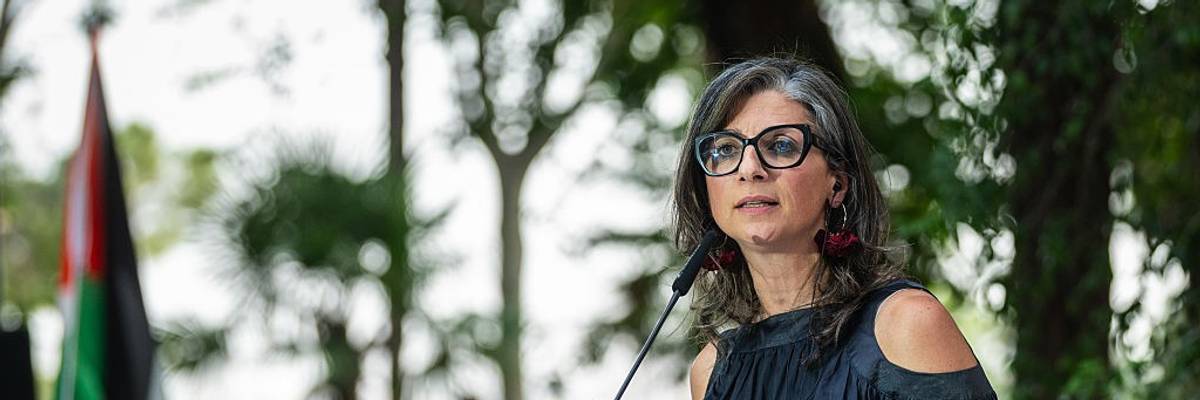
Francesca Albanese, United Nations special rapporteur for the occupied Palestinian territories, speaks at an event on June 23, 2025 in Madrid, Spain.
"The political, physical, and material persecution that Francesca Albanese is facing is not normal. Genocide is not normal."
United Nations experts and human rights advocates voiced alarm Friday after the right-wing Costa Rican government denied entry to Francesca Albanese, the UN special rapporteur for the occupied Palestinian territories and a trenchant critic of Israel's genocidal assault on Gaza.
Albanese, an Italian national, was set to receive an honorary doctorate on Friday from the University of Costa Rica. The head of Costa Rica’s immigration authority, Omer Badilla, said Albanese was held at the Juan Santamaria International Airport on Thursday because she was allegedly "subject to an international alert due to links to terrorist acts." Albanese called the terrorism claim "nonsense," writing on social media, "Defending human rights is not terrorism."
Speaking to the local student publication Semanario Universidad, Albanese speculated that the "international alert" may have come from the United States, which—under the administration of President Donald Trump—has targeted her with sanctions for demanding international accountability for Israel and its allies. The Trump administration's sanctions bar Albanese from entering the US and banking there.
Albanese said Friday that she had "a very long discussion, surrounded by several immigration agents," upon being denied entry to Costa Rica.
"It was a rather intimidating situation," said Albanese, who has faced death threats and smear campaigns over her criticism of Israel and defense of Palestinian rights. "Honestly, I’ve never felt so humiliated and threatened in my life."
This is where I will spend my first night in Costa Rica. https://t.co/9DbgdNOqDO
— Francesca Albanese, UN Special Rapporteur oPt (@FranceskAlbs) November 27, 2026
Volker Türk, the UN high commissioner for human rights, said he was "deeply concerned" by the Costa Rican government's decision to bar Albanese and urged officials to reverse course.
"This is difficult to reconcile with Costa Rica’s longstanding commitment to human rights," said Türk.
Agnes Callamard, secretary-general of Amnesty International, called the Costa Rican government's actions "shameful" and "utterly unacceptable."
"Amnesty is calling on the Costa Rica authorities to ensure Francesca Albanese is allowed in Costa Rica to receive her honoris causa doctorate degree from the University of Costa Rica," said Callamard. "This is a big test too for the Costa Rican democracy, for the integrity and independence of its legal processes, for academic freedom."
Costa Rican President Laura Fernández, who took office in May, is a political ally of Trump and has sought closer diplomatic and trade ties with Israel.
Late last year, Albanese denounced the government of Costa Rica for reaching a trade agreement with Israel "in the midst of apartheid, illegal occupation, and genocide, ignoring rulings by the International Court of Justice and UN decisions." She called on Costa Rican lawmakers to pause the deal, which has yet to be ratified.
One member of Costa Rica's ruling party, José Miguel Villalobos, criticized his government's decision to bar Albanese, saying that "she has the right to enter, whether she is wrong or not."
"I don’t want to hear Ms. Albanese, but I defend her right to come in and say what I don’t want to hear, because that is tolerance," he said. "Albanese is not Hamas."
Federica D'Alessio, an Italian journalist and founder of the news outlet Kritica, wrote on social media that "the enormous risk of this historical moment is that we start to see all of this as normal."
"It is not normal," she added. "The political, physical, and material persecution that Francesca Albanese is facing is not normal. Genocide is not normal. Criminalizing those who oppose it and legitimizing those who perpetrate it is not normal. It has happened before in history. It was not normal then either, and it is not normal now."
This country and this world are at a monumental crossroads. US voters have an opportunity to beat back the forces of fascism and confront the billionaires who are rigging the economy, our media system, and our democracy, making it increasingly impossible for ordinary people to get by. We’re not just talking about the election. We’re talking about what must be done once these fascist elements are vanquished from power. We need a bolder set of solutions than what either major party has so far been willing to offer and a working-class movement ready to fight like hell for it. Trump didn't emerge from nowhere. The conditions that fueled MAGA authoritarianism were created by decades of radical neoliberal economic policies and a corrupt political system dominated by corporate interests. They slashed taxes on the super-rich, promising that the benefits would trickle down. They said giveaways to the corporate titans would make life more affordable for the rest of us. It was all bullshit. And when a bitter, betrayed populace searches for someone to blame, right-wing demagogues have little trouble finding scapegoats. People know when they're being lied to, but you won't hear any of this from the corporate media. Only independent journalism—powered and funded by people who believe in building a better world—can deliver truly trustworthy daily news. If you share our vision, please contribute whatever you can to sustain our work. |
United Nations experts and human rights advocates voiced alarm Friday after the right-wing Costa Rican government denied entry to Francesca Albanese, the UN special rapporteur for the occupied Palestinian territories and a trenchant critic of Israel's genocidal assault on Gaza.
Albanese, an Italian national, was set to receive an honorary doctorate on Friday from the University of Costa Rica. The head of Costa Rica’s immigration authority, Omer Badilla, said Albanese was held at the Juan Santamaria International Airport on Thursday because she was allegedly "subject to an international alert due to links to terrorist acts." Albanese called the terrorism claim "nonsense," writing on social media, "Defending human rights is not terrorism."
Speaking to the local student publication Semanario Universidad, Albanese speculated that the "international alert" may have come from the United States, which—under the administration of President Donald Trump—has targeted her with sanctions for demanding international accountability for Israel and its allies. The Trump administration's sanctions bar Albanese from entering the US and banking there.
Albanese said Friday that she had "a very long discussion, surrounded by several immigration agents," upon being denied entry to Costa Rica.
"It was a rather intimidating situation," said Albanese, who has faced death threats and smear campaigns over her criticism of Israel and defense of Palestinian rights. "Honestly, I’ve never felt so humiliated and threatened in my life."
This is where I will spend my first night in Costa Rica. https://t.co/9DbgdNOqDO
— Francesca Albanese, UN Special Rapporteur oPt (@FranceskAlbs) November 27, 2026
Volker Türk, the UN high commissioner for human rights, said he was "deeply concerned" by the Costa Rican government's decision to bar Albanese and urged officials to reverse course.
"This is difficult to reconcile with Costa Rica’s longstanding commitment to human rights," said Türk.
Agnes Callamard, secretary-general of Amnesty International, called the Costa Rican government's actions "shameful" and "utterly unacceptable."
"Amnesty is calling on the Costa Rica authorities to ensure Francesca Albanese is allowed in Costa Rica to receive her honoris causa doctorate degree from the University of Costa Rica," said Callamard. "This is a big test too for the Costa Rican democracy, for the integrity and independence of its legal processes, for academic freedom."
Costa Rican President Laura Fernández, who took office in May, is a political ally of Trump and has sought closer diplomatic and trade ties with Israel.
Late last year, Albanese denounced the government of Costa Rica for reaching a trade agreement with Israel "in the midst of apartheid, illegal occupation, and genocide, ignoring rulings by the International Court of Justice and UN decisions." She called on Costa Rican lawmakers to pause the deal, which has yet to be ratified.
One member of Costa Rica's ruling party, José Miguel Villalobos, criticized his government's decision to bar Albanese, saying that "she has the right to enter, whether she is wrong or not."
"I don’t want to hear Ms. Albanese, but I defend her right to come in and say what I don’t want to hear, because that is tolerance," he said. "Albanese is not Hamas."
Federica D'Alessio, an Italian journalist and founder of the news outlet Kritica, wrote on social media that "the enormous risk of this historical moment is that we start to see all of this as normal."
"It is not normal," she added. "The political, physical, and material persecution that Francesca Albanese is facing is not normal. Genocide is not normal. Criminalizing those who oppose it and legitimizing those who perpetrate it is not normal. It has happened before in history. It was not normal then either, and it is not normal now."