SUBSCRIBE TO OUR FREE NEWSLETTER
Daily news & progressive opinion—funded by the people, not the corporations—delivered straight to your inbox.
5
#000000
#FFFFFF
To donate by check, phone, or other method, see our More Ways to Give page.
Daily news & progressive opinion—funded by the people, not the corporations—delivered straight to your inbox.
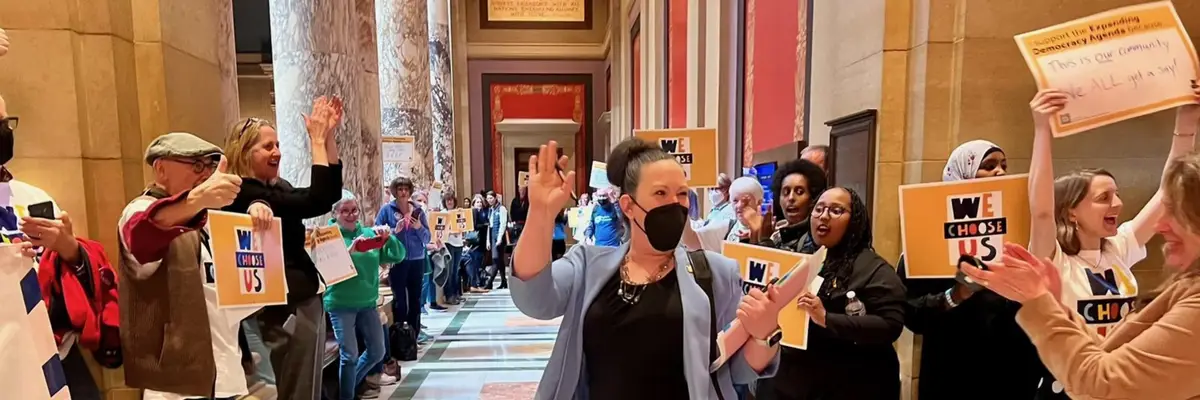
Supporters celebrate the Minnesota Senate's passage of the Democracy for the People Act on April 26, 2023 in St. Paul.
Gov. Tim Walz, a Democrat, has promised to sign the Democracy for the People Act "to put up a firewall to keep Minnesota's elections safe, free, and fair."
Campaign finance reform advocates on Thursday cheered final passage by legislators in Minnestoa of a bill prohibiting multinational corporations from spending money on state elections.
In a late-night 34-33 vote, the Minnesota Senate on Wednesday approved the Democracy for the People Act, an omnibus democracy bill that will ban companies with at least a 5% ownership stake by multiple foreign owners or a 1% stake by a single foreign owner from making political contributions in Minnesota state and municipal elections. The legislation also prohibits such companies from making "dark money" donations to super PACs.
"If there was a Mount Rushmore for electoral reform bills in the history of Minnesota... this would be on it," said Minnesota Secretary of State Steve Simon, a Democrat.
The measure—which was approved 70-57 along party lines by the state House of Representatives earlier this month—now heads to the desk of Gov. Tim Walz, a Democrat who has promised to sign it into law "to put up a firewall to keep Minnesota's elections safe, free, and fair."
"Multinational corporations are corrupting representative democracy by drowning out the voices of the people," said Alexandra Flores-Quilty, campaign director at Free Speech For People, whose model legislation heavily influenced the bill. "The Democracy for the People Act will help put power back in the hands of citizens."
According to the Center for American Progress (CAP):
This legislation will close a dangerous loophole opened by the U.S. Supreme Court's decision in Citizens United v. Federal Election Commission and reduce foreign influence in Minnesota's elections. It contains additional important measures to strengthen the freedom to vote and modernize the state's campaign finance system, including establishing automatic voter registration, enabling voters to opt in to automatically receive a mail-in ballot for each election, preregistering 16- and 17-year-olds to vote upon turning 18, prohibiting intimidation and interference with the voting process, and increasing disclosure of secret political spending.
"Today, Minnesota took a giant step forward to strengthening free and fair elections, setting a strong example for the nation," CAP senior fellow Michael Sozan said in a statement following the state Senate vote.
"At a time when many states are passing laws to suppress voters or subvert elections, Minnesota has become a national leader in protecting elections and empowering voters," Sozan added. "The provision to stop political spending by foreign-influenced U.S. corporations will limit the ability of foreign entities to spend money in Minnesota's elections and strengthen the ability of Minnesotans to chart their state's future."
There has been some momentum toward enacting similar legislation at the national level in recent years, including Sen. Elizabeth Warren's (D-Mass.) Anti-Corruption and Public Integrity Act, and Rep. Jamie Raskin's (D-Md.) Get Foreign Money Out of U.S. Elections Act.
Dear Common Dreams reader, It’s been nearly 30 years since I co-founded Common Dreams with my late wife, Lina Newhouser. We had the radical notion that journalism should serve the public good, not corporate profits. It was clear to us from the outset what it would take to build such a project. No paid advertisements. No corporate sponsors. No millionaire publisher telling us what to think or do. Many people said we wouldn't last a year, but we proved those doubters wrong. Together with a tremendous team of journalists and dedicated staff, we built an independent media outlet free from the constraints of profits and corporate control. Our mission has always been simple: To inform. To inspire. To ignite change for the common good. Building Common Dreams was not easy. Our survival was never guaranteed. When you take on the most powerful forces—Wall Street greed, fossil fuel industry destruction, Big Tech lobbyists, and uber-rich oligarchs who have spent billions upon billions rigging the economy and democracy in their favor—the only bulwark you have is supporters who believe in your work. But here’s the urgent message from me today. It's never been this bad out there. And it's never been this hard to keep us going. At the very moment Common Dreams is most needed, the threats we face are intensifying. We need your support now more than ever. We don't accept corporate advertising and never will. We don't have a paywall because we don't think people should be blocked from critical news based on their ability to pay. Everything we do is funded by the donations of readers like you. When everyone does the little they can afford, we are strong. But if that support retreats or dries up, so do we. Will you donate now to make sure Common Dreams not only survives but thrives? —Craig Brown, Co-founder |
Campaign finance reform advocates on Thursday cheered final passage by legislators in Minnestoa of a bill prohibiting multinational corporations from spending money on state elections.
In a late-night 34-33 vote, the Minnesota Senate on Wednesday approved the Democracy for the People Act, an omnibus democracy bill that will ban companies with at least a 5% ownership stake by multiple foreign owners or a 1% stake by a single foreign owner from making political contributions in Minnesota state and municipal elections. The legislation also prohibits such companies from making "dark money" donations to super PACs.
"If there was a Mount Rushmore for electoral reform bills in the history of Minnesota... this would be on it," said Minnesota Secretary of State Steve Simon, a Democrat.
The measure—which was approved 70-57 along party lines by the state House of Representatives earlier this month—now heads to the desk of Gov. Tim Walz, a Democrat who has promised to sign it into law "to put up a firewall to keep Minnesota's elections safe, free, and fair."
"Multinational corporations are corrupting representative democracy by drowning out the voices of the people," said Alexandra Flores-Quilty, campaign director at Free Speech For People, whose model legislation heavily influenced the bill. "The Democracy for the People Act will help put power back in the hands of citizens."
According to the Center for American Progress (CAP):
This legislation will close a dangerous loophole opened by the U.S. Supreme Court's decision in Citizens United v. Federal Election Commission and reduce foreign influence in Minnesota's elections. It contains additional important measures to strengthen the freedom to vote and modernize the state's campaign finance system, including establishing automatic voter registration, enabling voters to opt in to automatically receive a mail-in ballot for each election, preregistering 16- and 17-year-olds to vote upon turning 18, prohibiting intimidation and interference with the voting process, and increasing disclosure of secret political spending.
"Today, Minnesota took a giant step forward to strengthening free and fair elections, setting a strong example for the nation," CAP senior fellow Michael Sozan said in a statement following the state Senate vote.
"At a time when many states are passing laws to suppress voters or subvert elections, Minnesota has become a national leader in protecting elections and empowering voters," Sozan added. "The provision to stop political spending by foreign-influenced U.S. corporations will limit the ability of foreign entities to spend money in Minnesota's elections and strengthen the ability of Minnesotans to chart their state's future."
There has been some momentum toward enacting similar legislation at the national level in recent years, including Sen. Elizabeth Warren's (D-Mass.) Anti-Corruption and Public Integrity Act, and Rep. Jamie Raskin's (D-Md.) Get Foreign Money Out of U.S. Elections Act.
Campaign finance reform advocates on Thursday cheered final passage by legislators in Minnestoa of a bill prohibiting multinational corporations from spending money on state elections.
In a late-night 34-33 vote, the Minnesota Senate on Wednesday approved the Democracy for the People Act, an omnibus democracy bill that will ban companies with at least a 5% ownership stake by multiple foreign owners or a 1% stake by a single foreign owner from making political contributions in Minnesota state and municipal elections. The legislation also prohibits such companies from making "dark money" donations to super PACs.
"If there was a Mount Rushmore for electoral reform bills in the history of Minnesota... this would be on it," said Minnesota Secretary of State Steve Simon, a Democrat.
The measure—which was approved 70-57 along party lines by the state House of Representatives earlier this month—now heads to the desk of Gov. Tim Walz, a Democrat who has promised to sign it into law "to put up a firewall to keep Minnesota's elections safe, free, and fair."
"Multinational corporations are corrupting representative democracy by drowning out the voices of the people," said Alexandra Flores-Quilty, campaign director at Free Speech For People, whose model legislation heavily influenced the bill. "The Democracy for the People Act will help put power back in the hands of citizens."
According to the Center for American Progress (CAP):
This legislation will close a dangerous loophole opened by the U.S. Supreme Court's decision in Citizens United v. Federal Election Commission and reduce foreign influence in Minnesota's elections. It contains additional important measures to strengthen the freedom to vote and modernize the state's campaign finance system, including establishing automatic voter registration, enabling voters to opt in to automatically receive a mail-in ballot for each election, preregistering 16- and 17-year-olds to vote upon turning 18, prohibiting intimidation and interference with the voting process, and increasing disclosure of secret political spending.
"Today, Minnesota took a giant step forward to strengthening free and fair elections, setting a strong example for the nation," CAP senior fellow Michael Sozan said in a statement following the state Senate vote.
"At a time when many states are passing laws to suppress voters or subvert elections, Minnesota has become a national leader in protecting elections and empowering voters," Sozan added. "The provision to stop political spending by foreign-influenced U.S. corporations will limit the ability of foreign entities to spend money in Minnesota's elections and strengthen the ability of Minnesotans to chart their state's future."
There has been some momentum toward enacting similar legislation at the national level in recent years, including Sen. Elizabeth Warren's (D-Mass.) Anti-Corruption and Public Integrity Act, and Rep. Jamie Raskin's (D-Md.) Get Foreign Money Out of U.S. Elections Act.