
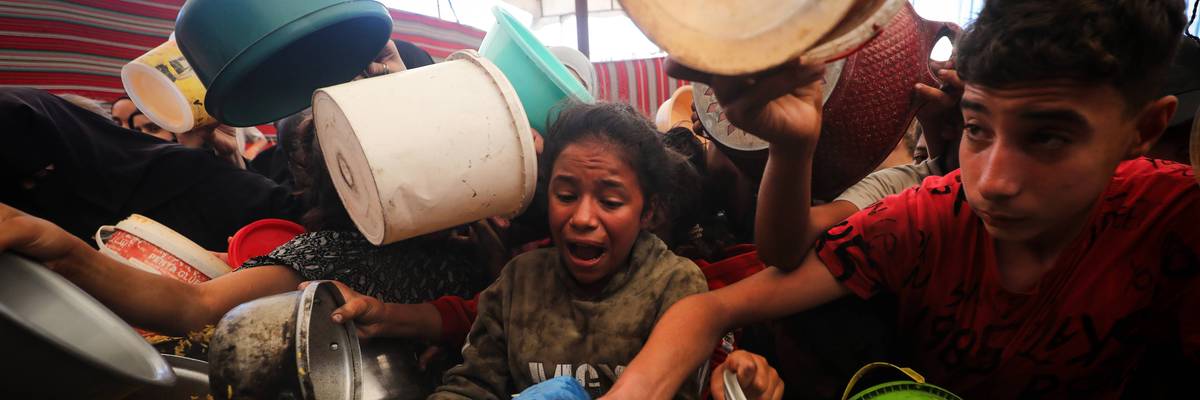
Displaced Palestinians, including numerous children holding empty containers and cooking pots, crowd around a community aid distribution in Gaza Strip, Palestine on October 17, 2026.
Half a Million People in Gaza to Lose Food Aid Due to Funding Shortages: UN
The World Food Program said the fiscal shortfalls came after it received "less than half as much funding for its Palestine operation in 2026 as in previous years."
The United Nations's World Food Program announced on Monday that funding shortages were forcing it to significantly reduce assistance in Gaza, where it projected half a million people would lose access to food aid.
The WFP said the cuts would also mean that families still receiving assistance will only get half of the rations they previously received.
WFP has cut the number of hot meals it provides in Gaza by 40%, while reducing the value of cash assistance it provides to 75,000 families.
The agency also said that it would be reducing its operations in the West Bank, where an estimated 200,000 people are projected to lose access to food assistance.
The WFP said the fiscal shortfalls came after it received "less than half as much funding for its Palestine operation in 2026 as in previous years," adding that it needs $450 million to maintain its critical operations in the two Palestinian territories over the next six months.
"As winter approaches," WFP said, "additional resources are urgently needed to sustain emergency food assistance, provide critical engineering support and prevent malnutrition among young children and pregnant and breastfeeding women."
Shaun Hughes, WFP's representative and country director for Palestine, told The Guardian that the cuts were coming after the program had made steady progress in reducing hunger in Gaza, while emphasizing that "these are very fragile gains, easily reversed, and the situation is still brutal."
"We need to invest in recovery," Hughes added. "This humanitarian operation isn’t affordable or sustainable in the long term. Ultimately that’s also what everyone in Gaza is telling us. They really don’t want to be reliant on these handouts, don’t want to stand in the hot meals queue every day. They want to have some chance of stability and recovery."
Some Palestinians who spoke with BBC on Monday expressed horror at news of the cuts, which come as Gaza is still under attack by Israeli forces.
Mervat al-Satari, a displaced Palestinian mother, told BBC that the cuts were "a disaster" and asked "how will we provide for the little ones?"
Palestinian mother Dalal al-Dahdouh, who is living in the ruins of her home in Gaza City, told BBC that WFP rations were already insufficient before the cuts took effect.
"In the past, thank God, we had our own home and a wonderful life," al-Dahdouh said. "We had fresh vegetables, proper sanitation facilities, and our own land. Now we live entirely on aid, including WFP vouchers."
We are at a crossroads
This country and this world are at a monumental crossroads. US voters have an opportunity to beat back the forces of fascism and confront the billionaires who are rigging the economy, our media system, and our democracy, making it increasingly impossible for ordinary people to get by. We’re not just talking about the election. We’re talking about what must be done once these fascist elements are vanquished from power. We need a bolder set of solutions than what either major party has so far been willing to offer and a working-class movement ready to fight like hell for it. Trump didn't emerge from nowhere. The conditions that fueled MAGA authoritarianism were created by decades of radical neoliberal economic policies and a corrupt political system dominated by corporate interests. They slashed taxes on the super-rich, promising that the benefits would trickle down. They said giveaways to the corporate titans would make life more affordable for the rest of us. It was all bullshit. And when a bitter, betrayed populace searches for someone to blame, right-wing demagogues have little trouble finding scapegoats. People know when they're being lied to, but you won't hear any of this from the corporate media. Only independent journalism—powered and funded by people who believe in building a better world—can deliver truly trustworthy daily news. Our Fall Campaign is underway, and we need your help. To power our newsroom through the rest of the year, we need to raise $125,000 by midnight on October 31. So if you share our vision, please contribute whatever you can to sustain our work. |
The United Nations's World Food Program announced on Monday that funding shortages were forcing it to significantly reduce assistance in Gaza, where it projected half a million people would lose access to food aid.
The WFP said the cuts would also mean that families still receiving assistance will only get half of the rations they previously received.
WFP has cut the number of hot meals it provides in Gaza by 40%, while reducing the value of cash assistance it provides to 75,000 families.
The agency also said that it would be reducing its operations in the West Bank, where an estimated 200,000 people are projected to lose access to food assistance.
The WFP said the fiscal shortfalls came after it received "less than half as much funding for its Palestine operation in 2026 as in previous years," adding that it needs $450 million to maintain its critical operations in the two Palestinian territories over the next six months.
"As winter approaches," WFP said, "additional resources are urgently needed to sustain emergency food assistance, provide critical engineering support and prevent malnutrition among young children and pregnant and breastfeeding women."
Shaun Hughes, WFP's representative and country director for Palestine, told The Guardian that the cuts were coming after the program had made steady progress in reducing hunger in Gaza, while emphasizing that "these are very fragile gains, easily reversed, and the situation is still brutal."
"We need to invest in recovery," Hughes added. "This humanitarian operation isn’t affordable or sustainable in the long term. Ultimately that’s also what everyone in Gaza is telling us. They really don’t want to be reliant on these handouts, don’t want to stand in the hot meals queue every day. They want to have some chance of stability and recovery."
Some Palestinians who spoke with BBC on Monday expressed horror at news of the cuts, which come as Gaza is still under attack by Israeli forces.
Mervat al-Satari, a displaced Palestinian mother, told BBC that the cuts were "a disaster" and asked "how will we provide for the little ones?"
Palestinian mother Dalal al-Dahdouh, who is living in the ruins of her home in Gaza City, told BBC that WFP rations were already insufficient before the cuts took effect.
"In the past, thank God, we had our own home and a wonderful life," al-Dahdouh said. "We had fresh vegetables, proper sanitation facilities, and our own land. Now we live entirely on aid, including WFP vouchers."
- Israeli Troops Gun Down 30+ Palestinians in Yet Another Food Aid Massacre ›
- World Food Program Economist Warns 'Worst Is Yet to Come' in Gaza ›
- UN Program Out of Food in Gaza as Israel Maintains Blockade ›