SUBSCRIBE TO OUR FREE NEWSLETTER
Daily news & progressive opinion—funded by the people, not the corporations—delivered straight to your inbox.
5
#000000
#FFFFFF
To donate by check, phone, or other method, see our More Ways to Give page.
Daily news & progressive opinion—funded by the people, not the corporations—delivered straight to your inbox.
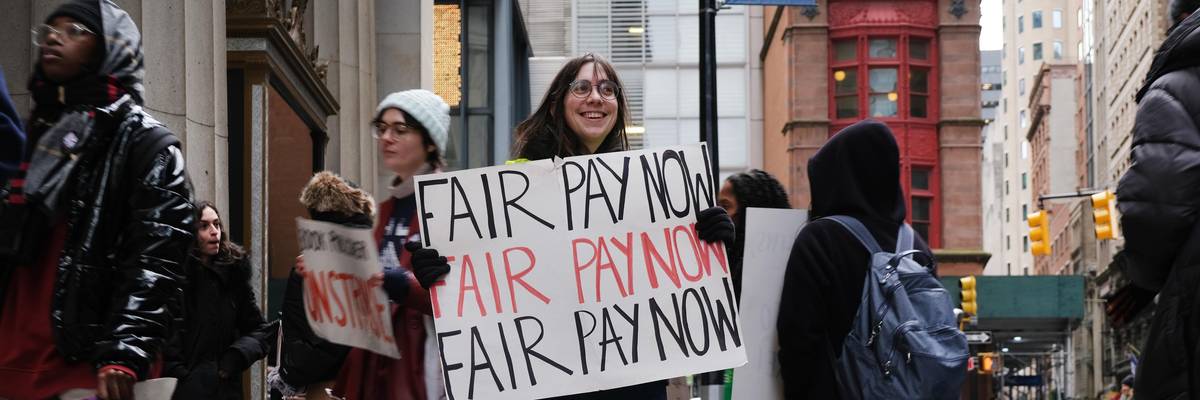
Employees of HarperCollins Publishers participate in a strike outside the company's offices in Manhattan on November 15, 2022 in New York City.
If the agreement is ratified by union members, said one supporter, "this strike will have helped publishing in general and not just this team."
The HarperCollins Publishers union announced late Thursday that its work stoppage that began in November has successfully pressured the company into reaching a tentative agreement including pay raises.
The tentative deal reportedly includes one-time $1,500 bonuses for all union members and increased minimum starting salaries, which are currently $45,000 per year.
The union went on strike on November 10, pledging to continue the walkout for "as long as it takes" to secure a contract with fair pay and benefits. The roughly 250 workers represented by the Association of HarperCollins Employees—which is affiliated with Local 2110 of the United Auto Workers union—worked without a contract for seven months last year before negotiations fell apart.
According to the Massachusetts Institute of Technology's living wage calculator, New York residents need to earn a minimum of $53,000 in order to pay for living expenses in the city. The union had demanded that minimum starting salaries be raised to $50,000.
"We all hope for a quick resolution, but it wholly depends on what the company is willing to put on the table."
The HarperCollins union—the only collective bargaining unit at a major U.S. book publisher—had also called for better paid family leave benefits and greater efforts by management to diversify the company's workforce.
The union includes employees in the publisher's editorial, publicity, sales, marketing, legal, and design departments.
Author and NPR podcast host Linda Holmes noted that if the union members vote to ratify the agreement, the strike "will have helped publishing in general and not just this team."
Numerous HarperCollins authors have demonstrated solidarity with the workers since they walked out on November 10, with many saying they would withhold submissions to the publisher until a fair contract was agreed upon.
On social media, the union emphasized on Thursday that "the strike isn't over yet" as representatives enter mediation with the company.
"We all hope for a quick resolution, but it wholly depends on what the company is willing to put on the table," said the union. "We in the union aren't willing to throw away months of sacrifice on the line for an unfair contract—we're in it for as long as it takes."
If the deal is approved by members, the contract will remain in place through 2025.
Dear Common Dreams reader, It’s been nearly 30 years since I co-founded Common Dreams with my late wife, Lina Newhouser. We had the radical notion that journalism should serve the public good, not corporate profits. It was clear to us from the outset what it would take to build such a project. No paid advertisements. No corporate sponsors. No millionaire publisher telling us what to think or do. Many people said we wouldn't last a year, but we proved those doubters wrong. Together with a tremendous team of journalists and dedicated staff, we built an independent media outlet free from the constraints of profits and corporate control. Our mission has always been simple: To inform. To inspire. To ignite change for the common good. Building Common Dreams was not easy. Our survival was never guaranteed. When you take on the most powerful forces—Wall Street greed, fossil fuel industry destruction, Big Tech lobbyists, and uber-rich oligarchs who have spent billions upon billions rigging the economy and democracy in their favor—the only bulwark you have is supporters who believe in your work. But here’s the urgent message from me today. It's never been this bad out there. And it's never been this hard to keep us going. At the very moment Common Dreams is most needed, the threats we face are intensifying. We need your support now more than ever. We don't accept corporate advertising and never will. We don't have a paywall because we don't think people should be blocked from critical news based on their ability to pay. Everything we do is funded by the donations of readers like you. When everyone does the little they can afford, we are strong. But if that support retreats or dries up, so do we. Will you donate now to make sure Common Dreams not only survives but thrives? —Craig Brown, Co-founder |
The HarperCollins Publishers union announced late Thursday that its work stoppage that began in November has successfully pressured the company into reaching a tentative agreement including pay raises.
The tentative deal reportedly includes one-time $1,500 bonuses for all union members and increased minimum starting salaries, which are currently $45,000 per year.
The union went on strike on November 10, pledging to continue the walkout for "as long as it takes" to secure a contract with fair pay and benefits. The roughly 250 workers represented by the Association of HarperCollins Employees—which is affiliated with Local 2110 of the United Auto Workers union—worked without a contract for seven months last year before negotiations fell apart.
According to the Massachusetts Institute of Technology's living wage calculator, New York residents need to earn a minimum of $53,000 in order to pay for living expenses in the city. The union had demanded that minimum starting salaries be raised to $50,000.
"We all hope for a quick resolution, but it wholly depends on what the company is willing to put on the table."
The HarperCollins union—the only collective bargaining unit at a major U.S. book publisher—had also called for better paid family leave benefits and greater efforts by management to diversify the company's workforce.
The union includes employees in the publisher's editorial, publicity, sales, marketing, legal, and design departments.
Author and NPR podcast host Linda Holmes noted that if the union members vote to ratify the agreement, the strike "will have helped publishing in general and not just this team."
Numerous HarperCollins authors have demonstrated solidarity with the workers since they walked out on November 10, with many saying they would withhold submissions to the publisher until a fair contract was agreed upon.
On social media, the union emphasized on Thursday that "the strike isn't over yet" as representatives enter mediation with the company.
"We all hope for a quick resolution, but it wholly depends on what the company is willing to put on the table," said the union. "We in the union aren't willing to throw away months of sacrifice on the line for an unfair contract—we're in it for as long as it takes."
If the deal is approved by members, the contract will remain in place through 2025.
The HarperCollins Publishers union announced late Thursday that its work stoppage that began in November has successfully pressured the company into reaching a tentative agreement including pay raises.
The tentative deal reportedly includes one-time $1,500 bonuses for all union members and increased minimum starting salaries, which are currently $45,000 per year.
The union went on strike on November 10, pledging to continue the walkout for "as long as it takes" to secure a contract with fair pay and benefits. The roughly 250 workers represented by the Association of HarperCollins Employees—which is affiliated with Local 2110 of the United Auto Workers union—worked without a contract for seven months last year before negotiations fell apart.
According to the Massachusetts Institute of Technology's living wage calculator, New York residents need to earn a minimum of $53,000 in order to pay for living expenses in the city. The union had demanded that minimum starting salaries be raised to $50,000.
"We all hope for a quick resolution, but it wholly depends on what the company is willing to put on the table."
The HarperCollins union—the only collective bargaining unit at a major U.S. book publisher—had also called for better paid family leave benefits and greater efforts by management to diversify the company's workforce.
The union includes employees in the publisher's editorial, publicity, sales, marketing, legal, and design departments.
Author and NPR podcast host Linda Holmes noted that if the union members vote to ratify the agreement, the strike "will have helped publishing in general and not just this team."
Numerous HarperCollins authors have demonstrated solidarity with the workers since they walked out on November 10, with many saying they would withhold submissions to the publisher until a fair contract was agreed upon.
On social media, the union emphasized on Thursday that "the strike isn't over yet" as representatives enter mediation with the company.
"We all hope for a quick resolution, but it wholly depends on what the company is willing to put on the table," said the union. "We in the union aren't willing to throw away months of sacrifice on the line for an unfair contract—we're in it for as long as it takes."
If the deal is approved by members, the contract will remain in place through 2025.