SUBSCRIBE TO OUR FREE NEWSLETTER
Daily news & progressive opinion—funded by the people, not the corporations—delivered straight to your inbox.
5
#000000
#FFFFFF
To donate by check, phone, or other method, see our More Ways to Give page.
Daily news & progressive opinion—funded by the people, not the corporations—delivered straight to your inbox.
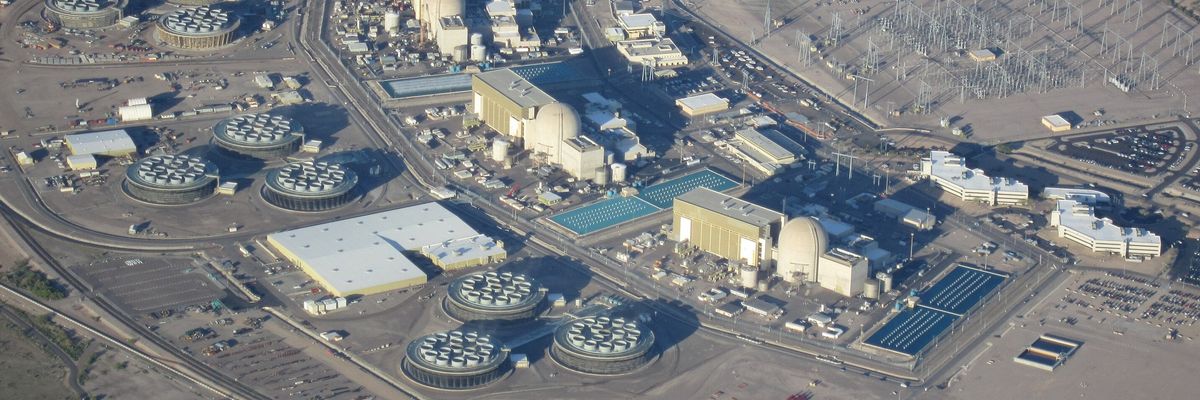
An aerial view of the Palo Verde Nuclear Power Plant in Arizona—the nation's largest—on April 7, 2010.
"People everywhere need to be aware of the NRC's dangerous decision and its implications for their health and safety."
A physicist at the Union of Concerned Scientists on Monday condemned a proposed U.S. Nuclear Regulatory Commission rule allowing the licensing of new nuclear reactors without requiring them to have offsite emergency plans, a policy experts argue could adversely affect disaster safety.
Proponents contend that the NRC's Part 53 rule—which would provide regulatory relief for advanced nuclear reactors—makes sense because those types of power plants are much safer than currently operating units.
However, Edwin Lyman, director of nuclear power safety at the Union of Concerned Scientists (UCS), said in a statement that "past natural and human-made disasters have taught us that having a robust and workable emergency plan in place is the key to minimizing human suffering and loss of life if the unthinkable happens."
"NRC's reckless decision today flies in the face of that experience," he added.
For over 50 years, the NRC and its predecessor agency, the U.S. Atomic Energy Commission, sought to build nuclear power plants away from densely populated areas due to the threat of accidents. However, under the new rule, construction of advanced nuclear reactors would be allowed in areas with high population densities.
"The central issue," Lyman explained last year, "is that the NRC is accepting on faith that these new reactors are going to be safer and wants to adjust its regulations accordingly, to make them less stringent—on faith."
Lyman said Monday that "concerns with the rule expressed by the Federal Emergency Management Agency and other authorities demonstrate how out-of-step the NRC is with experts on this issue. Coupled with other troubling regulatory changes that the NRC has already made or is considering, this new rule will only increase dangers for the public from the next generation of nuclear plants."
"Additionally, the absence of offsite emergency planning will create burdens in the aftermath of a nuclear plant accident, extreme weather event, or terrorist attack that will fall disproportionately on those people and communities with the fewest resources," he said.
"The cost of preparing for emergencies is relatively modest. And yet nuclear industry proponents have pushed to change the rules to facilitate constructing new nuclear reactors anywhere, even in densely populated areas where timely emergency evacuations might be extremely difficult or even impossible," Lyman added. "People everywhere need to be aware of the NRC's dangerous decision and its implications for their health and safety."
Dear Common Dreams reader, It’s been nearly 30 years since I co-founded Common Dreams with my late wife, Lina Newhouser. We had the radical notion that journalism should serve the public good, not corporate profits. It was clear to us from the outset what it would take to build such a project. No paid advertisements. No corporate sponsors. No millionaire publisher telling us what to think or do. Many people said we wouldn't last a year, but we proved those doubters wrong. Together with a tremendous team of journalists and dedicated staff, we built an independent media outlet free from the constraints of profits and corporate control. Our mission has always been simple: To inform. To inspire. To ignite change for the common good. Building Common Dreams was not easy. Our survival was never guaranteed. When you take on the most powerful forces—Wall Street greed, fossil fuel industry destruction, Big Tech lobbyists, and uber-rich oligarchs who have spent billions upon billions rigging the economy and democracy in their favor—the only bulwark you have is supporters who believe in your work. But here’s the urgent message from me today. It's never been this bad out there. And it's never been this hard to keep us going. At the very moment Common Dreams is most needed, the threats we face are intensifying. We need your support now more than ever. We don't accept corporate advertising and never will. We don't have a paywall because we don't think people should be blocked from critical news based on their ability to pay. Everything we do is funded by the donations of readers like you. When everyone does the little they can afford, we are strong. But if that support retreats or dries up, so do we. Will you donate now to make sure Common Dreams not only survives but thrives? —Craig Brown, Co-founder |
A physicist at the Union of Concerned Scientists on Monday condemned a proposed U.S. Nuclear Regulatory Commission rule allowing the licensing of new nuclear reactors without requiring them to have offsite emergency plans, a policy experts argue could adversely affect disaster safety.
Proponents contend that the NRC's Part 53 rule—which would provide regulatory relief for advanced nuclear reactors—makes sense because those types of power plants are much safer than currently operating units.
However, Edwin Lyman, director of nuclear power safety at the Union of Concerned Scientists (UCS), said in a statement that "past natural and human-made disasters have taught us that having a robust and workable emergency plan in place is the key to minimizing human suffering and loss of life if the unthinkable happens."
"NRC's reckless decision today flies in the face of that experience," he added.
For over 50 years, the NRC and its predecessor agency, the U.S. Atomic Energy Commission, sought to build nuclear power plants away from densely populated areas due to the threat of accidents. However, under the new rule, construction of advanced nuclear reactors would be allowed in areas with high population densities.
"The central issue," Lyman explained last year, "is that the NRC is accepting on faith that these new reactors are going to be safer and wants to adjust its regulations accordingly, to make them less stringent—on faith."
Lyman said Monday that "concerns with the rule expressed by the Federal Emergency Management Agency and other authorities demonstrate how out-of-step the NRC is with experts on this issue. Coupled with other troubling regulatory changes that the NRC has already made or is considering, this new rule will only increase dangers for the public from the next generation of nuclear plants."
"Additionally, the absence of offsite emergency planning will create burdens in the aftermath of a nuclear plant accident, extreme weather event, or terrorist attack that will fall disproportionately on those people and communities with the fewest resources," he said.
"The cost of preparing for emergencies is relatively modest. And yet nuclear industry proponents have pushed to change the rules to facilitate constructing new nuclear reactors anywhere, even in densely populated areas where timely emergency evacuations might be extremely difficult or even impossible," Lyman added. "People everywhere need to be aware of the NRC's dangerous decision and its implications for their health and safety."
A physicist at the Union of Concerned Scientists on Monday condemned a proposed U.S. Nuclear Regulatory Commission rule allowing the licensing of new nuclear reactors without requiring them to have offsite emergency plans, a policy experts argue could adversely affect disaster safety.
Proponents contend that the NRC's Part 53 rule—which would provide regulatory relief for advanced nuclear reactors—makes sense because those types of power plants are much safer than currently operating units.
However, Edwin Lyman, director of nuclear power safety at the Union of Concerned Scientists (UCS), said in a statement that "past natural and human-made disasters have taught us that having a robust and workable emergency plan in place is the key to minimizing human suffering and loss of life if the unthinkable happens."
"NRC's reckless decision today flies in the face of that experience," he added.
For over 50 years, the NRC and its predecessor agency, the U.S. Atomic Energy Commission, sought to build nuclear power plants away from densely populated areas due to the threat of accidents. However, under the new rule, construction of advanced nuclear reactors would be allowed in areas with high population densities.
"The central issue," Lyman explained last year, "is that the NRC is accepting on faith that these new reactors are going to be safer and wants to adjust its regulations accordingly, to make them less stringent—on faith."
Lyman said Monday that "concerns with the rule expressed by the Federal Emergency Management Agency and other authorities demonstrate how out-of-step the NRC is with experts on this issue. Coupled with other troubling regulatory changes that the NRC has already made or is considering, this new rule will only increase dangers for the public from the next generation of nuclear plants."
"Additionally, the absence of offsite emergency planning will create burdens in the aftermath of a nuclear plant accident, extreme weather event, or terrorist attack that will fall disproportionately on those people and communities with the fewest resources," he said.
"The cost of preparing for emergencies is relatively modest. And yet nuclear industry proponents have pushed to change the rules to facilitate constructing new nuclear reactors anywhere, even in densely populated areas where timely emergency evacuations might be extremely difficult or even impossible," Lyman added. "People everywhere need to be aware of the NRC's dangerous decision and its implications for their health and safety."