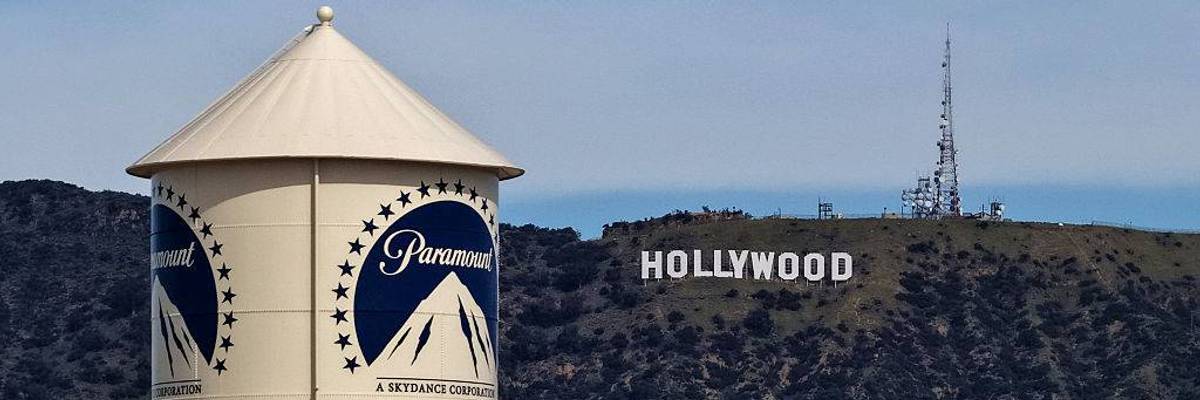
An aerial view of the Paramount logo on the water tower at Paramount Studios on February 23, 2026 in Los Angeles, California.
Legendary TV Comedy Writer Explains 'Existential' Threat of Paramount-Warner Bros. Merger
"We know what this merger will mean—one less buyer for our work, less demand for writing services, less leverage to negotiate deal terms that recognize our value, less creative latitude."
Top TV comedy writer Michael Schur, co-creator of hit shows such as Parks and Rec and The Good Place, is sounding the alarm about the "existential" dangers of allowing the proposed $110 billion megamerger between Paramount and Warner Bros. Discovery to go through.
In an op-ed published Monday in The Hollywood Reporter, Schur outlined the downsides of megamergers between major Hollywood studios, which he described as "bad for everyone except those at the very top" and "another potential broadsword blow to an already wounded industry, one that’s been gouged and squeezed and strangled by high-level corporate greed."
Focusing on the challenges faced by writers, Schur wrote that people in his profession "felt the walls closing in" when they first heard news of Paramount's proposed purchase of Warner Bros.
"We know what this merger will mean," wrote Schur, "one less buyer for our work, less demand for writing services, less leverage to negotiate deal terms that recognize our value, less creative latitude... The impact will be concrete, measurable, and serious."
Schur explained that writers and other workers in the entertainment industry personally understand how corporate consolidation affects their livelihoods.
"We don’t have to theorize any of these outcomes," Schur wrote. "Disney’s acquisition of 21st Century Fox in 2019 put them all on full display. After the merger, Fox’s television development operation was folded into Disney’s. Their studio’s priorities continued, Fox’s did not. Writers who had built relationships at Fox found themselves adrift... More than 4,000 Fox employees lost their jobs."
Schur concluded by encouraging opponents to the merger to "fight tooth and nail to sustain what is left of our struggling—but still breathing—creative industry" before it gets fully monopolized.
The combination of Paramount and Warner Bros. has long been controversial because it would put control of CBS, CNN, HBO, TikTok, and other major media properties all under the control of David Ellison, the son of billionaire Larry Ellison, a major donor to President Donald Trump.
The merger has been placed on hold amid multiple lawsuits seeking to block it, including one filed by 12 Democratic state attorneys general.
The New York Times reported on Monday that California Attorney General Rob Bonta, whose office has been leading the state AGs' antitrust complaint against the deal, called off a meeting that had been scheduled with Paramount executives to discuss a potential settlement.
In a statement, Bonta accused Paramount of leaking misleading information about settlement discussions between the parties, which he said demonstrated "a lack of good faith."
"As soon as Paramount stops playing games and engages sincerely," Bonta said, "my office is happy to meet again."
We are at a crossroads
This country and this world are at a monumental crossroads. In a few short weeks, US voters will have an opportunity to beat back the forces of fascism and confront the billionaires who are rigging the economy, our media system, and our democracy, making it increasingly impossible for ordinary people to get by. We’re not just talking about the election. We’re talking about what must be done once these fascist elements are vanquished from power. We need a bolder set of solutions than what either major party has so far been willing to offer and a working-class movement ready to fight like hell for it. Trump didn't emerge from nowhere. The conditions that fueled MAGA authoritarianism were created by decades of radical neoliberal economic policies and a corrupt political system dominated by corporate interests. They slashed taxes on the super-rich, promising that the benefits would trickle down. They said giveaways to the corporate titans would make life more affordable for the rest of us. It was all bullshit. And when a bitter, betrayed populace searches for someone to blame, right-wing demagogues have little trouble finding scapegoats. People know when they're being lied to, but you won't hear any of this from the corporate media. Only independent journalism—powered and funded by people who believe in building a better world—can deliver truly trustworthy daily news. Our Fall Campaign is underway, and we need your help. To power our newsroom through the rest of the year, we need to raise $125,000 by midnight on October 31. So if you share our vision, please contribute whatever you can to sustain our work. |
Top TV comedy writer Michael Schur, co-creator of hit shows such as Parks and Rec and The Good Place, is sounding the alarm about the "existential" dangers of allowing the proposed $110 billion megamerger between Paramount and Warner Bros. Discovery to go through.
In an op-ed published Monday in The Hollywood Reporter, Schur outlined the downsides of megamergers between major Hollywood studios, which he described as "bad for everyone except those at the very top" and "another potential broadsword blow to an already wounded industry, one that’s been gouged and squeezed and strangled by high-level corporate greed."
Focusing on the challenges faced by writers, Schur wrote that people in his profession "felt the walls closing in" when they first heard news of Paramount's proposed purchase of Warner Bros.
"We know what this merger will mean," wrote Schur, "one less buyer for our work, less demand for writing services, less leverage to negotiate deal terms that recognize our value, less creative latitude... The impact will be concrete, measurable, and serious."
Schur explained that writers and other workers in the entertainment industry personally understand how corporate consolidation affects their livelihoods.
"We don’t have to theorize any of these outcomes," Schur wrote. "Disney’s acquisition of 21st Century Fox in 2019 put them all on full display. After the merger, Fox’s television development operation was folded into Disney’s. Their studio’s priorities continued, Fox’s did not. Writers who had built relationships at Fox found themselves adrift... More than 4,000 Fox employees lost their jobs."
Schur concluded by encouraging opponents to the merger to "fight tooth and nail to sustain what is left of our struggling—but still breathing—creative industry" before it gets fully monopolized.
The combination of Paramount and Warner Bros. has long been controversial because it would put control of CBS, CNN, HBO, TikTok, and other major media properties all under the control of David Ellison, the son of billionaire Larry Ellison, a major donor to President Donald Trump.
The merger has been placed on hold amid multiple lawsuits seeking to block it, including one filed by 12 Democratic state attorneys general.
The New York Times reported on Monday that California Attorney General Rob Bonta, whose office has been leading the state AGs' antitrust complaint against the deal, called off a meeting that had been scheduled with Paramount executives to discuss a potential settlement.
In a statement, Bonta accused Paramount of leaking misleading information about settlement discussions between the parties, which he said demonstrated "a lack of good faith."
"As soon as Paramount stops playing games and engages sincerely," Bonta said, "my office is happy to meet again."
- Progressives Rip Newsom Over Reported Meddling in Suit Against Paramount-Warner Merger ›
- 'No One Is Above the Law': 12 States Sue to Block Paramount-Warner Bros. Merger ›
- 'One Family Is About to Control CBS, CNN, HBO, and TikTok': Alarm Grows Over Paramount-Warner Bros. Merger ›
Top TV comedy writer Michael Schur, co-creator of hit shows such as Parks and Rec and The Good Place, is sounding the alarm about the "existential" dangers of allowing the proposed $110 billion megamerger between Paramount and Warner Bros. Discovery to go through.
In an op-ed published Monday in The Hollywood Reporter, Schur outlined the downsides of megamergers between major Hollywood studios, which he described as "bad for everyone except those at the very top" and "another potential broadsword blow to an already wounded industry, one that’s been gouged and squeezed and strangled by high-level corporate greed."
Focusing on the challenges faced by writers, Schur wrote that people in his profession "felt the walls closing in" when they first heard news of Paramount's proposed purchase of Warner Bros.
"We know what this merger will mean," wrote Schur, "one less buyer for our work, less demand for writing services, less leverage to negotiate deal terms that recognize our value, less creative latitude... The impact will be concrete, measurable, and serious."
Schur explained that writers and other workers in the entertainment industry personally understand how corporate consolidation affects their livelihoods.
"We don’t have to theorize any of these outcomes," Schur wrote. "Disney’s acquisition of 21st Century Fox in 2019 put them all on full display. After the merger, Fox’s television development operation was folded into Disney’s. Their studio’s priorities continued, Fox’s did not. Writers who had built relationships at Fox found themselves adrift... More than 4,000 Fox employees lost their jobs."
Schur concluded by encouraging opponents to the merger to "fight tooth and nail to sustain what is left of our struggling—but still breathing—creative industry" before it gets fully monopolized.
The combination of Paramount and Warner Bros. has long been controversial because it would put control of CBS, CNN, HBO, TikTok, and other major media properties all under the control of David Ellison, the son of billionaire Larry Ellison, a major donor to President Donald Trump.
The merger has been placed on hold amid multiple lawsuits seeking to block it, including one filed by 12 Democratic state attorneys general.
The New York Times reported on Monday that California Attorney General Rob Bonta, whose office has been leading the state AGs' antitrust complaint against the deal, called off a meeting that had been scheduled with Paramount executives to discuss a potential settlement.
In a statement, Bonta accused Paramount of leaking misleading information about settlement discussions between the parties, which he said demonstrated "a lack of good faith."
"As soon as Paramount stops playing games and engages sincerely," Bonta said, "my office is happy to meet again."
- Progressives Rip Newsom Over Reported Meddling in Suit Against Paramount-Warner Merger ›
- 'No One Is Above the Law': 12 States Sue to Block Paramount-Warner Bros. Merger ›
- 'One Family Is About to Control CBS, CNN, HBO, and TikTok': Alarm Grows Over Paramount-Warner Bros. Merger ›