
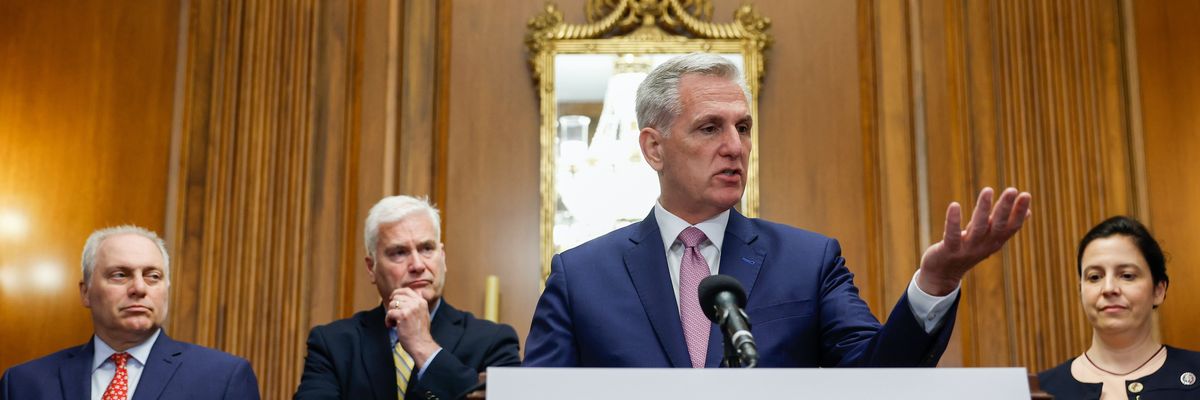
U.S. House Speaker Kevin McCarthy (R-Calif., center) speaks while Majority Leader Steve Scalise (R-La.; far left), Majority Whip Tom Emmer (R-Minn,; left of center), and GOP Conference Chair Elise Stefanik (R-N.Y.; right) look on during a July 14, 2023 press conference in Washington, D.C.
'Five-Alarm Fire': GOP Adds Over 200 Poison Pills to House Spending Bills
"We cannot allow policy that harms regular people, threatens our rights, hurts the environment, and does any number of other terrible things to ride along with the appropriations package," said Public Citizen's Lisa Gilbert.
A coalition of advocacy groups on Monday sounded the alarm on the more than 200 so-called "poison pill" riders attached by Republican U.S. lawmakers to House spending bills in recent weeks in a bid to block funding for a dizzying range of progressive policies and programs.
According to the Clean Budget Coalition—which is made up of nearly 260 advocacy groups—"at least 104 poison pill policy riders were added to appropriations bills drafted in the U.S. House over the past week."
"Prior to the July 4th recess, it took two months for House Republican appropriators to add more than 100 new poison pills to draft spending bills marked up in committee," the coalition noted. "In the past week alone, the previous total has doubled to more than 217."
"Most of these measures are special favors for big corporations and ideological extremists that have nothing to do with funding our government and could not become law on their own merits," the groups added. "Some of them attack women's health, some fuel political corruption, some harm our environment, and much more."
Some of the riders tracked by the Clean Budget Coalition include measures to block proposed transportation safety rules and prohibit funding for the World Health Organization, climate mitigation, gender equality programs, and criticial race theory education. Other riders target gas stove bans, funding for high-speed rail, pesticide warning labeling, wildlife protection, reproductive healthcare, and diversity, equity, and inclusion programs.
"The sheer volume of dangerous riders being included in these draft bills is an overreach and an emergency," Lisa Gilbert, executive vice president of the consumer advocacy group Public Citizen and co-chair of the Clean Budget Coalition, said in a statement.
"We cannot allow policy that harms regular people, threatens our rights, hurts the environment, and does any number of other terrible things to ride along with the appropriations package," Gilbert added. "We must put out this five-alarm fire by rejecting the inclusion of poison pills."
"The sheer volume of dangerous riders being included in these draft bills is an overreach and an emergency."
To that end, the Clean Budget Coalition is calling on lawmakers to "pass clean spending bills" by removing all poison pill riders and opposing passage of "any legislation that includes these unpopular and controversial special favors for big corporations and ideological extremists."
David Shadburn, senior government affairs advocate at the League of Conservation Voters—a Clean Budget Coalition member—said earlier this month that "House Republicans continue using the same tired playbook: They're hijacking must-pass bills with harmful poison pill riders that neither the public nor Congress support but benefit their polluter donors."
"Just as Republican leaders held the full faith and credit of the United States hostage to make it easier to pollute, now they are proposing riders to greenlight pipelines, block clean air and water regulations, stall clean energy deployment, and prohibit the federal government from addressing long-standing inequities," Shadburn added. "These must-pass spending bills are already loaded down with harmful poison pill riders that need to be removed—the last thing Congress should do is add more."
We are at a crossroads
This country and this world are at a monumental crossroads. In a few short weeks, US voters will have an opportunity to beat back the forces of fascism and confront the billionaires who are rigging the economy, our media system, and our democracy, making it increasingly impossible for ordinary people to get by. We’re not just talking about the election. We’re talking about what must be done once these fascist elements are vanquished from power. We need a bolder set of solutions than what either major party has so far been willing to offer and a working-class movement ready to fight like hell for it. Trump didn't emerge from nowhere. The conditions that fueled MAGA authoritarianism were created by decades of radical neoliberal economic policies and a corrupt political system dominated by corporate interests. They slashed taxes on the super-rich, promising that the benefits would trickle down. They said giveaways to the corporate titans would make life more affordable for the rest of us. It was all bullshit. And when a bitter, betrayed populace searches for someone to blame, right-wing demagogues have little trouble finding scapegoats. People know when they're being lied to, but you won't hear any of this from the corporate media. Only independent journalism—powered and funded by people who believe in building a better world—can deliver truly trustworthy daily news. Our Fall Campaign is underway, and we need your help. To power our newsroom through the rest of the year, we need to raise $125,000 by midnight on October 31. So if you share our vision, please contribute whatever you can to sustain our work. |
A coalition of advocacy groups on Monday sounded the alarm on the more than 200 so-called "poison pill" riders attached by Republican U.S. lawmakers to House spending bills in recent weeks in a bid to block funding for a dizzying range of progressive policies and programs.
According to the Clean Budget Coalition—which is made up of nearly 260 advocacy groups—"at least 104 poison pill policy riders were added to appropriations bills drafted in the U.S. House over the past week."
"Prior to the July 4th recess, it took two months for House Republican appropriators to add more than 100 new poison pills to draft spending bills marked up in committee," the coalition noted. "In the past week alone, the previous total has doubled to more than 217."
"Most of these measures are special favors for big corporations and ideological extremists that have nothing to do with funding our government and could not become law on their own merits," the groups added. "Some of them attack women's health, some fuel political corruption, some harm our environment, and much more."
Some of the riders tracked by the Clean Budget Coalition include measures to block proposed transportation safety rules and prohibit funding for the World Health Organization, climate mitigation, gender equality programs, and criticial race theory education. Other riders target gas stove bans, funding for high-speed rail, pesticide warning labeling, wildlife protection, reproductive healthcare, and diversity, equity, and inclusion programs.
"The sheer volume of dangerous riders being included in these draft bills is an overreach and an emergency," Lisa Gilbert, executive vice president of the consumer advocacy group Public Citizen and co-chair of the Clean Budget Coalition, said in a statement.
"We cannot allow policy that harms regular people, threatens our rights, hurts the environment, and does any number of other terrible things to ride along with the appropriations package," Gilbert added. "We must put out this five-alarm fire by rejecting the inclusion of poison pills."
"The sheer volume of dangerous riders being included in these draft bills is an overreach and an emergency."
To that end, the Clean Budget Coalition is calling on lawmakers to "pass clean spending bills" by removing all poison pill riders and opposing passage of "any legislation that includes these unpopular and controversial special favors for big corporations and ideological extremists."
David Shadburn, senior government affairs advocate at the League of Conservation Voters—a Clean Budget Coalition member—said earlier this month that "House Republicans continue using the same tired playbook: They're hijacking must-pass bills with harmful poison pill riders that neither the public nor Congress support but benefit their polluter donors."
"Just as Republican leaders held the full faith and credit of the United States hostage to make it easier to pollute, now they are proposing riders to greenlight pipelines, block clean air and water regulations, stall clean energy deployment, and prohibit the federal government from addressing long-standing inequities," Shadburn added. "These must-pass spending bills are already loaded down with harmful poison pill riders that need to be removed—the last thing Congress should do is add more."
- House Approps Republicans Pollute Annual Spending Bills with Attacks on Climate, Clean Energy, Water ›
- Opinion | The GOP’s Environmental Appropriations Bill Is a Major Giveaway to the Fossil Fuel Industry | Common Dreams ›
- 'Remove All of Them': House GOP Adds Dozens More Poison Pills to Spending Bill ›
- Coalition Spotlights Dangerous 'January 6th Riders' Crammed Into House Spending Bills ›
- House Freedom Caucus Threatens 'Reckless' Government Shutdown Unless Far-Right Demands Met ›
- Opinion | The Rich and Their Right-Wing Allies Have Poisoned America; We Hold the Antidote | Common Dreams ›
A coalition of advocacy groups on Monday sounded the alarm on the more than 200 so-called "poison pill" riders attached by Republican U.S. lawmakers to House spending bills in recent weeks in a bid to block funding for a dizzying range of progressive policies and programs.
According to the Clean Budget Coalition—which is made up of nearly 260 advocacy groups—"at least 104 poison pill policy riders were added to appropriations bills drafted in the U.S. House over the past week."
"Prior to the July 4th recess, it took two months for House Republican appropriators to add more than 100 new poison pills to draft spending bills marked up in committee," the coalition noted. "In the past week alone, the previous total has doubled to more than 217."
"Most of these measures are special favors for big corporations and ideological extremists that have nothing to do with funding our government and could not become law on their own merits," the groups added. "Some of them attack women's health, some fuel political corruption, some harm our environment, and much more."
Some of the riders tracked by the Clean Budget Coalition include measures to block proposed transportation safety rules and prohibit funding for the World Health Organization, climate mitigation, gender equality programs, and criticial race theory education. Other riders target gas stove bans, funding for high-speed rail, pesticide warning labeling, wildlife protection, reproductive healthcare, and diversity, equity, and inclusion programs.
"The sheer volume of dangerous riders being included in these draft bills is an overreach and an emergency," Lisa Gilbert, executive vice president of the consumer advocacy group Public Citizen and co-chair of the Clean Budget Coalition, said in a statement.
"We cannot allow policy that harms regular people, threatens our rights, hurts the environment, and does any number of other terrible things to ride along with the appropriations package," Gilbert added. "We must put out this five-alarm fire by rejecting the inclusion of poison pills."
"The sheer volume of dangerous riders being included in these draft bills is an overreach and an emergency."
To that end, the Clean Budget Coalition is calling on lawmakers to "pass clean spending bills" by removing all poison pill riders and opposing passage of "any legislation that includes these unpopular and controversial special favors for big corporations and ideological extremists."
David Shadburn, senior government affairs advocate at the League of Conservation Voters—a Clean Budget Coalition member—said earlier this month that "House Republicans continue using the same tired playbook: They're hijacking must-pass bills with harmful poison pill riders that neither the public nor Congress support but benefit their polluter donors."
"Just as Republican leaders held the full faith and credit of the United States hostage to make it easier to pollute, now they are proposing riders to greenlight pipelines, block clean air and water regulations, stall clean energy deployment, and prohibit the federal government from addressing long-standing inequities," Shadburn added. "These must-pass spending bills are already loaded down with harmful poison pill riders that need to be removed—the last thing Congress should do is add more."
- House Approps Republicans Pollute Annual Spending Bills with Attacks on Climate, Clean Energy, Water ›
- Opinion | The GOP’s Environmental Appropriations Bill Is a Major Giveaway to the Fossil Fuel Industry | Common Dreams ›
- 'Remove All of Them': House GOP Adds Dozens More Poison Pills to Spending Bill ›
- Coalition Spotlights Dangerous 'January 6th Riders' Crammed Into House Spending Bills ›
- House Freedom Caucus Threatens 'Reckless' Government Shutdown Unless Far-Right Demands Met ›
- Opinion | The Rich and Their Right-Wing Allies Have Poisoned America; We Hold the Antidote | Common Dreams ›