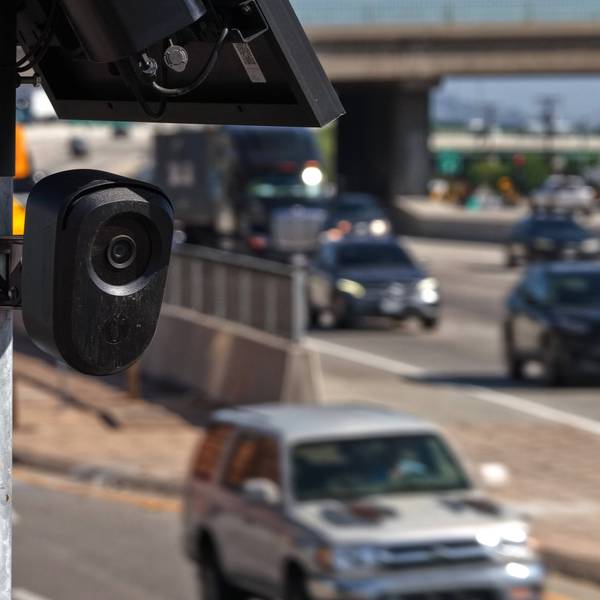
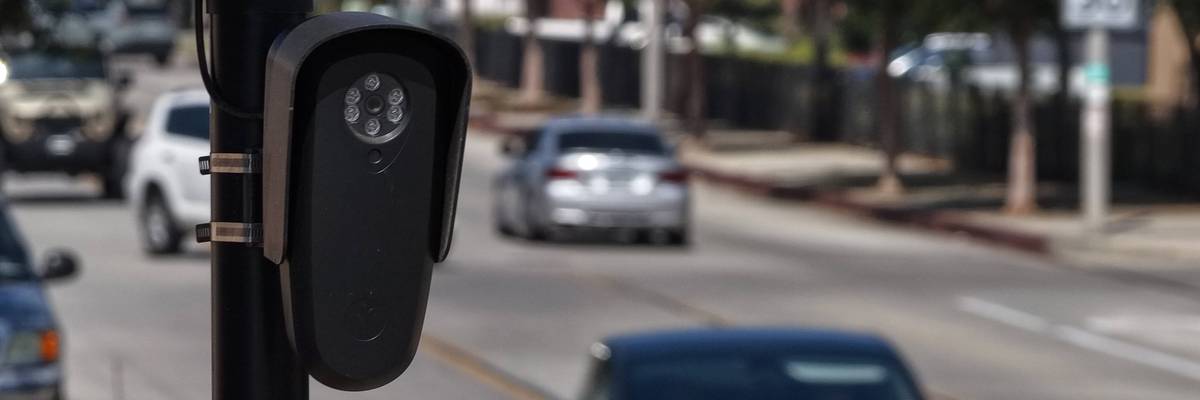
An aerial view of a Flock camera on September 14, 2026 in Burbank, California.
Tlaib Unveils Bill to Ban Federal Funding for Flock Cameras Amid 'Mass Surveillance Crisis'
“Flock’s technology isn’t making us safer," the Michigan congresswoman said. "Instead, it has been used to stalk people, misidentify and arrest innocent people, surveil protestors, and wrongfully record our neighbors."
Amid what she called a "mass surveillance crisis," US Rep. Rashida Tlaib announced legislation on Wednesday to ban the use of federal funds for powerful dragnet spying systems—including the automated license plate-reading cameras manufactured by Flock Safety.
Flock has quickly grown into a massive nationwide surveillance network with more than 120,000 of its artificial intelligence-powered cameras installed across 49 states, allowing law enforcement agencies to track and reconstruct Americans' movements, often without warrants.
While supporters describe Flock cameras as a tool to help police solve crimes, there is little evidence that they actually reduce it. There are also many documented cases of cops using the technology to stalk romantic partners, track women who've had abortions, monitor First Amendment-protected protests, and surveil people on behalf of US Immigration and Customs Enforcement (ICE) as part of its mass deportation push.
“Flock’s technology isn’t making us safer," Tlaib (D-Mich.) said in a statement on Wednesday. "Instead, it has been used to stalk people, misidentify and arrest innocent people, surveil protesters, and wrongfully record our neighbors. My bill would prevent our government on all levels from selling us out to Big Tech companies that trample our civil rights for profit.”
The bill, titled the Get the Flock Out of Our Communities Act, is co-sponsored by Reps. Sylvia Garcia (D-Texas), Summer Lee (D-Pa.), Ilhan Omar (D-Minn.), Delia Ramirez (D-Ill.), Nydia Velázquez (D-NY), and Bonnie Watson Coleman (D-NJ).
It is part of a growing wave of bipartisan efforts to restrict the use of Flock cameras and other surveillance tech. Reps. Thomas Massie (R-Ky.) and Greg Steube (R-Fla.), along with Rep. Alexandria Ocasio-Cortez, have introduced legislation to limit government use or funding of automated license plate readers, while Sen. Josh Hawley (R-Mo.) has proposed limits on data collection.
Tlaib's legislation would go further. Its restrictions would also extend beyond license plate readers to other "mass surveillance systems," such as those that employ facial recognition technology and biometric tracking.
It would not only prohibit federal, state, and local governments from using federal funds to purchase, operate, or access automated mass surveillance systems; it would also make state and local governments ineligible for certain federal law enforcement grants unless they stop operating or accessing mass surveillance networks that already exist.
Federal agencies would also be barred from using data derived from these systems, and they'd be required to delete certain data that has already been gathered.
The full extent to which Flock cameras are funded with federal dollars is unknown. But the company itself has identified several federal grant programs that local police departments can apply for to purchase the cameras.
"Federal funds should be used to invest in our communities in real safety solutions. We need good jobs, affordable homes, clean water, and reliable electricity. That’s what’s going to make us safer," Tlaib said at a news conference Wednesday. "Instead, our government is sacrificing our rights to big tech companies that care more about their profits, selling our data, than about our safety."
Tlaib's bill comes as backlash to Flock cameras grows around the country. A recent Data for Progress poll showed 52% of voters viewed Flock cameras unfavorably, while more than 200 cities and counties have canceled their contracts with the company.
“People everywhere are starting to recognize that conflating surveillance with safety makes communities less safe,” said Tawana Petty, a digital and data justice organizer from Detroit. “The persistent abuse of Flock cameras and other surveillance systems by law enforcement agencies across the United States, and the lack of transparency by the companies that market them, has caused an awakening among residents and city government agencies who are ridding themselves of the technologies."
We are at a crossroads
This country and this world are at a monumental crossroads. In a few short weeks, US voters will have an opportunity to beat back the forces of fascism and confront the billionaires who are rigging the economy, our media system, and our democracy, making it increasingly impossible for ordinary people to get by. We’re not just talking about the election. We’re talking about what must be done once these fascist elements are vanquished from power. We need a bolder set of solutions than what either major party has so far been willing to offer and a working-class movement ready to fight like hell for it. Trump didn't emerge from nowhere. The conditions that fueled MAGA authoritarianism were created by decades of radical neoliberal economic policies and a corrupt political system dominated by corporate interests. They slashed taxes on the super-rich, promising that the benefits would trickle down. They said giveaways to the corporate titans would make life more affordable for the rest of us. It was all bullshit. And when a bitter, betrayed populace searches for someone to blame, right-wing demagogues have little trouble finding scapegoats. People know when they're being lied to, but you won't hear any of this from the corporate media. Only independent journalism—powered and funded by people who believe in building a better world—can deliver truly trustworthy daily news. Our Fall Campaign is underway, and we need your help. To power our newsroom through the rest of the year, we need to raise $125,000 by midnight on October 31. So if you share our vision, please contribute whatever you can to sustain our work. |
Amid what she called a "mass surveillance crisis," US Rep. Rashida Tlaib announced legislation on Wednesday to ban the use of federal funds for powerful dragnet spying systems—including the automated license plate-reading cameras manufactured by Flock Safety.
Flock has quickly grown into a massive nationwide surveillance network with more than 120,000 of its artificial intelligence-powered cameras installed across 49 states, allowing law enforcement agencies to track and reconstruct Americans' movements, often without warrants.
While supporters describe Flock cameras as a tool to help police solve crimes, there is little evidence that they actually reduce it. There are also many documented cases of cops using the technology to stalk romantic partners, track women who've had abortions, monitor First Amendment-protected protests, and surveil people on behalf of US Immigration and Customs Enforcement (ICE) as part of its mass deportation push.
“Flock’s technology isn’t making us safer," Tlaib (D-Mich.) said in a statement on Wednesday. "Instead, it has been used to stalk people, misidentify and arrest innocent people, surveil protesters, and wrongfully record our neighbors. My bill would prevent our government on all levels from selling us out to Big Tech companies that trample our civil rights for profit.”
The bill, titled the Get the Flock Out of Our Communities Act, is co-sponsored by Reps. Sylvia Garcia (D-Texas), Summer Lee (D-Pa.), Ilhan Omar (D-Minn.), Delia Ramirez (D-Ill.), Nydia Velázquez (D-NY), and Bonnie Watson Coleman (D-NJ).
It is part of a growing wave of bipartisan efforts to restrict the use of Flock cameras and other surveillance tech. Reps. Thomas Massie (R-Ky.) and Greg Steube (R-Fla.), along with Rep. Alexandria Ocasio-Cortez, have introduced legislation to limit government use or funding of automated license plate readers, while Sen. Josh Hawley (R-Mo.) has proposed limits on data collection.
Tlaib's legislation would go further. Its restrictions would also extend beyond license plate readers to other "mass surveillance systems," such as those that employ facial recognition technology and biometric tracking.
It would not only prohibit federal, state, and local governments from using federal funds to purchase, operate, or access automated mass surveillance systems; it would also make state and local governments ineligible for certain federal law enforcement grants unless they stop operating or accessing mass surveillance networks that already exist.
Federal agencies would also be barred from using data derived from these systems, and they'd be required to delete certain data that has already been gathered.
The full extent to which Flock cameras are funded with federal dollars is unknown. But the company itself has identified several federal grant programs that local police departments can apply for to purchase the cameras.
"Federal funds should be used to invest in our communities in real safety solutions. We need good jobs, affordable homes, clean water, and reliable electricity. That’s what’s going to make us safer," Tlaib said at a news conference Wednesday. "Instead, our government is sacrificing our rights to big tech companies that care more about their profits, selling our data, than about our safety."
Tlaib's bill comes as backlash to Flock cameras grows around the country. A recent Data for Progress poll showed 52% of voters viewed Flock cameras unfavorably, while more than 200 cities and counties have canceled their contracts with the company.
“People everywhere are starting to recognize that conflating surveillance with safety makes communities less safe,” said Tawana Petty, a digital and data justice organizer from Detroit. “The persistent abuse of Flock cameras and other surveillance systems by law enforcement agencies across the United States, and the lack of transparency by the companies that market them, has caused an awakening among residents and city government agencies who are ridding themselves of the technologies."