SUBSCRIBE TO OUR FREE NEWSLETTER
Daily news & progressive opinion—funded by the people, not the corporations—delivered straight to your inbox.
5
#000000
#FFFFFF
To donate by check, phone, or other method, see our More Ways to Give page.
Daily news & progressive opinion—funded by the people, not the corporations—delivered straight to your inbox.
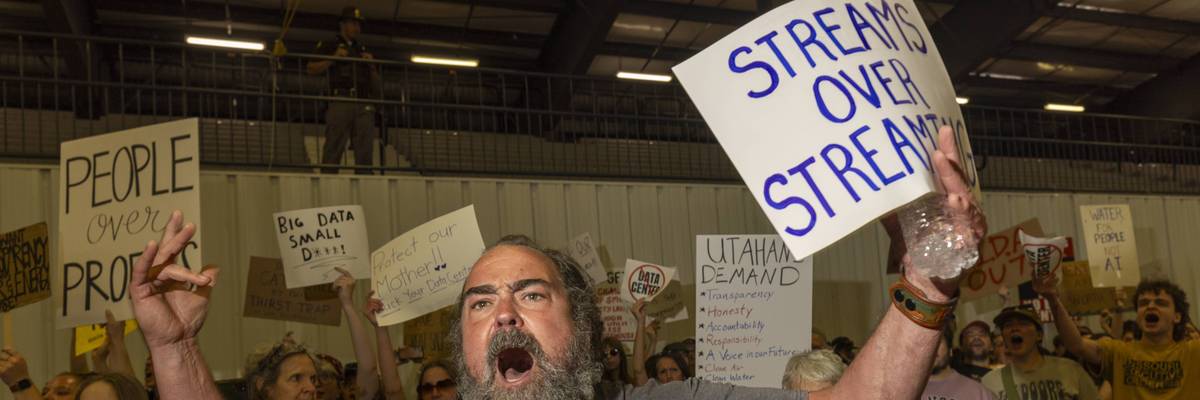
Michael Smith from Beaver Dam, Utah reacts as the Box Elder County Commission announces approval of a large data center near the north shore of the Great Salt Lake, in Tremonton, Utah, on May 4, 2026.
One expert asserted that "the tax breaks are a windfall rewarding Big Tech companies for building what they would build anyway."
The Trump administration is considering construction of at least a dozen artificial intelligence data centers on thousands of acres of public land across six Western states, reporting revealed Friday, while a separate analysis found that Big Tech is receiving tens of billions of dollars in tax breaks for AI investments they were already likely to make.
The US Bureau of Land Management (BLM) is reviewing proposals for at least 12 data centers and related infrastructure projects on 17,600 acres of public land across Arizona, Idaho, Nevada, Oregon, Utah, and Wyoming, according to an investigation published Friday by The Washington Sun's Mara Hoplamazian and Jade Lozada. Many of the proposals had not previously been publicly reported.
The Sun's report came on the heels of an Institute on Taxation and Economic Policy (ITEP) analysis published Thursday that found that five major technology companies—Amazon, Alphabet, Meta, Microsoft, and Oracle—received approximately $70 billion in federal tax breaks in 2025.
The Trump administration is considering proposals for at least 12 data centers and data center-related infrastructure projects to be built on federal public lands — far more than previously known.
[image or embed]
— The Washington Sun (@washingtonsun.bsky.social) September 18, 2026 at 4:00 AM
Matthew Gardner, who authored the ITEP analysis, wrote that "AI leaders have acknowledged that the demand from other companies for data centers is 'insatiable,' suggesting that the tax breaks are a windfall rewarding Big Tech companies for building what they would build anyway."
According to Gardner:
Few investments in the American economy look less in need of encouragement right now than the hundreds of billions of dollars the world’s largest technology companies are already racing to spend on AI. And it’s hard to think of an investment that American taxpayers value less: Polling shows that Americans dislike data centers, distrust AI, and are concerned about the economic and environmental effects it may bring.
At the same time, Interior Secretary Doug Burgum has directed BLM officials to identify federal lands "ripe for data center development," according to the Sun. State BLM officials were reportedly given only three days to compile lists, with the effort described as a "top priority."
Burgum has also been meeting with Big Tech executives about accelerating data center development, an effort stemming from an executive order President Donald Trump signed in July 2025 directing the federal government to identify lands that could be used for data centers.
Mary Jo Rugwell, president of the Public Lands Foundation—a nonprofit advocacy group—and a former BLM state director, recently accused the Trump administration of “bending [the] knee to the tech oligarchs and letting them do whatever they need to do” without adequate consideration for the impact of data centers on public lands.
Environmentalists warn that building on public land would help tech companies skirt growing public opposition to data centers, which is increasingly transcending the political divide. It would also have outsized consequences for Western states where public lands comprise a disproportionate share of total land area.
“In Oregon, this would be a really bad precedent,” Ben Brint , the senior climate program director at the Oregon Environmental Council, told the Sun. “Some very large percentage of the state is public lands, and if we’re starting to allow that, that’s large swaths of the state that really could be at risk of further development.”
This country and this world are at a monumental crossroads. US voters have an opportunity to beat back the forces of fascism and confront the billionaires who are rigging the economy, our media system, and our democracy, making it increasingly impossible for ordinary people to get by. We’re not just talking about the election. We’re talking about what must be done once these fascist elements are vanquished from power. We need a bolder set of solutions than what either major party has so far been willing to offer and a working-class movement ready to fight like hell for it. Trump didn't emerge from nowhere. The conditions that fueled MAGA authoritarianism were created by decades of radical neoliberal economic policies and a corrupt political system dominated by corporate interests. They slashed taxes on the super-rich, promising that the benefits would trickle down. They said giveaways to the corporate titans would make life more affordable for the rest of us. It was all bullshit. And when a bitter, betrayed populace searches for someone to blame, right-wing demagogues have little trouble finding scapegoats. People know when they're being lied to, but you won't hear any of this from the corporate media. Only independent journalism—powered and funded by people who believe in building a better world—can deliver truly trustworthy daily news. If you share our vision, please contribute whatever you can to sustain our work. |
The Trump administration is considering construction of at least a dozen artificial intelligence data centers on thousands of acres of public land across six Western states, reporting revealed Friday, while a separate analysis found that Big Tech is receiving tens of billions of dollars in tax breaks for AI investments they were already likely to make.
The US Bureau of Land Management (BLM) is reviewing proposals for at least 12 data centers and related infrastructure projects on 17,600 acres of public land across Arizona, Idaho, Nevada, Oregon, Utah, and Wyoming, according to an investigation published Friday by The Washington Sun's Mara Hoplamazian and Jade Lozada. Many of the proposals had not previously been publicly reported.
The Sun's report came on the heels of an Institute on Taxation and Economic Policy (ITEP) analysis published Thursday that found that five major technology companies—Amazon, Alphabet, Meta, Microsoft, and Oracle—received approximately $70 billion in federal tax breaks in 2025.
The Trump administration is considering proposals for at least 12 data centers and data center-related infrastructure projects to be built on federal public lands — far more than previously known.
[image or embed]
— The Washington Sun (@washingtonsun.bsky.social) September 18, 2026 at 4:00 AM
Matthew Gardner, who authored the ITEP analysis, wrote that "AI leaders have acknowledged that the demand from other companies for data centers is 'insatiable,' suggesting that the tax breaks are a windfall rewarding Big Tech companies for building what they would build anyway."
According to Gardner:
Few investments in the American economy look less in need of encouragement right now than the hundreds of billions of dollars the world’s largest technology companies are already racing to spend on AI. And it’s hard to think of an investment that American taxpayers value less: Polling shows that Americans dislike data centers, distrust AI, and are concerned about the economic and environmental effects it may bring.
At the same time, Interior Secretary Doug Burgum has directed BLM officials to identify federal lands "ripe for data center development," according to the Sun. State BLM officials were reportedly given only three days to compile lists, with the effort described as a "top priority."
Burgum has also been meeting with Big Tech executives about accelerating data center development, an effort stemming from an executive order President Donald Trump signed in July 2025 directing the federal government to identify lands that could be used for data centers.
Mary Jo Rugwell, president of the Public Lands Foundation—a nonprofit advocacy group—and a former BLM state director, recently accused the Trump administration of “bending [the] knee to the tech oligarchs and letting them do whatever they need to do” without adequate consideration for the impact of data centers on public lands.
Environmentalists warn that building on public land would help tech companies skirt growing public opposition to data centers, which is increasingly transcending the political divide. It would also have outsized consequences for Western states where public lands comprise a disproportionate share of total land area.
“In Oregon, this would be a really bad precedent,” Ben Brint , the senior climate program director at the Oregon Environmental Council, told the Sun. “Some very large percentage of the state is public lands, and if we’re starting to allow that, that’s large swaths of the state that really could be at risk of further development.”