SUBSCRIBE TO OUR FREE NEWSLETTER
Daily news & progressive opinion—funded by the people, not the corporations—delivered straight to your inbox.
5
#000000
#FFFFFF
To donate by check, phone, or other method, see our More Ways to Give page.
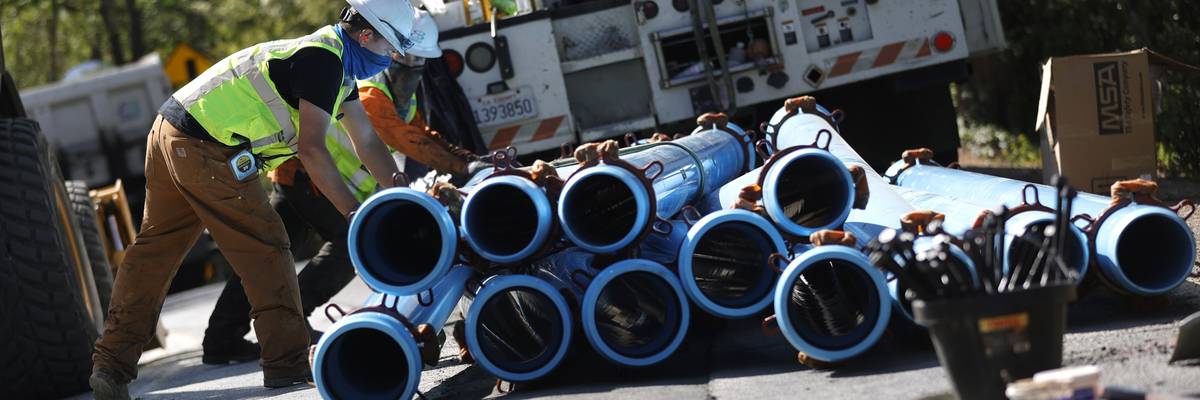
A report published Tuesday by a leading environmental group shows that household drinking water bills in the United States have surged faster than inflation over the past decade, with privatized systems charging significantly more than public ones.
The new research, conducted by Food & Water Watch (FWW), shows that for-profit water corporations charged typical US households 67% more on average than publicly owned water systems, prompting the group to urge state and local governments to ban water privatization and roll back all pro-privatization bills.
“Rampant corporate control of our water systems and federal disinvestment in aging infrastructure are driving up bills, forcing households to pick up the tab," said Mary Grant, FWW's water policy director. "Policymakers must rein in corporate abuses, hold polluters accountable, and provide dedicated funding for water systems. Everyone should have access to safe and affordable water."
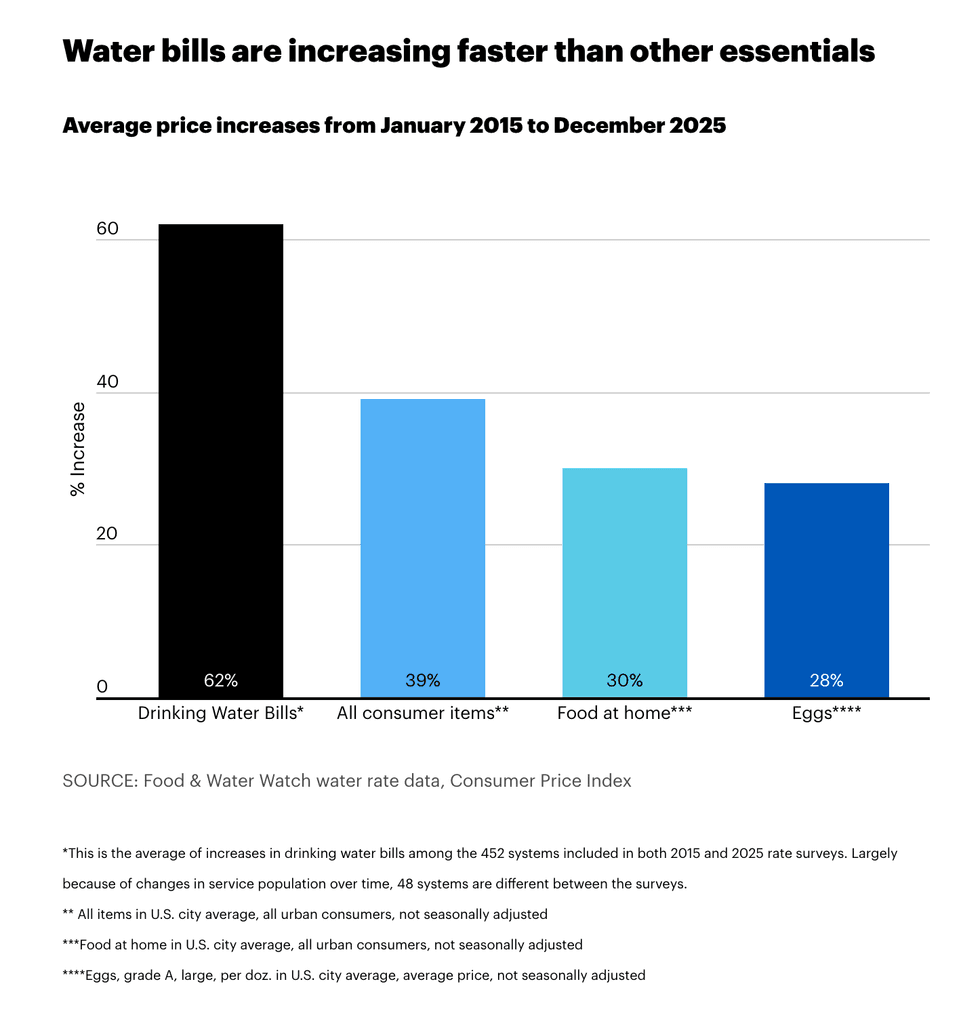
The report shows that, overall, household drinking water bills surged by an average of 62% for typical American households over the past decade—increasing twice as much as grocery prices and 19% faster than median household incomes on average.
"A water affordability crisis is rapidly expanding throughout America," said Grant. "While struggling to pay for other essentials like food and energy, many households are grappling with water costs that are rising even faster."
More than half of the 25 most expensive water systems in the US were located in California. The most expensive water bills in the country between 2015 and 2025 were issued by San Jose Water Company, a private utility.
"In the list of the top 10 most expensive water systems in the study, California and Pennsylvania stood out with numerous appearances," FWW said. "However, in Louisiana, Maryland, New Hampshire, and West Virginia, water bills grew about twice as fast as their corresponding statewide median household incomes. West Virginia, a state with one of the lowest average household incomes in the country, had the highest average water cost, at $1,383/year."
"Overall," the group added, "water bills were unaffordable for low-income households in nearly all (93%) of the surveyed water systems."
In addition to calling on state and local governments to ban water privatization and support local control of water systems, FWW urged the US Congress and federal government to:
"Water bills will continue to increase faster than households can keep up with," FWW warned, "unless all levels of government take action to stop corporate abuses and support water affordability."
A report published Tuesday by a leading environmental group shows that household drinking water bills in the United States have surged faster than inflation over the past decade, with privatized systems charging significantly more than public ones.
The new research, conducted by Food & Water Watch (FWW), shows that for-profit water corporations charged typical US households 67% more on average than publicly owned water systems, prompting the group to urge state and local governments to ban water privatization and roll back all pro-privatization bills.
“Rampant corporate control of our water systems and federal disinvestment in aging infrastructure are driving up bills, forcing households to pick up the tab," said Mary Grant, FWW's water policy director. "Policymakers must rein in corporate abuses, hold polluters accountable, and provide dedicated funding for water systems. Everyone should have access to safe and affordable water."
The report shows that, overall, household drinking water bills surged by an average of 62% for typical American households over the past decade—increasing twice as much as grocery prices and 19% faster than median household incomes on average.
"A water affordability crisis is rapidly expanding throughout America," said Grant. "While struggling to pay for other essentials like food and energy, many households are grappling with water costs that are rising even faster."
More than half of the 25 most expensive water systems in the US were located in California. The most expensive water bills in the country between 2015 and 2025 were issued by San Jose Water Company, a private utility.
"In the list of the top 10 most expensive water systems in the study, California and Pennsylvania stood out with numerous appearances," FWW said. "However, in Louisiana, Maryland, New Hampshire, and West Virginia, water bills grew about twice as fast as their corresponding statewide median household incomes. West Virginia, a state with one of the lowest average household incomes in the country, had the highest average water cost, at $1,383/year."
"Overall," the group added, "water bills were unaffordable for low-income households in nearly all (93%) of the surveyed water systems."
In addition to calling on state and local governments to ban water privatization and support local control of water systems, FWW urged the US Congress and federal government to:
"Water bills will continue to increase faster than households can keep up with," FWW warned, "unless all levels of government take action to stop corporate abuses and support water affordability."
A report published Tuesday by a leading environmental group shows that household drinking water bills in the United States have surged faster than inflation over the past decade, with privatized systems charging significantly more than public ones.
The new research, conducted by Food & Water Watch (FWW), shows that for-profit water corporations charged typical US households 67% more on average than publicly owned water systems, prompting the group to urge state and local governments to ban water privatization and roll back all pro-privatization bills.
“Rampant corporate control of our water systems and federal disinvestment in aging infrastructure are driving up bills, forcing households to pick up the tab," said Mary Grant, FWW's water policy director. "Policymakers must rein in corporate abuses, hold polluters accountable, and provide dedicated funding for water systems. Everyone should have access to safe and affordable water."
The report shows that, overall, household drinking water bills surged by an average of 62% for typical American households over the past decade—increasing twice as much as grocery prices and 19% faster than median household incomes on average.
"A water affordability crisis is rapidly expanding throughout America," said Grant. "While struggling to pay for other essentials like food and energy, many households are grappling with water costs that are rising even faster."
More than half of the 25 most expensive water systems in the US were located in California. The most expensive water bills in the country between 2015 and 2025 were issued by San Jose Water Company, a private utility.
"In the list of the top 10 most expensive water systems in the study, California and Pennsylvania stood out with numerous appearances," FWW said. "However, in Louisiana, Maryland, New Hampshire, and West Virginia, water bills grew about twice as fast as their corresponding statewide median household incomes. West Virginia, a state with one of the lowest average household incomes in the country, had the highest average water cost, at $1,383/year."
"Overall," the group added, "water bills were unaffordable for low-income households in nearly all (93%) of the surveyed water systems."
In addition to calling on state and local governments to ban water privatization and support local control of water systems, FWW urged the US Congress and federal government to:
"Water bills will continue to increase faster than households can keep up with," FWW warned, "unless all levels of government take action to stop corporate abuses and support water affordability."