

SUBSCRIBE TO OUR FREE NEWSLETTER
Daily news & progressive opinion—funded by the people, not the corporations—delivered straight to your inbox.
5
#000000
#FFFFFF
To donate by check, phone, or other method, see our More Ways to Give page.
Daily news & progressive opinion—funded by the people, not the corporations—delivered straight to your inbox.

Jenn Ettinger, 202-265-1490 x 35
On Thursday, the Federal Communications Commission approved a Notice of Proposed Rulemaking on "bill shock" -- the unexpectedly high cell phone bills that occur when subscribers unknowingly exceed their monthly allowance for calls, text or data.
Free Press Political Adviser Joel Kelsey made the following statement:
On Thursday, the Federal Communications Commission approved a Notice of Proposed Rulemaking on "bill shock" -- the unexpectedly high cell phone bills that occur when subscribers unknowingly exceed their monthly allowance for calls, text or data.
Free Press Political Adviser Joel Kelsey made the following statement:
"This is just the beginning of a process to write overdue rules for the wireless market. The FCC's proposal is a good start, but it needs to follow through by enacting rules that protect consumers from deceptive billing practices and that promote transparency and disclosure by mobile providers.
"For consumers to truly be empowered, they also need the ability to act based on the information carriers will be required to disclose. Subscribers should be able to change providers easily when they feel mistreated or wrongly billed.
"We also encourage the Commission to examine handset exclusivity agreements, which tie mobile phones -- and subscribers -- to one carrier, and to look into early termination fees incurred when subscribers choose to end their contracts early.
"Mobile subscribers should be adequately informed about their plans, receive alerts when they are nearing their usage limits, and, ultimately, be allowed to change carriers if they are subjected to unfair practices. Real competition in the wireless market is fostered by consumer choice, and putting an end to bill shock is just one way of improving the outlook for mobile users."
Free Press was created to give people a voice in the crucial decisions that shape our media. We believe that positive social change, racial justice and meaningful engagement in public life require equitable access to technology, diverse and independent ownership of media platforms, and journalism that holds leaders accountable and tells people what's actually happening in their communities.
(202) 265-1490
The pediatrician and hospital director—who is reportedly being held in solitary confinement—called his imprisonment "unjust and arbitrary."
Showing signs of the "severe torture" he has allegedly endured at the hands of his Israeli captors over 530 days of detention without charge, Palestinian physician and Gaza hospital director Dr. Hussam Abu Safiya appeared remotely before the Israel's Supreme Court on Wednesday to demand his freedom.
“My detention is unjust and arbitrary, and I demand my immediate release,” Abu Safia—who appeared to have lost considerable weight—told the court through his defense attorney, Nasser Abu Odeh. “I am a pediatrician who provides medical services and care to patients, the wounded and vulnerable people in the Gaza Strip.”
Abu Safiya's son, Ilyas Abu Safiya, spoke with Al Jazeera after the hearing, telling the Qatar-owned network, “When we saw his latest image, we received it with shock, with tears, and with weeping."
“We did not only see the face of a father we have missed for many long months, we saw the marks of torture, pain, and exhaustion clearly etched on his face."
Abu Safiya lost his mother to a fatal heart attack during his imprisonment, and his 15-year-old son Ibrahim Hussam Idris Abu Safiya was killed in an October 2024 drone strike.
Israeli troops detained Abu Safiya—now 52 years old—on December 28, 2024 amid a prolonged siege and assault on Kamal Adwan Hospital in Beit Lahia, where he served as director. Abu Safiya defied an Israeli forced displacement order and refused to evacuate the facility as long as patients were still being treated.
Israel accuses Abu Safiya of being affiliated with Hamas, whose armed wing led the October 7, 2023 attack, and whose political division governs Gaza. Specifically, Israel claims the doctor is an officer in Hamas' Military Medical Services.
However, Israel has produced no verifiable evidence supporting its claims.
Former inmates at the notorious Sde Teiman torture prison in southern Israel's Negev Desert said they saw Abu Safiya there. According to testimonies gathered by the Geneva-based Euro-Mediterranean Human Rights Monitor, the physician was tortured before his arrival at Sde Teiman and inside the prison.
Abu Safiya was subsequently transferred to Ofer Prison in the illegally occupied West Bank, where another renowned Gaza physician, Dr. Adnan al-Bursh, died after reportedly enduring torture. United Nationsa Palestine expert Francesca Albanese cited reports that al-Bursh was “likely raped to death."
Israeli courts have repeatedly extended Abu Safiya's detention, most recently in late April. Last week, the advocacy group Physicians for Human Rights Israel (PHRI) said that Abu Safiya was moved to solitary confinement in Nafha Prison, also in the Negev, reportedly in retaliation for appealing his imprisonment.
“Dr. Hussam remains in solitary confinement in Nafha Prison. He appeared in court via screen, handcuffed and shackled; the court refused to remove the shackles,” Abu Odeh told Al Jazeera on Thursday.
"He has not received medical treatment or the medications he requires for his chronic illness," the attorney said of his client. "He continues to suffer from severe back and neck pain following an assault, and is experiencing vision problems after his glasses were confiscated and have not yet been returned.”
PHRI has repeatedly demanded the release not only of Abu Safiya but of more than a dozen other Palestinian doctors and hundreds of medical professionals jailed by Israel.
"Since the start of the genocide in Gaza, Israel has arrested hundreds of essential medical workers, effectively paralyzing an already fragile healthcare system under constant destruction," the group recently said. "These arrests have removed critical, highly trained individuals from their roles at a time when their expertise is most urgently needed. Dozens of these medical workers remain detained without due process as of today, many held for prolonged periods."
PHRI "calls for the immediate cancellation of these detention orders and urges both national and international actors to take action in solidarity, enabling these physicians to return home and resume their lifesaving duties."
A UN commission concluded in 2024 that “Israel has perpetrated a concerted policy to destroy Gaza’s healthcare system as part of a broader assault on Gaza" that has left more than 250,000 Palestinians dead, maimed, or missing. The UN experts further accused Israel of "committing war crimes and the crime against humanity of extermination with relentless and deliberate attacks on medical personnel and facilities.”
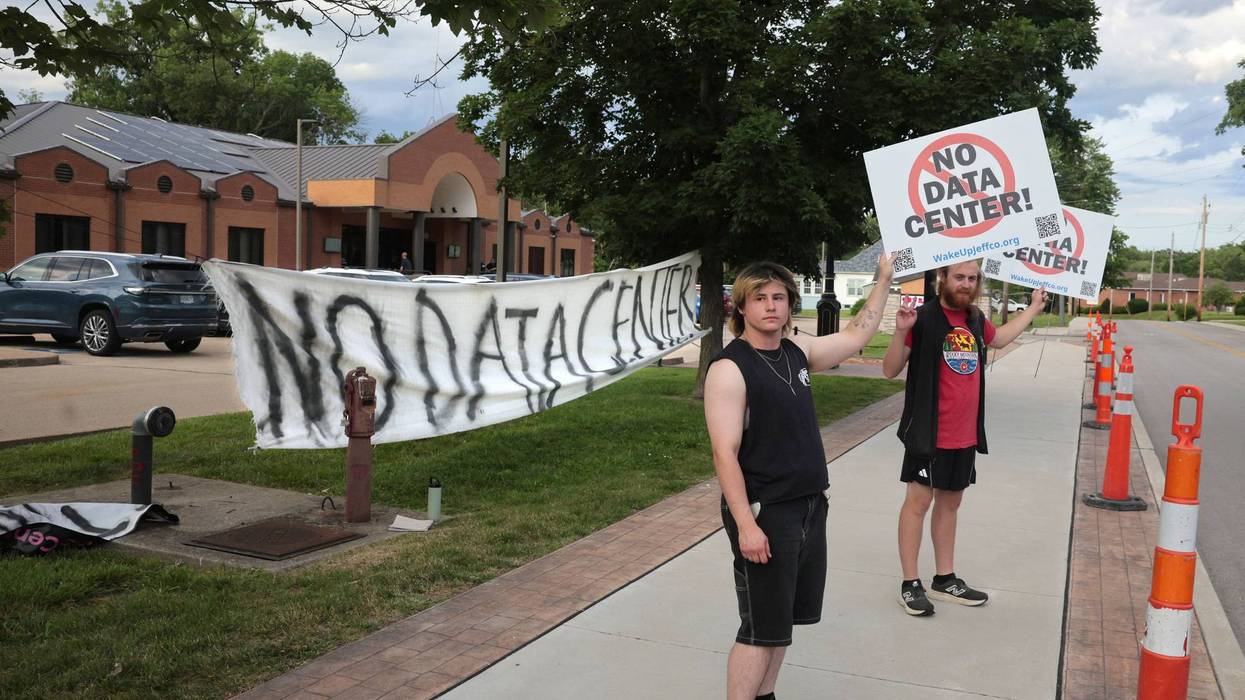
The coalition called for a nationwide ban "until adequate regulations can be enacted to fully protect our communities, our families, our environment, and our health from the runaway damage this industry is already inflicting."
Over 500 organizations representing millions of people across the United States wrote to Congress on Thursday to call for "a national moratorium on the approval and construction of new data centers," warning that "the rapid, largely unregulated rise" of such projects already threatens "Americans' economic, environmental, climate, and water security."
"The rapid expansion of data centers across the United States, driven by the generative artificial intelligence (AI) and crypto boom, presents one of the biggest environmental and social threats of our generation," the groups wrote. "This expansion is rapidly increasing demand for energy, driving more fossil fuel pollution, straining water resources, and raising electricity prices across the country."
"All this compounds the significant and concerning impacts AI is having on society, including lost jobs, social instability, and economic concentration," the letter notes. "We urge you to join our call for a national moratorium on new data centers until adequate regulations can be enacted to fully protect our communities, our families, our environment, and our health from the runaway damage this industry is already inflicting."
While the letter doesn't name any specific legislation, it came just a few months after a pair of progressive powerhouses, Sen. Bernie Sanders (I-Vt.) and Rep. Alexandria Ocasio-Cortez (D-NY), announced the Artificial Intelligence Data Center Moratorium Act, a first-of-its-kind federal bill that would prohibit new construction until a range of safeguards are in place.
Thursday's letter was facilitated by the advocacy group Food & Water Watch (FWW)—a key backer of that bill—and signed by hundreds of other national, regional, and state organizations, including Americans for Financial Reform, Center for Constitutional Rights, Center for Food Safety, Friends of the Earth, Greenpeace USA, Honor the Earth, Oil Change International, Our Revolution, People's Action Institute, Popular Democracy, Third Act, Women's Earth and Climate Action Network, and more.
"The large and surging national movement to rein in runaway data center build-out was born at the grassroots level, with concerned residents in countless communities across the country reacting to the real harms and hazards this industry brings wherever it lands," said FWW organizing director Emily Wurth in a statement. "We are following their lead, working at the local, state, and federal levels to support these fights and halt Big Tech in its tracks."
In addition to unveiling the letter to Congress on Thursday, the groups announced the Stop Data Centers Coalition. Wurth declared that "the time is right for a national coalition to lift up state and local fights, and drive a national agenda that will allow stakeholders to properly consider not how, but if this industry can operate in a responsible, sustainable manner."
📣 BIG NEWS 📣 Today we’re launching the Stop Data Centers Coalition – a group of advocacy organizations fighting Big Tech’s unregulated data center frenzy. Learn more about the coalition, explore helpful resources and learn how you can plug in here: https://fwwat.ch/datacentercoalition
[image or embed]
— Food & Water Watch (@foodandwater.bsky.social) June 11, 2026 at 11:30 AM
Paco Fabián, deputy director at Our Revolution, said that his organization "is proud to help launch this coalition because a moratorium is necessary to ensure transparency, accountability, and community input before more energy-intensive projects move forward and lock us into decades of higher costs and greater climate risks."
The coalition and letter announcements followed US Environmental Protection Agency Administrator (EPA) Lee Zeldin's saying at the Politico Energy Summit on Wednesday that he would not set national requirements for data centers.
"Ten times out of 10, I'm not going to sit inside of an agency building in Washington, DC, and that we say that we know that local community in Georgia or Florida or Arizona or elsewhere, better than everyone there locally," Zeldin said, as polling demonstrates the unpopularity of data centers and people in communities across the country—including from Monterey Park, California and Seattle, Washington just this month—come together to block new projects.
Responding to Zeldin's remarks, Clara Vondrich, senior policy counsel with Public Citizen's Climate Program, said in a statement that he "just gave Big Tech the green light to build data centers that will consume massive amounts of power and water without any enforcement by the EPA. He says he won't meddle in community affairs, but his inaction dooms communities to higher asthma rates, noise and light pollution, and new fossil fuel infrastructure the climate can't afford."
"Once again, the administration is dangerously out of touch with the needs and wants of the American people: A majority of registered voters oppose building data centers in their local area, and 6 in 10 think that if a data center opened in their local area, their electricity bills would increase," Vondrich continued. "Yet the administration insists on enabling Big Tech companies in the race to be first and fastest, cosigning their reckless build-out of behemoth AI data centers with a combination of gas, diesel, and even coal."
"Zeldin is right that we should follow what communities want. And that's clear: no dirty data centers near their homes, schools, parks, and playgrounds," she added. "Big Tech executives have lobbied hard to ingratiate themselves into the Trump administration's orbit... Zeldin made clear that their investment was money well spent."
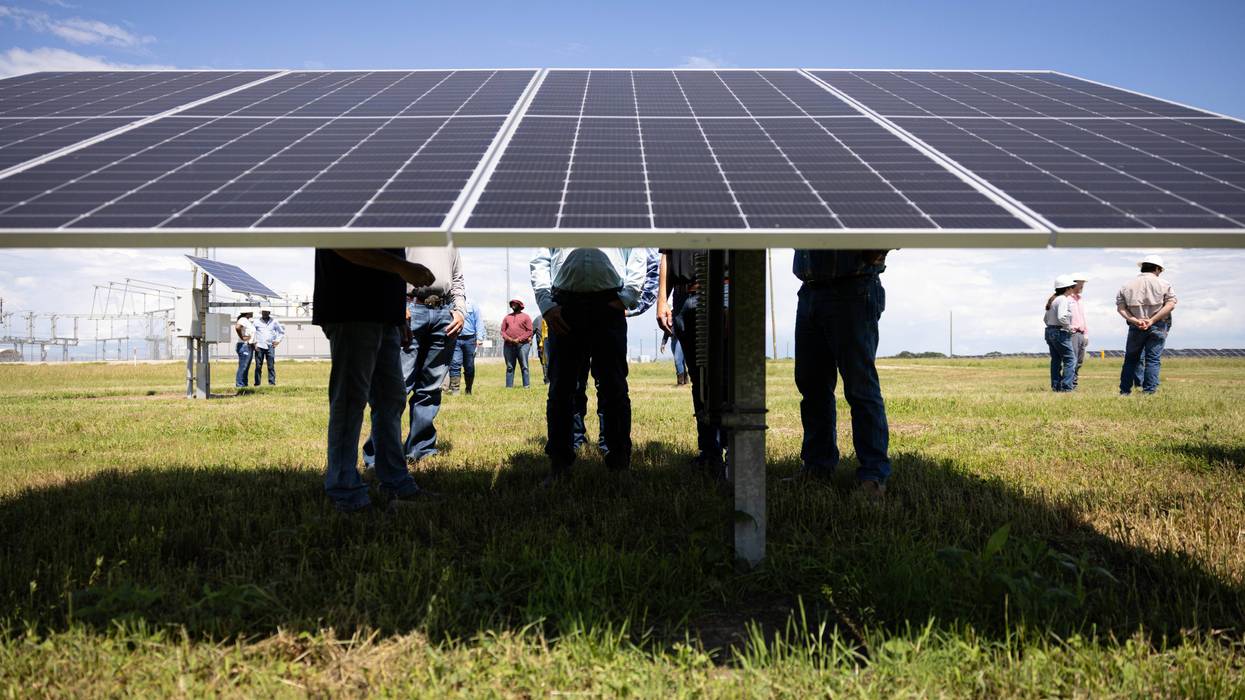
"Solar is cheaper, cleaner, more reliable," said Rep. Jared Huffman. "Trump needs to end his war on clean energy and get on board with what’s best for America."
Since taking office 16 months ago, President Donald Trump has gone to extreme lengths to try to reverse the undeniable trend in the direction of solar power and away from expensive, planet-heating coal—but two new reports reveal how, despite Trump's relentless efforts, Americans are using renewable solar energy to power their homes and businesses more than ever.
The global energy think tank Ember revealed Wednesday that in May, for the first ever, solar supplied more of the United States' electricity than coal, at 12.8%. Coal dropped to its fourth-lowest point last month, delivering just 12.2% of electricity. Solar also became the third-largest source of electricity in May, behind gas and nuclear power.
The previous month, coal hit an all-time low, according to data from the US Energy Information Administration analyzed by Ember.
Another report from the Solar Energy Industries Association (SEIA) and the analytics firm Wood Mackenzie found that solar and battery storage accounted for 91% of all new energy generation capacity in the first quarter of 2026.
The news comes a week after Trump announced $700 million in new funding for the nation's coal industry, some of which is planned for the building of two brand-new coal-fired plants, which would be the first to be built in the US in 13 years.
US Rep. Jared Huffman (D-Calif.) compared Trump's latest effort to "lighting $700 million taxpayer dollars on fire," but emphasized that "the proof is there."
"Solar is cheaper, cleaner, more reliable," he said. "Trump needs to end his war on clean energy and get on board with what’s best for America."
Last week's announcement is one of numerous steps Trump has taken to prop up coal, one of the fossil fuels that scientists warn are heating the planet and increasingly causing destructive extreme weather events.
In February the president ordered the Pentagon to sign taxpayer-funded contracts with coal plants that otherwise would have been retired in the coming years, to provide electricity to military installations.
The Department of Energy also pledged $625 million to "expand and reinvigorate America’s coal industry," an effort that has run into opposition even from the industry itself. In Colorado, two utilities, Tri-State Generation and Transmission Association and the Platte River Power Authority, which co-own a coal-fired plant the administration has demanded stay in operation, filed a petition earlier this year asking the DOE to allow them to close the facility, saying they've built solar and wind farms and that being forced to buy coal and maintain the plant amounts to a violation of the US Constitution's takings clause.
While demanding that coal production continues, Trump has taken direct aim at the booming solar industry—canceling projects and terminating $7 billion in funding for an affordable renewable energy program.
On the online news show "Breaking Points," Ryan Grim noted that solar and wind power surged in the first quarter before Trump joined Israel in waging war on Iran, a decision that sent oil prices skyrocketing.
"I would imagine the second quarter is going to see 98%" of energy generating capacity coming from solar power, said Grim.
Despite the political attacks and regulatory slowdowns... solar and storage were still 91% of all new grid capacity added in Q1.
Why? "Because solar is cheaper."
Breaking Point's @RyanGrim and @emilyjashinsky explain👇 pic.twitter.com/lhppEVqAR1
— Solar and Storage Industry (@SEIA) June 11, 2026
"Who out there is like, 'You know, what we need to do is invest deeply in building out our fossil fuel infrastructure' at this point?" he said.