

SUBSCRIBE TO OUR FREE NEWSLETTER
Daily news & progressive opinion—funded by the people, not the corporations—delivered straight to your inbox.
5
#000000
#FFFFFF
To donate by check, phone, or other method, see our More Ways to Give page.
Daily news & progressive opinion—funded by the people, not the corporations—delivered straight to your inbox.
The NOSB, intended to safeguard the integrity of the organic food label, was created by Congress with independent authorities that operate outside the discretion of the U.S. Department of Agriculture (USDA). Petitioners maintain that in renewing the charter under the Federal Advisory Committee Act (FACA), USDA mistakenly re-categorized the NOSB as a time-limited Advisory Board subject to USDA's discretion and a narrowing of responsibilities.
"These changes to the NOSB Charter are significant and directly controvert the specific mandates of OFPA and Congress that NOSB is a permanent, non-discretionary committee that must fulfill a long list of statutorily mandated duties integral to the organic program," said Aimee Simpson policy director and staff attorney for Beyond Pesticides.
The NOSB Board, appointed by the Secretary of Agriculture, is comprised of a wide swath of organic interests, including farmers, consumers, environmentalists, processors, a retailer, and a certifier. It is charged with a number of specific duties, including establishing and renewing the list of synthetic and non-organic materials allowed to be used in organic production, known as the National List.
"Congress created the Board so that a balance of organic interests, from consumer to industry, would have an irrevocable seat at the table in defining, maintaining and enhancing organic standards. That independent voice is now seriously jeopardized," noted Paige Tomaselli, senior attorney at the Center for Food Safety.
"We have made our living from selling certified organic seed and food for over thirty years," said Jim Gerritsen, an organic farmer in Maine and President of Organic Seed Growers and Trade Association.
"NOSB integrity and fulfillment of its unique legal responsibility to represent the interests of the organic community is critical to maintaining consumer confidence in organic food and to the success of organic farming," said Gerristen.
In response to one of several recent moves by USDA to reclassify the NOSB's role as a purely advisory and discretionary committee, petitioners urge USDA to reverse what they consider missteps. The petition finds that to comply with organic law, USDA must immediately revise the most recent NOSB Charter to accurately reflect the mandatory, non-discretionary duties and ongoing status of the NOSB as described in OFPA.
"One of the most unique things about organic is that consumers can get involved in setting the standards behind the label. For that to remain true, we need to have a strong National Organic Standards Board process," comments Patty Lovera of Food & Water Watch.
The groups signing the petition include: Beyond Pesticides, Center for Food Safety, The Cornucopia Institute, Food & Water Watch, Equal Exchange, La Montanita Co-op (New Mexico), Maine Organic Farmers and Gardeners Association, Midwest Organic and Sustainable Education Service, Northeast Organic Dairy Producers Alliance, Northwest Organic Farming Association (NOFA) Interstate Council, Connecticut NOFA, NOFA/Massachusetts Chapter, Inc., NOFA New Hampshire, NOFA New Jersey, NOFA-New York, Inc., NOFA Vermont, Organic Consumers Association, Organically Grown Company, Organic Seed Growers and Trade Association, and PCC Natural Markets.
The Organic Seed Growers and Trade Association (OSGATA) develops, protects and promotes the organic seed trade and its growers, and assures that the organic community has access to excellent quality organic seed, free of contaminants and adapted to the diverse needs of local organic agriculture.
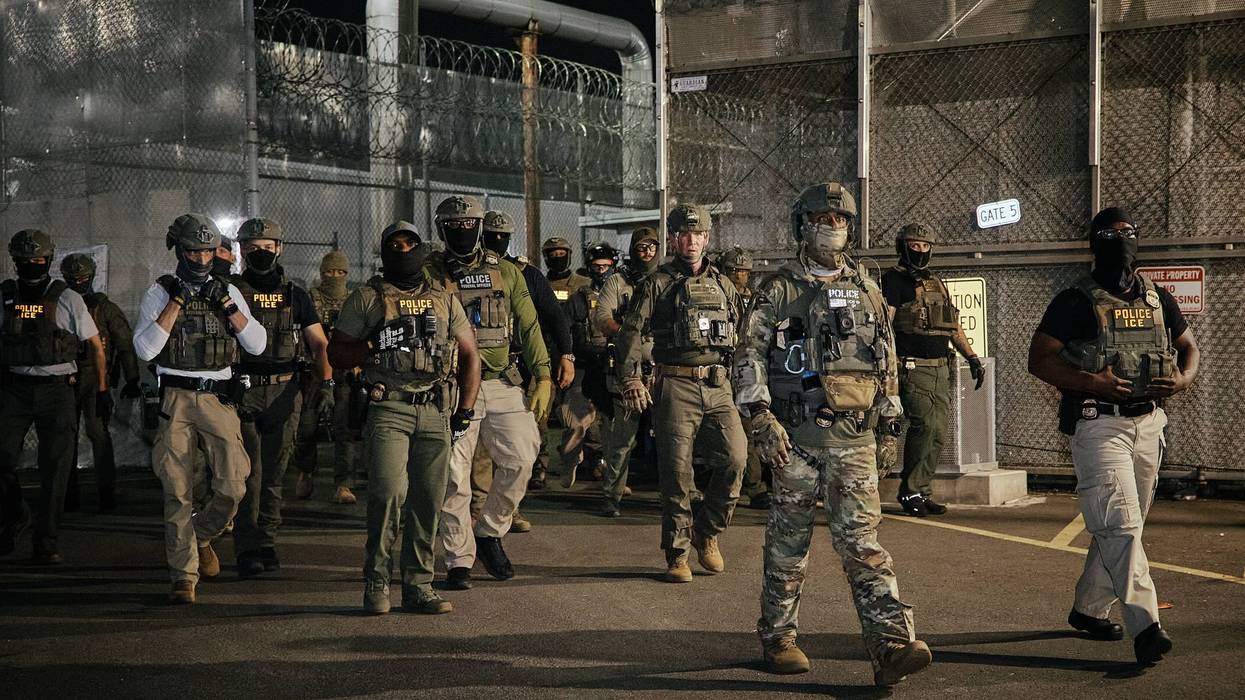
Those arrested in the recent surge include a 56-year-old Catholic nun from Nigeria.
Ordered by the Trump White House to aggressively increase arrest rates, federal immigration officials have reportedly detained more than 10,000 people in just the last five days, intensifying fear in communities across the United States.
The New York Times, which was first to report the new detention figures late Wednesday, noted that Immigration and Customs Enforcement (ICE) officials were "told that 2,000 arrests a day was the new standard for enforcement." The agency, flush with cash following President Donald Trump's signing of a reconciliation package containing another $70 billion for immigration enforcement, has been instructed to assign 80% of its officers to "arrest operations," according to the Times.
The Trump administration claims to be targeting the "worst of the worst," but available data shows that the percentage of people arrested by ICE despite having no criminal convictions has tended to rise during the agency's mass detention efforts. On Sunday, ICE briefly detained a 56-year-old nun from Nigeria as she walked to church in McAllen, Texas.
"The geniuses at ICE just arrested a Catholic nun, who practices as a nurse, as she was walking to church," Sen. Sheldon Whitehouse (D-RI) wrote in response to Sister Leticia Ugboaja's detention. "Our Republican colleagues think they need even more money. Had enough?"
The Times reported that immigration attorneys across the US "have been on alert" as ICE arrests surge, though much more quietly than earlier blitzes in Minneapolis—where federal immigration agents killed two US citizens—and other major cities, where groups of armed and masked officers roamed the streets and menaced neighborhoods.
"Cindy Blandon, an immigration attorney in Miami, said that one of her clients, a Nicaraguan father of two children, had an immigration court hearing set for 2027, but was arrested by ICE on Monday during a routine check-in," the Times reported. "And in Utah, Ysabel Lonazco, an immigration attorney, has noticed an uptick as well... One of her clients, Arturo, a 48-year-old Mexican man, was arrested in Salt Lake City on his way to a soccer game on Sunday, according to his wife, Veronica. She said the arrest had shattered their family."
ICE also appears to be ignoring a federal judge's order last week curtailing arrests at immigration courthouses. According to The Intercept:
On Thursday, U.S. Immigration and Customs Enforcement agents arrested an Ecuadorian man at a court at 26 Federal Plaza and a man from the Dominican Republic at another court at 290 Broadway, both in Lower Manhattan. The arrests continued on Monday, when ICE agents detained a third man, originally from Guatemala, at 290 Broadway.
In legal filings challenging the detentions of the men taken Thursday, advocates with the nonprofit Make the Road New York accused ICE of not only violating their clients’ right to due process, but also of brazenly flouting a federal court order.
Murad Awawdeh, president and CEO of the New York Immigration Coalition, told The Intercept that "we’re witnessing ICE, yet again, operate in a lawless and rogue fashion and not following court orders."
“We’re supposedly a nation under the rule of law, and our judicial branch has said that this agency must stop engaging in this lawless behavior, and they continue to do so," said Awawdeh.
ICE is currently headed by Acting Director David Venturella, a former private prison executive. A record number of people have died in ICE custody under the second Trump administration.
Last week, Trump announced that he intends to nominate former Oklahoma state trooper Lance Schroyer to lead ICE in a permanent capacity.
Marcos Charles, the head of ICE’s deportation wing, cheered the recent arrest surge in an email to agency personnel earlier this week. On Saturday, ICE officers arrested 2,400 people.
“I want to personally thank each of you for your extraordinary efforts this past weekend,” Charles wrote, according to the Times. “Through your dedication, professionalism, and unwavering commitment to our mission, enforcement and removal operations achieved remarkable operational results."

Environmental and public health advocates on Wednesday ripped the US Environmental Protection Agency's fifth approval of a "forever chemical" pesticide during the current term of President Donald Trump, who campaigned on a promise to "Make America Healthy Again."
Despite that pledge, Trump's second administration—much like his first—has served the pesticide industry in various ways, including by putting out a MAHA report that echoes industry talking points, installing a former industry lobbyist in a key EPA post, backing Bayer-owned Monsanto over cancer patients at the US Supreme Court, and issuing an executive order that mandates the production of glyphosate.
Under Trump, the EPA has also approved or reapproved various controversial pesticides, from atrazine and dicamba to trifludimoxazin, which was approved late Tuesday. Like diflufenican and epyrifenacil, which were authorized by the EPA earlier Tuesday, as well as cyclobutrifluram and isocycloseram, which got a green light from the agency last November, trifludimoxazin is what some scientists and campaigners call a forever chemical pesticide.
Per- and polyfluoroalkyl substances (PFAS)—which have been used in not only pesticides but also fabrics, firefighting foam, nonstick cookware, and other household products—are widely known as forever chemicals because they don't break down naturally. They're also linked to a range of health issues, including various cancers.
"This is the PFAS presidency brought to you by Donald Trump and EPA Administrator Lee Zeldin," Nathan Donley, environmental health science director at the Center for Biological Diversity, declared Wednesday.
As with his Tuesday critique of the Trump EPA approving diflufenican and epyrifenacil, Donley pointed to the Supreme Court's recent ruling in favor of Trump-backed Bayer, rather than the thousands of Americans who argue that Monsanto's glyphosate-based weedkiller Roundup caused their cancer.
"Waiting to open the floodgates on new pesticide approvals until after the Supreme Court granted immunity to pesticide companies takes a special kind of callousness," he said.
Bill Freese, science director at Center for Food Safety (CFS), similarly said Wednesday that "with yesterday's pesticide approvals, the Trump administration's EPA is once again showing its disdain for Americans' health and the natural world."
"The EPA's pesticide division is seemingly no longer able to recognize evidence that a pesticide causes cancer, even when it's the pesticide company's own studies that show it," he continued. "And as per usual, EPA dismisses out of hand incriminating independent studies by scientists not affiliated with the pesticide industry."
In addition to the PFAS pesticides, the EPA is under fire this week for approving new uses for chlormequat, a non-PFAS pesticide tied to reproductive issues, and the fungicide fluoxapiprolin.
CFS co-executive director Sylvia Wu pointed out that the agency dismissed studies showing that fluoxapiprolin and epyrifenacil both produce tumors in laboratory rodents and classified both as "not likely to be carcinogenic to humans."
"The EPA's illegitimate rejection of the evidence that these two pesticides cause cancer is very similar to the tricks it pulled in denying glyphosate could cause cancer," Wu said. "These blatant violations of the agency's own cancer guidelines are unacceptable."
As for chlormequat, Freese said that "EPA should never have approved this endocrine-disrupting pesticide, particularly since its persistence and potential for widespread use on wheat and other widely consumed grains will mean universal exposure."
Already, "chlormequat is found in the urine of 90% of Americans, thought to come mostly from residues on imported foods where the pesticide has been used," the Center for Biological Diversity noted Wednesday. Like Freese, the group warned that "approval of its use on US wheat and oats ensures that exposure to the US population will increase dramatically."

“USPS’ plan was unwise, unlawful, and a threat to the millions of voters who rely on mailed ballots to participate in our democracy," said one case litigant.
In a ruling hailed by democracy defenders, a federal court on Wednesday halted the US Postal Service's implementation of President Donald Trump's March executive order targeting mail-in ballots as part of his administration's broader attack on voting rights.
Judge Emmet Sullivan of the US District Court for the District of Columbia granted a request by the NAACP to enforce a 2021 settlement agreement requiring the USPS to protect mail-in voting and prioritize delivery of mail related to elections through 2028.
The request followed the Postal Service's publication last month of a proposed rule that would block the delivery of mail-in ballots to voters in states where election officials refused to provide certain information to USPS or use a specific envelope design. That proposal came after Trump's March executive order directing federal agencies to create a nationwide list of eligible voters using federal data.
The directive also requires the Postal Service to verify that mail-in ballots are sent and returned only by eligible voters, preserve election-related records for a longer period, and exercise heightened oversight of mailed ballots.
The Public Citizen Litigation Group and Legal Defense Fund (LDF) filed a motion on behalf of the NAACP asserting that the proposed rule "manifests USPS’ intent not to deliver certain mail-in ballots, establishing a process that directly violates its obligations under the agreement."
“The court today correctly recognized that USPS’ plan to create roadblocks to mail-in voting was inconsistent with its commitment to timely deliver election mail,” Public Citizen Litigation Group director Allison Zieve said in a statement following Sullivan's ruling. “USPS’ plan was unwise, unlawful, and a threat to the millions of voters who rely on mailed ballots to participate in our democracy.”
🚨BREAKING: In the latest blow to President Donald Trump’s anti-voting agenda, a federal court on Wednesday granted the NAACP’s request to halt the U.S. Postal Service’s (USPS) implementation of his executive order against mail voting. www.democracydocket.com/news-alerts/...
[image or embed]
— Marc Elias (@marcelias.bsky.social) July 1, 2026 at 1:41 PM
LDF associate director-counsel Sam Spital said, “Today’s decision recognizes that USPS cannot disregard its legal obligation to timely deliver mail-in ballots to all voters."
"We are glad that the court blocked a blatant attempt to renege on this commitment through a proposed rule that ran the risk of undermining the fairness of our national elections, creating particular dangers for Black voters," Spital continued. "LDF will continue to defend our democracy and combat unlawful restrictions of the right to vote.”
Anthony P. Ashton, senior associate general counsel at the NAACP, called the decision "a critical step in protecting the rights of voters who rely on the timely delivery of mail-in ballots to participate in our democracy."
Ashton continued:
The proposed USPS changes would have created unnecessary and unlawful barriers, in direct violation of the USPS’ mandate to prioritize election mail. Those barriers could have disproportionately harmed Black voters, who are more likely to rely on mail voting due to long-standing inequities in access. Put simply, the use of mail-in voting helps reduce voter intimidation at the polls and election day dirty tricks. This decision makes clear that access to the ballot cannot be tied to arbitrary requirements. The NAACP will continue to hold this government accountable when it attempts to undermine fair and equal access to the electoral process.
Wednesday's order—from a judge who's been appointed to various positions by Republican and Democratic presidents throughout his career—is the latest in a string of federal court rulings against Trump's attacks on voting rights, crowned by Monday's Watson v. Republican National Committee US Supreme Court decision, in which the justices affirmed that states may count ballots received after Election Day if they were postmarked in time.
Last week, a federal judge in Massachusetts sided with Democratic state attorneys who challenged Trump's March 2025 executive order that requires Americans to show proof of citizenship when registering to vote, while another judge in the same district blocked parts of the president's March 2026 order, which included the USPS directive.