
SUBSCRIBE TO OUR FREE NEWSLETTER
Daily news & progressive opinion—funded by the people, not the corporations—delivered straight to your inbox.
5
#000000
#FFFFFF
To donate by check, phone, or other method, see our More Ways to Give page.


Daily news & progressive opinion—funded by the people, not the corporations—delivered straight to your inbox.

Jane Kleeb, Bold Alliance, 402-705-3622, jane@boldnebraska.org, Mark Hefflinger, Bold Alliance, 323-972-5192, mark@boldnebraska.org, Gabby Brown, Sierra Club, 914-261-4626, gabby.brown@sierraclub.org, Lindsay Meiman, 350.org, lindsay@350.org, Jade Begay, Indigenous Environmental Network, jade@ienearth.org
Pipeline Fighters from Nebraska and across the region marched through the streets of Lincoln, Nebraska yesterday -- on the eve of a weeklong public hearing on the proposed Keystone XL pipeline before the Nebraska Public Service Commission, where Nebraska farmers and ranchers, The Ponca Tribe of Nebraska, Yankton Sioux Tribe, Bold Alliance and other environmental and citizen advocates will present evidence on why TransCanada's tarsands export pipeline is unnecessary and not in the public interest.
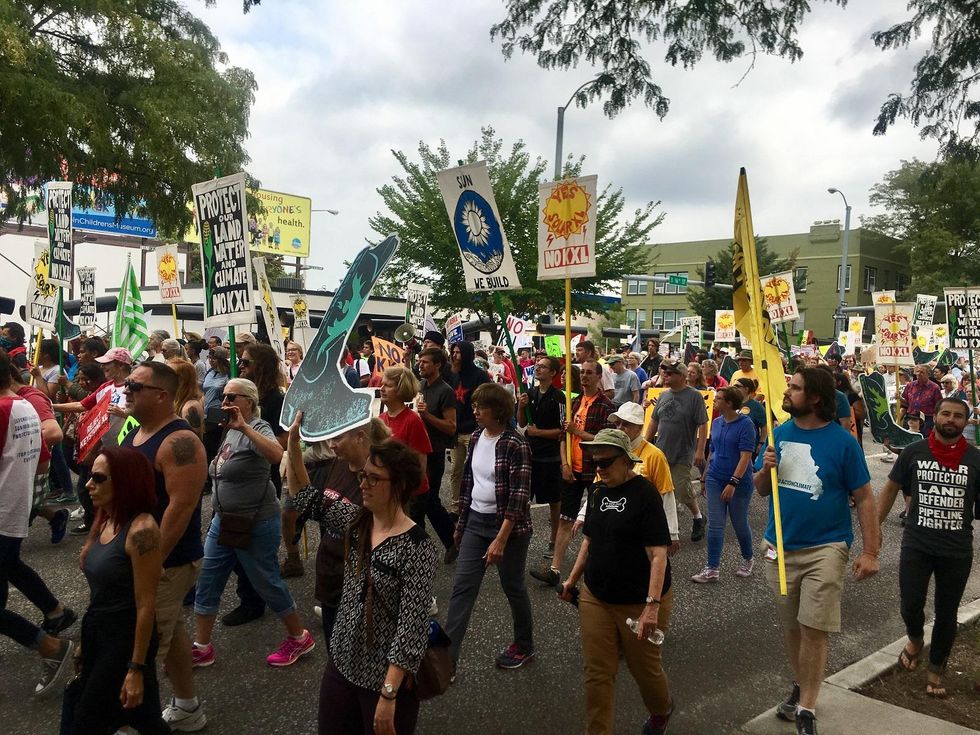
Pipeline opponents have vastly outnumbered proponents who showed up to testify at public meetings on Keystone XL held by the Public Service Commission in Norfolk, York, O'Neill and Omaha. Landowners and citizens have voiced concerns about the state authorizing the use of eminent domain for a foreign corporation to take their land for a private gain pipeline that threatens the Ogallala aquifer and fragile Nebraska farmland.
In addition, a coalition of organizations including Bold Nebraska, 350.org, Sierra Club, Indigenous Environmental Network, CREDO, Greenpeace, Oil Change International and MoveOn have collected hundreds of thousands of written public comments from citizens from Nebraska and across the country with their concerns about Keystone XL's threat to property rights, water and climate. The coalition will deliver these public comments to the Nebraska Public Service Commission's offices in Lincoln at 8:30 a.m. on Thursday, August 10th -- on the eve of the PSC's Keystone XL public comment submission deadline of Friday, August 11th.
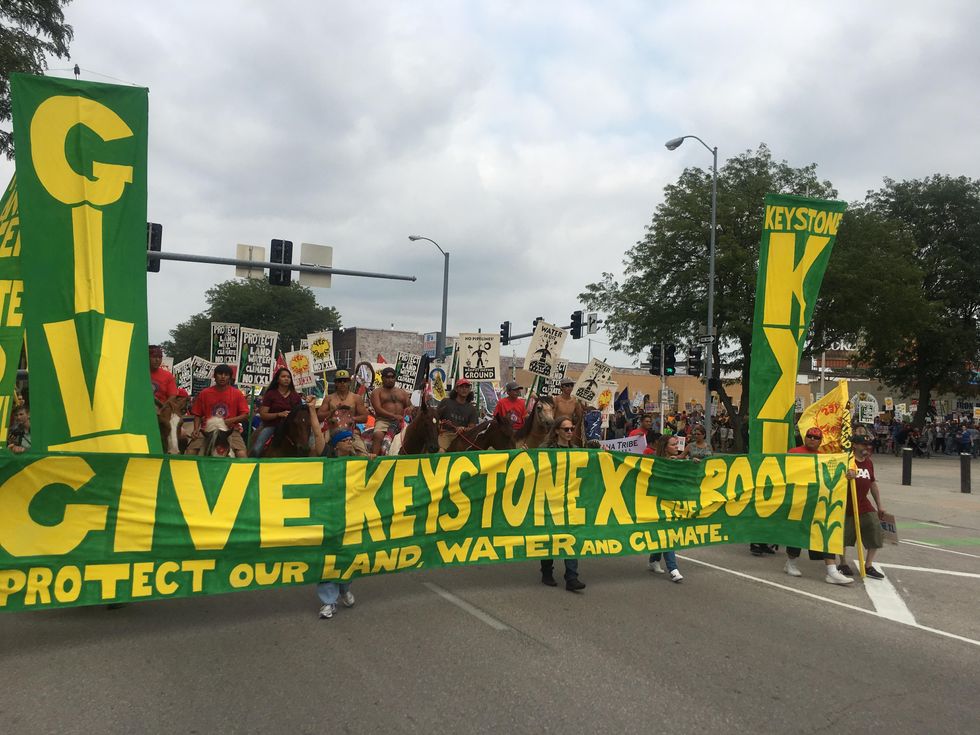
The public comments delivery will take place just blocks from the Cornhusker Marriott hotel in downtown Lincoln -- where landowners, Tribal leaders and environmental advocates were set to testify during the critical week of intervenor hearings on Keystone XL at the Public Service Commission.
QUOTES:
Chairman Harold Frazier, Cheyenne River Sioux Tribe:
"The Nebraska Public Service Commission has an immense responsibility. Not only does it have the responsibility to act in the best interest of Nebraska but also bear the trust responsibility the federal government chooses to ignore. Approving the permit for TransCanada would place send a message that Nebraska supports the damage that has already happened to our environment from the Tarsands oil. I have always said that the American government has failed us, but the American people have not. This is an opportunity to prove that."
Manape LaMere, Government representative of the Sioux Nation of Indians & Headsmen of the Oceti Sakowin:
"We, as Nebraskans with the original landlords of this territory, must not allow American and foreign corporations to jeopardize the sanctity of our natural resources. It's already happened over and over again to my ancestors. Now, as predicted from prophecies, we must all come together to stand up for our resources that we share. Not for our own sake, but for the sake of the generations to come. Our stance is very simple. This is water. The very foundation of life on this planet, as well as the key element in all our religious and spiritual ceremonies. We've been battling over these fundamentals for generations, and now American citizens are starting to feel that bane. We will all continue to pray that people awaken from their slumber. "
Art Tanderup, landowner on Keystone XL route near Neligh:
"It is not in Nebraska's interest to place a tarsands pipeline through Nebraska's eastern Sandhills and over the Ogallala Aquifer, or to allow a foreign corporation to use eminent domain for corporate greed and abuse landowners with 'all risk, no reward' easements."
Jane Kleeb, President, Bold Alliance:
"Keystone XL never has been and never will be in Nebraska's public interest. This is a foreign pipeline, headed to the foreign export market, wanting to use eminent domain for private gain on Nebraska landowners. We are confident the PSC will follow the rules they set forth and reject the proposed route that still crosses the Sandhills and risks the Ogallala Aquifer."
Reverend Kim Morrow, Nebraska Interfaith Power & Light:
"This pipeline is one more example of humanity's relationship with the earth gone amok. We need to stop plundering its beauty for corporate profit. All creation is a gift from God, and from the beginning God asked us to protect it. It's time for all of us to do our part to fulfill that promise."
Sara Shor, Keep it in the Ground Campaign Manager, 350.org:
"We know that the Keystone XL pipeline is not in the public interest, and Nebraska's Public Service Commission has a chance to stop this project for good. Communities in Nebraska and from surrounding states, including farmers, Indigenous peoples, and many more, are here to keep the pressure on and fight for a livable future. We've built solar panels in the path of Keystone XL to show what we need on a massive scale. Commissioners in Nebraska have a choice to make -- either they protect the fossil fuel industry's greed, or they stand up for the health and safety of our climate and our communities."
John Crabtree, Campaign Representative, Sierra Club:
"The PSC is tasked with determining whether Keystone XL is in our state's best interest, and the answer is simple: the only people who would benefit from this pipeline being built are oil executives in Canada, while Nebraskans would face the daily threat of a devastating tar sands spill. Keystone XL is all risk and no benefit for Nebraska, and the PSC should reject it."
Joye Braun, Organizer, Indigenous Environmental Network:
"Time and time again through the many years of the resistance to Keystone XL, Indigenous Peoples have said this project is not in the best interest of the people. The PSC of Nebraska has an extremely serious decision to make: a decision that will lead our communities towards clean energy, towards jobs, and towards a stronger relationship with Indigenous communities. Or they will make a decision that leads us towards more pollution, climate disaster, increased crime and human trafficking, and more disregard for Indigenous and human rights. We hope that they make the decision that puts our communities, our safety, and our futures first, not the oil companies."
Lorne Stockman, Senior Research Analyst, Oil Change International:
"The United States and the world are rapidly moving away from oil to clean, climate-safe sources of energy. As the world's dirtiest and most expensive source of oil, the Canadian tar sands has no future. Today, there is no company financially committed to tar sands growth or to the reckless Keystone XL pipeline. Nebraskans should not be forced to hand over land to a project with no future, relinquishing control over what happens to that land for generations to come. Keystone XL must be stopped now before any more damage is done."
Christina-Alexa Liakos, Senior Climate and Energy Organizer:
"The people beat back Keystone XL once, and we are here again with as much resolve as before. Far from being in the people's interest, this pipeline's true purpose is to expand extraction out of Canada's dirty tar sands, produce unnecessary oil for export when the world is increasingly saying no to fossil fuels, and to line the pockets of the oil and gas industry and TransCanada before the oil market goes belly up. We are in the streets today to support a finding that truly serves Nebraskans and all people living in this land: No Keystone XL, ever."
350 is building a future that's just, prosperous, equitable and safe from the effects of the climate crisis. We're an international movement of ordinary people working to end the age of fossil fuels and build a world of community-led renewable energy for all.
"This is an atrocious downplaying of real antisemitism at a time when rampant Jew hatred is killing people," said an American congressional candidate and school shooting survivor.
Israeli Prime Minister Benjamin Netanyahu was swiftly criticized around the world on Sunday for trying to connect a deadly shooting that targeted a Hanukkah celebration at Bondi Beach in Sydney to the Australian government's decision to recognize Palestinian statehood.
Netanyahu referenced a letter he sent to Australian Prime Minister Anthony Albanese in August, after Albanese and Foreign Affairs Minister Penny Wong announced the decision, which followed similar moves from Canada, France, and the United Kingdom, amid Israel's assault on the Gaza Strip, which has been widely condemned as genocide.
As Netanyahu noted, he wrote to Albanese: "Your call for a Palestinian state pours fuel on the antisemitic fire. It rewards Hamas terrorists. It emboldens those who menace Australian Jews and encourages the Jew hatred now stalking your streets."
The Israeli leader shared a video and transcript of his commentary on the social media platform X, where Jasper Nathaniel, who reports on the illegally occupied West Bank, called it a "depraved response to a depraved act."
"Obviously massacring unarmed men, women, and children at a Hanukkah celebration is antisemitic terror," Nathaniel added in a separate thread. "Just like massacring unarmed men, women, and children in Gaza and the West Bank is anti-Palestinian terror. There are no moral exceptions regarding the slaughter of civilians."
Electronic Intifada director Ali Abunimah said, "Basically Netanyahu is saying that Australia got what it had coming for not supporting his genocide in Gaza even more than it already does."
Avi Meyerstein, founder of the Washington, DC-based Alliance for Middle East Peace, declared: "This is absurd. Calling to resolve the Israeli-Palestinian conflict with peace, security, and self-determination for all, recognizing Israel and Palestine both, is a call to reduce the flames and put everyone on a path toward a better future."
Cameron Kasky, who survived the 2018 mass shooting at Marjory Stoneman Douglas High School in Parkland, Florida and is now running for Congress as a Democrat in New York, also blasted Netanyahu over his comments, saying that "this is an atrocious downplaying of real antisemitism at a time when rampant Jew hatred is killing people."
The death toll in Australia has risen to 16, including one of at least two gunmen, and dozens more people were injured in the attack. A bystander who wrestled a gun away from one of the shooters has been identified by Australian media as Ahmed al Ahmed, a 43-year-old fruit shop owner and father. His cousin said that he was shot twice and had to get surgery.
Even Netanyahu recognized that in Australia, "we saw an action of a brave man—turns out a Muslim brave man, and I salute him—that stopped one of these terrorists from killing innocent Jews," but the Israeli leader then doubled down on what he called Albanese's "weakness."
Responding to Netanyahu, Assal Rad, a fellow at the Arab Center Washington, DC, said that "blaming Palestinian statehood, while committing genocide against them, is just another reminder that you want to erase Palestinians from existence."
"If you condemn the horrific, antisemitic attack in Bondi Beach while still defending genocide in Gaza, you're not actually outraged by the killing of innocent people," Rad also said. "It's not hard to condemn both, unless you think some lives are more valuable than others."
"The images out of Bondi Beach in Australia this morning of a vile, antisemitic massacre at a Hanukkah celebration are shocking, disgusting, and heartbreaking," said Dr. Abdul El-Sayed, a US Senate candidate.
This is a developing story… Please check back for updates…
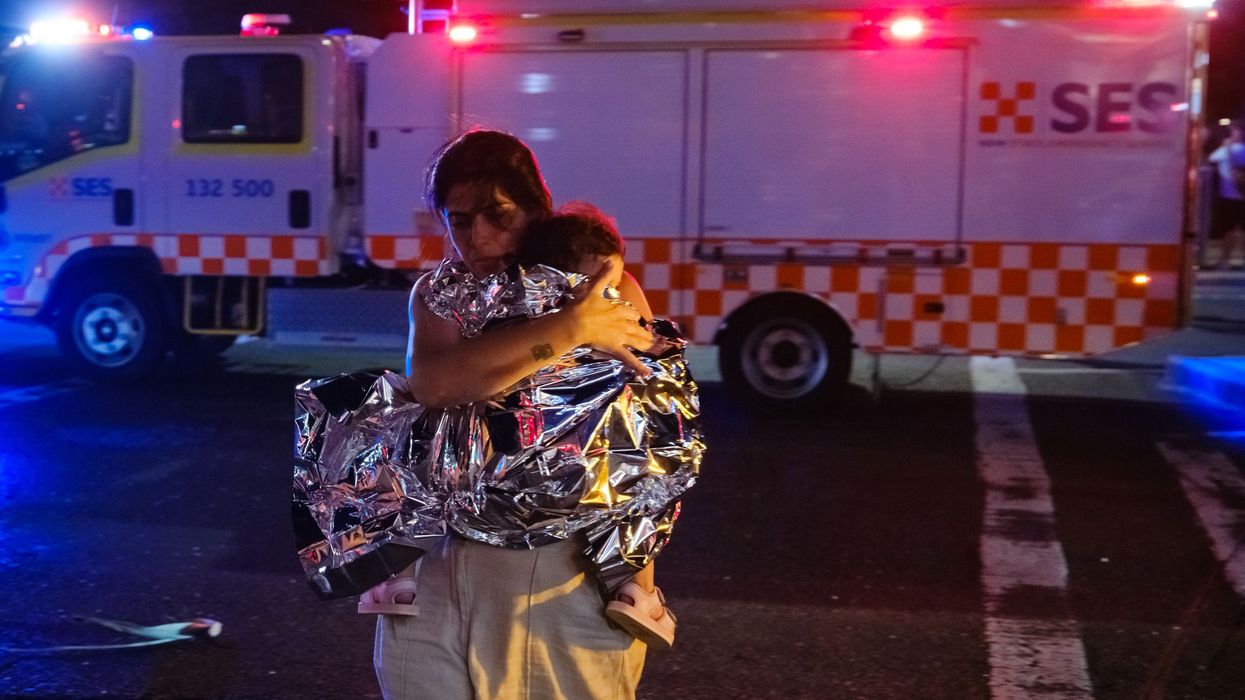
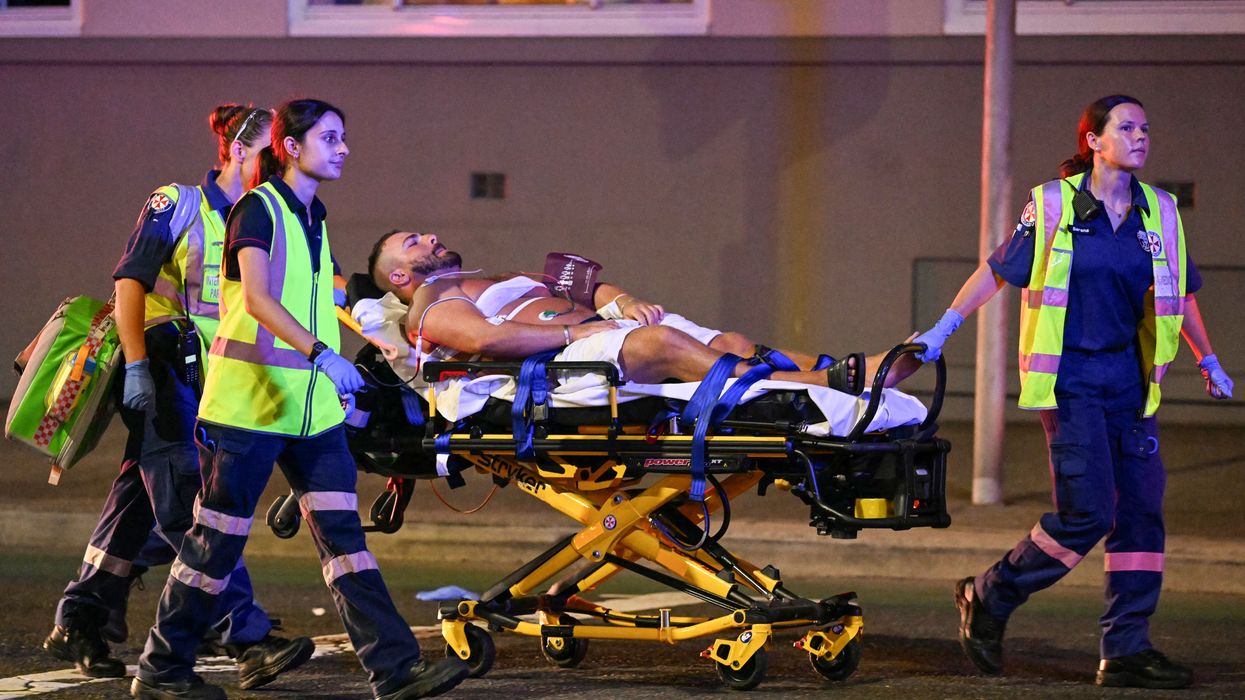
At least 16 people are dead, including a gunman, and dozens of others were transported to various hospitals for injuries after shooters attacked a Hanukkah celebration at the iconic Bondi Beach in Sydney, Australia.
New South Wales Police confirmed that one suspect was killed and another is in custody, and a suspected improvised explosive device (IED) was found in a nearby vehicle, according to the Australian Broadcasting Corporation.
"One of the gunmen has been identified as Naveed Akram from Bonnyrigg in Sydney's southwest," ABC also reported. "An official, speaking on condition of anonymity, says Mr Akram's home in Bonnyrigg is being raided by police."
Australian Prime Minister Anthony Albanese called the shooting "a targeted attack on Jewish Australians on the first day of Hanukkah, which should be a day of joy, a celebration of faith," and "an act of evil, antisemitism, terrorism, that has struck the heart of our nation."
"There is no place for this hate, violence, and terrorism in our nation," he continued, noting that many people remain alive "because of the courage and quick action of the New South Wales Police, and the first responders who rushed to their aid, as well as the courage of everyday Australians who, without hesitating, put themselves in danger in order to keep their fellow Australians safe."
A video of one such bystander has swiftly circulated online: A man identified as Ahmed al Ahmed tackled one gunman and took his weapon. A 7NEWS reporter spoke with a cousin of the 43-year-old Muslim fruit shop owner and father of two at the hospital. The "hero," as his cousin and many others have called him, was shot twice and had surgery, but should be OK.
The video garnered attention around the world. Democratic congressional candidate and outgoing New York City Comptroller Brad Lander, who is Jewish, acknowledged the "extraordinary courage" of the man who "bravely risked his life to save his neighbors celebrating Hanukkah." Lander added: "Praying for his full and speedy recovery. And so deeply inspired by his example."
As the Associated Press noted Sunday:
Mass shootings in Australia are extremely rare. A 1996 massacre in the Tasmanian town of Port Arthur, where a lone gunman killed 35 people, prompted the government to drastically tighten gun laws and made it much more difficult for Australians to acquire firearms.
Significant mass shootings this century included two murder-suicides with death tolls of five people in 2014, and seven in 2018, in which gunmen killed their own families and themselves.
In 2022, six people were killed in a shootout between police and Christian extremists at a rural property in Queensland state.
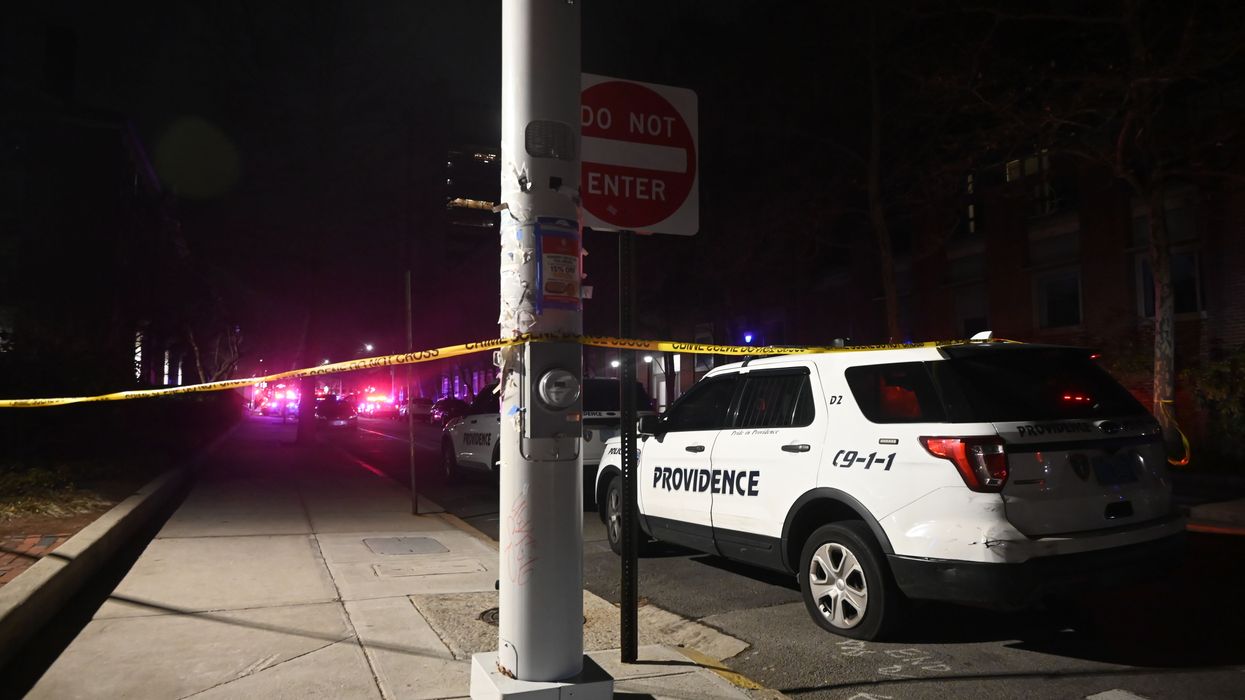
The attack in Australia followed a deadly shooting Saturday at Brown University in Providence, Rhode Island in the United States, where such incidents are far more common.
In the largest US city, the New York Police Department said Sunday that "we are in touch with our Australian partners, and at this time we see no nexus to NYC. We are deploying additional resources to public Hanukkah celebrations and synagogues out of an abundance of caution."
American leaders and political candidates also condemned the Sunday attack, including Dr. Abdul El-Sayed, a Democratic US Senate candidate in Michigan who said that "the images out of Bondi Beach in Australia this morning of a vile, antisemitic massacre at a Hanukkah celebration are shocking, disgusting, and heartbreaking. The shooters deliberately attacked families celebrating a holiday because of their faith. There is no justification for such a cowardly act of terrorism."
"Our family is praying for the victims and their families—and for Jewish communities in Australia and around the world," added El-Sayed, who is Muslim. "I join my Jewish sisters and brothers grieving these attacks. And we stand resolved to stamp out antisemitism and hate in all its forms."
With at least two people dead, several others in critical but stable condition at Rhode Island Hospital, and a suspect at large after a Saturday shooting at Brown University in Providence, gun violence prevention advocates and some US lawmakers renewed calls for swift action to take on what the nonprofit Brady called "a uniquely American problem" that "is completely preventable."
"Our hearts are with the victims, survivors, their families, and the entire community of Brown University and the surrounding Providence area in this horrific time," said Brady president Kris Brown in a statement. "As students prepare for finals and then head home to loved ones for the holidays, our all-too-American gun violence crisis has shattered their safety."
"Guns are the leading cause of death for youth in this nation. Only in America do we live in fear of being shot and killed in our schools, places of worship, and grocery stores," she continued. "Now, as students, faculty, and staff hide and barricade themselves in immense fear, we once again call on lawmakers in Congress and around the country to take action against this uniquely American public health crisis. We cannot continue to allow politics and special interests to take priority over our lives and safety."
Despite some early misinformation, no suspects are in custody, and authorities are searching for a man in dark clothing. The law enforcement response is ongoing and Brown remains in lockdown, according to a 9:29 pm Eastern update on the university's website. Everyone is urged to shelter in place, which "means keeping all doors locked and ensuring no movement across campus."
The Ivy League university's president, Christina H. Paxson, said in a public message that "this is a deeply tragic day for Brown, our families, and our local community. There are truly no words that can express the deep sorrow we are feeling for the victims of the shooting that took place today at the Barus & Holley engineering and physics building."
US Sen. Sheldon Whitehouse (D-RI) said on social media that he was "praying for the victims and their families," and thanked the first responders who "put themselves in harm’s way to protect all of us." He also echoed the city's mayor, Brett Smiley, "in urging Rhode Islanders to heed only official updates from Brown University and the Providence Police."
In a statement, US Sen. Jack Reed (D-RI) also acknowledged everyone impacted by "this horrific, active, and unfolding tragedy," and stressed the importance of everyone listening to law enforcement "as they continue working to ensure the entire campus and surrounding community is safe, and the threat is neutralized."
The state's two Democratic congressmen, Brown alumnus Seth Magaziner and Gabe Amo, released similar statements. Amo also said that "the scourge of mass shootings is a horrific stain on our nation. We must seek policies to ensure that these tragedies do not strike yet another community and no more lives are needlessly taken from us."
Elected officials at various levels of government across the country sent their condolences to the Brown community. Some also used the 389th US mass shooting this year and the 230th gun incident on school grounds—according to Brady's president—to argue that, as US House Democratic Whip Katherine Clark (Mass.) put it, "it's past time for us to act and stop senseless gun violence from happening again."
Both Democratic US senators from Massachusetts also emphasized on Saturday that, in Sen. Elizabeth Warren's words, "students should be able to learn in peace, not fear gun violence." Her colleague Sen. Ed Markey said that "we must act now to end this painful epidemic of gun violence. Our children should be safe at school."
New York City's democratic socialist mayor-elect, Zohran Mamdani, noted that this shooting occurred just before the anniversary of the 2012 massacre at Sandy Hook Elementary School in Newtown, Connecticut:
This senseless violence—once considered unfathomable—has become nauseatingly normal to all of us across our nation. Tonight, on the eve of the anniversary of the Sandy Hook shooting, we find ourselves in mourning once again.
The epidemic of gun violence stretches across America. We reckon with it when we step into our houses of worship and out onto our streets, when we drop our children off at kindergarten and when we fear if those children, now grown, will be safe on campus. But unlike so many other epidemics, we possess the cure. We have the power to eradicate this suffering from our lives if we so choose.
I send my deepest condolences to the families of the victims, and to the Brown and Providence communities, who are wrestling with a grief that will feel familiar to far too many others. May we never allow ourselves to grow numb to this pain, and let us rededicate ourselves to the enduring work of ending the scourge of gun violence in our nation.
Fred Guttenberg has been advocating against gun violence since his 14-year-old daughter was among those murdered at Marjory Stoneman Douglas High School in Parkland, Florida nearly eight years ago. He said on social media that he knows two current students at Brown and asserted that "IT DOESN'T NEED TO BE THIS WAY!!!"
Students Demand Action similarly declared: "Make no mistake: We DO NOT have to live and die like this. Our lawmakers fail us every day that they refuse to take action on gun violence."
Gabby Giffords, a former Democratic congresswoman from Arizona who became an activist after surviving a 2011 assassination attempt, said that "my heart breaks for Brown University. Students should only have to worry about studying for finals right now, not hiding from gunfire. Guns are the leading cause of death for young people in America—this is a five-alarm fire and our leaders in Washington have ignored it for too long. Americans are tired of waiting around for Congress to decide that protecting kids matters."
John Feinblatt, president of Everytown for Gun Safety, warned that "we either take action, or we bury more of our kids."
The Associated Press noted that "Rhode Island has some of the strictest gun laws in the US. Last spring the Democratic-controlled Legislature passed an assault weapon ban that will prohibit the sale and manufacturing of certain high-powered firearms, but not their possession, starting next July."
Gun violence prevention advocates often argue for federal restrictions, given that, as Everytown's latest analysis of state-level policies points out, "even the strongest system can't protect a state from its neighbors' weak laws."