SUBSCRIBE TO OUR FREE NEWSLETTER
Daily news & progressive opinion—funded by the people, not the corporations—delivered straight to your inbox.
5
#000000
#FFFFFF
To donate by check, phone, or other method, see our More Ways to Give page.


Daily news & progressive opinion—funded by the people, not the corporations—delivered straight to your inbox.

Darcey Rakestraw, 202-683-2467; drakestraw@fwwatch.org
"The Trump administration released the text of the U.S.-Mexico-Canada Agreement trade deal that would enshrine and globalize Trump's deregulatory zealotry into a trade pact that would outlast the administration and imperil future efforts to protect consumers, workers and the environment.
"The text reveals provisions that undermine U.S. food safety protections, including aggressive 'sound science' language designed to make it harder to defend or implement food safety safeguards. The text includes the type of attacks on commonsense public health standards that were championed by the disgraced Environmental Protection Agency Administrator Scott Pruitt. Including the 'sound science' red herring in trade pacts means that even after Trump leaves the White House, his deregulatory agenda is locked into international agreements.
"The new text encourages the United States to accept the food safety rules in Mexico as comparable to domestic protections, and to accept imports from Mexico with less scrutiny than from other countries. The deal even creates new ways for Canada and Mexico to second-guess U.S. border inspectors that halt suspicious food shipments, which would have a dangerously chilling effect on food safety enforcement.
"The new deal also has giant giveaways to the agrochemical industry that paves the way for unregulated gene-edited GMOs, rolls back Mexico's regulation of GMOs, and lets chemical giants like Monsanto and Dow keep the data on the safety of their pesticides secret for 10 years.
"The energy provisions will encourage more pipelines and exports of natural gas and oil that would further expand fracking in the United States and Mexico. The text also provides new avenues for polluters to challenge and try and roll back proposed environmental safeguards, cementing Trump's pro-polluter agenda in the trade deal.
" Food & Water Watch will closely read the food safety, chemical safety, energy, water and other deregulatory language in the coming weeks to assess the extent of the additional negative impact on these issues. A closer look at the text will undoubtedly reveal a host of pro-polluter, pro-fossil fuel industry, pro-Wall Street deregulation that has been a hallmark of Trump's domestic agenda.
"This deal is a giant step backwards for people, communities and the environment. Based on our initial read, Trump's trade deal poses a considerably greater threat to commonsense regulatory protections than the existing North American Free Trade Agreement, and Congress must reject it."
Food & Water Watch mobilizes regular people to build political power to move bold and uncompromised solutions to the most pressing food, water, and climate problems of our time. We work to protect people's health, communities, and democracy from the growing destructive power of the most powerful economic interests.
(202) 683-2500"The GOP doesn't care about your skyrocketing costs for gas, groceries, and everything else. They only care about appeasing Trump," said the House minority whip.
After four US Senate Republicans on Tuesday helped Democrats advance a war powers resolution intended to halt President Donald Trump's illegal war on Iran, GOP leadership in the House of Representatives canceled a similar vote on Wednesday, and again on Thursday.
Progressive and Democratic Party leaders in the House were quick to call out Republican leadership, including Rep. Mike Johnson (R-La.), who Congressional Progressive Caucus (CPC) Chair Greg Casar (D-Texas) said "has cemented his legacy as the speaker who handed the most corrupt president ever complete control over the House."
"Republicans can run from Trump's disastrous war, but they can't hide. Thousands are dead, and gas and grocery prices are up, and progressives will not stop demanding votes... until the war is actually ended," Casar pledged, as Americans prepared to spend an estimated extra $3.5 billion on gasoline over the holiday weekend.
CPC Chair Emerita Pramila Jayapal (D-Wash.) similarly said on social media: "Republicans just called off the vote on a war powers resolution because they were afraid it would pass and Trump's war of choice in Iran would be ended. This is absolutely ridiculous, and a failure of leadership from the Republican Party."
House Minority Whip Katherine Clark (D-Mass.) also accused Republicans of refusing to hold a vote "because they knew it would pass," adding: "The GOP doesn't care about your skyrocketing costs for gas, groceries, and everything else. They only care about appeasing Trump."
Absences were the apparent issue for the House GOP on Thursday. Eight Republicans were not there for votes, according to C-SPAN Capitol Hill producer Craig Caplan, and retiring Rep. Jared Golden (D-Maine), who joined with nearly all Republicans to block a resolution last week, had made clear that he intended to support the measure this week.
Cheered on by colleagues, Rep. Jim McGovern (D-Mass.) took to the House floor to demand answers about the schedule: "Are we not voting on it because the American people are sick and tired of this illegal war that is costing tens of billions of dollars? Gas prices are through the roof. People can't afford their groceries. Is that why you're pulling it? You guys don't have the guts or the balls to vote on this."
Republican Congressmen Tom Barrett (Mich.), and Brian Fitzpatrick (Pa.), and Thomas Massie (Ky.) had broken ranks and joined Democrats for last week's vote. While Massie was absent on Thursday after a stinging primary loss earlier this week, "some Republicans believed Fitzpatrick and Barrett would vote for the resolution again Thursday before they pulled it," Politico reported.
Fitzpatrick confirmed that, telling Punchbowl News' Briana Reilly: "They're claiming they have two more days to bring it. I was prepared to vote for it."
After the cancellation, the National Iranian American Council (NIAC) said that "as tonight shows, the deck is stacked against pro-peace Americans: Even when a majority of Americans oppose a war, and a majority of Congress opposes a war, congressional leaders find ways to cancel a vote so that the war can continue!"
"This cowardice makes a mockery of the democratic process—but it will not silence Americans who are in the right that oppose this catastrophic, illegal war," NIAC added. "We will keep up the momentum until we bring this disastrous and backfiring war to a close."
Erik Sperling, executive director of Just Foreign Policy, suggested Thursday that "the best thing" for Trump and the GOP would be to lose a war powers vote, because then the president "would have cover to make a deal with Iran and let gas prices come down."
The cancellation of the war powers vote was part of what Politico's Meredith Lee Hill called "a BIG mess" in the chamber "as lawmakers want to leave for Memorial Day recess," given that "reconciliation 2.0 is already iced," and a "GOP-led bill to create a women's museum is set to fail amid a GOP revolt." That vote was held, and failed as expected.
"EPA owes it to Americans to put people’s health first—not give hidebound corporations more time to keep using outdated chemicals," said one critic.
In a reversal of his past position and what critics are calling yet another betrayal of his "Make America Healthy Again" campaign pledge, US President Donald Trump announced Thursday that his administration is loosening limits on so-called "super pollutant" hydrofluorocarbons used in air conditioners and refrigerators at the expense of the environment and climate.
Trump and Environmental Protection Agency Administrator Lee Zeldin spun the move as a measure that will "save American families and businesses more than $2.4 billion" by revising "costly overreaching restrictions" imposed during the Biden administration "limiting the type of refrigerants American businesses and families can use."
"Today, the Trump EPA is fulfilling President Trump’s promise to lower costs and is fixing every problem we can under the authority Congress gave us," Zeldin said. "Our actions allow businesses to choose the refrigeration systems that work best for them, saving them billions of dollars. This will be felt directly by American families in lower grocery prices.”
Grocery prices have continued to rise during Trump’s second term, driven by the administration's erratic trade wars and actual war on Iran. Critics of Thursday's move argue that it will do little to reduce consumer costs, while increasing pollution and health risks for American families.
“It’s nice that they are paying attention to affordability, but if they want to make a difference, it’s tariffs and the Iran War," Ryan Young, a senior economist at the Competitive Enterprise Institute, a libertarian think tank, told NOTUS, estimating that the move would save consumers about $2 per year.
Hydrofluorocarbons (HFCs) are called “super pollutants” because they trap far more heat in the atmosphere than carbon dioxide, even though they are emitted in much smaller quantities. They were originally introduced to replace ozone-depleting chemicals like chlorofluorocarbons (CFCs) that ravaged the ozone layer.
However, scientists soon realized that HFCs are extremely powerful greenhouse gases in their own right. As air conditioning use and demand grows worldwide, so has HFC use.
As the EPA's own website acknowledges on its "Operation: Disrupt HFCs" webpage:
HFCs are potent greenhouse gases... with high global warming potential. HFCs are commonly utilized as refrigerants, aerosol propellants, foam blowing agents, solvents, and fire retardants across residential, commercial, and industrial applications. The major source of HFC emissions is their use as refrigerants—for example, in air conditioning systems in both vehicles and buildings. Emissions occur during manufacturing, as well as through leaks, servicing, and disposal of equipment containing HFCs.
Former EPA Assistant Administrator Joseph Goffman said in a statement Thursday that "families are already stretched thin by high grocery bills and everyday expenses, and weakening safeguards on these super-polluting refrigerant chemicals isn’t going to change that."
"Even manufacturers are saying this delay likely won’t lower prices for consumers because supplies of these chemicals are already being phased down in favor of cleaner, innovative replacements," he added.
Stephen Yurek, president and CEO of the Air-Conditioning, Heating, and Refrigeration Institute (AHRI)—an industry lobby—warned that the "reckless" new policy could actually cause refrigerant prices to increase.
“This rule works against basic supply and demand,” Yurek said. “By extending the compliance deadline, the EPA is maintaining and even increasing demand in the market for existing refrigerants while supply continues to fall under the AIM Act."
The American Innovation and Manufacturing (AIM) Act of 2020, bipartisan legislation signed by Trump during his first term, directed the EPA to "phase down the production and consumption of listed HFCs in the United States by 85% by 2036" and "facilitate the transition to next-generation technologies that do not rely on HFCs."
As of this year, more than 170 countries—including the United States—plus the European Union have ratified the Kigali Amendment to the Montreal Protocol, the main global agreement to phase down HFCs.
Yurek explained that "instead of falling, refrigerant prices are likely to rise, resulting in higher service costs, and higher costs for consumers."
Addressing the EPA's reversal on HFCs, Goffman said, "All this action does is slow the shift to cleaner technologies while risking continued releases of climate super pollutants and leaving families to face the much greater costs and health threats of dangerous climate change."
"EPA owes it to Americans to put people’s health first—not give hidebound corporations more time to keep using outdated chemicals," he added. "Americans deserve affordable groceries that don’t come at the expense of the strong safeguards they count on to keep our families safer, not sicker.”
The EPA move comes amid mounting calls by over 160 civil rights, environmental, faith, health, and labor groups to fire Zeldin over his agency's deregulation spree.
"Folks very close to the White House... were sitting on properties that were causing them losses every year," said a journalist tracking the purchases. "The decision was made to buy them at taxpayer expense."
In what More Perfect Union described as a "new level of corruption" for the Trump administration, an investigation by the progressive news outlet revealed how members of the president's inner circle are cashing in on the Department of Homeland Security's purchase of warehouses for immigrant detention.
It was reported earlier this year that under then-Secretary Kristi Noem, who has since been fired, DHS was planning to spend nearly $40 billion to buy up dozens of warehouses around the US to convert them into makeshift detention camps that could each hold anywhere from 1,000 to 10,000 people arrested as part of President Donald Trump's mass deportation effort.
But when Mae Ryan, a reporter at More Perfect Union, looked into the contracts, she said she "noticed something weird."
"Many of these warehouses had been sitting on the market for years," she explained in a video posted Wednesday. "Now DHS was buying them at a massive markup."
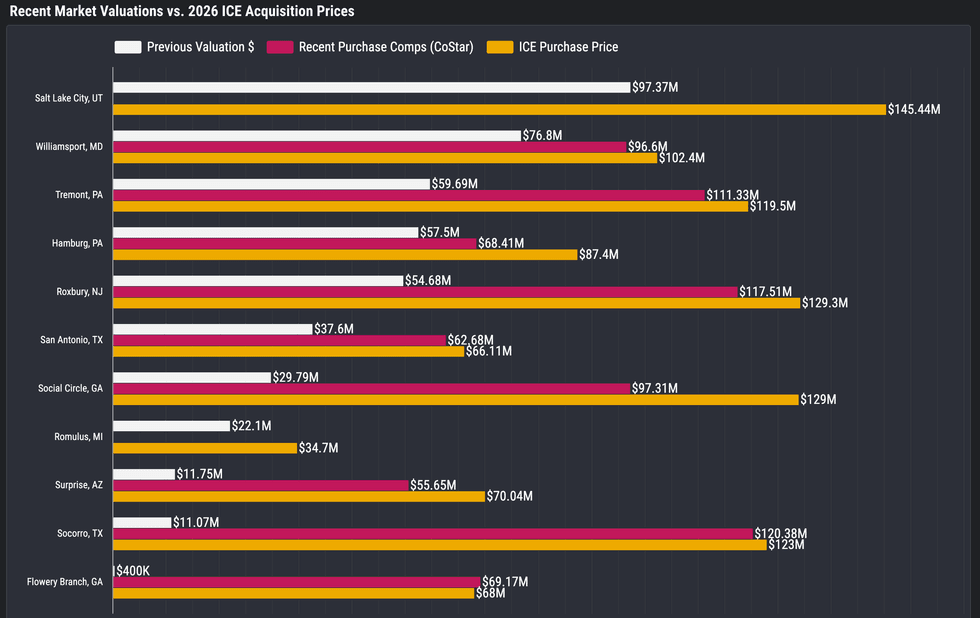
She pointed to one warehouse in Socorro, Texas, recently valued at $11 million, which Immigration and Customs Enforcement (ICE) purchased from the company El Paso Logistics II LLC for $123 million—more than a 1,000% profit.
According to Michael Wriston, an ex-military analyst and investigative journalist who tracked the enormous markups for several of these warehouse purchases for his website Project Salt Box back in March, "across more than a dozen warehouse acquisitions, ICE paid prices that exceeded both prior property valuations and recent market comparables at nearly every site."
For one warehouse in Surprise, Arizona, previously valued at just under $12 million, ICE paid over $70 million. For another in Social Circle, Georgia, valued at about $30 million, the agency paid nearly $130 million.
Many of the warehouses that raked in obscene taxpayer-funded purchases by DHS were owned by financial institutions with deep connections to the Trump administration, Ryan explained.
One warehouse in Roxbury, New Jersey, valued at about $54.6 million in 2025, inexplicably sold to ICE for over $129 million, more than double. Its majority owner was the investment bank Goldman Sachs, where many Trump appointees during his first term—including former Treasury Secretary Steve Mnuchin and Trump financial adviser Gary Cohn—were formerly employed.
ICE paid double for another warehouse in Tremont, Pennsylvania, buying it for nearly $120 million despite a valuation of about $60 million. It was owned by the private capital firm Blue Owl, where at least 33 members of Trump's administration have investments in its funds, including the president himself, who has about $5 million invested in the firm.
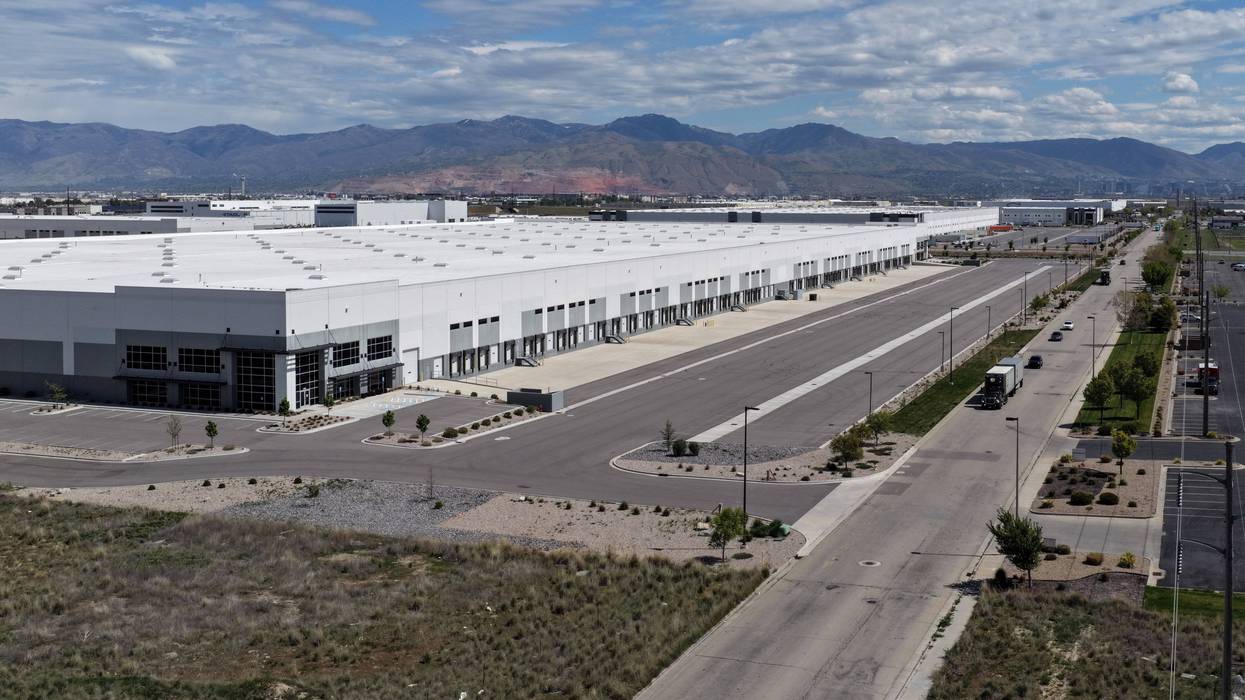
Another in Salt Lake City, valued at just $97 million, was purchased by ICE for $145 million, and the agency now plans to convert it into a 10,000-bed facility. It was owned by Deutsche Bank, which has loaned Trump about $2.5 billion over the past two decades.
Wriston told More Perfect Union that the financial payout to Trump allies was top of mind for DHS as it drew up the controversial warehouse plan.
"ICE doesn't necessarily want to be using warehouses," he said. "The plan came from folks very close to the White House who were sitting on properties that were causing them losses every year. And the decision was made to buy them at taxpayer expense."
It's part of a larger pattern of ICE contracts being distributed to companies that have given major financial support to Trump.
According to an investigation in March by OpenSecrets, the GEO Group and CoreCivic, two private prison companies that have collectively received more than $2.8 billion in ICE contracts, each donated $500,000 to Trump's inaugural committee. The GEO Group's employee-funded political action committee contributed $1 million to the pro-Trump super PAC Make America Great Again, Inc. during his reelection campaign in 2024.
The vast majority of those who have been detained during Trump's second term have had no criminal records, despite claims by the administration that they are targeting "the worst of the worst" criminals for deportation.
Those who have been held in ICE detention centers—often without any due process or access to a lawyer—have consistently reported being held in horrendous conditions, denied access to basic food, sanitation, and medical care, and subject to torture and sexual assault by guards.
DHS has reportedly spent only about $1 billion of the more than $38 billion allotted for immigration detention warehouses so far. According to The New York Times, the administration is hoping to build a mass detention system that could stuff these warehouses with over 100,000 detainees at a time across more than 20 facilities.
According to Wriston's running tracker of ICE warehouse sales, at least 13 purchases have been canceled, in many cases due to public backlash. Still, the administration has already purchased enough warehouse space to hold more than 41,500 people at once.
"What we're seeing happen now—I never in a million years envisioned seeing this happen on US soil," Wriston said. "Never. Never once."