October, 28 2020, 12:00am EDT

Bankrolling Extinction: The Top 10 Banks Financing Biodiversity Loss
Report names HSBC, Bank of America, Mitsubishi Financial & others
WASHINGTON
- In 2019, 50 global banks provided loans and underwriting of more than USD 2.6 trillion (>GDP of Canada) to economic sectors scientists and governments agree are primary drivers of biodiversity loss.
- Banks that provided most finance to sectors that are the primary drivers of biodiversity loss were Bank of America, Citigroup, JP Morgan Chase, Mizuho Financial, Wells Fargo, BNP Paribas, Mitsubishi UFJ Financial, HSBC, SMBC Group and Barclays.
- None of the banks assessed had chosen to put sufficient systems in place to monitor or measure the impact of their loans on biodiversity loss, nor do they have comprehensive policies to halt it.
The loans and underwriting provided by some of the world's largest banks to companies operating in economic sectors which governments and scientists agree are the primary drivers of biodiversity destruction have been quantified for the first time.
Bankrolling Extinction finds that over the course of 2019, 50 global banks together provided loans and underwriting worth more than USD 2.6 trillion to the food, forestry, mining, fossil fuels, infrastructure, tourism and transport and logistics sectors, all of which have been identified as primary drivers of the global extinction crisis. It also finds that none of the banks have chosen to put comprehensive policies or sufficient systems in place to monitor or measure the impact of their loans on biodiversity.
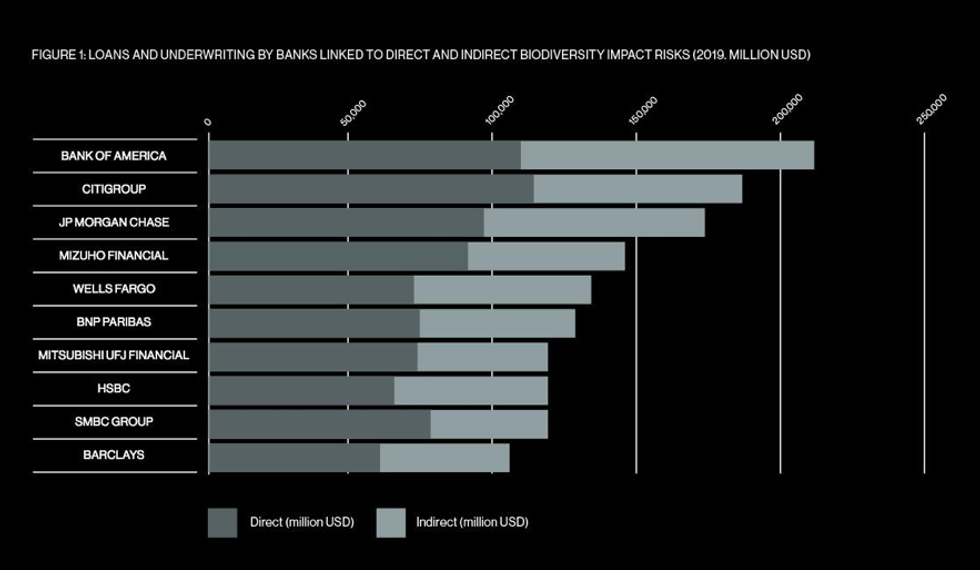
The ten banks with the largest exposure to biodiversity destruction risks were Bank of America, Citigroup, JP Morgan Chase, Mizuho Financial, Wells Fargo, BNP Paribas, Mitsubishi UFJ Financial, HSBC, SMBC Group and Barclays (figure 1). On average, each of the 50 banks was linked to finance with biodiversity loss risk of USD 52 billion.
With the species extinction rate at up to 10,000 times higher than the background rate and scientists warning of 'biological annihilation', Bankrolling Extinction shows how banks have largely evaded scrutiny on these issues and are playing a key role in a system that free rides on biodiversity, with the regulators and rules which govern them protecting them from the consequences
The report states that the financial sector is bankrolling the mass extinction crisis, while undermining human rights and indigenous sovereignty. It calls for:
- Banks to disclose and radically reduce their impact on nature and stop finance for new fossil fuels, deforestation, overfishing and ecosystem destruction.
- Governments to stop protecting banks' role in biodiversity destruction and rewrite the rules of finance to hold banks liable for the damage caused by their lending.
- People everywhere to have a say in how their money is invested, and a right to stop banks from causing serious harm to people and planet.
Bankrolling Extinction is launched by collaborative group portfolio.earth, a collective of individuals working to take on the finance industries' role in contributing to the destruction of nature.
QUOTE SHEET
Professor Kai Chan, University of British Columbia and a leading author of the IPBES Global Assessment report said: A global sustainable economy sits at the centre of humanity's much-needed transformation to meet the climate and ecological crises. And at the centre of that sit the banks and the finance institutions whose investments power development around the globe. Imagine a world in which projects can only raise capital when they have demonstrated that they will contribute meaningfully and positively to restoring the planet's bounty and a safe climate for all? That's the future this report envisions and builds toward.
Moira Birss, Climate & Finance Director of Amazon Watch said: Right now in the Amazon rainforest, industries like agribusiness, mining, and fossil fuels are trampling Indigenous rights and causing extensive deforestation, bankrolled by lending and underwriting from big banks. If the Amazon rainforest is going to survive, and if we are to have a future on this planet, financial institutions must stop funneling trillions of dollars into the very industries unabashedly driving biodiversity loss.
Todd Paglia, Executive Director at Stand.earth said: Today's visionary financial institutions are those that invest in projects that regenerate our oceans, forests, and climate. We need to reverse the damage of several centuries of banks investing in the destruction of the heart, lungs, and limbs of our planet -- and do so in short order.
Mark Campanale, Founder & Executive Chair of the Carbon Tracker Initiative said: In a complex world of growing consumer power linked to rising global living standards, we are seeing unfettered demand for nature's scarce resources. With a collective failure on the part of Governments to act, and accelerated by profit motive, little stands in the way of bad corporate actors determined to exploit, mine or plunder the world's oceans, atmosphere and forests. Yet one powerful bulwark can stand in the way of corporate greed, namely the banking system. This new report reminds us that there is no time to lose for Governments and financial regulators to create an appropriate rules-based system to oversee and ensure that banks cannot continue to finance this corporate planetary plunder, unconstrained and unnoticed.
Hana Begovic, Earth Advocacy Youth said: Reading this report, it is increasingly clear that today's global system is allowing and, in many ways, encouraging humanity to keep pushing the boundaries of the planet's regenerative capacity and defying Natural Law that governs the planet's life systems. By maintaining a global system fundamentally based on eternal economic growth and never-ending exploitation of natural elements, we allow for life on this Earth to be considered human-owned property whose point of existence is to be exploited and commodified for human benefit and economic profit. Banks must wake up to their part in fuelling the ecological crises and take responsibility for their actions and decisions which clearly contribute to the massive destruction of ecosystems. As young advocates for the Earth system, we demand the banks take responsibility and change their practices which currently try to maintain this outdated paradigm.
Robin Smale, Director of Vivid Economics said: Banks are a key part of the system that is destroying biodiversity. They provide the capital to the supply chain. The current legal system protects them from responsibility and liability, and therefore reduces their business incentive to help address damaging activities. Removing these legal protections would force banks to more systematically address the biodiversity impacts of their financing, and transform activities across major supply chains.
Liz Gallagher, portfolio.earth, said: Half the world's GDP is indebted to nature and the services it provides. We need to reset the financial system so it is held fully accountable for its impacts.
Figure 1
350 is building a future that's just, prosperous, equitable and safe from the effects of the climate crisis. We're an international movement of ordinary people working to end the age of fossil fuels and build a world of community-led renewable energy for all.
LATEST NEWS
'Stuck and Confused' Waymo Robotaxis Snarl San Francisco Traffic During Massive Blackout
"During a disaster... Waymos would be blocking evacuation routes. Hard to believe no one asked these questions, until you realize that good governance is suspended when billionaires knock on the door," said one observer.
Dec 21, 2025
A citywide Pacific Gas & Electric power outage Saturday in San Francisco paralyzed Waymo autonomous taxis, exacerbating traffic chaos and prompting a fleet-wide shutdown—and calls for more robust robotaxi regulation.
Around 130,000 San Francisco homes and businesses went dark due to an afternoon fire at a PG&E substation in the city's South of Market neighborhood. While most PG&E customers had their electricity restored by around 9:00 pm, more than 20,000 rate-payers remained without power on Sunday morning, according to the San Francisco Standard.
The blackout left traffic lights inoperable, rendering much of Waymo's fleet of around 300 robotaxis "stuck and confused," as one local resident put it, as cascading failures left groups of as many as half a dozen of the robotaxis immobile. In some cases, the stopped vehicles nearly caused collisions.
On a walk across San Francisco on Saturday night prior to the fleet grounding at around 7:00 pm, this reporter saw numerous Waymos stuck on streets or in intersections, while others seemed to surrender, pulling or even backing out of intersections and parking themselves where they could.
Bad look for Waymo. Lots of reports out of SF where the power outage caused its robotaxis to stop in traffic, causing jams.
On the other side, the Tesla robotaxi fleet (& personal FSD users) continued the service without hiccups.
Not clear if Waymo vehicles themselves are… pic.twitter.com/DexuAh0Bpt
— Jaan of the EVwire.com ⚡ (@TheEVuniverse) December 21, 2025
"There are a lot of unique road scenarios on the roads I can see being hard to anticipate and you just hope your software can manage it. 'What if we lose contact with all our cars due to a power outage' is something you should have a meeting and a plan about ahead of time," Fast Company digital editor Morgan Clendaniel—a self-described "big Waymo guy"—said Sunday on Bluesky.
Clendaniel called the blackout "a predictable scenario [Waymo] should have planned for, when clearly they had no plan, because 'they all just stop' is not a plan and is not viable for city roads in an emergency."
Waymo—which is owned by Alphabet, the parent company of Google—said it is "focused on keeping our riders safe and ensuring emergency personnel have the clear access they need to do their work.”
Oakland Observer founder and publisher Jaime Omar Yassin said on X, "as others have noted, during a disaster with a consequent power outage, Waymos would be blocking evacuation routes. Hard to believe no one asked these questions, until you realize that good governance is suspended when billionaires knock on the door."
"Waymo's problems are known to anyone paying attention," he added. "At a recent anti-[Department of Homeland Security] protest that occurred coincidentally not far from a Waymo depot, vehicles simply left [the] depot and jammed [the] street behind a police van far from [the] protest that wasn't blocking traffic."
Waymo came to dominate the San Francisco robotaxi market after the California Public Utilities Commission suspended the permit of leading competitor Cruise to operate driverless taxis over public safety concerns following an October 2023 incident in which a pedestrian was critically injured when a Cruise car dragged her 20 feet after she was struck by a human-driven vehicle. The CPUC accused Cruise of covering up the details of the accident.
Some California officials have called for more robust regulation of robotaxis like Waymo. But last year, a bill introduced by state Sen. Dave Cortese (D-15) that would have empowered county and municipal governments "to protect the public through local governance of autonomous vehicles" failed to pass after it was watered down amid pressure from industry lobbyists.
In San Francisco, progressive District 9 Supervisor Jackie Fielder said during a press conference last month after a Waymo ran over and killed a beloved Mission District bodega cat named KitKat that while Waymo "may treat our communities as laboratories and human beings and our animals as data points, we in the Mission do not."
Waymo claimed that KitKat "darted" under its car, but security camera video footage corroborated witness claims to Mission Local that the cat had been sitting in front of the vehicle for as long as eight seconds before it was crushed.
Fielder lamented that "the fate of autonomous vehicles has been decided behind closed doors in Sacramento, largely by politicians in the pocket of big tech and tech billionaires."
The first-term supervisor—San Francisco's title for city council members—is circulating a petition "calling on the California State Legislature and [Gov. Gavin Newsom] to give counties the right to vote on whether autonomous vehicles can operate in their areas."
"This would let local communities make decisions that reflect their needs and safety concerns, while also addressing state worries about intercity consistency," Fielder wrote.
Other local progressives pointed to the citywide blackout as more proof that PG&E—whose reputation has been battered by incidents like the 2018 Camp Fire, which killed 85 people in Butte County and led to the company pleading guilty to 84 counts of involuntary manslaughter—should be publicly run, as progressive advocacy groups have urged for years.
The San Francisco power outage is absolutely unacceptable. There are still people & businesses in SF that don’t have power. I can’t imagine what this is like for the elderly & people with disabilities. PG&E should not be a private company.
[image or embed]
— Nadia Rahman 駱雯 (@nadiarahman.bsky.social) December 21, 2025 at 10:35 AM
"Sacramento and Palo Alto don’t have PG&E, they have public power," progressive Democratic congressional candidate Saikat Chakrabarti said Sunday on X. "They pay about half as much as us in utility bills and do not have weekend-long power outages. We could have that in San Francisco."
Keep ReadingShow Less
Israeli Cabinet Approves 19 New Apartheid Colonies in Occupied West Bank
"The ONLY reason Israel gets away with this naked thievery is US military and political support," said one observer.
Dec 21, 2025
Israel's Cabinet on Sunday finalized approval of 19 new Jewish-only settler colonies in the illegally occupied West Bank, a move the apartheid state's far-right finance minister said was aimed at thwarting Palestinian statehood.
Cabinet ministers approved the legalization of the previously unauthorized settler outposts throughout the occupied Palestinian territory, bringing the total number of new settlements in recent years to 69.
The move will bring the overall total number of exclusively or overwhelmingly Jewish settlements—which are illegal under international law—to more than 200, up from around 140 just three years ago.
Included in the new approval are two former settlements—Kadim and Ganim—that were evacuated in compliance with the now effectively repealed 2005 Disengagement Law, under which Israel dismantled all of its colonies in the Gaza Strip and four in the West Bank.
"This is righting a historic injustice of expulsion from 20 years ago," Israeli Finance Minister Bezalel Smotrich—who is a settler—said on Sunday. "We are putting the brakes on the rise of a Palestinian terror state."
"We will continue to develop, build, and settle the inherited land of our ancestors, with faith in the righteousness of our path," Smotrich added.
Following an earlier round of approval for the new settlements last week, Palestinian presidential spokesperson Nabil Abu Rudeineh said, “All Israeli settlement activity is illegal and constitutes a violation of international law and international legitimacy resolutions."
United Nations Secretary-General António Guterres earlier this month denounced Israel's "relentless" settlement expansion.
Such colonization, said Guterres, "continues to fuel tensions, impede access by Palestinians to their land, and threaten the viability of a fully independent, democratic, contiguous, and sovereign Palestinian state."
Israeli Prime Minister Benjamin Netanyahu and other Israeli officials—some of whom, including Smotrich, deny the very existence of the Palestinian people—have vowed that such a state will not be established.
While Netanyahu—who is wanted by the International Criminal Court for alleged war crimes and crimes against humanity in Gaza—is under pressure from right-wing and far-right government officials, settlers, and others to annex all of the West Bank, US President Donald Trump recently said that "Israel would lose all of its support from the United States if that happened."
Some doubted Trump's threat, with Democracy for the Arab World Now (DAWN) executive director Sarah Leah Whitson reacting to the new settlements' approval by posting on X that "the ONLY reason Israel gets away with this naked thievery is US military and political support."
Israel seized and occupied the West Bank including East Jerusalem along with Gaza in 1967, ethnically cleansing around 300,000 Palestinians. Many of these forcibly displaced people were survivors of the Nakba, the Jewish terror and ethnic cleansing campaign that saw more than 750,000 Palestinians flee or be forced from Palestine during the foundation of the modern state of Israel.
Since 1967, Israel has steadily seized more and more Palestinian land in the West Bank while building and expanding colonies there. Settlement population has increased exponentially from around 1,500 colonists in 1970 to roughly 140,000 at the time of the Oslo Accords in 1993—under which Israel agreed to halt new settlement activity—to around 770,000 today.
Settlers often attack Palestinians and their property, including in deadly pogroms, in order to terrorize them into leaving so their land can be stolen. Israeli colonists have also attacked Israel Defense Forces soldiers they view as standing in the way of their expansion.
In July 2024, the International Court of Justice—where Israel is currently facing a genocide case related to the Gaza war—found the occupation of Palestine to be an illegal form of apartheid that must be ended as soon as possible. The ICJ also ruled that Israeli settler colonization of the West Bank amounts to annexation, also a crime under international law. Article 49 of the Fourth Geneva Convention states that an “occupying power shall not deport or transfer parts of its own civilian population into the territory it occupies.”
As the world's attention focused on Gaza during the past two years, Israeli soldiers and settlers have killed at least 1,039 Palestinians—at least 225 of them children—in the West Bank. This year, at least 233 Palestinians, including at least 52 children, have been killed so far, according to the United Nations Relief and Works Agency for Palestinian Refugees in the Near East.
On Saturday, Israeli occupation forces shot and killed two Palestinians in the northern West Bank, including a 16-year-old boy, Rayan Abu Muallah, who the Israel Defense Forces said was shot after he threw an object at its troops.
Keep ReadingShow Less
Trump Ramps Up Aggression Against Venezuela With Seizure of Ship Not Under US Sanctions
The Venezuelan government condemned the seizure as "a serious act of international piracy;" meanwhile, a US official said the Coast Guard was pursuing a third tanker in the Caribbean.
Dec 21, 2025
The Trump administration's "total and complete blockade" of "all sanctioned oil tankers" off the Venezuelan coast was already denounced by critics as "an act of war"—and the United States further escalated its aggression on Saturday by seizing a tanker that is not on a list vessels under US sanctions.
US Coast Guard troops led Saturday's seizure of the Centuries, a Panamanian-flagged, Chinese-owned oil tanker in the Caribbean Sea, after it left Venezuela.
"The United States will continue to pursue the illicit movement of sanctioned oil that is used to fund narco-terrorism in the region," US Homeland Security Secretary Kristi Noem said on X. "We will find you, and we will stop you."
On Sunday, an unnamed US official told Reuters that the Coast Guard "is in active pursuit" of a third tanker near Venezuela, "a sanctioned dark fleet vessel" that "is flying a false flag and under a judicial seizure order.”
The Venezuelan government condemned Saturday's seizure as "a serious act of international piracy."
Venezuela “denounces and rejects the theft and hijacking of a new private vessel transporting oil, as well as the forced disappearance of its crew, committed by military personnel of the United States of America in international waters," Venezuelan Vice President Delcy Rodríguez said in a statement.
“These acts will not go unpunished,” she vowed, adding that Venezuela will pursue "all corresponding actions, including filing a complaint before the United Nations Security Council, other multilateral organizations, and the governments of the world."
Earlier this week, President Donald Trump declared a blockade of all oil tankers under US sanctions that are traveling to or from Venezuela.
Saturday's action followed the US seizure of the Panamanian-flagged Skipper—which is under sanctions—off the Venezuelan coast on December 10.
The Centuries seizure also comes amid the Trump administration's bombing of at least 28 boats allegedly transporting drugs in the Caribbean Sea and Pacific Ocean, attacks that have killed more than 100 people and have been condemned as acts of extrajudicial murder.
In addition to the blockade and boat strikes, Trump has deployed an armada of warships and thousands of troops to the southern Caribbean, authorized covert CIA action against the socialist government of Venezuelan President Nicolás Maduro, and has threatened to invade the South American nation. This latest wave of aggression continues more than a century of US meddling in Venezuela's affairs and sovereignty.
Numerous world leaders have denounced the US aggression toward Venezuela. On Saturday, leftist Brazilian President Luiz Inácio Lula de Silva said during a summit of the South American Mercosur bloc in Foz do Iguaçu, Brazil that an "armed intervention in Venezuela would be a humanitarian catastrophe."
In the United States, multiple efforts by members of Congress—mostly Democrats, but also a handful of anti-war Republicans—to pass a war powers resolution blocking the Trump administration from bombing boats or attacking Venezuela have failed.
Echoing assertions by Venezuelan officials and others, one of those Republicans, Rep. Thomas Massie of Kentucky, said earlier this week that Trump's aggressive escalation "is all about oil and regime change."
Some critics have called Trump's actions a renewal of the "gunboat diplomacy" practiced by the US in the 19th and 20th centuries. The US has conducted scores of military interventions in Latin America, including dozens of regime change operations.
Keep ReadingShow Less
Most Popular