

SUBSCRIBE TO OUR FREE NEWSLETTER
Daily news & progressive opinion—funded by the people, not the corporations—delivered straight to your inbox.
5
#000000
#FFFFFF
To donate by check, phone, or other method, see our More Ways to Give page.
Daily news & progressive opinion—funded by the people, not the corporations—delivered straight to your inbox.
Clare Fauke, PNHP communications specialist, clare@pnhp.org or 312-782-6006
Dr. Susan Rogers, PNHP President, s.rogers@pnhp.org
Physicians for a National Health Program (PNHP), a nonprofit research and education organization whose 24,000 members support single-payer national health insurance, endorses the Medicare for All Act of 2021, filed today by lead sponsors Reps. Pramila Jayapal (D-Wa.) and Debbie Dingell (D-Mich.) along with 110 additional co-sponsors, representing more than half of House Democrats.
"Physicians cannot give patients the care they need in a fractured and profit-driven system," said Dr. Susan Rogers, a Chicago-based internal medicine physician and president of PNHP. "For too long, doctors have watched helplessly as our patients delayed or skipped needed care -- even walked out of our hospital doors -- because they could not afford to pay."
Dr. Rogers added that subsidizing commercial insurance to cover uninsured Americans, as was done in the recent American Rescue Plan, is an expensive and dangerous approach. "The fatal flaw of commercial insurance plans are their financial firewalls -- deductibles and copays -- that keep patients from seeking timely care," said Dr. Rogers. "These costs have a negative effect on patient health, but are overlooked in Congress' current fixation on premiums."
The Medicare for All Act is the only plan that puts patients first: It guarantees health care for everyone in the U.S. for life, with free choice of hospital and medical provider, and no financial firewalls to stand in the way of care. Unlike commercial plans, Medicare for All covers all medically necessary services, including hospital and doctor visits; dental, vision, hearing, mental health, and reproductive care; long-term care; ambulatory services; and prescription drugs.
Besides bringing down health costs for families, experts predict that single-payer Medicare for All would save more than $600 billion annually by slashing the administrative waste of commercial insurance, including the paperwork burdens that insurers impose on hospitals and doctors. In addition, more than $100 billion would be saved by negotiating drug prices with manufacturers.
For the past year, PNHP leaders -- many of whom serve as frontline health workers -- have warned that Covid-19 will prey on the weakness of the U.S. health system and exacerbate our long standing racial and class inequities: Despite having less than 5% of the global population, America has 25% of the world's confirmed cases and 20% of the world's deaths from Covid.
A new report issued yesterday by Public Citizen found that about one-third of U.S. Covid deaths were tied to a lack of insurance, and that hundreds of thousands of deaths and millions of infections would likely have been prevented if the U.S. had Medicare for All. This report follows a landmark study published earlier this year in The Lancet that found nearly half a million deaths would have been averted since 1980 if U.S. death rates had matched those of other wealthy nations with national health programs.
"We can't let Congress sit on their hands while our patients suffer and die needlessly," said Dr. Rogers. "It's time to invest in a system that is designed to improve health outcomes, not profit margins. It's time for single-payer Medicare for All."
Physicians for a National Health Program is a single issue organization advocating a universal, comprehensive single-payer national health program. PNHP has more than 21,000 members and chapters across the United States.

"If Trump is using this justification to use military force on any individuals he chooses... what’s stopping him from designating anyone within our own borders in a similar fashion and conducting lethal, militarized attacks against them?"
A Democratic senator is raising concerns about President Donald Trump potentially relying on the same rationale he's used to justify military strikes on purported drug trafficking vessels to kill American citizens on US soil.
In an interview with the Intercept, Sen. Tammy Duckworth (D-Ill.) argued that Trump's boat strikes in the Caribbean and the Pacific Ocean have been flatly illegal under both domestic and international law.
Diving into specifics, Duckworth explained that the administration has been justifying its boat-bombing spree by arbitrarily declaring suspected drug traffickers as being part of "designated terrorist organizations," which the senator noted was "not grounded in US statute nor international law, but in solely what Trump says."
Many other legal experts have called the administration's strikes illegal, with some going so far as to call them acts of murder.
Duckworth, a military veteran, also said it was not a stretch to imagine Trump placing terrorist designations on US citizens as well, which would open up the opportunity to carry out lethal strikes against them.
"If Trump is using this justification to use military force on any individuals he chooses—without verified evidence or legal authorization—what’s stopping him from designating anyone within our own borders in a similar fashion and conducting lethal, militarized attacks against them?" Duckworth asked. "This illegal and dangerous misuse of lethal force should worry all Americans, and it can’t be accepted as normal."
Independent journalist Ken Klippenstein reported last week that Attorney General Pam Bondi recently wrote a memo that directed the Department of Justice (DOJ) to compile a list of potential “domestic terrorism” organizations that espouse “extreme viewpoints on immigration, radical gender ideology, and anti-American sentiment.”
The memo expanded upon National Security Presidential Memorandum-7 (NSPM-7), a directive signed by Trump in late September that demanded a “national strategy to investigate and disrupt networks, entities, and organizations that foment political violence so that law enforcement can intervene in criminal conspiracies before they result in violent political acts."
The Intercept revealed that it reached out to the White House, the DOJ, and the US Department of Defense and asked whether the tactics used on purported Caribbean drug traffickers could be deployed on the US citizens that wind up on Bondi's list of extremists. All three entities, reported the Intercept, "have, for more than a month, failed to answer this question."
The DOJ, for instance, responded the Intercept's question about using lethal force against US citizens by saying that "political violence has no place in this country, and this Department of Justice will investigate, identify, and root out any individual or violent extremist group attempting to commit or promote this heinous activity."
Rebecca Ingber, a former State Department lawyer and current professor at Cardozo Law School, told the Intercept that the administration's designation of alleged cartel members as terrorists shows that there appears to be little limit to its conception of the president's power to deploy deadly force at will.
“This is one of the many reasons it is so important that Congress push back on the president’s claim that he can simply label transporting drugs an armed attack on the United States and then claim the authority to summarily execute people on that basis," Ingber explained.
The Intercept noted that the US government "has been killing people—including American citizens, on occasion—around the world with drone strikes" for the past two-and-a-half decades, although the strikes on purported drug boats represent a significant expansion of the use of deadly force.
Nicholas Slayton, contributing editor at Task and Purpose, pointed the finger at former President Barack Obama for pushing the boundaries of drone warfare during his eight years in office.
"Really sucks that Obama administration set a legal precedent for assassinating Americans," he commented on Bluesky.

"The American public is demanding decisive action to end US complicity in the Israeli government’s war crimes by stopping the flow of weapons to Israel."
Jewish Voice for Peace Action on Friday led a coalition of groups demanding that the Democratic Party stop providing arms to the Israeli government.
Speaking outside the Democratic National Committee’s Winter Meeting in Los Angeles, Jewish Voice for Peace Action (JVP Action) held a press conference calling on Democrats to oppose all future weapons shipments to Israel, whose years-long assault on Gaza has, according to one estimate, killed more than 100,000 Palestinian people.
While carrying banners that read, "Stop Arming Israel," speakers at the press conference also called on Democrats to reject money from the American Israeli Political Action Committee (AIPAC), which has consistently funded primary challenges against left-wing critics of Israel.
JVP Action was joined at the press conference by representatives from Health Care 4 US (HC4US), Progressive Democrats of America, the Council on American-Islamic Relations Action (CAIR Action), and the United Teachers of Los Angeles (UTLA) Board of Directors.
Estee Chandler, founder of the Los Angeles chapter of Jewish Voice for Peace, warned Democrats at the press conference that they risked falling out of touch with public opinion if they continued to support giving weapons to Israel.
"The polls are clear,” Chandler said. "The American public is demanding decisive action to end US complicity in the Israeli government’s war crimes by stopping the flow of weapons to Israel, and the Democratic Party refusing to heed that call will continue to come at their own peril."
The press conference came a day after the progressive advocacy group RootsAction and journalist Christopher D. Cook released an "autopsy" report of the Democratic Party's crushing 2024 losses, finding that the party's support for Israel's assault on Gaza contributed to last year's election results.
Chandler also called on Democrats to get behind the Block the Bombs Act, which currently has 58 sponsors, and which she said "would block the transfer of the worst offensive weapons from being sent to Israel, including bombs, tank rounds, and artillery shells that are US-supplied and have been involved in the mass killing of Palestinian civilians and the grossest violations of international law in Gaza."
Although there has technically been a ceasefire in place in Gaza since October, Israeli forces have continued to conduct deadly military operations in the enclave that have killed hundreds of civilians, including dozens of children.
Ricardo Pires, a spokesperson for the United Nations Children’s Fund, said last month that the number of deaths in Gaza in recent weeks has been "staggering" given that they've happened "during an agreed ceasefire."
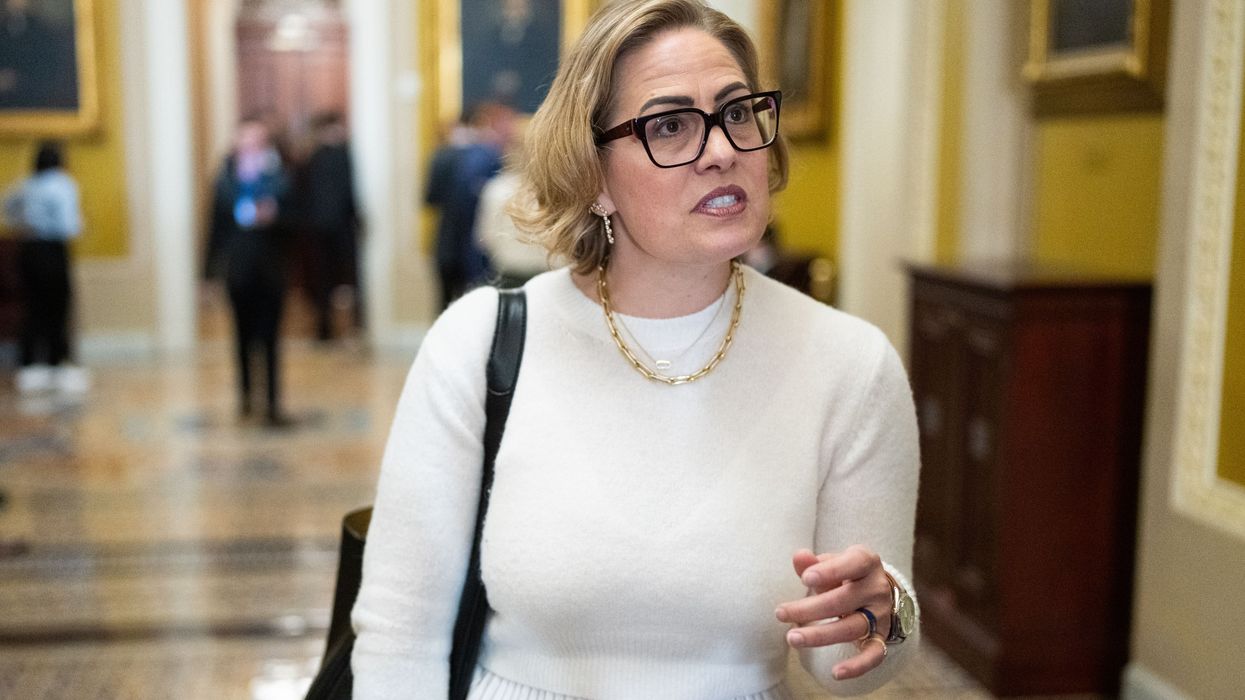
"She can't even be effective as a shill," said one critic of the ex-senator's lobbying.
Congresswoman Alexandria Ocasio-Cortez was among those celebrating after the Chandler, Arizona City Council on Thursday night unanimously rejected an artificial intelligence data center project promoted by former US Sen. Kyrsten Sinema.
"Good!" Ocasio-Cortez (D-NY) simply said on social media Friday.
The defeat of the proposed $2.5 billion project comes as hundreds of advocacy groups and progressive leaders, including US Sen. Bernie Sanders (I-Vt.), are urging opponents of energy-sucking AI data centers across the United States to keep pressuring local, state, and federal leaders over climate, economic, environmental, and water concerns.
In Chandler, "the nearly 43,000-square-foot data center on the corner of Price and Dobson roads would have been the 11th data center in the Price Road Corridor, an area known for employers like Intel and Wells Fargo," the Arizona Republic reported.
The newspaper noted that around 300 people attended Thursday's meeting—many holding signs protesting the project—and city spokesperson Matthew Burdick said that the government received 256 comments opposing the data center.
Although Sinema skipped the debate on Thursday, the ex-senator—who frequently thwarted Democratic priorities on Capitol Hill and ultimately ditched the party before leaving office—previously attended a planning and zoning commission meeting in Chandler to push for the project. That stunt earned her the title of "cartoon villain."
Sinema critics again took aim at her after the 7-0 vote, saying that "she can't even be effective as a shill" and "Sinema went all in to lobby for a data center in Chandler, Arizona and the council told her to get rekt."
Progressive commentator Krystal Ball declared: "Kyrsten Sinema data center L. Love to see it."
Politico noted Friday that "several other Arizona cities, including Phoenix and Tucson, have written zoning rules for data centers or placed new requirements on the facilities. Local officials in cities in Oregon, Missouri, Virginia, Arizona, and Indiana have also rejected planned data centers."
Janos Marton, chief advocacy officer at Dream.Org, said: "Another big win in Arizona, following Tucson's rejection of a data center. When communities are organized they can fight back and win. Don't accept data centers that hide their impacts behind NDAs, drive up energy prices, and bring pollution to local neighborhoods."
When Sinema lobbied for the Chandler data center in October, she cited President Donald Trump's push for such projects.
"The AI Action Plan, set out by the Trump administration, says very clearly that we must continue to proliferate AI and AI data centers throughout the country," she said at the time. "So federal preemption is coming. Chandler right now has the opportunity to determine how and when these new, innovative AI data centers will be built."
Trump on Thursday signed an executive order (EO) intended to block states from enforcing their own AI regulations.
"I understand the president has issued an EO. I think that is yet to play itself out," Chandler Mayor Kevin Hartke reportedly said after the city vote. "Really, this is a land use question, not [about] policies related to data centers."