SUBSCRIBE TO OUR FREE NEWSLETTER
Daily news & progressive opinion—funded by the people, not the corporations—delivered straight to your inbox.
5
#000000
#FFFFFF
To donate by check, phone, or other method, see our More Ways to Give page.

Daily news & progressive opinion—funded by the people, not the corporations—delivered straight to your inbox.

Today, Representatives Seth Moulton, Alexandria Ocasio-Cortez, and Jim Costa and Senators Ed Markey and Kirsten Gillibrand began circulating a bicameral letter addressed to the committee chairs and leadership of both chambers. They are seeking increased funding for high-speed rail in the American Jobs Plan. The group represents a broad coalition within the Democratic party making a united appeal to fund high-speed rail at levels that equal the funding Congress provides to road and air travel.
In the letter, the lawmakers said, "With the new administration, we have a generational opportunity to invest in our nation's infrastructure, and we are grateful for your leadership in ensuring we invest in next generation infrastructure, not just the infrastructure of the past. As negotiations continue to develop around a comprehensive infrastructure package, we write to express our support for the inclusion of dedicated funding to develop international-standard high-speed rail with high-performance connections that feed into a larger network. A federal commitment to these modern and proven transportation systems will dramatically improve our environment, reduce inequity, and help grow cities and sustain vibrant downtowns across the nation."
The letter has received early endorsements from the following organizations as of press time: The American Public Transportation Association (APTA); The High Speed Rail Alliance; The U.S. High Speed Rail Association; Former Amtrak Vice President of High-Speed Rail and Immediate Past Chair of the APTA High-Speed and Intercity Passenger Rail Committee Al Engel; Brightline Trains; SYSTRA USA; Building America's Future; Emeritus Chair of California High Speed Rail Authority and former APTA Chair Rod Dirido; the American Train Dispatchers Association; National Conference of Firemen & Oilers, SEIU; American Train Dispatchers Association; HJI Group Corporation; Cascadia Rail; and Transportation for Massachusetts.
The full text of the letter is as follows:
Dear Leader Schumer, Speaker Pelosi, Leader McConnell, Leader McCarthy, Chair Cantwell, Chairman DeFazio, Ranking Member Wicker, and Ranking Member Graves:
With the new administration, we have a generational opportunity to invest in our nation's infrastructure, and we are grateful for your leadership in ensuring we invest in next generation infrastructure, not just the infrastructure of the past. As negotiations continue to develop around a comprehensive infrastructure package, we write to express our support for the inclusion of dedicated funding to develop international-standard high-speed rail with high-performance connections that feed into a larger network. A federal commitment to these modern and proven transportation systems will dramatically improve our environment, reduce inequity, and help grow cities and sustain vibrant downtowns across the nation.
Reducing emissions from the transportation sector is critical to meeting our nation's climate goals and cutting our carbon footprint. According to an Environmental Protection Agency report, the transportation sector accounted for 28 percent of total greenhouse gas emissions from 1990 to 2018, making it the largest contributing sector.[1]
A robust network of high-speed rail corridors with high-performance connections is the best option to dramatically reduce carbon emissions while improving intercity travel. It will be decades before aviation is carbon-free, and electric cars - although vital - will not improve highway speeds. By contrast, electrified high-speed rail will capture a significant portion of demand for travel between 250 and 1000 miles with greater efficiency than flying or driving. Notably, the average and median distances of American long-distance travel are 744 and 391 miles, respectively.[2] High-speed rail also dramatically reduces land use: a single high-speed rail line matches the capacity of six highway lanes, 91 airport gates, and two new runways.
As we rebuild coming out of the pandemic, investing in a high-speed rail network with high-performance rail connections will create direct, good-paying, and secure jobs immediately, while enabling long-term economic growth across whole megaregions and providing vital access to opportunity for smaller communities. Good-paying jobs provide benefits through construction and engineering, steel production, and manufacturing in the rail sector, but also result in economic development around stations both in major cities and in intermediate communities. High-speed rail also reduces regional disparities--as it did in China by an average of 25% [3]--through increased access to jobs and housing. A high-speed rail line from Chicago to Atlanta is equivalent to Beijing to Shanghai, and would connect the people and economies of intermediate cities like Indianapolis, Louisville, Nashville, and Chattanooga with two top-ten Gross Metropolitan Product metropolises.
A recent study by Microsoft, Oregon, Washington, and British Columbia of the Cascadia Corridor estimated $355 billion in economic benefits from building a 250 mph high-speed rail line, a 10:1 return on investment. Consider an alternative: adding a lane of highway in each direction would cost more than twice as much, the study estimates, and accrue almost no additional economic benefits because travel times would not improve. Likewise, making only modest investments to existing rail service would provide travelers with an attractive alternative to driving, but would not improve overall travel times enough to generate anywhere near this scale of economic benefits. Even countries like Morocco, with roughly half a percent of the U.S. GDP, are building true high-speed rail because the return on investment is so positive.
Properly designed, high-speed trunk lines form the backbone of a broader integrated network. Airport connections to high-speed rail in Europe and Asia are routine, as are higher-speed feeders, and local connections speed travelers at low environmental cost to their destinations. Germany and France, for instance, have prioritized high-speed rail for domestic travel, with connections to airports for international travel. In San Jose, California, high-speed rail will connect to a hub with six rail systems and several bus lines at Diridon Station. Seamless connections such as this boost the ridership and economic efficiency of all the component elements. In addition, a series of high-performance rail lines will ensure that smaller and more historically disadvantaged communities have their own connections into a larger national network of travel and opportunity.
As Congress advances legislation to build back better as a nation, we urge you to create a carve-out for dedicated high-speed rail corridor planning and development grants, which will enable investments in high-speed and high-performance rail. In the event that Congress advances the American Jobs Plan through budget reconciliation, we request that you raise the topline funding levels for transportation in the budget resolution above the American Jobs Plan number to include dedicated high-speed rail corridor planning and development funding with high-performance rail connections. This will demonstrate that the federal government is ready to commit as a partner in developing high-speed rail corridors across the United States, connecting communities, enhancing economic development, and protecting our environment.
Thank you for your full and fair consideration of these requests. We stand ready to work with you to deliver an infrastructure package for the American people. |
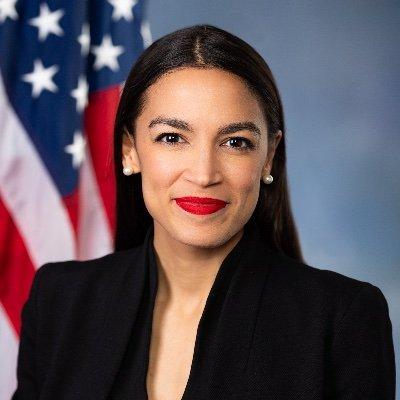
Alexandria Ocasio-Cortez is an American politician serving as the U.S. Representative for New York's 14th congressional district.
(718) 662-5970"Professional sports teams should be owned and controlled by the fans who love them, not by the multibillionaire oligarchs," Sanders said.
US Sen. Bernie Sanders and Rep. Greg Casar on Tuesday introduced a bill that would require owners of professional sports franchises who are considering relocating to give the communities in which they are located a chance to buy the teams first.
"The American people are sick and tired of billionaires threatening to move the sports teams they own to different states unless they get hundreds of millions in corporate welfare to build new stadiums,” Sanders (I-Vt.) said in a statement announcing the Home Team Act.
"In my view, professional sports teams should be owned and controlled by the fans who love them, not by the multibillionaire oligarchs who are getting even richer by charging outrageous prices and getting taxpayers to pick up their extravagant costs," he continued.
"You shouldn’t have to be wealthy to take your family to a football game," Sanders added. "You shouldn’t have to fear that a multibillionaire will move your favorite team to a different city if taxpayers refuse to subsidize it. The Home Team Act is a very modest piece of legislation that begins to address this problem. I am proud to support it.”
The Home Team Act is cosponsored by Democratic Sens. Chris Murphy and Richard Blumenthal of Connecticut—which lost the National Hockey League's Hartford Whalers to North Carolina in the 1990s—and five House Democrats.
If passed as written, the bill would:
“Sports in America should be about more than just making billionaire owners even richer," Casar said Thursday.
"Far too many Americans know the pain of losing a team, and far too many communities have had to fork over billions in subsidies just to keep an already profitable team home," he added. "Our bill is about creating a level playing field so leagues work for fans and taxpayers, not just owners.”
Sanders' office acknowledged that "team relocation has plagued communities across America for decades," from the Brooklyn Dodgers and New York Giants moving respectively to Los Angeles and San Francisco in 1958 to the Oakland Athletics—who previously called Philadelphia and Kansas City home—relocating to Sacramento and, eventually, Las Vegas.
Oaklanders have arguably felt the heartbreak of losing their beloved pro sports franchises more than any other US city, having lost the As, the NFL's Raiders, and the Warriors of the National Basketball Association in a five-year span.
"Currently, the Chicago Bears are threatening to leave the city after more than 100 years in response to the state of Indiana offering massive subsidies," Sanders' office said of the storied NFL franchise known for its passionately loyal fan base. "The bill would prevent the Bears from being moved across state lines without being offered for sale."
In his youth, Sanders—who grew up during a time when Jewish players dominated racially segregated professional basketball—was known for his killer mid-range jump shot. As a senator, he has championed professional athletes, especially baseball players, during their collective bargaining struggles against oligarch owners.
Sanders still holds a grudge against the former owner of the beloved Brooklyn Dodgers of his youth who relocated the team to Los Angeles in 1958, when he was a teenager. In 2018, he posted an old Brooklyn adage that "the three worst people in modern history were Adolf Hitler, Joseph Stalin, and Dodgers owner Walter O'Malley—but not necessarily in that order."
Serving in the House of Representatives at the time, Sanders even had a bit part in the 1999 comedy “My X-Girlfriend’s Wedding Reception," in which he played Manny Shevitz, a rabbi who argues that the Dodgers leaving Brooklyn was the "worst thing that ever happened."
"My bill is about basic fairness and making the ultrawealthy pay their fair share," said Sen. Elizabeth Warren. "It's time for the government to stop listening to the richest of the rich and start working for working people."
Backed by dozens of lawmakers, advocacy organizations, and labor unions, a trio of congressional Democrats on Thursday reintroduced the Ultra-Millionaire Tax Act, which would generate an estimated $6.2 trillion in revenue over the next decade by imposing a wealth tax on US fortunes above $50 million.
As the lead sponsors, Sen. Elizabeth Warren (D-Mass.) and Reps. Pramila Jayapal (D-Wash.) and Brendan Boyle (D-Pa.), highlighted in a statement, that estimated revenue is "more than double the score of the bill when it was first introduced five years ago, and enough money to pay for investments like universal childcare, free community college, Medicare expansion, and more—without raising taxes on 99.85% of American households."
The reintroduction comes just months away from the midterm elections. Democrats are working to reclaim control of Congress from President Donald Trump's Republican Party, which last year used its slim majorities in both chambers to push through a budget package that gave more tax cuts to the rich while cutting social programs for working families.
"While multimillionaires and billionaires are getting richer and richer, families are getting squeezed by a rigged economy," said Warren. "My bill is about basic fairness and making the ultrawealthy pay their fair share. It's time for the government to stop listening to the richest of the rich and start working for working people."
Under the bill, the country's wealthiest 260,000 households would pay a 2% annual tax on fortunes valued at over $50 million and an additional 1% on the net worth of households and trusts above $1 billion. The legislation would also impose a 40% "exit tax" on ultrarich individuals who renounce their citizenship for evasion purposes and would give the Internal Revenue Service $100 million in new funding.
"As millions of families are struggling under the weight of inflation, tariffs, and rising gas prices, the richest billionaires continue to see their net worth grow. We live in the richest country in the world, but that wealth is incredibly concentrated in a tiny group of people. It's time to tax the rich and level the playing field to ensure that every American has a chance to succeed," said Jayapal.
"The Ultra-Millionaire Tax Act is a major step toward making sure the wealthy finally pay their fair share," she continued. "With this legislation, we can narrow the racial wealth gap and invest trillions of dollars in healthcare, schools, clean energy, housing, and more to improve lives in communities across America."
At the beginning of 2026, an Institute for Policy Studies analysis found that the total wealth of US billionaires surged to $8.1 trillion last year—and the country's top 15 billionaires saw their collective fortune grow from $2.4 trillion to $3.2 trillion, more than double the S&P 500's 16% increase in 2025.
In the months since, even a columnist at the Rupert Murdoch-owned Wall Street Journal acknowledged that "billionaires' low taxes are becoming a problem for the economy," and Peter Mallouk, the CEO of wealth management firm Creative Planning, suggested that US wealth inequality "is 100% completely unsustainable as a society."
Boyle declared Thursday that "a secretary shouldn't pay a higher tax rate than the CEO. The current tax code is rigged against working people and the middle class. Our proposal finally changes this and makes billionaires pay their fair share."
Today, I'm introducing my wealth tax — and more than 50 members of Congress are joining me. It’s time for the government to start working for American families, not just the ultra-rich.
[image or embed]
— Elizabeth Warren (@warren.senate.gov) March 26, 2026 at 1:54 PM
Unions backing the bill include the American Federation of Government Employees; American Federation of Teachers; American Federation of State, County, and Municipal Employees (AFSCME); Communications Workers of America; Service Employees International Union; and United Steelworkers.
"Anti-worker extremists in Congress and their billionaire backers are slashing safety net programs and rigging the tax code to make the ultrawealthy richer as working families are pushed closer to the brink," said AFSCME president Lee Saunders. "The working people who keep this country running shouldn't be the ones carrying a heavier tax burden than the richest 0.1%."
"It's past time billionaires paid their fair share, so we can invest in the public services that working people need—from childcare to healthcare to food support," he argued. "Congress must pass Sen. Warren and Rep. Jayapal's Ultra-Millionaire Tax Act now."
Other organizations behind the bill include Americans for Tax Fairness, Climate Hawks Vote, Groundwork Collaborative, Indivisible, MomsRising, Oxfam America, Patriotic Millionaires, People's Action Institute, Public Citizen, the Sunrise Movement, and more.
“The United States is capable of sustaining the rich, stable, and free economy and country the vast majority of Americans—regardless of political party—actually want. The only way to ensure we get there, though, is by building a tax system that puts a check on the extreme inequality that threatens our economy and our democracy," said Patriotic Millionaires chair Morris Pearl.
"Millionaires like me want less inequality because we and our families will be better off in a society with less economic disparity. And it's not because I'm good or altruistic. I am not any more altruistic than the next person, I'm just greedy for a different kind of country than some other rich people in America," he continued. "I'm willing to pay more in taxes if it means helping us become the kind of country I know we can be. The Patriotic Millionaires are proud to support the Ultra-Millionaire Tax Act, and we urge Congress to act quickly to make this law."
Sen. Bernie Sanders (I-Vt.) and Rep. Ro Khanna (D-Calif.) introduced another bill to tax the rich—the Make Billionaires Pay Their Fair Share Act—earlier this month, but neither proposal is likely to advance in the GOP-controlled Congress.
However, as historian Lawrence Wittner highlighted in a Thursday opinion piece for Common Dreams, "campaigns for state tax-the-rich legislation are flourishing in California, Colorado, New York, Oregon, Rhode Island, Texas, and Virginia, and have already succeeded in getting such legislation adopted in Massachusetts and Washington."
"Most Americans support proposals to raise taxes on the rich," he noted, citing a January poll that found 80% of Americans saw wealth inequality as a problem, 80% said the rich had too much political power, and 78% said taxes on billionaires were too low. Wittner concluded that "it's time to tax the rich."
Democrats may have enough votes to pass a war powers resolution before the two-week recess, but party leaders have still not committed to doing so, even as the president appears ready for a ground invasion.
Backlash is continuing to grow after US House Democratic leaders made the decision to push off a war powers vote on President Donald Trump's Iran war for more than two weeks, even though they may have the votes to pass it immediately.
With Trump appearing poised to make the deathly unpopular decision to deploy ground troops into Iran within days, momentum around an act to restrict his warmaking capabilities only continues to grow.
Most of the Democrats who killed the last war powers resolution are now reportedly on board. So is Rep. Nancy Mace (R-SC), who emerged from a closed-door House Armed Services Committee briefing on Wednesday saying she was “even more” opposed to boots on the ground than when she entered.
But despite having introduced the resolution himself, Rep. Gregory Meeks (D-NY), the ranking member of the House Foreign Affairs Committee, appeared to get cold feet about bringing it to the floor for a vote before next week's recess, a move which was met with anger and confusion from progressive critics.
A spokesperson for Democrats on the committee told Common Dreams on Wednesday that Meeks was very much committed to passing a bill to "hold President Trump accountable for his reckless war of choice," but that one could not be pursued until April 13, after the recess, because some of the necessary "yes" votes had left Washington.
Drop Site News co-founder Ryan Grim described this as a "pathetic" excuse. "As Trump threatens a ground invasion, Democratic members of Congress are saying they won’t do the one thing they are elected to do: Show up and vote," he wrote on social media.
Additionally, Grim reported on Thursday that Reps. Eric Swalwell (D-Calif.) and Emanuel Cleaver II (D-Mo.) had since returned to town. The only Democrat not currently in DC, he said, was Rep. Jared Moskowitz (D-Fla.), who said on Wednesday that his wife was undergoing a routine surgery.
Axios reported on Thursday afternoon that Rep. Ted Lieu (D-Calif.) is also absent due to the recent death of his father, and Rep. Jared Golden (Maine), one of the Democrats who opposed the last war powers vote, was still wavering as of Wednesday.
Even with some absences, Republicans are also not at full strength. Assuming that Republican Reps. Thomas Massie (Ky.) and Warren Davidson (Ohio) plan to vote yes, as they did in February, there may still be enough votes for the resolution to pass.
When asked by Drop Site reporter Lily Franks on Thursday whether there were enough votes to pass the resolution, Meeks insisted, "We can't win the vote."
"When you see me put the bill on the floor, that means we're going to win," Meeks said sharply. "I know how to count. I know how to do my job."
When Franks pointed out that enough Republicans appeared to be on board, Meeks—continuing to interrupt—told her to "go find out" herself if there were enough votes.
"If only there were some mechanism on the House floor to find out how somebody might vote," Grim quipped in response.
The Democratic spokesperson could not be reached for comment when asked by Common Dreams whether Meeks was now planning to push for a resolution vote before the recess, given that some Democrats have returned to Washington.
Nathan Thompson, a senior policy adviser for Just Foreign Policy, argues that even if Democrats do not have the votes to pass the resolution now, there is no reason not to bring it to a vote.
"Forcing a vote will make House Republicans own an increasingly likely ground invasion," he said in a letter sent to House Democrats on Thursday morning, which was shared with Common Dreams. "Even a vote that falls short will be painful for House Republicans and put real pressure on the Trump administration."
"The attendance excuse doesn't hold," he said. "Members can return by tomorrow to vote, and Republicans aren't at full strength either... An unfortunate scheduling error should not prevent Congress from weighing in at a critical moment in history."
Calls for a war powers resolution on Capitol Hill continued to grow after reports that the Trump administration is mulling several potential ground operations in Iran, potentially as early as Friday.
Axios reported on Thursday that the Pentagon is considering "invading or blockading" Kharg Island, Iran’s primary oil export hub—and sending American forces “deep inside the interior of Iran” in an effort to seize the country’s enriched uranium.
The concerns about the repercussions of a prolonged war—even for just another two weeks—are broadly shared. Speaking on MS NOW on Thursday, former Defense Secretary and CIA Director Leon Panetta warned that serious dangers exist that a short extension of the war could lead to a much more intractable situation.
"If we continue the war," Panetta said, "if we go another 16 days of war and we incur casualties, or they incur serious casualties, then the likelihood is that you're planting the seeds for a more permanent war."
As the risk of a more protracted conflict was magnified on Wednesday, Trump insisted that the US is not at war at all, but is simply waging a "military operation" against Iran.
This has heightened the urgency among many Democrats on Capitol Hill, including Rep. Pramila Jayapal (D-Wash.).
"If it looks like a war, sounds like a war, and costs like a war… It’s probably a war," the former chair of the Congressional Progressive Caucus wrote on social media Thursday. "Trump is admitting to violating the Constitution. No amount of doublespeak can change that."
"Congress must vote on another war powers resolution," she added.
Rep. Delia Ramirez (D-Ill.) told Axios that there was "absolutely" frustration among progressives that Democrats were planning to punt the vote to next month.
Meanwhile, critics are increasingly raising suspicion that Meeks—whom The Lever noted received more than $2.2 million from pro-Israel lobbying groups according to the watchdog group TrackAIPAC—is intentionally dragging out the vote.
A prolonged war and the resulting economic turmoil are brutally unpopular, including among Republicans, and the theory goes that Democrats may seek to let it become an albatross around their opponents' necks in this fall's midterms.
Independent journalist Aída Chávez has emphasized that Meeks held up the previous war powers vote by overinflating the number of Democrats likely to defect, and may have attempted to do so again.
But with Democratic stragglers on board and more Republicans "starting to break," Chávez said: "Democratic leadership can’t keep hiding behind process.
"Bring the Iran war powers resolution to the floor right now," she said.
Thompson of Just Foreign Policy warned Democrats that "failing to force a vote will be noticed and covered in the media," and that "the Democratic base is watching and expects their party to put up a real fight."
"Even if the vote falls short by a couple votes, the members who voted yes will have a powerful record to champion to their constituents," he said. "The members who voted no will have a very difficult record to explain if troops end up being killed and injured on the ground in Iran."