

SUBSCRIBE TO OUR FREE NEWSLETTER
Daily news & progressive opinion—funded by the people, not the corporations—delivered straight to your inbox.
5
#000000
#FFFFFF
To donate by check, phone, or other method, see our More Ways to Give page.
Daily news & progressive opinion—funded by the people, not the corporations—delivered straight to your inbox.

A new study by Environmental Working Group scientists finds almost 42,000 potential sources of the toxic "forever chemicals" known as PFAS that could be polluting surface water or drinking water in communities across the U.S.
The study bolsters EWG's long-running calls for strict PFAS regulations, in addition to more testing.
PFAS pollution affects all communities, from the affluent to those near the fence lines of industrial facilities. More work is urgently needed to identify areas where residents might face greater health risks from contaminated water.
EWG researchers analyzed potential sources of PFAS contamination in drinking water supplies nationwide, using public data from the Environmental Protection Agency's Enforcement and Compliance History Online database.
The facilities that appeared most often as possible sources were solid waste landfills, wastewater treatment plants, electroplaters and metal finishers, and petroleum refiners.
The analysis was published in a special issue of the American Water Works Association Water Science journal featuring the latest PFAS research.
PFAS are called forever chemicals because they build up in our bodies and never break down in the environment.
"It is critical that the EPA start regulating PFAS - now," said David Andrews, Ph.D., the lead author of the study and a senior scientist at EWG. "Every community in the U.S. is likely affected by PFAS contamination, but those living near or downstream from industrial facilities may be more at risk.
"Our investigation identifies a huge number of potential sources of contamination. It also provides a framework for deciding where and what to test so we can end releases into the environment," Andrews added.
In March, EWG-commissioned tests of tap water samples from throughout Northern Virginia revealed PFAS contamination at levels significantly higher than those previously reported for other parts of the Washington, D.C., metro area.
Valuable case studies of data available from California and Michigan show that PFAS contamination is common at many different types of sites and that widespread testing for PFAS in wastewater is crucial.
"The results from states like Michigan show there is a wide variety of sources of PFAS in surface water," said Andrews. "Many landfills and industrial sites release PFAS at detectable concentrations that may exceed state limits or health guidelines for PFAS in water.
"It is urgent that ongoing releases of PFAS be identified. We need to stop non-essential uses of PFAS and use filters to reduce these compounds from out water," he said.
Industrial PFAS discharges in Michigan have gone down substantially as a result of widespread testing, permitting of discharges and added treatment. In 2018, state officials set water quality standards for PFOA and PFOS, the two most notorious PFAS compounds, for discharges into drinking water supplies.
State law prohibits releases from wastewater utilities of more than 420 parts per trillion, or ppt, for PFOA and 11 ppt for PFOS.
Results from tests of water downstream from manufacturing facilities and from PFAS users across the U.S. revealed many previously unknown PFAS, which confirmed the need for broad testing of industrial facilities across the entire class of PFAS compounds.
PFAS are among the most persistent toxic compounds in existence, contaminating everything from drinking water to food, food packaging and personal care products. They are found in the blood of virtually everyone on Earth, including newborn babies.
Very low doses of PFAS chemicals in drinking water have been linked to suppression of the immune system and are associated with an elevated risk of cancer, increased cholesterol, and reproductive and developmental harms, among other serious health concerns.
Reducing PFAS levels in surface water and drinking water remains a nationwide challenge. But it's one that can be met through comprehensive tests of surface water and drinking water, along with tests of wastewater from potential PFAS sources.
The Biden administration also needs to use the EPA's powers to regulate as many industrial categories of PFAS discharges as possible.
"We need to turn off the tap of PFAS pollution from these industrial discharges, which affects more and more Americans every day. That's the first step," said Scott Faber, EWG's senior vice president for government affairs.
"The second step is for the EPA to set a national PFAS drinking water standard. And the third is to clean up legacy pollution," Faber added.
The EPA's proposal to regulate some industrial discharges of PFAS into our drinking water falls short of what's needed to end the pollution flowing from companies. EWG's new research shows that the contamination is likely even more widespread across the U.S. than has been confirmed, further underscoring the need for swift regulatory action.
The Environmental Working Group is a community 30 million strong, working to protect our environmental health by changing industry standards.
(202) 667-6982
US Central Command said that the "lone ISIS gunman" who targeted the Americans "was engaged and killed."
This is a developing story… Please check back for updates…
Despite publicly seeking a Nobel Peace Prize, President Donald Trump on Saturday told reporters that "we will retaliate" after US Central Command announced that a solo Islamic State gunman killed three Americans—two service members and one civilian—and wounded three other members of the military.
"This is an ISIS attack," Trump said before departing the White House for the Army-Navy football game in Baltimore, according to the Associated Press. He also said the three unidentified American survivors of the ambush "seem to be doing pretty well."
US Central Command said that the "lone ISIS gunman" who targeted the Americans "was engaged and killed," and that in accordance with Department of Defense policy, "the identities of the service members will be withheld until 24 hours after their next of kin have been notified."
Citing three local officials, Reuters reported that the attacker "was a member of the Syrian security forces."
The news agency also noted that a Syrian Interior Ministry spokesperson, Noureddine el-Baba, told the state-run television channel Al-Ikhbariya that the man did not have a leadership role.
"On December 10, an evaluation was issued indicating that this attacker might hold extremist ideas, and a decision regarding him was due to be issued tomorrow, on Sunday," the spokesperson said.

"Noem's decision to rip up the union contract for 47,000 TSA officers is an illegal act of retaliatory union busting that should cause concern for every person who steps foot in an airport," said the AFGE president.
On the heels of a major win for federal workers in the US House of Representatives, the Transportation Security Administration on Friday revived Homeland Security Secretary Kristi Noem's effort to tear up TSA employees' collective bargaining agreement.
House Democrats and 20 Republicans voted Thursday to restore the rights of 1 million federal workers, which President Donald Trump had moved to terminate by claiming their work is primarily focused on national security, so they shouldn't have union representation. Noem made a similar argument about collective bargaining with the TSA workforce.
A federal judge blocked Noem's first effort in June, in response to a lawsuit from the American Federation of Government Employees, but TSA moved to kill the 2024 agreement again on Friday, citing a September memo from the Department of Homeland Security (DHS) chief. AFGE pledged to fight the latest attack on the 47,000 transportation security officers it represents.
"Secretary Noem's decision to revoke our union contract is a slap in the face to the dedicated workforce that shows up each and every day for the flying public," declared AFGE Council 100 president Hydrick Thomas. "TSA officers take pride in the work we perform on behalf of the American people—many of us joined the agency following the September 11 attacks because we wanted to serve our country and make sure that the skies are safe for air travel."
"Prior to having a union contract, many employees endured hostile work environments, and workers felt like they didn't have a voice on the job, which led to severe attrition rates and longer wait times for the traveling public. Since having a contract, we've seen a more stable workforce, and there has never been another aviation-related attack on our country," he noted. "AFGE TSA Council 100 is going to keep fighting for our union rights so we can continue providing the very best services to the American people."
As the Associated Press reported:
The agency said it plans to rescind the current seven-year contract in January and replace it with a new "security-focused framework." The agreement... was supposed to expire in 2031.
Adam Stahl, acting TSA deputy administrator, said in a statement that airport screeners "need to be focused on their mission of keeping travelers safe."
"Under the leadership of Secretary Noem, we are ridding the agency of wasteful and time-consuming activities that distracted our officers from their crucial work," Stahl said.
AFGE national president Everett Kelley highlighted Friday that "merely 30 days ago, Secretary Noem celebrated TSA officers for their dedication during the longest government shutdown in history. Today, she's announcing a lump of coal right on time for the holidays: that she’s stripping those same dedicated officers of their union rights."
"Secretary Noem's decision to rip up the union contract for 47,000 TSA officers is an illegal act of retaliatory union busting that should cause concern for every person who steps foot in an airport," he added. "AFGE will continue to challenge these illegal attacks on our members' right to belong to a union, and we urge the Senate to pass the Protect America's Workforce Act immediately."
American Federation of Labor and Congress of Industrial Organizations (AFL-CIO) president Liz Shuler similarly slammed the new DHS move as "an outrageous attack on workers' rights that puts all of us at risk" and accused the department of trying to union bust again "in explicit retaliation for members standing up for their rights."
"It's no coincidence that this escalation, pulled from the pages of Project 2025, is coming just one day after a bipartisan majority in the House of Representatives voted to overturn Trump's executive order ripping away union rights from federal workers," she also said, calling on senators to pass the bill "to ensure that every federal worker, including TSA officers, are able to have a voice on the job."
The DHS union busting came after not only the House vote but also a lawsuit filed Thursday by Benjamin Rodgers, a TSA officer at Denver International Airport, over the federal government withholding pay during the 43-day shutdown, during which he and his co-workers across the country were expected to keep reporting for duty.
"Some of them actually had to quit and find a separate job so they could hold up their household with kids and stuff," Rodgers told HuffPost. "I want to help out other people as much as I can, to get their fair wages they deserve."
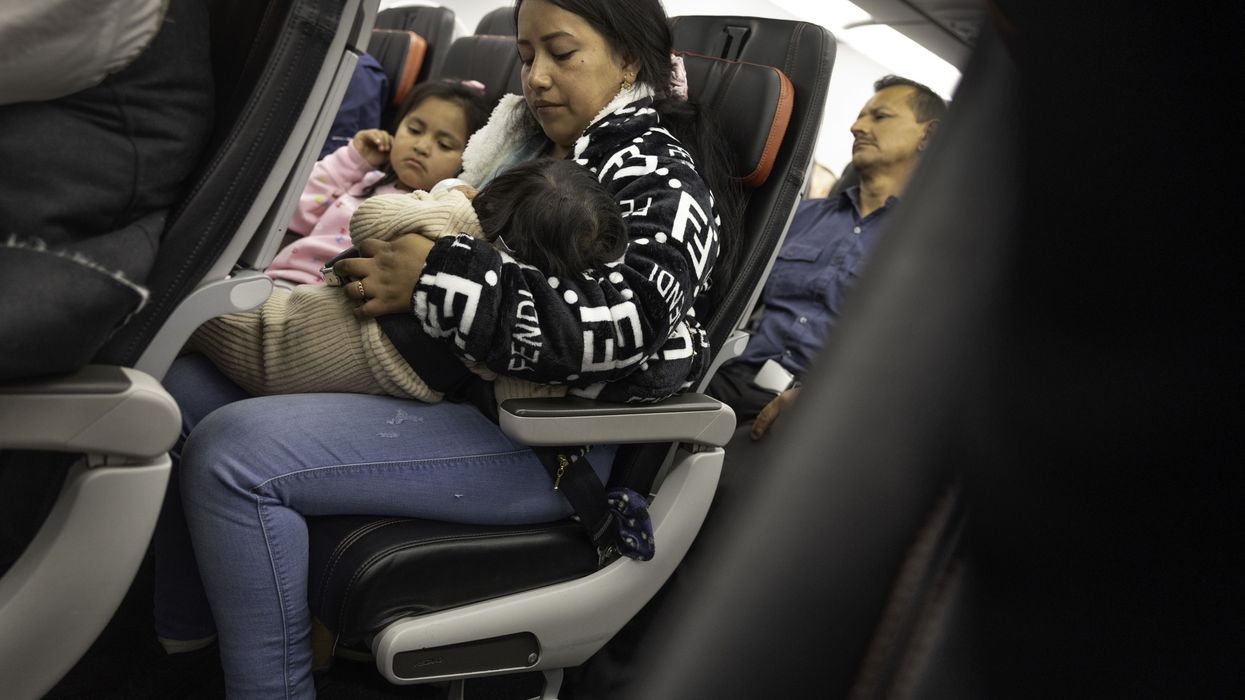
"We will continue to fight alongside all immigrants and their families who are unjustly targeted by this callous administration," vowed the legal director at Justice Action Center.
As a "chilling" report in the New York Times revealed that the Transportation Security Administration is providing the names of all airline passengers to immigration officials, President Donald Trump's administration on Friday also openly continued its war on immigrants by announcing an end to allowing relatives of citizens or lawful permanent residents to enter the United States while awaiting green cards.
The US Department of Homeland Security (DHS) said in a statement that it is terminating all categorical family reunification parole programs for immigrants from Colombia, Cuba, Ecuador, El Salvador, Guatemala, Haiti, and Honduras, and "returning parole to a case-by-case basis." An official notice has been prepared for publication in the Federal Register on Monday, and the policy is set to take effect on January 14.
Responding in a statement late Friday, Anwen Hughes, senior director of legal strategy for the refugee programs at Human Rights First, said that "this outrageous decision to pull the rug out from under the thousands of people who came to the US lawfully to reunite with their families is shocking."
"Yet again, this administration is taking extraordinary measures to delegalize as many people as possible, even when they have done everything the US government has asked of them," she continued. "The government did this in March when they announced their intent to take away lawful status from hundreds of thousands of humanitarian parole beneficiaries; they are doing it now with more than 10,000 people who came lawfully to reunite with their families; they are taking their attacks on birthright citizenship to the Supreme Court; and they are escalating their threats to delegalize untold numbers of others without notice."
"This outrageous decision to pull the rug out from under the thousands of people who came to the US lawfully to reunite with their families is shocking."
Guerline Jozef, executive director of the grassroots group Haitian Bridge Alliance, said in a Saturday statement: "Let's be clear: This is not about security. This is about an administration using racist, nativist scare tactics to dismantle lawful family reunification and terrorize Black and Brown immigrants."
"Family reunification parole was created to keep families together and provide a safe, legal pathway while people waited for visas that the US government itself told them would take years," Jozef noted. "Now those same families—many of them Haitian—are being punished for trusting the system. It is state violence, it is anti-Black, and it is an unacceptable betrayal of basic human dignity."
Lawyers behind a class action lawsuit against DHS Secretary Kristi Noem and other key administration leaders over the March policy—Svitlana Doe v. Noem—plan to also challenge the new move.
"Those who entered under the family reunification program should contact their immigration attorney immediately to better understand their options, as those options may change on December 15," warned Esther Sung, legal director at Justice Action Center, which represented plaintiffs in the earlier case.
"The legal team in Svitlana Doe v. Noem will also alert the court as soon as possible to ensure that our clients and class members are not unlawfully harmed by this move," Sung said. "Today's news is devastating for families across the country, but we will continue to fight alongside all immigrants and their families who are unjustly targeted by this callous administration."
Ending family reunification parole won't make us safer, it will only tear families apart. Our immigration policies should be fair and humane. This is just cruel.www.uscis.gov/newsroom/ale...
[image or embed]
— Rep. Linda Sánchez (@replindasanchez.bsky.social) December 12, 2025 at 2:36 PM
Meanwhile, as the Times reported Friday, in March, TSA began sending the names of all air travelers to another DHS agency, Immigration and Customs Enforcement (ICE), which "can then match the list against its own database of people subject to deportation and send agents to the airport to detain those people."
"It's unclear how many arrests have been made as a result of the collaboration," the newspaper detailed. "But documents obtained by the New York Times show that it led to the arrest of Any Lucía López Belloza, the college student picked up at Boston Logan Airport on November 20 and deported to Honduras two days later. A former ICE official said 75% of instances in that official's region where names were flagged by the program yielded arrests."
In López Belloza's case, she tried to board her plane, but her ticket didn't work. The 19-year-old—who said she didn't know about a previous deportation order—was sent to customer service, where she was met by agents with Customs and Border Protection (CBP), another DHS agency playing a key role in Trump's sweeping and violent crackdown on immigrants.
Like the new attack on family reunification, the Times reporting sparked a wave of condemnation. David Kaye, a law professor at the University of California, Irvine, said on social media, "Make sure people you know who need this information have this information."
Jonathan Cohn, political director for the group Progressive Mass, declared that "the Trump administration wants to make flying unsafe: unsafe because of surveillance, unsafe because of understaffed air traffic controllers, and unsafe because of gutted consumer protections."
Eva Galperin, the Electronic Frontier Foundation's director of cybersecurity, pointed to the constitutional protection from unreasonable searches and seizures, saying, "I'm not a lawyer, but I feel like the Fourth Amendment has something to say about this."
Immigration Agents Are Using Air Passenger Data for Deportation EffortThe Transportation Security Administration is providing passenger lists to ICE to identify and detain travelers subject to deportation orders.www.nytimes.com/2025/12/12/u... obvi lawlessly…Prosecute all of them…
[image or embed]
— Sarah Szalavitz💡 (@dearsarah.bsky.social) December 12, 2025 at 4:14 PM
Amid protests over Trump's broader deportation push and the president's plunging approval rating on immigration, unnamed DHS sources confirmed Friday that CBP teams "under Commander Gregory Bovino will change tactics," according to NewsNation. "Instead of sweeping raids like those that have taken place at locations including Home Depot, agents will now be narrowing their focus to specific targets, such as illegal immigrants convicted of heinous crimes."
NewNation's reporting came just days after DHS published a database on ICE arrestees that led Aaron Reichlin-Melnick, a senior fellow at the American Immigration Council, to conclude that the department "is implicitly admitting that less than 5% of the people it arrests are people they believe are 'the worst of the worst.'"
This article has been updated with comment from Haitian Bridge Alliance.