

SUBSCRIBE TO OUR FREE NEWSLETTER
Daily news & progressive opinion—funded by the people, not the corporations—delivered straight to your inbox.
5
#000000
#FFFFFF
To donate by check, phone, or other method, see our More Ways to Give page.
Daily news & progressive opinion—funded by the people, not the corporations—delivered straight to your inbox.
Michael Neuwirth
Chief Communications Officer, ASBN
mneuwirth@asbcouncil.org
The country's leading small business organizations united today to express their opposition to the attack on voting rights and support the United States Senate passing voting rights legislation using filibuster reform to protect the fundamentals of American democracy.
While the Senate continues to debate voting rights legislation, it is critical to note that business owners' voices in many states are being suppressed, particularly those in communities of color.
Polling shows that entrepreneurs, especially those of color, feel disadvantaged within the political system and want equitable access to the lawmakers and votes that impact their lives and livelihoods. There is a direct link between a functioning and truly representative government and a functioning market economy. Entrepreneurship depends on a democracy in which people know that if they have a good idea to serve a market need and are willing to sacrifice and work diligently, their idea can become a successful, profitable business for themselves, their families, and their communities. The Senate must do its part to protect every eligible American's right to vote and guarantee that election results are respected by passing fair and transparent voting rights legislation.
Failing to pass voting rights legislation that protects our democracy threatens our economy. Allowed to continue, these anti-democracy actions will result in an autocratic government favoring politically-connected special interests that will sap the will of the entrepreneurs who drive our local, state, and national economies.
A national survey shows small business owners are concerned about the state of our democracy and favor expanding voting rights. Business owners need to know that our leaders' concerns and interests are being addressed and not overshadowed by the desires of wealthy elites that use their exorbitant resources to garner direct access to political figures. Passing voting rights legislation is crucial to ensuring small businesses have an opportunity to impact the political process.
Another national survey released last week found that businesses with over 250 employees expressed the same concerns about the state of our democracy and the need for a well-functioning democracy to maintain a stable economy. Respondents to this survey also overwhelmingly supported the passage of voting the Freedom to Vote Act and the John Lewis Voting Rights Advancement Act by amending Senate rules if necessary.
Changing Senate rules to expedite important legislation is neither new nor radical. The body already allows more than 160 types of votes and legislation to pass by a simple majority, including just in the last few weeks bypassing the filibuster rules to pass an increase in the debt ceiling.
Our government has no more important job than protecting the health and stability of our democracy. Failing to use this standard tool to protect the one-person, one-vote foundation of our country would be a foolish adherence to a process that would threaten the long-term health of our economy as well as nearly 250 years of self-determination. Failure to act would be the most alarming and radical course of action.
We stand united in support of immediate Senate passage of the Freedom to Vote Act and the John Lewis Voting Rights Advancement Act.
"I am grateful for business leaders and community voices like the American Sustainable Business Network, Main Street Alliance, Small Business Majority, and the Small Business for America's Future, for speaking up and speaking out against the rampant efforts to take away citizens' freedom to vote," said Senator Jeff Merkley (D-OR). "It shouldn't matter where you live, how much money you have, or the color of your skin--we all deserve the same chance to cast our ballots and know our vote will count. Our small business owners are a driving force of our economy, and their voices should not be overshadowed by string-pulling wealthy elites. I applaud the strong voices within our small business communities for their concerted fight to protect American citizens' sacred right to vote."
"A sustainable and just economy needs a strong democracy in which all Americans are able to participate with their votes and their voices. However, American Democracy is under attack in many states across the country," said Thomas Oppel, American Sustainable Business Network Executive Vice President. "Congress has a duty under Section 1 of the Constitution to protect every American's right to vote, but the current Senate filibuster rules clearly stand in the way of Congress protecting our rights. On behalf of the more than 500,000 businesses our collective organizations represent, ASBN has been an outspoken advocate on behalf of the Freedom to Vote Act, For the People Act (S.1) and the John Lewis Voting Rights Advancement Act. We commend House and Senate leadership on their support for a 'carve out' of the filibuster in which the Senate rules would be changed to permit Constitutional issues, such as voting rights, to pass with a simple 51-vote majority. We call on the U.S. Senate to take the needed actions to enable it to be faithful to our Constitution."
"As a Black woman growing up in the south, I understand the power of the vote! Small business voices are critical and must be protected," said Chanda Causer, Co-Executive Director Main Street Alliance. "The Freedom to Vote Act reflects our shared values as Americans, but politics have once again blocked even having a debate on the bill. We need lasting, structural change to reassure small businesses that our democracy is healthy so that we can get to the business of resilient economic recovery. The Senate must do whatever it takes to pass the Freedom to Vote Act."
"Protecting the right to vote for all Americans, especially those who have been marginalized, is critical to creating an equitable path to entrepreneurship and an inclusive economy," said John Arensmeyer, Founder & CEO of Small Business Majority. "Congress must do all that it can to ensure a fair and transparent political system that will give all citizens equal access to voting and allow small businesses to impact the political process. This means creating a carve-out to the filibuster rule to advance critical voting rights legislation."
"It is not a coincidence that the United States has a strong democracy and a thriving entrepreneurial economy that is second to none. The two go together," said Frank Knapp Jr., Co-Chair of Small Business for America's Future. "Small business owners understand that when voting rights are stripped from any of us, we all lose our influence over government actions. Economic prosperity is tied directly to a healthy democracy, and small business owners want Congress to protect both."
On September 8, 2021, small business owners and community organizations participated in a special event with House Majority Whip James E. Clyburn to discuss the need to prevent laws suppressing Americans' voting rights across the country, discuss why voting rights are essential to democracy and entrepreneurship, and learn about the history of the filibuster. To listen to the recording of the September 8 event, visithttps://tinyurl.com/4w86j7xz.
A recording of today's event is available here: https://vimeo.com/664887272
The American Sustainable Business Council (ASBC) advocates for policy change and informs business owners, policymakers and the public about the need and opportunities for building a vibrant, broadly prosperous, sustainable economy. Founded in 2009, its membership represents over 250,000 businesses in a wide range of industries.
(202) 660-1455
"If Trump is using this justification to use military force on any individuals he chooses... what’s stopping him from designating anyone within our own borders in a similar fashion and conducting lethal, militarized attacks against them?"
A Democratic senator is raising concerns about President Donald Trump potentially relying on the same rationale he's used to justify military strikes on purported drug trafficking vessels to kill American citizens on US soil.
In an interview with the Intercept, Sen. Tammy Duckworth (D-Ill.) argued that Trump's boat strikes in the Caribbean and the Pacific Ocean have been flatly illegal under both domestic and international law.
Diving into specifics, Duckworth explained that the administration has been justifying its boat-bombing spree by arbitrarily declaring suspected drug traffickers as being part of "designated terrorist organizations," which the senator noted was "not grounded in US statute nor international law, but in solely what Trump says."
Many other legal experts have called the administration's strikes illegal, with some going so far as to call them acts of murder.
Duckworth, a military veteran, also said it was not a stretch to imagine Trump placing terrorist designations on US citizens as well, which would open up the opportunity to carry out lethal strikes against them.
"If Trump is using this justification to use military force on any individuals he chooses—without verified evidence or legal authorization—what’s stopping him from designating anyone within our own borders in a similar fashion and conducting lethal, militarized attacks against them?" Duckworth asked. "This illegal and dangerous misuse of lethal force should worry all Americans, and it can’t be accepted as normal."
Independent journalist Ken Klippenstein reported last week that Attorney General Pam Bondi recently wrote a memo that directed the Department of Justice (DOJ) to compile a list of potential “domestic terrorism” organizations that espouse “extreme viewpoints on immigration, radical gender ideology, and anti-American sentiment.”
The memo expanded upon National Security Presidential Memorandum-7 (NSPM-7), a directive signed by Trump in late September that demanded a “national strategy to investigate and disrupt networks, entities, and organizations that foment political violence so that law enforcement can intervene in criminal conspiracies before they result in violent political acts."
The Intercept revealed that it reached out to the White House, the DOJ, and the US Department of Defense and asked whether the tactics used on purported Caribbean drug traffickers could be deployed on the US citizens that wind up on Bondi's list of extremists. All three entities, reported the Intercept, "have, for more than a month, failed to answer this question."
The DOJ, for instance, responded the Intercept's question about using lethal force against US citizens by saying that "political violence has no place in this country, and this Department of Justice will investigate, identify, and root out any individual or violent extremist group attempting to commit or promote this heinous activity."
Rebecca Ingber, a former State Department lawyer and current professor at Cardozo Law School, told the Intercept that the administration's designation of alleged cartel members as terrorists shows that there appears to be little limit to its conception of the president's power to deploy deadly force at will.
“This is one of the many reasons it is so important that Congress push back on the president’s claim that he can simply label transporting drugs an armed attack on the United States and then claim the authority to summarily execute people on that basis," Ingber explained.
The Intercept noted that the US government "has been killing people—including American citizens, on occasion—around the world with drone strikes" for the past two-and-a-half decades, although the strikes on purported drug boats represent a significant expansion of the use of deadly force.
Nicholas Slayton, contributing editor at Task and Purpose, pointed the finger at former President Barack Obama for pushing the boundaries of drone warfare during his eight years in office.
"Really sucks that Obama administration set a legal precedent for assassinating Americans," he commented on Bluesky.

"The American public is demanding decisive action to end US complicity in the Israeli government’s war crimes by stopping the flow of weapons to Israel."
Jewish Voice for Peace Action on Friday led a coalition of groups demanding that the Democratic Party stop providing arms to the Israeli government.
Speaking outside the Democratic National Committee’s Winter Meeting in Los Angeles, Jewish Voice for Peace Action (JVP Action) held a press conference calling on Democrats to oppose all future weapons shipments to Israel, whose years-long assault on Gaza has, according to one estimate, killed more than 100,000 Palestinian people.
While carrying banners that read, "Stop Arming Israel," speakers at the press conference also called on Democrats to reject money from the American Israeli Political Action Committee (AIPAC), which has consistently funded primary challenges against left-wing critics of Israel.
JVP Action was joined at the press conference by representatives from Health Care 4 US (HC4US), Progressive Democrats of America, the Council on American-Islamic Relations Action (CAIR Action), and the United Teachers of Los Angeles (UTLA) Board of Directors.
Estee Chandler, founder of the Los Angeles chapter of Jewish Voice for Peace, warned Democrats at the press conference that they risked falling out of touch with public opinion if they continued to support giving weapons to Israel.
"The polls are clear,” Chandler said. "The American public is demanding decisive action to end US complicity in the Israeli government’s war crimes by stopping the flow of weapons to Israel, and the Democratic Party refusing to heed that call will continue to come at their own peril."
The press conference came a day after the progressive advocacy group RootsAction and journalist Christopher D. Cook released an "autopsy" report of the Democratic Party's crushing 2024 losses, finding that the party's support for Israel's assault on Gaza contributed to last year's election results.
Chandler also called on Democrats to get behind the Block the Bombs Act, which currently has 58 sponsors, and which she said "would block the transfer of the worst offensive weapons from being sent to Israel, including bombs, tank rounds, and artillery shells that are US-supplied and have been involved in the mass killing of Palestinian civilians and the grossest violations of international law in Gaza."
Although there has technically been a ceasefire in place in Gaza since October, Israeli forces have continued to conduct deadly military operations in the enclave that have killed hundreds of civilians, including dozens of children.
Ricardo Pires, a spokesperson for the United Nations Children’s Fund, said last month that the number of deaths in Gaza in recent weeks has been "staggering" given that they've happened "during an agreed ceasefire."
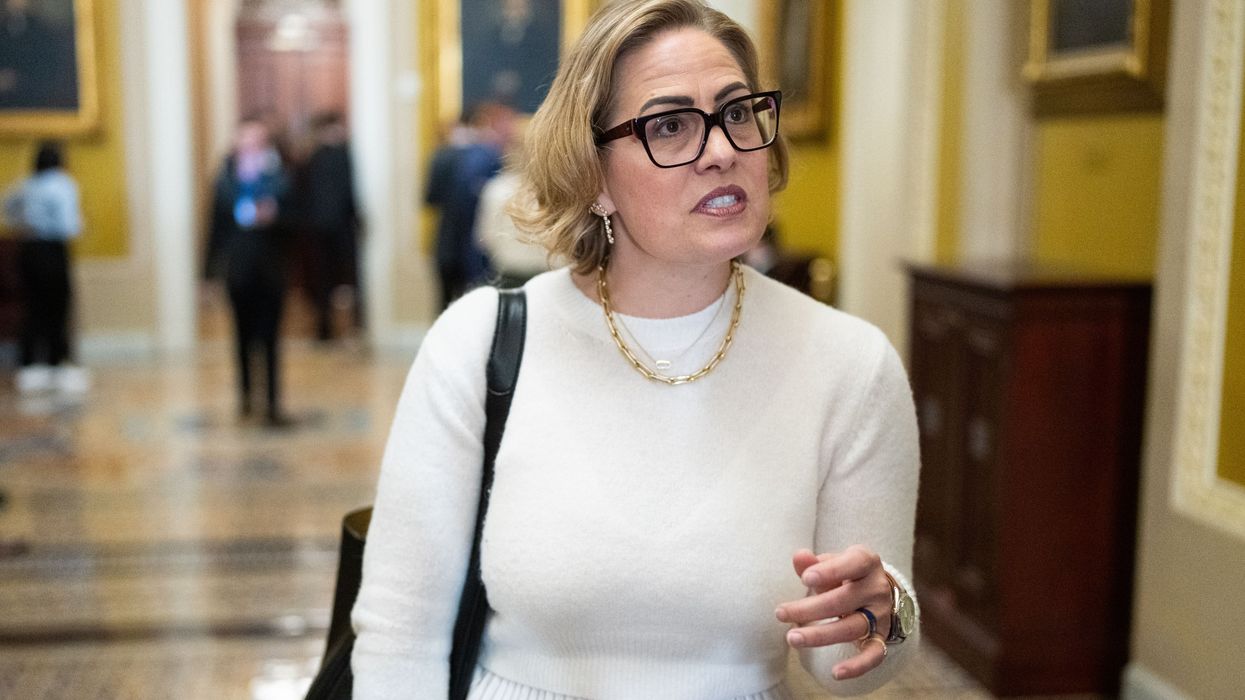
"She can't even be effective as a shill," said one critic of the ex-senator's lobbying.
Congresswoman Alexandria Ocasio-Cortez was among those celebrating after the Chandler, Arizona City Council on Thursday night unanimously rejected an artificial intelligence data center project promoted by former US Sen. Kyrsten Sinema.
"Good!" Ocasio-Cortez (D-NY) simply said on social media Friday.
The defeat of the proposed $2.5 billion project comes as hundreds of advocacy groups and progressive leaders, including US Sen. Bernie Sanders (I-Vt.), are urging opponents of energy-sucking AI data centers across the United States to keep pressuring local, state, and federal leaders over climate, economic, environmental, and water concerns.
In Chandler, "the nearly 43,000-square-foot data center on the corner of Price and Dobson roads would have been the 11th data center in the Price Road Corridor, an area known for employers like Intel and Wells Fargo," the Arizona Republic reported.
The newspaper noted that around 300 people attended Thursday's meeting—many holding signs protesting the project—and city spokesperson Matthew Burdick said that the government received 256 comments opposing the data center.
Although Sinema skipped the debate on Thursday, the ex-senator—who frequently thwarted Democratic priorities on Capitol Hill and ultimately ditched the party before leaving office—previously attended a planning and zoning commission meeting in Chandler to push for the project. That stunt earned her the title of "cartoon villain."
Sinema critics again took aim at her after the 7-0 vote, saying that "she can't even be effective as a shill" and "Sinema went all in to lobby for a data center in Chandler, Arizona and the council told her to get rekt."
Progressive commentator Krystal Ball declared: "Kyrsten Sinema data center L. Love to see it."
Politico noted Friday that "several other Arizona cities, including Phoenix and Tucson, have written zoning rules for data centers or placed new requirements on the facilities. Local officials in cities in Oregon, Missouri, Virginia, Arizona, and Indiana have also rejected planned data centers."
Janos Marton, chief advocacy officer at Dream.Org, said: "Another big win in Arizona, following Tucson's rejection of a data center. When communities are organized they can fight back and win. Don't accept data centers that hide their impacts behind NDAs, drive up energy prices, and bring pollution to local neighborhoods."
When Sinema lobbied for the Chandler data center in October, she cited President Donald Trump's push for such projects.
"The AI Action Plan, set out by the Trump administration, says very clearly that we must continue to proliferate AI and AI data centers throughout the country," she said at the time. "So federal preemption is coming. Chandler right now has the opportunity to determine how and when these new, innovative AI data centers will be built."
Trump on Thursday signed an executive order (EO) intended to block states from enforcing their own AI regulations.
"I understand the president has issued an EO. I think that is yet to play itself out," Chandler Mayor Kevin Hartke reportedly said after the city vote. "Really, this is a land use question, not [about] policies related to data centers."