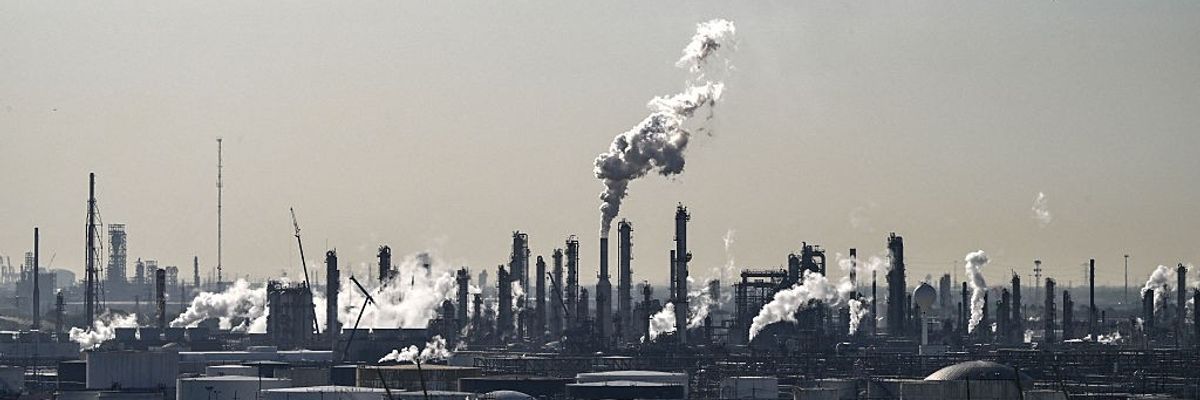
The PEMEX Deer Park oil refinery is seen on April 8, 2025, in Deer Park, Texas.
Trump Cares More About Growing Fossil Fuel Profits Than Shrinking Your Energy Bill
Many things the Trump administration does are simply designed to waste energy, because that is good for the incumbent producers, i.e. Big Oil.
It would be tempting to dismiss U.S. President Donald Trump’s many functionaries as idiots, because many of them are. Here, for instance, is a transcript of leaked audio from a recent staff meeting led by acting Federal Emergency Management Agency director David Richardson, a man with no experience in disaster management (but who did write what the reliable Kate Aronoff described as a bad autobiographical novel with the inspired title War Story). Anyway, put yourself in the place of the FEMA staff hearing this highly relatable anecdote:
The other day I was chatting with my girlfriend, she's from Texas. She's got like huge red hair. Like, she's from Texas. And I said something and she said, well, you know, oh, I know what it was. I said, how come it takes so long to drive 10 hours from Galveston to Amarillo? And she said, well, you know, Texas is bigger than Spain. I didn't know that. So I looked at the map. Texas is huge! I mean, if you put it in the middle of Europe, it takes up most of Europe up. However, they do disaster recovery very, very well, and so does Florida, okay. So, we should be able to take some lessons learned on how Florida and Texas do their disaster recovery, we’ve got to spread that around and get other folks do it some way. And there should be some budgeting things that they have, I bet. I bet Gov. [Greg] Abbott has a rainy day fund for fires and tornadoes and disasters such as hurricanes, and he doesn't spend it on something else.
But if there’s endless idiocy at work (some of it as cover—if I was taking flak for my $400 million flying bribe I’d start tweeting about Taylor Swift and Bruce Springsteen too), there’s also a kind of underlying feral cunning. All the stupid stuff heads in the same direction.
For example, the administration announced earlier this month it would get rid of the Energy Star program, which rates various appliances by their efficiency so that consumers (and landlords and building owners) can make wise choices.
“The Energy Star program and all the other climate work, outside of what’s required by statute, is being de-prioritized and eliminated,” Paul Gunning, the director of the Environmental Protection Agency (EPA) Office of Atmospheric Protection, told employees during the meeting, according to the recording obtained by The New York Times. Mr. Gunning’s office itself is also slated for elimination.
This is a program begun by Republicans—former EPA administrator William K. Reilly wrote a fond reminiscence yesterday for The Washington Post, who pointed out that if you were actually worried about, say, waste, then this would be the last program to cut:
The program costs $32 million in annual federal outlays to administer but has saved consumers $200 billion in utility bills since 1992—$14 billion in 2024 alone. The averted air pollution, which was the EPA’s initial objective, has been considerable, equivalent to the emissions of hundreds of thousands of cars removed from the road.
But what if you wanted to burn more fossil fuel? What if you wanted to stretch out the transition to cheap, clean renewable energy? Well then it would make a lot of sense.
Or take last week’s news, from EPA administrator Lee Zeldin, who vowed that he would eliminate the “start-stop” technology in cars because “everyone hates it.” This feature keeps your car from idling at stoplights—when you tap the accelerator the car turns back on. It’s not mandatory for carmakers, and drivers can turn it off with a button. But, as Fox News points out,
The feature can improve fuel economy by between 4% and 5%, previous EPA estimates showed. It also eliminated nearly 10 million tons of greenhouse gas emissions per year as of 2023.
Meanwhile, Energy Secretary Chris Wright, according to excellent reporting in Heatmap News Friday, is taking federal money designed to convert a steel plant to electricity and hydrogen and instead using it to convert the steel plant to… the fossil fuel it’s already using. The company, its CEO explained, is working with the Department of Energy (DOE) to “explore changes in scope to better align with the administration’s energy priorities,” and those priorities, of course, are to use more energy.
Occam’s Razor, I think, would lead us to say that many things the Trump administration does are simply designed to waste energy, because that is good for the incumbent producers, i.e. Big Oil. That’s not a particularly sophisticated rule for understanding their actions, but remember: Trump was bankrolled by the fossil fuel industry, and that industry has always wanted us to waste energy. Remember all that endless Trump nonsense about low-flow shower heads? They cut the use of hot water by about 40%. Ditto incandescent bulbs, which use 75-90% more energy, and which Trump is trying to bring back. It’s strange to be pro-waste, but there you are. This administration is garbage in every way.
That all of this costs consumers money is obvious—but we don’t really pretend to care about consumers any more. Remember: two dolls and five pencils apiece. No, the ultimate customer for the Trump administration is the oil industry. And really for the GOP as a whole: It became increasingly clear this week that the Republican congressional majority is all too willing to gut the Inflation Reduction Act, even though that will come at a big price to consumers, in its effort to help Big Oil.
And Big Oil is in trouble. Power demand in New England hit an all time low in late April, because so many homes now have solar panels on top. In, um, Saudi Arabia solar arrays are springing up left and right. Bloomberg’s David Fickling chronicles the “relentless” switch toward spending on clean energy, albeit too slowly to hit the most important climate targets. A new global poll of business executives found that 97% were eager to make the switch to renewable energy for their companies, on the grounds that
Electricity is the most efficient form of energy, and renewables-generated electricity a value-add to businesses and economies. In many countries, fossil fuels, with their exposure to imports and volatility to geopolitical shocks, are a liability. For business, this isn’t just inconvenient. It’s dangerous. Volatility drives up costs, turns strategic planning into guesswork, and delays investment.
That’s how sensible people with sensible goals—like making their businesses work, think. But it’s exactly the opposite of how our government now imagines its role. The DOE put their strategy pretty plainly in a filing to the Federal Register last week: Their goal, they said, was “bolstering American energy dominance by increasing exports and subsequently the reliance of foreign nations on American energy.” If you’re a foreign government, that about sums it up: Either you can rely on the sun and wind which shine on your country, or you can rely on the incredibly unreliable U.S. China, meanwhile, is essentially exporting energy security, in the form of clean energy tech.
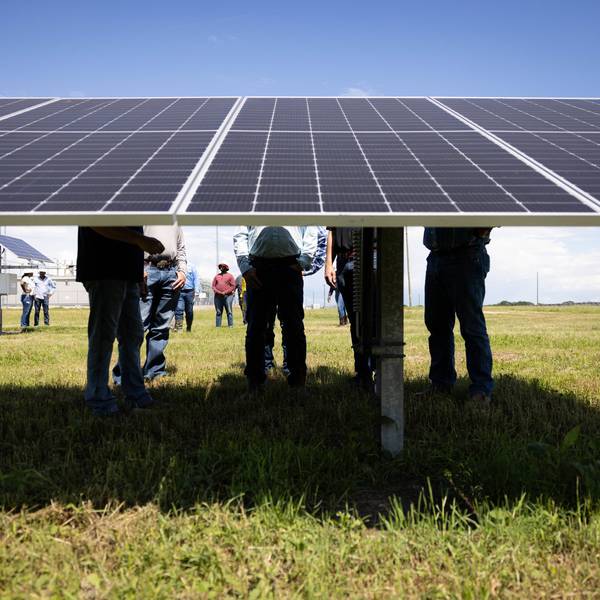
So the goal for the rest of us, as we resist Trump and resist climate change, is pretty clear: Do everything we can to speed up this transition to clean energy, here and everywhere. Solar works, solar is cheap, and solar is liberating.
We are at a crossroads
This country and this world are at a monumental crossroads. In a few short weeks, US voters will have an opportunity to beat back the forces of fascism and confront the billionaires who are rigging the economy, our media system, and our democracy, making it increasingly impossible for ordinary people to get by. We’re not just talking about the election. We’re talking about what must be done once these fascist elements are vanquished from power. We need a bolder set of solutions than what either major party has so far been willing to offer and a working-class movement ready to fight like hell for it. Trump didn't emerge from nowhere. The conditions that fueled MAGA authoritarianism were created by decades of radical neoliberal economic policies and a corrupt political system dominated by corporate interests. They slashed taxes on the super-rich, promising that the benefits would trickle down. They said giveaways to the corporate titans would make life more affordable for the rest of us. It was all bullshit. And when a bitter, betrayed populace searches for someone to blame, right-wing demagogues have little trouble finding scapegoats. People know when they're being lied to, but you won't hear any of this from the corporate media. Only independent journalism—powered and funded by people who believe in building a better world—can deliver truly trustworthy daily news. Our Fall Campaign is underway, and we need your help. To power our newsroom through the rest of the year, we need to raise $125,000 by midnight on October 31. So if you share our vision, please contribute whatever you can to sustain our work. |
It would be tempting to dismiss U.S. President Donald Trump’s many functionaries as idiots, because many of them are. Here, for instance, is a transcript of leaked audio from a recent staff meeting led by acting Federal Emergency Management Agency director David Richardson, a man with no experience in disaster management (but who did write what the reliable Kate Aronoff described as a bad autobiographical novel with the inspired title War Story). Anyway, put yourself in the place of the FEMA staff hearing this highly relatable anecdote:
The other day I was chatting with my girlfriend, she's from Texas. She's got like huge red hair. Like, she's from Texas. And I said something and she said, well, you know, oh, I know what it was. I said, how come it takes so long to drive 10 hours from Galveston to Amarillo? And she said, well, you know, Texas is bigger than Spain. I didn't know that. So I looked at the map. Texas is huge! I mean, if you put it in the middle of Europe, it takes up most of Europe up. However, they do disaster recovery very, very well, and so does Florida, okay. So, we should be able to take some lessons learned on how Florida and Texas do their disaster recovery, we’ve got to spread that around and get other folks do it some way. And there should be some budgeting things that they have, I bet. I bet Gov. [Greg] Abbott has a rainy day fund for fires and tornadoes and disasters such as hurricanes, and he doesn't spend it on something else.
But if there’s endless idiocy at work (some of it as cover—if I was taking flak for my $400 million flying bribe I’d start tweeting about Taylor Swift and Bruce Springsteen too), there’s also a kind of underlying feral cunning. All the stupid stuff heads in the same direction.
For example, the administration announced earlier this month it would get rid of the Energy Star program, which rates various appliances by their efficiency so that consumers (and landlords and building owners) can make wise choices.
“The Energy Star program and all the other climate work, outside of what’s required by statute, is being de-prioritized and eliminated,” Paul Gunning, the director of the Environmental Protection Agency (EPA) Office of Atmospheric Protection, told employees during the meeting, according to the recording obtained by The New York Times. Mr. Gunning’s office itself is also slated for elimination.
This is a program begun by Republicans—former EPA administrator William K. Reilly wrote a fond reminiscence yesterday for The Washington Post, who pointed out that if you were actually worried about, say, waste, then this would be the last program to cut:
The program costs $32 million in annual federal outlays to administer but has saved consumers $200 billion in utility bills since 1992—$14 billion in 2024 alone. The averted air pollution, which was the EPA’s initial objective, has been considerable, equivalent to the emissions of hundreds of thousands of cars removed from the road.
But what if you wanted to burn more fossil fuel? What if you wanted to stretch out the transition to cheap, clean renewable energy? Well then it would make a lot of sense.
Or take last week’s news, from EPA administrator Lee Zeldin, who vowed that he would eliminate the “start-stop” technology in cars because “everyone hates it.” This feature keeps your car from idling at stoplights—when you tap the accelerator the car turns back on. It’s not mandatory for carmakers, and drivers can turn it off with a button. But, as Fox News points out,
The feature can improve fuel economy by between 4% and 5%, previous EPA estimates showed. It also eliminated nearly 10 million tons of greenhouse gas emissions per year as of 2023.
Meanwhile, Energy Secretary Chris Wright, according to excellent reporting in Heatmap News Friday, is taking federal money designed to convert a steel plant to electricity and hydrogen and instead using it to convert the steel plant to… the fossil fuel it’s already using. The company, its CEO explained, is working with the Department of Energy (DOE) to “explore changes in scope to better align with the administration’s energy priorities,” and those priorities, of course, are to use more energy.
Occam’s Razor, I think, would lead us to say that many things the Trump administration does are simply designed to waste energy, because that is good for the incumbent producers, i.e. Big Oil. That’s not a particularly sophisticated rule for understanding their actions, but remember: Trump was bankrolled by the fossil fuel industry, and that industry has always wanted us to waste energy. Remember all that endless Trump nonsense about low-flow shower heads? They cut the use of hot water by about 40%. Ditto incandescent bulbs, which use 75-90% more energy, and which Trump is trying to bring back. It’s strange to be pro-waste, but there you are. This administration is garbage in every way.
That all of this costs consumers money is obvious—but we don’t really pretend to care about consumers any more. Remember: two dolls and five pencils apiece. No, the ultimate customer for the Trump administration is the oil industry. And really for the GOP as a whole: It became increasingly clear this week that the Republican congressional majority is all too willing to gut the Inflation Reduction Act, even though that will come at a big price to consumers, in its effort to help Big Oil.
And Big Oil is in trouble. Power demand in New England hit an all time low in late April, because so many homes now have solar panels on top. In, um, Saudi Arabia solar arrays are springing up left and right. Bloomberg’s David Fickling chronicles the “relentless” switch toward spending on clean energy, albeit too slowly to hit the most important climate targets. A new global poll of business executives found that 97% were eager to make the switch to renewable energy for their companies, on the grounds that
Electricity is the most efficient form of energy, and renewables-generated electricity a value-add to businesses and economies. In many countries, fossil fuels, with their exposure to imports and volatility to geopolitical shocks, are a liability. For business, this isn’t just inconvenient. It’s dangerous. Volatility drives up costs, turns strategic planning into guesswork, and delays investment.
That’s how sensible people with sensible goals—like making their businesses work, think. But it’s exactly the opposite of how our government now imagines its role. The DOE put their strategy pretty plainly in a filing to the Federal Register last week: Their goal, they said, was “bolstering American energy dominance by increasing exports and subsequently the reliance of foreign nations on American energy.” If you’re a foreign government, that about sums it up: Either you can rely on the sun and wind which shine on your country, or you can rely on the incredibly unreliable U.S. China, meanwhile, is essentially exporting energy security, in the form of clean energy tech.
So the goal for the rest of us, as we resist Trump and resist climate change, is pretty clear: Do everything we can to speed up this transition to clean energy, here and everywhere. Solar works, solar is cheap, and solar is liberating.
- Trump Has Plenty of Accomplices in His Reckless Energy Policies ›
- Speaking to Career EPA Staffers Reveals What Will Be Lost if Trump Guts the Agency ›
- 'This Executive Order is Illegal': Trump Attacks Half-Century of Environmental Protections in One Fell Swoop ›
- Trump’s Cabinet of Planet-Wreckers Are Destroying What They’ve Sworn to Protect ›
- Alarm as Trump Energy Dept Redefines 'High-Level' Nuclear Waste to 'Low-Level' in Order to Save Disposal Costs ›
It would be tempting to dismiss U.S. President Donald Trump’s many functionaries as idiots, because many of them are. Here, for instance, is a transcript of leaked audio from a recent staff meeting led by acting Federal Emergency Management Agency director David Richardson, a man with no experience in disaster management (but who did write what the reliable Kate Aronoff described as a bad autobiographical novel with the inspired title War Story). Anyway, put yourself in the place of the FEMA staff hearing this highly relatable anecdote:
The other day I was chatting with my girlfriend, she's from Texas. She's got like huge red hair. Like, she's from Texas. And I said something and she said, well, you know, oh, I know what it was. I said, how come it takes so long to drive 10 hours from Galveston to Amarillo? And she said, well, you know, Texas is bigger than Spain. I didn't know that. So I looked at the map. Texas is huge! I mean, if you put it in the middle of Europe, it takes up most of Europe up. However, they do disaster recovery very, very well, and so does Florida, okay. So, we should be able to take some lessons learned on how Florida and Texas do their disaster recovery, we’ve got to spread that around and get other folks do it some way. And there should be some budgeting things that they have, I bet. I bet Gov. [Greg] Abbott has a rainy day fund for fires and tornadoes and disasters such as hurricanes, and he doesn't spend it on something else.
But if there’s endless idiocy at work (some of it as cover—if I was taking flak for my $400 million flying bribe I’d start tweeting about Taylor Swift and Bruce Springsteen too), there’s also a kind of underlying feral cunning. All the stupid stuff heads in the same direction.
For example, the administration announced earlier this month it would get rid of the Energy Star program, which rates various appliances by their efficiency so that consumers (and landlords and building owners) can make wise choices.
“The Energy Star program and all the other climate work, outside of what’s required by statute, is being de-prioritized and eliminated,” Paul Gunning, the director of the Environmental Protection Agency (EPA) Office of Atmospheric Protection, told employees during the meeting, according to the recording obtained by The New York Times. Mr. Gunning’s office itself is also slated for elimination.
This is a program begun by Republicans—former EPA administrator William K. Reilly wrote a fond reminiscence yesterday for The Washington Post, who pointed out that if you were actually worried about, say, waste, then this would be the last program to cut:
The program costs $32 million in annual federal outlays to administer but has saved consumers $200 billion in utility bills since 1992—$14 billion in 2024 alone. The averted air pollution, which was the EPA’s initial objective, has been considerable, equivalent to the emissions of hundreds of thousands of cars removed from the road.
But what if you wanted to burn more fossil fuel? What if you wanted to stretch out the transition to cheap, clean renewable energy? Well then it would make a lot of sense.
Or take last week’s news, from EPA administrator Lee Zeldin, who vowed that he would eliminate the “start-stop” technology in cars because “everyone hates it.” This feature keeps your car from idling at stoplights—when you tap the accelerator the car turns back on. It’s not mandatory for carmakers, and drivers can turn it off with a button. But, as Fox News points out,
The feature can improve fuel economy by between 4% and 5%, previous EPA estimates showed. It also eliminated nearly 10 million tons of greenhouse gas emissions per year as of 2023.
Meanwhile, Energy Secretary Chris Wright, according to excellent reporting in Heatmap News Friday, is taking federal money designed to convert a steel plant to electricity and hydrogen and instead using it to convert the steel plant to… the fossil fuel it’s already using. The company, its CEO explained, is working with the Department of Energy (DOE) to “explore changes in scope to better align with the administration’s energy priorities,” and those priorities, of course, are to use more energy.
Occam’s Razor, I think, would lead us to say that many things the Trump administration does are simply designed to waste energy, because that is good for the incumbent producers, i.e. Big Oil. That’s not a particularly sophisticated rule for understanding their actions, but remember: Trump was bankrolled by the fossil fuel industry, and that industry has always wanted us to waste energy. Remember all that endless Trump nonsense about low-flow shower heads? They cut the use of hot water by about 40%. Ditto incandescent bulbs, which use 75-90% more energy, and which Trump is trying to bring back. It’s strange to be pro-waste, but there you are. This administration is garbage in every way.
That all of this costs consumers money is obvious—but we don’t really pretend to care about consumers any more. Remember: two dolls and five pencils apiece. No, the ultimate customer for the Trump administration is the oil industry. And really for the GOP as a whole: It became increasingly clear this week that the Republican congressional majority is all too willing to gut the Inflation Reduction Act, even though that will come at a big price to consumers, in its effort to help Big Oil.
And Big Oil is in trouble. Power demand in New England hit an all time low in late April, because so many homes now have solar panels on top. In, um, Saudi Arabia solar arrays are springing up left and right. Bloomberg’s David Fickling chronicles the “relentless” switch toward spending on clean energy, albeit too slowly to hit the most important climate targets. A new global poll of business executives found that 97% were eager to make the switch to renewable energy for their companies, on the grounds that
Electricity is the most efficient form of energy, and renewables-generated electricity a value-add to businesses and economies. In many countries, fossil fuels, with their exposure to imports and volatility to geopolitical shocks, are a liability. For business, this isn’t just inconvenient. It’s dangerous. Volatility drives up costs, turns strategic planning into guesswork, and delays investment.
That’s how sensible people with sensible goals—like making their businesses work, think. But it’s exactly the opposite of how our government now imagines its role. The DOE put their strategy pretty plainly in a filing to the Federal Register last week: Their goal, they said, was “bolstering American energy dominance by increasing exports and subsequently the reliance of foreign nations on American energy.” If you’re a foreign government, that about sums it up: Either you can rely on the sun and wind which shine on your country, or you can rely on the incredibly unreliable U.S. China, meanwhile, is essentially exporting energy security, in the form of clean energy tech.
So the goal for the rest of us, as we resist Trump and resist climate change, is pretty clear: Do everything we can to speed up this transition to clean energy, here and everywhere. Solar works, solar is cheap, and solar is liberating.
- Trump Has Plenty of Accomplices in His Reckless Energy Policies ›
- Speaking to Career EPA Staffers Reveals What Will Be Lost if Trump Guts the Agency ›
- 'This Executive Order is Illegal': Trump Attacks Half-Century of Environmental Protections in One Fell Swoop ›
- Trump’s Cabinet of Planet-Wreckers Are Destroying What They’ve Sworn to Protect ›
- Alarm as Trump Energy Dept Redefines 'High-Level' Nuclear Waste to 'Low-Level' in Order to Save Disposal Costs ›