

SUBSCRIBE TO OUR FREE NEWSLETTER
Daily news & progressive opinion—funded by the people, not the corporations—delivered straight to your inbox.
5
#000000
#FFFFFF
To donate by check, phone, or other method, see our More Ways to Give page.
Daily news & progressive opinion—funded by the people, not the corporations—delivered straight to your inbox.

Israeli forces intercepted and detained at least 175 people off the coast of Greece, including 14 Americans, some of whom reportedly suffered broken bones and other injuries.
Congresswoman Rashida Tlaib of Michigan and 18 other House Democrats on Tuesday condemned the US State Department's failure to protect 14 Americans aboard the latest humanitarian aid convoy seized by Israeli forces en route to Gaza, as well as the agency's threat to punish US participants in the flotilla.
"On Wednesday April 29, 2026, Israeli military forces illegally intercepted and attacked nearly two dozen civilian vessels in international waters and abducted at least 175 unarmed humanitarians, journalists, and solidarity activists taking part in the Global Sumud Flotilla, a brave effort to end the Israeli government's ongoing starvation blockade of Gaza and deliver essential food and medical aid, establish a humanitarian corridor, and save lives," the lawmakers wrote in a letter to Secretary of State Marco Rubio.
"This attack on a civilian humanitarian mission involving participants from over 55 countries, including the United States, conducted an unprecedented 600 miles into international waters, is a grave violation of international law," the letter states. "It demands action and accountability from the United States to protect abducted US citizens, to allow the free flow of humanitarian aid to Palestinians in Gaza enduring forced starvation, and an end to the decades of impunity that enable these crimes."
The lawmakers continued:
We are outraged that instead of speaking out and taking action to ensure the safety and immediate release of the at least 14 US citizens illegally abducted by the Israeli military, the Department of State went out of its way to issue a formal condemnation of their humanitarian efforts, smearing them with libelous falsehoods that expose them to greater danger and violence and threatening allied countries who allow port access to this humanitarian mission. This is an abdication of your duty to protect the safety of all Americans and is an Orwellian distortion where providing food to the hungry is terror and forced starvation is peace.
While we are relieved by reporting that most abducted flotilla passengers have now been released and will not be forced to suffer the abuse and inhumane conditions endured for days by participants of the previous flotilla illegally detained in Israeli prison, we are disturbed by reports that abductees were violently abused while held on Israeli vessels and that multiple US citizens have been hospitalized following their release. After all this, it is extremely alarming that US participants in the flotilla may face additional unjust persecution upon their return home.
Numerous people aboard the flotilla reported being brutally beaten by their captors, with some allegedly suffering broken ribs, noses, and other injuries, some of which reportedly required hospitalization.
Instead of assisting US victims, State Department spokesperson Thomas Piggott said his agency "will explore using available tools to impose consequences on those who provide support to this pro-Hamas flotilla."
The lawmakers' letter calls on Rubio and the Trump administration "to rescind these threats against flotilla participants, their supporters, and states that open their ports to this humanitarian mission and urge you to use your immense leverage to secure the freedom of all passengers who continue to be illegally detained."
"Above all else, we urge you to address the issue at the root of this voyage: the brutal Israeli blockade and genocide of the Palestinian people in Gaza," the Democrats said.
"The ongoing forced starvation of the Palestinian population in Gaza is a direct result of the Israeli government’s siege and blockade of the territory, which continues to impede the entry of food and humanitarian aid in flagrant violation of legally binding orders from the International Court of Justice," they continued.
"Likewise, the United Nations Independent International Commission of Inquiry has determined that the Israeli government is committing the crime of genocide in Gaza and that this blockade is deliberately inflicting conditions of life calculated to bring about the physical destruction of the Palestinian people in whole or in part," the letter notes.
"While the Trump administration fails to use its immense leverage to end this blockade and fulfill the United States’ binding legal obligations under the Genocide Convention, the activists on board the flotilla are an example of profound solidarity and humanitarianism," the lawmakers added. "Undeterred by this latest attack, additional flotilla ships continue their mission to deliver aid to Gaza. We call on you to deter any further hostile actions against the flotilla and ensure the successful completion of its humanitarian mission.”
Earlier Tuesday, Brazilian President Luiz Inácio Lula da Silva condemned Israel’s twice-extended detention of two Global Sumud Flotilla members—Thiago Ávila of Brazil and Spanish-Swedish national Saif Abu Keshek—who Israeli authorities claim without providing evidence are linked to the Palestinian militant resistance group Hamas. Spanish Prime Minister Pedro Sánchez has also condemned the activists' abduction and demanded their release, as have numerous humanitarian groups and advocates around the world.
In addition to Tlaib—the only Palestinian American member of Congress—the letter was signed by Reps. Mark Pocan (Wis.), Delia Ramirez (Ill.), Ro Khanna (Calif.), Jesús "Chuy" García (Ill.), André Carson (Ind.), Jim McGovern (Mass.), Pramila Jayapal (Wash.), Greg Casar (Texas), Henry "Hank" Johnson (Ga.), Nydia Velásquez (NY), Ayanna Pressley (Mass.), Maxine Dexter (Ore.), Summer Lee (Pa.), Ilhan Omar (Minn.), Bonnie Watson Coleman (NJ), Al Green (Texas), Lateefah Simon (Calif.), and Alexandria Ocasio-Cortez (NY).

"Netanyahu helped walk us into war, but he cannot keep us there," said US Rep. Debbie Dingell.
A group of Democrats in the US House of Representatives on Thursday demanded that any ceasefire deal to pause the war in Iran must force Israel to halt its operations in Lebanon, and called for the passage of a war powers resolution to help end the attacks.
Although the US, Iran, and Israel agreed to a two-week ceasefire on Tuesday, Israel has continued its bombing campaign in Lebanon, killing more than 250 people on Wednesday alone.
Iran has said it will not abide by a deal to reopen the Strait of Hormuz until the attacks on Lebanon stop, while Pakistan, which helped broker the ceasefire, has insisted that halting strikes on Lebanon has always been part of the agreement.
In a Thursday social media post, Rep. Rashida Tlaib (D-Mich.) promoted a resolution she introduced in late March that called on the US to force Israel to stop its campaign in Lebanon, which has killed and wounded thousands of people while displacing more than 1 million more.
"I didn't wait for the genocidal regime of Israel to kill over 250 people in Lebanon yesterday to file resolutions to stop the US funding of these war crimes," wrote Tlaib. "So for colleagues speaking up now, welcome, but also don't just tweet, support the war powers resolution to save lives."
The call to include Lebanon in any ceasefire didn't just come from progressives like Tlaib, but from centrist members such as Rep. Valerie Foushee (D-NC), who recently defeated a progressive primary challenger who heavily criticized her past support from the American Israeli Public Affairs Committee (AIPAC).
"I am signing Rep. Tlaib's war powers resolution to stop all US military involvement in Israel’s hostilities in Lebanon," Foushee said. "The war in Lebanon has displaced nearly 1 million people and has claimed the lives of thousands. Our federal government must hold itself to higher humanitarian standards than participating in a war that is putting innocent people at risk."
Rep. Debbie Dingell (D-Mich.) didn't explicitly endorse Tlaib's resolution, but affirmed that any ceasefire deal needed to curtail Israel's Lebanon campaign.
"This ceasefire must become a permanent peace. That means including Lebanon," wrote Dingell. "Netanyahu helped walk us into war, but he cannot keep us there."
Tlaib's resolution, which was introduced on March 27, calls for the US to force Israel to end its incursion and to withdraw its forces from Lebanese territory, while providing humanitarian aid and guaranteeing a right of return for all displaced Lebanese people.
Anti-war advocacy organization Just Foreign Policy encouraged Democratic leaders to get on board with Tlaib's resolution.
"Let's hope that leadership of House Democrats can support Rep. Tlaib's war powers resolution—without any delay!" the group wrote.
The group called on voters to demand that House Minority Leader Hakeem Jeffries (D-NY), House Foreign Affairs Committee Ranking member Gregory Meeks (D-NY), and other leaders to "do so—and say they'll support the House floor vote—NOW!"
On Thursday, House Republicans blocked Democrats' efforts to force a vote on a war powers resolution that would halt Trump's Iran war, although the party is expected to try again next week when Congress is scheduled to return to Washington, DC.
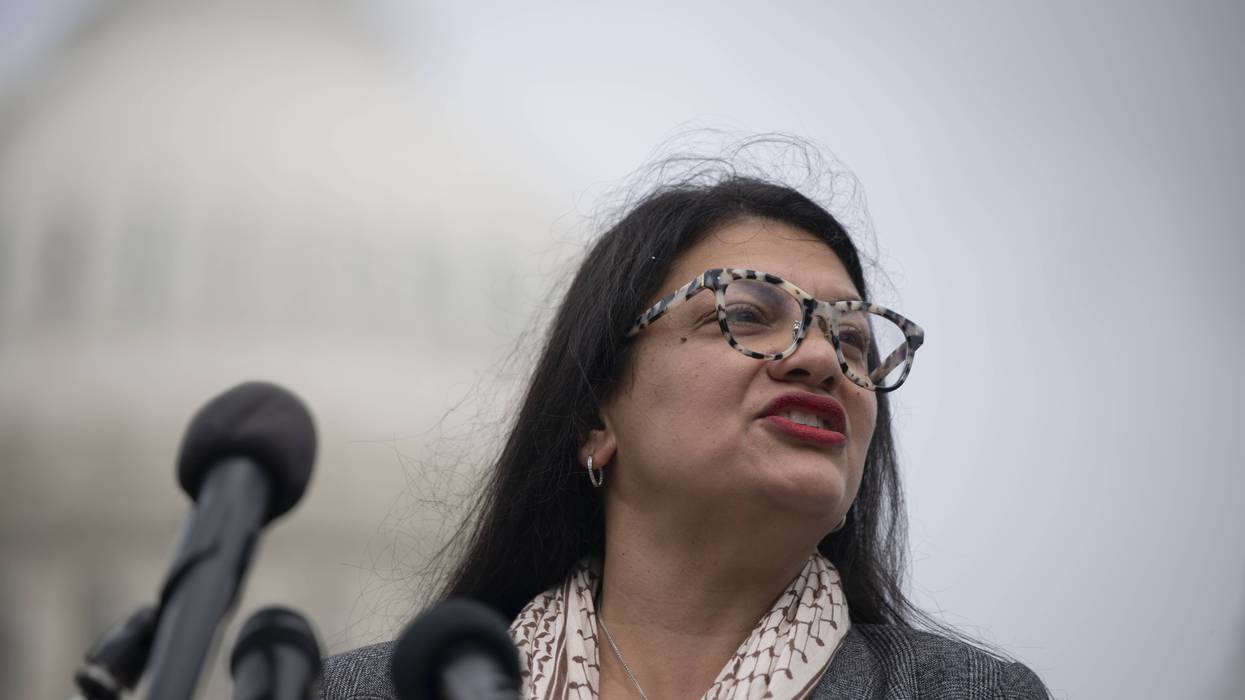
"We are witnessing the same genocidal playbook used against Palestinians in Gaza, now in Lebanon," Rep. Rashida Tlaib said.
As Israel ramps up its devastating invasion of Lebanon, Rep. Rashida Tlaib has introduced legislation in the US House of Representatives aimed at blocking US support.
Israel's latest onslaught against Lebanon, launched after the militant group Hezbollah retaliated against the joint US-Israeli attack against Iran at the end of February, has already killed more than 1,100 people, including at least 121 children, according to the Lebanese Health Ministry.
Many pieces of civilian infrastructure—including hospitals, schools, and residential buildings—have been attacked, and Israel has issued forced evacuation orders that have led more than 1 million people to be displaced from their homes.
“Thousands of families in our district with strong ties to Lebanon are living through immense pain,” said Tlaib, who represents a district that includes parts of Detroit and surrounding suburbs. “Many have lost loved ones, watched their grandparents' towns and villages be completely destroyed, and seen relatives uprooted from their homes, not knowing if they will ever be able to return.”
Tlaib (D-Mich.), the only Palestinian-American member of Congress, introduced two resolutions on Friday. The first calls on the US to use its leverage to end Israel's land and air assaults against Lebanese territory, denounce efforts at territorial expansion, and investigate alleged crimes against humanity.
The second, cosponsored by Reps. Delia Ramirez (D-Ill.) and Nydia Velázquez (D-NY), is a war powers resolution that would require President Donald Trump to remove US forces from participation in all military actions in Lebanon that have not been authorized by Congress.
In recent days, Israel has expanded its ground operation, aiming to control the entire territory south of the Litani River indefinitely. Leaders of the military campaign, such as Defense Minister Israel Katz, have suggested using the genocidal war in Gaza as a "model" for Lebanon, including the full destruction of residential areas.
"We are witnessing the same genocidal playbook used against Palestinians in Gaza, now in Lebanon," Tlaib said. "Israeli leaders are openly celebrating it. This ethnic cleansing campaign is only possible because of US support, funded by our tax dollars. We must act now to stop these crimes against humanity and illegal invasion of Lebanon.”
Nathan Thompson, a senior analyst at Just Foreign Policy, which advised Tlaib on the legislation, told Common Dreams that although the US military and Israel Defense Forces (IDF) are "deeply operationally integrated, and have only become more so since October 7, 2023," the extent of direct US involvement in Lebanon has been kept secret from the public.
"Military officials wouldn’t say whether or not they provided targeting assistance for Israel’s airstrikes on Hezbollah in 2024, and that’s exactly the type of action Congress has considered to be unauthorized ‘hostilities’ under the War Powers Act in the past," Thompson said.
However, he said, "We know that the IDF and the US military are linked at the hip—on weapons sales, missile defense, targeting assistance, everything."
Tlaib's resolutions come as another war powers resolution to limit Trump's ability to launch more attacks against Iran appears to have gained enough support to pass the House, although Democratic leadership has chosen to delay the vote until mid-April despite warnings that Trump may soon dramatically escalate the war, including with US ground troops.
That bill remains viable due to limited Republican support, including from Reps. Thomas Massie (Ky.), Warren Davidson (Ohio), and Nancy Mace (SC). While Massie has been a consistent anti-war vote, it's unclear whether other Republicans, as well as some pro-Israel Democrats, would similarly sign onto a resolution concerning Lebanon.
Thompson said the Lebanon-related legislation is an “urgently necessary tool to end US complicity” as Israeli officials are “talking about functionally annexing southern Lebanon and recreating Gaza-level destruction there.”
He said, "A war powers vote forces all of Congress to go on the record: Do you want the US to enable this genocide, or not?"