

SUBSCRIBE TO OUR FREE NEWSLETTER
Daily news & progressive opinion—funded by the people, not the corporations—delivered straight to your inbox.
5
#000000
#FFFFFF
To donate by check, phone, or other method, see our More Ways to Give page.
Daily news & progressive opinion—funded by the people, not the corporations—delivered straight to your inbox.
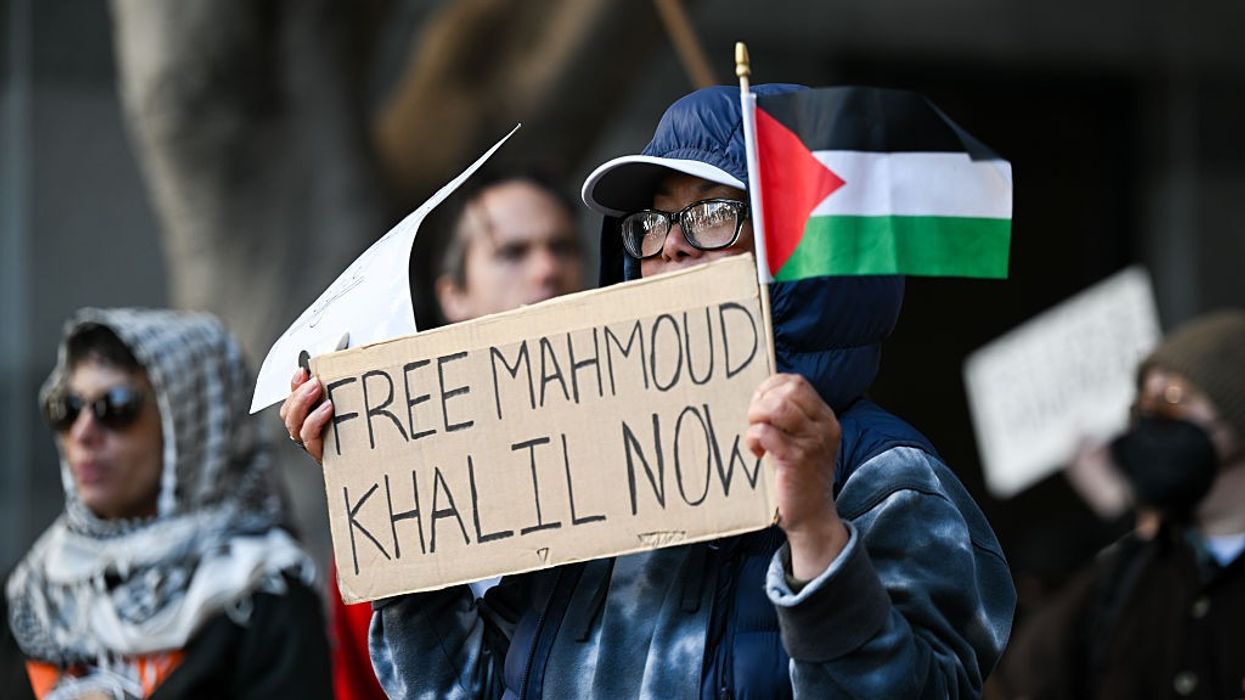
The Antisemitism Awareness Act has never been about countering antisemitism or protecting Jewish students from discrimination; it is about silencing pro-Palestine students and protecting the Israeli government from criticism.
When Senate Republicans brought the so-called Antisemitism Awareness Act up for a committee vote last week, they were expecting an easy win. After all, the bill had the support of Senate Republican leaders, most Israel advocacy groups, and even some Democrats.
Yet the bill faced an unexpected problem that may ultimately doom its passage. During a markup hearing of the HELP Committee, two Republicans broke ranks, joining all Democrats in approving free speech amendments that undermined the true goal of the bill: requiring colleges and universities to conflate criticism of the Israeli government and Zionism with antisemitism.
The first amendment considered was HELP Chairman Sen. Bill Cassidy's (R-La.) manager amendment, which affirmed that “Nothing in this Act shall be constructed to diminish or infringe upon any right protected under the First Amendment to the Constitution of the United States."
While that vague reassurance passed with bipartisan support, most Republicans refused to support substantive amendments that explicitly referenced Gaza as an example of free speech, laid out examples of protected student speech, and prohibited retaliation against dissent.
If the true purpose of the Antisemitism Awareness Act was protecting Jewish students from illegal anti-Semitic discrimination, then none of these amendments should have been a problem.
At start of the hearing, ranking member Sen. Bernie Sanders (I-Vt.) warned, “Unfortunately and unacceptably, the Antisemitism Awareness Act we are considering today would label speech that criticizes the Israeli government and Netanyahu’s horrific war in Gaza as antisemitic and a violation of civil rights laws, and that is an extremely dangerous precedent.”
Sanders then offered several amendments designed to reduce the risk that government agencies and educational institutions can use the bill as a new tool of censorship.
His first amendment clarified, "no person shall be considered antisemitic for using their rights of free speech or protest under the First Amendment to the Constitution of the United States to ... oppose Benjamin Netanyahu's led war effort, which has killed more than 50,000 and wounded more than 113,000, 60 percent of whom are women and children” and "oppose the Israeli government's devastation of Gaza..."
All Democrats voted in favor, which was itself a surprise given how many Democratic politicians have desperately avoided any criticism of the Israeli government. The bigger surprise came from Senator Rand Paul. He broke ranks with other Republicans and supported the amendment, ensuring its passage.
A second Sanders amendment declared that the federal government cannot force any school, college, or university to adopt a policy that a branch of the federal government may compel a school "to violate the rights of a student, faculty, or staff member under the First Amendment to the Constitution of the United States."
In a sane world, every Republican senator would have supported such a basic amendment. Yet all opposed it except for two: Sen. Paul and Sen. Susan Collins (D-Maine).
The third Sanders' amendment clarified that speech, such as distributing flyers, inviting guest speakers, or engaging in classroom discussions, is protected unless it involves true threats or incitement of violence. Again, Paul and Collins were the only Republicans to break with their colleagues to support it.
Sen. Ed Markey (D-Mass.) introduced an amendment prohibiting the federal government from detaining or deporting students based on protected political speech. That amendment passed by a single vote, thanks again to Senator Paul. Markey stated, “When a young person writes an op-ed in the student newspaper and get whisked off of the streets of Tuffs University to a prison in Louisiana with no charges that is what we are debating today.”
If the true purpose of the Antisemitism Awareness Act was protecting Jewish students from illegal anti-Semitic discrimination, then none of these amendments should have been a problem. They should have received universal support, and their approval should not have derailed the bill.
Yet the fate of the legislation is now up in the air.
HELP Committee Chair Sen. Bill Cassidy (R-La.) said during the hearing that, “Supporting these amendments is an effort to kill this bill.”
Sen. Markwayne Mullin (R-Ok.) responded the next day by telling Jewish Insider that “Rand Paul totally killed that bill.” Sen. Roger Marshall (R-Kan.) also said, “These amendments are dealbreakers.”
Why? Because the Antisemitism Awareness Act has never been about countering antisemitism or protecting Jewish students from discrimination; it is about silencing pro-Palestine students and protecting the Israeli government from criticism.
The bill would require government agencies and schools to enforce federal civil rights law using the International Holocaust Remembrance Alliance (IHRA) working definition of antisemitism—a vague and widely disputed standard that poses a mortal threat to First Amendment freedoms.
Kenneth S. Stern, the original drafter of the IHRA definition, has testified to Congress that, "My fear is, if we similarly enshrine this definition into law, outside groups will try and suppress–rather than answer–political speech they don’t like. The academy, Jewish students, and faculty teaching about Jewish issues, will all suffer." Stern has repeatedly stated that the definition was never meant to be enforceable law and that doing so risks unconstitutional viewpoint discrimination. That is precisely what this legislation seeks to achieve.
The IHRA definition declares that any student describing the founding of Israel as a "racist endeavor" has engaged in antisemitism punishable by their school and the government of the United States—even though racist militias and terrorist groups like the Irgun subjected Palestinians to a horrific campaign of ethnic cleansing and mass murder during the founding of Israel.
IHRA also declares anyone “applying double standards” to Israel is antisemtiic. If someone criticizes the Israeli government's war crimes in Gaza but hasn't made time to criticize the RSF's war crimes in Sudan, they must be antisemitic. Ditto for anyone “drawing comparisons of contemporary Israeli policy to that of the Nazis,” comparisons that--while controversial—have even been made by far-right supporters of the Israeli government.
As Sen. Paul noted during the hearing, these and other examples establish a dangerous double standard. No other foreign government is granted this level of immunity from criticism under U.S. civil rights law. If enforced through Title VI of the Civil Rights Act, these vague and politically motivated examples would transform legitimate political critique into grounds for federal investigations, and dissent into a punishable offense.
If passed, this bill—even in its watered-down form—would open the door for the Israeli government and its supporters to misconstrue American civil rights laws.
CAIR, like many other civil rights groups, has called on congress to not pass the Antisemitism Awareness Act into law, as it would give the Department of Education—under a Trump administration already targeting, arresting, detaining, and attempting to deport anti-genocide protesters—even more power to investigate, silence, and punish speech on campus critical of Israel. We are already seeing the consequences. More than 1,700 student visas have been revoked since January. Students like Columbia’s Mahmoud Khalil and Tufts’ Rumeysa Ozturk remain in ICE custody for nothing more than participating in peaceful, protected protest and speech. Others face deportation for daring to speak out. This is not theoretical. This is not speculative. It is happening now.
In its original form, the Antisemitism Awareness Act would have given the Trump administration even more power to escalate its attack on free speech for Palestine. Even with the addition of Sanders' amendments, the now-contradictory bill still threatens free speech protections by including the IHRA definition.
That's still not good enough for most Senate Republicans and pro-Israel groups pushing the bill. Now that the bill cannot be so easily weaponized to silence dissent against Israeli government's war crimes in Gaza or its founding ideology, at least some of its key backers are threatening to abandon it.
Congress must reject this bill in full. No amendment can salvage legislation built on an anti-democratic foundation. Americans have the right to speak out against injustice, whether it occurs in our own country or in Gaza.
We must be absolutely clear about what is at stake. If passed, this bill—even in its watered-down form—would open the door for the Israeli government and its supporters to misconstrue American civil rights laws. That is not only a betrayal of free speech. It is a threat to American sovereignty.
Americans must unequivocally oppose antisemitism, Islamophobia, anti-Black racism, anti-immigrant sentiment, and all forms of hate. But conflating antisemitism with opposition to Israel’s military occupation, apartheid policies, or the ongoing genocide in Gaza is not just dishonest. It is dangerous.
Congress must reject this bill in full. No amendment can salvage legislation built on an anti-democratic foundation. Americans have the right to speak out against injustice, whether it occurs in our own country or in Gaza.
Silencing speech does not stop hate. It only deepens injustice. And we should not stand by while our government attempts to criminalize moral clarity.

"The ability to criticize governments and their policies is a critical component of our democracy."
The ACLU on Thursday sent a letter to U.S. senators arguing that bipartisan legislation which backers claim would combat antisemitism on university campuses would actually be an affront to free speech protections and censor legitimate criticism of the Israeli government as it carries out atrocities in Gaza, the occupied West Bank, and Lebanon.
The group's letter comes two weeks after Axios reported that Senate Majority Leader Chuck Schumer (D-N.Y.) "recently promised Jewish leaders that he would try later this year to pass" the House-approved Antisemitism Awareness Act, or S. 4127.
"Instead of addressing antisemitism on campus, this misguided legislation would punish protected political speech," said ACLU senior policy counsel Jenna Leventoff, who signed the letter with Christopher Anders, director of democracy and technology.
"At a time when civil rights enforcement on campus could not be more critical, this bill risks politicizing these vital protections by censoring legitimate political speech that criticizes the Israeli government," Leventoff warned. "The right to criticize government actions is the most fundamental protection provided by the First Amendment—and this includes the actions of foreign governments. The Senate must continue to block this bill and protect free speech."
"It would likely chill free speech of students on college campuses by incorrectly equating criticism of the Israeli government with antisemitism."
The letter highlights that "federal law already prohibits antisemitic discrimination and harassment by federally funded entities. S. 4127 is therefore not needed to protect against antisemitic discrimination; instead, it would likely chill free speech of students on college campuses by incorrectly equating criticism of the Israeli government with antisemitism."
As Israeli forces—armed by the Biden administration and U.S. Congress—have bombed and starved Palestinians in Gaza over the past 13 months, students colleges and universities across the United States have held protests urging their education institutions and government to divest from the assault, which is the subject of a genocide case at the International Court of Justice.
Some campus administrations—under pressure from Zionists in Congress—have called in law enforcement to violently crack down on protesters and enacted new policies intended to limit anti-genocide demonstrations by students and faculty.
"The ACLU does not take a position on the conflict between Israel and Palestine, but it does staunchly defend the right of those in the United States to speak out on domestic and international political matters," the organization emphasized. "The ability to criticize governments and their policies is a critical component of our democracy."
As the letter explains:
This bill directs the Department of Education to take the International Holocaust Remembrance Alliance's (IHRA) working definition of "antisemitism" into consideration when determining whether alleged harassment was motivated by antisemitic intent and violates Title VI of the Civil Rights Act of 1964. Title VI prohibits discrimination on the basis of race, color, or national origin in programs receiving federal financial assistance, including in higher education. The federal government itself has interpreted Title VI to prohibit harassment or discrimination against Jews, Hindus, Muslims, and Sikhs as well as others when that discrimination is based on the group's actual or perceived shared ancestry or ethnic characteristics. These existing protections are critically important, particularly in the current environment.
The IHRA working definition, however, is overbroad. It equates protected political speech with unprotected discrimination. Enshrining this definition into regulation would chill the exercise of First Amendment rights and risk undermining the Department of Education’s legitimate and important efforts to combat discrimination. Criticism of Israel and its policies is political speech, squarely protected by the First Amendment.
"The IHRA definition of antisemitism is also unconstitutional," the letter continues, citing a case about Republican Texas Gov. Greg Abbott's executive order directing the state's higher education institutions to craft policies based on the controversial language.
The letter points out that even "the lead author of the original IHRA definition, Kenneth Stern, has himself opposed the application of this definition to campus speech, noting that codifying this definition would lead campus administrators to 'fear lawsuits when outside groups complain about anti-Israel expression, and the university doesn't punish, stop, or denounce it.'"
The ACLU specifically warned that "S. 4127 could result in colleges and universities suppressing a wide variety of speech critical of Israel or in support of Palestinian rights in an effort to avoid investigations by the department and the potential loss of funding, even where such speech is protected and does not qualify as harassment."
"Even where administrators do not take formal action, students and their organizations, faculty, and university staff may be deterred from speaking and organizing on these issues," the group added. The bill would also "likely inspire an increasing number of complaints focused on constitutionally protected criticism of Israel," taking time away from "meritorious" filings.
The Senate majority leader has faced intense pressure to bring the bill to a vote as this session of Congress winds down. Axios noted that Florence Avenue Initiative, a nonprofit that doesn't have to disclose its donors, "has spent about $5 million on an ad campaign blasting Schumer, the highest-ranking Jewish lawmaker, for his inaction."
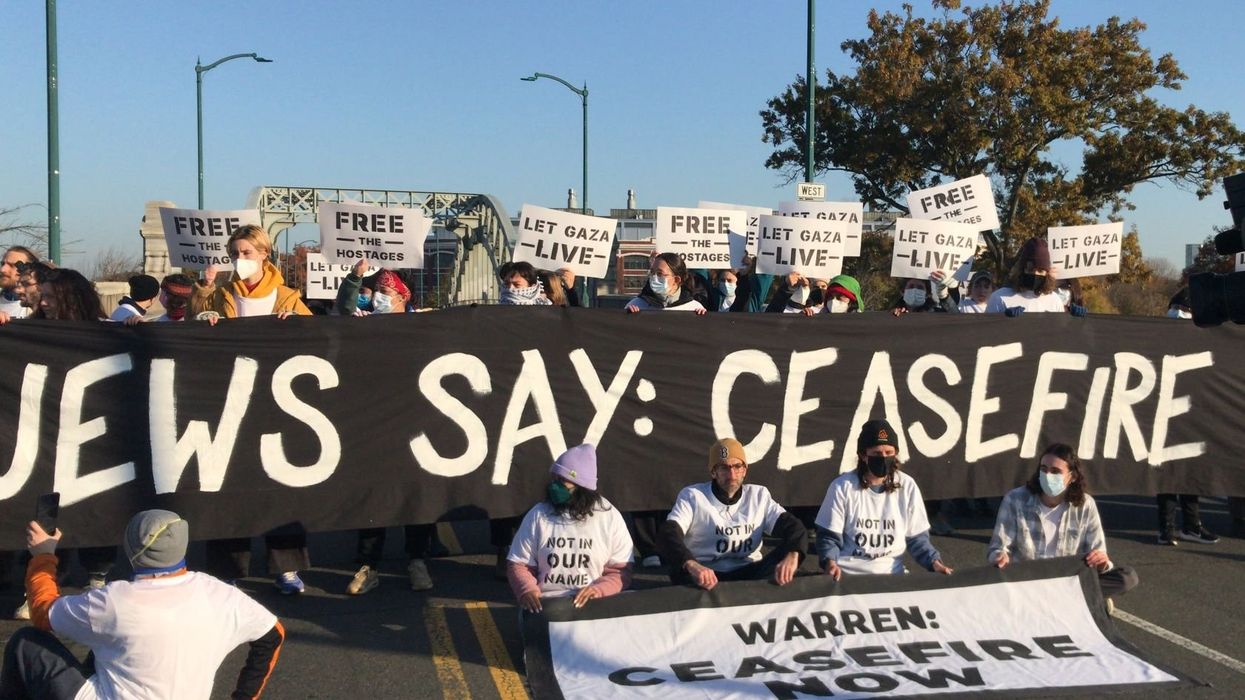
The bill could be used to crush legitimate debate about Israel, its policies, and American policies toward it—policies that have given rise to one of the greatest acts of genocide since the Holocaust.
Totalitarianism rarely shows its true face when it arises. Instead, it often pretends to stand for good and decent values. A new bill claims to fight antisemitism, something all decent people oppose. But antisemitism—that is, bias and discrimination against Jews because of their religion or ethnic identity—is already barred under civil rights law. The real goal of the so-called “Antisemitism Awareness Act” is to suppress free speech.
This dangerous bill was already passed by the House of Representatives and now awaits a Senate vote. It outsources some of our constitutional rights to an outside organization, the International Holocaust Remembrance Alliance, whose arbitrary definition of antisemitism poses a threat to civil liberties. It could be used to crush legitimate debate about Israel, its policies, and American policies toward it—policies that have given rise to one of the greatest acts of genocide since the Holocaust.
This bill could suppress historical research and ban the mention of facts that have been verified by international organizations. It could initiate lawsuits, funding cuts, and disciplinary action across all American “education programs or activities, and for other purposes.” (Those “other purposes” are not defined.) Student protesters, professors, writers, and even elected officials could face political repression and become legal targets.
It turns the USA’s much-celebrated sense of liberty into a funhouse mirror, a grotesque and distorted reflection of everything this country claims to see in itself. Its passage would make a travesty of everything America's leaders claim to believe in.
The implications are enormous. The federal government spends more than $100 billion per year on education, including $85.3 billion for kindergarten through high school, $24.6 billion in federal student aid assistance, and $1.3 billion in congressional earmarks for colleges (for projects that range from equipment purchases and airport runways to prison education programs). All these expenditures could be used as leverage to stifle legitimate debate.
Despite its “antisemitic” branding, the bill targets Jews as well as non-Jews. As literature professor Benjamin Balthasar writes, it would effectively ban the teaching of “much Jewish history and culture.” Balthasar observes that Hannah Arendt, Albert Einstein, Ed Asner, and “countless other Jews would now be considered ‘antisemitic’ under the new law.”
The bill defines criticism of Israel as a violation of Title VI of the Civil Rights Act of 1964. That legislation allows citizens to file “administrative complaints with the federal agency that provides funds,” or to sue in federal court. That means that non-Jews could take action against anti-apartheid Jews—including deeply religious Jews who object to Israel’s existence on theological grounds. And they could do it in the name of antisemitism.
As Balthasar writes, this bill “would in some ways be the most punitive law against Jews to be enacted in the U.S. since the Immigration Act of 1924.” Ultimately, it would infringe everyone’s civil liberties. Here are five examples of legitimate speech that could be banned under this legislation.
1. “Gaza is a concentration camp.”
This sentence runs afoul of a provision that would outlaw “drawing comparisons of contemporary Israeli policy to that of the Nazis.” That undoubtedly protects the sensitivity of people who are offended by the comparison, but at what cost to the Constitution? It isn’t hard to draw parallels between some Nazi actions and certain actions of many other countries, including both Israel and the United States.
Nor should that be a surprise. In Hitler’s American Model: The United States and the Making of Nazi Race Law, James Q. Whitman records that Hitler drew inspiration from American racism, especially laws “excluding certain races from naturalization.” Hitler also spoke admiringly of the way Americans had “gunned down the millions of (American Indians) to a few hundred thousand.”
Since some Nazi policies were drawn from our own country’s, it raises the question: How can there be a blanket ban on comparing them to those of any other country?
This provision would presumably forbid people on campuses and schools from saying, for example, that “Gaza is an open-air concentration camp.” But the Cambridge Dictionary defines a “concentration camp” as “a place where large numbers of people are kept as prisoners in extremely bad conditions, especially for political reasons.” Can anybody argue that Gaza is not a concentration camp, or that mass extermination isn’t already underway there?
The concentration camps weren’t invented by the Nazis. The Oxford Reference Dictionary’s overview begins, “Originally a place in which non-combatants were accommodated, as instituted by Lord Kitchener during the Second Boer War.” The United States also built concentration camps to intern Japanese American civilians during the Second World War.
If this bill passes, it would be permissible to compare any country’s policies to those of Nazi-era Germany. Every country, that is, except one.
2. “The creation of Israel involved considerations of race and ethnicity.”
The law outlaws “denying the Jewish people their right to self-determination, e.g., by claiming that the existence of a State of Israel is a racist endeavor.”
One commonly used definition of “racism” is “prejudice, discrimination, or antagonism directed against a person or people on the basis of their membership of a particular racial or ethnic group, typically one that is a minority or marginalized.”
Israel has granted special rights to members of one ethnic group since its creation, wherever they may live in the world, while denying some of those same rights to people who were already in its territory when it was created.
Here’s a historical fact that would be suppressed by this law: Israel is the only nation in the world that an occupying nation (Great Britain) established by fiat based on worldwide ethno-religious affiliation rather than a contemporary, living society.
The “racist endeavor” clause could also ban the discussion of another historical fact: that the Balfour Declaration led to an influx of primarily white European Jews onto land then inhabited by Indigenous people of color.
The right of self-determination is not automatically granted to any religious or ethnic group. Israel is the only instance where that right was extended to a people who largely did not live on the site of their supposed homeland, and where it was done by denying the civil and property rights of people who had lived there for generations.
3. “The right of self-determination doesn’t (or shouldn’t) permit the displacement of local populations in favor of people who currently live elsewhere.”
Less than 10% of Palestine’s population was Jewish in 1890. (By comparison, approximately 40% of Baghdad’s population was Jewish in the early 20th century.) The majority who had lived there for generations were denied self-determination, losing both rights and property, despite their innocence regarding Europe’s long-time persecution of the Jews.
How can such a right be granted to one group at the expense of another, already existing population? At the very least, that’s a debatable proposition. But this kind of debate could very possibly be forbidden under the same “racism” provision of this law.
4. “Israel is the only democracy in the Middle East.”
You could also get in trouble by challenging a related claim about Israel: that it is “the only democracy in the Middle East.” A democracy? Three-quarters of all Palestinians—some 750,000-1,000,000 people—were deliberately displaced at Israel’s founding. A 2018 law explicitly states that “the right of national self-determination in the State of Israel is unique to the Jewish people.”
That’s hard to reconcile with principles of democracy or self-determination. At the very least, they are reasonable subjects for debate—debate that this law would ban.
5. “Israel is conducting a genocidal campaign in Gaza.”
Israel’s actions in Gaza—systematic bombing, destruction of homes and infrastructure, killings of journalists and medical personnel—meet many legal definitions of genocide and other crimes. That is a matter of law. But this statement could also run afoul of the law’s overly broad ban on Nazi-era comparisons.
In fact, many countries and leaders have been accused of acting in a Nazi-like fashion since World War II. That shouldn’t surprise us, nor is it necessarily wrong to make the comparison. Yes, such comparisons can be odious and extreme. But, as Alex Ross writes in The New Yorker:
The kind of genocidal hatred that erupted in Germany had been seen before and has been seen since. Only by stripping away its national regalia and comprehending its essential human form do we have any hope of vanquishing it.
We can’t vanquish something we’re not allowed to name.
What Israel is reportedly doing in Gaza was defined as criminal many years ago under international law. But any mention of that—or even of international case law regarding Israel—could be banned under this bill.
The proposed law also forbids “holding Jews collectively responsible for actions of the state of Israel.” That’s fair enough, especially considering the many Jews worldwide who are protesting Israel’s actions today. But there’s a bitter irony. Many of the bill’s backers blame all Gazans for the events of October 7, an accusation Israel’s leaders have openly used to justify their genocide.
Also banned under this law is, “accusing Jews as a people of being responsible for real or imagined wrongdoing committed by a single Jewish person or group, or even for acts committed by non-Jews.”
Again, fair enough. And yet, again, this is precisely what Israel’s supporters and media allies are doing to Palestinians. They’re doing it to student protesters, too. They search far and wide for someone—anyone—who has said anything antisemitic and can be linked, however loosely, with these peaceful and high-minded demonstrators. Then they broadcast these aberrant individuals’ words all over the news, using them to smear an entire movement.
Under this bill, they can. The document it relies on says:
“Antisemitism is a certain perception of Jews, which may be expressed in hatred of Jews. Rhetorical and physical manifestations of antisemitism are directed toward Jewish or non-Jewish individuals and/or their property, toward Jewish community institutions and religious facilities.” (Emphases mine.)
This definition of antisemitism is so broad, in fact, that it doesn’t have to involve Jews at all. One non-Jew might express “hatred” (a term that isn’t defined) against another non-Jew and still run afoul of this law. Or they might be guilty of a certain forbidden “perception” of their fellow non-Jew.
It gets even weirder. As it’s written, this law could forbid a Jew who opposes the occupation from arguing with a non-Jew who supports it, on the grounds that the Jew’s speech is “antisemitic.”
Every year at Passover, Jews repeat the prayer, “Next year in Jerusalem.”
When we studied this in Hebrew school, it seemed clear to some of us that the return to Jerusalem was meant to come with the appearance of the Messiah, not through a political declaration. But those of us who raised this question were waved off. Today, many of the world’s most traditional Jews hold the belief that the state of Israel violates scripture and Halakhic law. They, too, could be considered “antisemitic” under this law. These absurdities highlight the bill’s real purpose, which is the state suppression of certain speech.
Despite its name, the “Antisemitism Awareness Act” doesn’t do much to address real antisemitism. And it’s designed to stifle, not promote, “awareness.” It turns the USA’s much-celebrated sense of liberty into a funhouse mirror, a grotesque and distorted reflection of everything this country claims to see in itself. Its passage would make a travesty of everything America's leaders claim to believe in.
The Senate must reject this bill.
Let your senators know you oppose this bill. The U.S. Capitol Switchboard operator can connect you directly with their offices: (202) 224-3121.

Why we must maintain our focus on the agonies of Gaza and the West Bank, denouncing them and calling for an end to Israel’s assaults.
All of us—and we are legion across the worldmust keep our eyes on the genocide in Gaza, as well as on the vicious pogroms underway in the West Bank. A recent statement by James Elder of UNICEF reports that in Rafah, “The European hospital is crammed with severely injured and dying children. A military offensive here will be catastrophic.”
At the same time, throughout the West Bank, mobs of fascist settlers torch homes, steal possessions including livestock, kill Palestinians and drive them off their land. All of this has been enabled by President Joseph Biden, who has sent fulsome amounts of aid to Israel to carry out its genocidal and ethnic cleansing assaults on the Palestinian people. A holocaust, underwritten by the greatest military power in the world, is underway in both occupied territories.
Promoting the savageries Israeli Finance Minister Bezalel Smotrich, said, “Whoever perpetrates against the Jewish people like these evil ones have perpetrated on us, will be destroyed, they will be annihilated, and it will echo for decades and decades onwards.” In another statement he declared: “Rafah, Deir al-Balah, Nuseirat, total and utter destruction that will erase the memory of the Amalek from under the skies.”
This is the fulfillment of Israel’s dream of inhabiting all of what was once historic Palestine, making it a land unencumbered by its indigenous Arab population. Israel’s ongoing efforts since 1948 to kill or expel all Palestinians from what was historic Palestine have triggered student sit-ins and demonstrations on some 120 American college campuses.
Israel has become a country with powerful fascistic tendencies, headed by fanatics and demagogues catering to a population so filled with hatred of Arabs that it welcomes the genocide. In a recent article, “Dead on Arrival: Israel’s Blowback Genocide,” Ellen recalls visiting the West Bank city of Hebron in the 1980s and seeing graffiti on walls that proclaimed, “Arabs to the Gas Chambers.” At that time renowned Israeli public intellectual Yeshayahu Leibowitz warned that Israel was turning its soldiers into Judeonazis. Recent YouTube videos of soldiers mocking their victims bear out his prophecy. This hatred is pervasive in Israel. There are courageous exceptions like journalists Amira Hass and Gideon Levy who write for the newspaper Haaretz and the group Combatants for Peace. But all too many Israelis have supported their country’s assault on Gaza, or even wanted something worse.
The student protests that for weeks have been under public scrutiny have been peaceful mass gatherings of citizens outraged at Biden’s unconditional support for Israel's relentless campaign in Gaza. Yet early on, riot police were summoned to Columbia’s campus as well as that of the City College of New York, the University of Texas-Austin, UCLA, and others, to dismantle the encampments, arrest, and sometimes beat up students and supporting faculty. Ayman Mohyeldin on MSNBC last week showed images of a mob hurling fireworks at the UCLA protesters, spraying them with pepper spray, and beating them with sticks and other weapons.
In tandem with the police actions, cries of “antisemitism” have arisen about the protests. When interviewed in print or on television, the Jewish student activists have said unanimously that these protests are neither antisemitic nor hate-filled. Moreover, the antisemitism claims are irreconcilable with the fact that thousands of Jewish students nationwide are participating. Two leading protest organizations, Jewish Voices for Peace and If Not Now, are Jewish, proclaiming that never again may genocide take place against any people, not just Jews.
Both of us writers of this article have experienced real antisemitism. Ellen remembers, in her early childhood, around 1945, her mother saying that the local grocer, a Mr. McGonigle, was glad Hitler was “mopping up all the kikes.” She remembers the child in her third-grade class who called her “a kike.” Jennifer remembers being pelted with spitballs by classmates shouting “Jew!” at her for making a Star of David design in her art class. Meanwhile, her father recalled being chased around the block by a neighborhood bully holding a knife saying, “You killed Christ!”
These experiences mirror what until now has been the guiding definition of antisemitism, that of The International Holocaust Remembrance Alliance (IHRA): “Antisemitism is a certain perception of Jews, which may be expressed as hatred toward Jews. Rhetorical and physical manifestations of antisemitism are directed toward Jewish and non-Jewish individuals and/or their property, toward Jewish community institutions and religious facilities.”
Yet the campaign against alleged “antisemitism” has gone forward, adding criticism of Israel to the definition of the term. In Congress, the House of Representatives on May 1 passed a bill entitled “The Antisemitism Awareness Act.” It makes speech seemingly threatening the existence of Israel newly “antisemitic,” citing, for example, the cry, “From the river to the sea, Palestine will be free” as a call for the annihilation of the Jewish state and of the Jews in it. It makes no difference that Jewish students and people like the writers of this article have chanted that slogan, intending its meaning to be that Palestinians should be free within a redefined state.
Congressman Jerrold Nadler, a longtime supporter of Israel and a Zionist, has criticized the bill: “While there is much in the bill that I agree with,” he said, “its core provision would put a thumb on the scale in favor of one particular definition of antisemitism to the exclusion of all others to be used when the Department of Education assesses claims of antisemitism on campus.” He continued that the new definition includes “contemporary examples of antisemitism,” adding: “The problem is that these examples may include protected speech, in some contexts, particularly with respect to criticism of the State of Israel.”
Omer Bartov, an Israeli-American Professor of Holocaust and Genocide Studies at Brown University, described by the U.S. Holocaust Memorial museum as one of the world’s leading specialists on the subject of genocide, is the author of an article entitled, “Weaponizing Language: Misuses of Holocaust Memory and the Never Again Syndrome.” In a recent dialogue with the Israeli Holocaust scholar Raz Segal, the two discussed antisemitism and “the perils of antisemitism and its current weaponization.”
In an April 30 interview on Democracy Now!, Bartov noted the peaceful nature of the University of Pennsylvania demonstration as well as the one at Brown University. Of antisemitism he said that it “is a vile sentiment, it’s an old sentiment, it has been used for bloodshed, for violence, and for genocide. But it has also become a tool to silence speech about Israel. And that, too, has quite a history, and numerous governments under Benjamin Netanyahu have been pushing this agenda of arguing that any criticism of Israeli policy, not least, of Israeli occupation policies, is antisemitic.” He added that there are Jewish students who feel threatened, for instance by the term “Intifada,” which literally means “shaking off,” as in the shaking off of the 57-year-long occupation of the West Bank and Gaza. “But there’s nothing threatening about opposing occupation and oppression.”
The Antisemitism Awareness Act, which indeed weaponizes antisemitism against those protesting Israel’s savagery in Gaza and the cruelty of its overall occupation policies, is soon to be voted upon by the Senate. Its enactment would mark a giant step towards degrading the U.S. Constitution, in particular its protection of freedom of speech, assembly, and a free press. It also threatens the status of academia as a realm in which the free exchange of ideas can flourish.
Fascism threatens American democracy embodied in a Republican Party that has long ceased to be a political party and is rather, according to Thomas Mann and Norman Ornstein of The American Enterprise Institute, “an insurrection.” The reelection of Donald Trump would import an Israeli-style fascism embodied by Netanyahu and Smotrich, while the reelection of Joe Biden will allow these smoldering tendencies to ignite the flames of that ideology within the U.S. If the Antisemitism Awareness Act is passed by the Senate, the erosion of civil liberties long anchored in the Constitution seems all but certain.
Like all forms of prejudice and ethnocentrism, antisemitism has no place in an enlightened society. But what about genocide? Is that an acceptable manifestation of a modern society? Are those denouncing protests against Israel’s genocidal and ethnic cleansing actions OK knowing that over 100,000 people, most of them women and children, have been killed, wounded, and maimed in indiscriminate bombing raids across the Strip since Oct. 7th?
Meanwhile, all the focus on alleged antisemitism has diverted national attention from the genocide in Gaza and the barbaric settler actions in the West Bank. The official number of Gaza’s dead is close to 35,000 with another 8-10,000 people unaccounted for under the rubble. If 6,000 of these people were Hamas fighters, that still leaves a total of nearly 40,000 civilians dead.
News of atrocities within this holocaust continues. Recently, UN Special Rapporteur of the Palestinian Territories Francesca Albanese stated, “I am extremely alarmed by information that Dr. Adnan Albursh, a well-known surgeon at #alshifa_hospital, has died while detained by Israeli forces in the Ofer military prison. While I acquire more information, I urge the diplomatic community to intervene with CONCRETE MEASURES to protect Palestinians. No Palestinian is safe under Israel’s occupation today.”
Israel is neither a democratic nor a peace-loving society. It is an arm of US regional hegemony and a US client state that receives $3.8 billion annually in military aid and that has received over $30 billion additional military aid since October 7th. Since its founding in 1948, Israel has received $158 billion in military support, making it the greatest recipient of US military aid in history. Israel has nuclear, biological, and chemical weapons the only such power in the Middle East to have this kind of arsenal. [We] suggest the next time someone complains that “little Israel” is “surrounded by enemies” (a false statement to begin with), people consider these facts. We need look no further than Tel Aviv to determine which nation is the real destabilizing force in the region.
If the Antisemitism Awareness Act passes the Senate, what will befall student protests? Will they all become acts of civil disobedience? What about the alternative press, whose independent organs have become invaluable given the corporate media’s pussyfooting or downright ignoring of the Gaza holocaust and West Bank atrocities? Will it be shuttered by the federal government on the grounds of banned “hate speech”? Will what we write be rejected by publications that fear for their survival?
“As a Jewish person who stands hand-in-hand with my Palestinian brothers and sisters and works daily against anti-Arab hate, I find this weaponization of my identity particularly disgusting,” states Arab-American Antidiscrimination Committee staff attorney Chris Godshall-Bennet. “Criticism of Zionism and of the Israeli government is not antisemitic, and conflating the two only serves to provide cover for Israel’s numerous, ongoing human rights abuses and violations of international law, as well as its genocide of Palestinians in Gaza.”
Declares Palestinian poet Mohammad Al Kurd, “I am asked to have patience for these kinds of debates that tell me that words are genocidal. The Israeli regime is engaging in a war of attrition against the Palestinian people and yet we are asked to talk about chants and slogans… But this is about our moral obligation as human beings to reject genocide, the real genocide that is happening in real time.”
All people of conscience must keep this in mind. And we must maintain our focus on the agonies of Gaza and the West Bank, denouncing them and calling for an end to Israel’s assaults, to settler violence, and ultimately to the occupation of both the West Bank and Gaza.
We must honor the student demonstrators and all who champion them as the heroes they are, cease the opportunistic abuse of the term ‘antisemitism,’ and urge them to continue their protests.
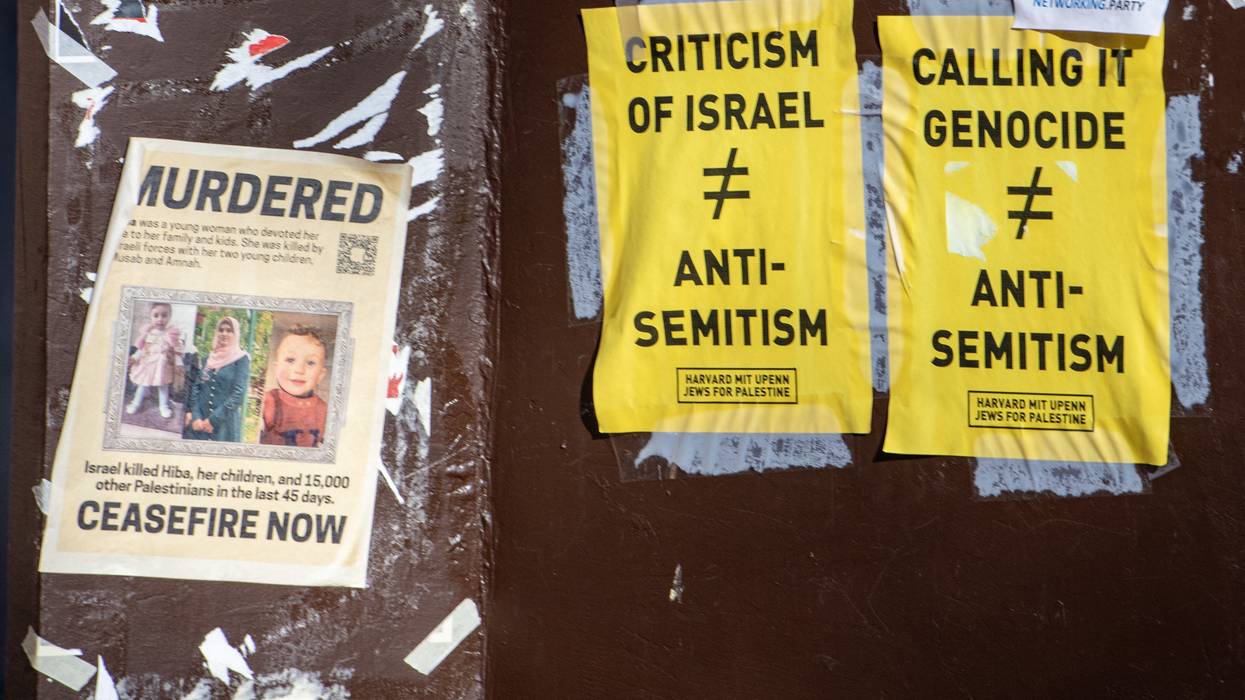
"Criticism of the state of Israel, the Israeli government, policies of the Israeli government, or Zionist ideology is not—in and of itself—antisemitic," reads a new letter.
A Dartmouth University professor who once served as the school's head of Jewish studies and was violently arrested at a Palestinian rights protest last week was among more than 800 Jewish educators who had signed a letter as of Thursday, demanding that lawmakers and U.S. President Joe Biden oppose a bill claiming to combat antisemitism.
The Awareness of Antisemitism Act, said the letter, would actually "amplify the real threats Jewish Americans already face" by "conflating antisemitism with legitimate criticism of Israel."
The bill, which was passed by the Republican-controlled House last week over the objections of 70 progressive Democrats and 21 Republicans, would codify the International Holocaust Remembrance Alliance's (IHRA) working definition of antisemitism, which includes "targeting of the state of Israel" and "drawing comparisons of contemporary Israeli policy to that of the Nazis."
The Awareness of Antisemitism Act, which could soon be taken up by the Senate, would require the Department of Education to consider the group's working definition when determining whether harassment is motivated by antisemitism.
The professors noted that the working definition has been "internationally criticized," with more than 100 civil society organizations—including some Israeli groups—calling on the United Nations last year to reject the IHRA's interpretation because it has been "misused" to shield Israel from legitimate criticism.
"We hold varied opinions on Israel," reads the letter. "Whatever our differences, we oppose the IHRA's definition of antisemitism. If imported into federal law, the IHRA definition will delegitimize and silence Jewish Americans—among others—who advocate for Palestinian human rights or otherwise criticize Israeli policies."
The professors pointed out the irony that by using the IHRA definition—which also includes "accusing Jewish citizens of being more loyal to Israel" than their own home countries—the bill "hardens the dangerous notion that Jewish identity is inextricably linked to every decision of Israel's government."
"Far from combating antisemitism, this dynamic promises to amplify the real threats Jewish Americans already face," the letter reads.
Annelise Orleck, the Dartmouth professor who was arrested last week, was joined by other Jewish academics including City University of New York professor Peter Beinart and professor emeritus Avishai Margalit of the Hebrew University of Jerusalem in signing the letter.
Orleck, a labor historian, told ABC affiliate WMUR after her arrest that she hopes Dartmouth and other schools that have cracked down on and condemned pro-Palestinian protests in recent weeks will "stop weaponizing antisemitism."
The professors urged political leaders who are "earnestly concerned with antisemitism" to "join hundreds of Jewish scholars from across the globe who have endorsed alternative definitions of antisemitism—such as those contained in the Nexus Document or Jerusalem Declaration. Unlike the IHRA definition, these documents offer meaningful tools to combat antisemitism without undermining Jewish safety and civil rights by insulating Israel from legitimate criticism."
When the Antisemitism Awareness Act was passed by the House last week, Jewish-led Palestinian rights groups were among those that condemned the proposal.
Biden has angered pro-Palestinian rights groups by suggesting the campus protests that have spread across the U.S. in recent weeks, with students and faculty demanding an end to U.S. support for Israel as it bombards Gaza, are inherently antisemitic.
"Criticism of the state of Israel, the Israeli government, policies of the Israeli government, or Zionist ideology is not—in and of itself—antisemitic," reads the professors' letter, which was first publicized Wednesday. "We accordingly urge our political leaders to reject any effort to codify into federal law a definition of antisemitism that conflates antisemitism with criticism of the state of Israel."
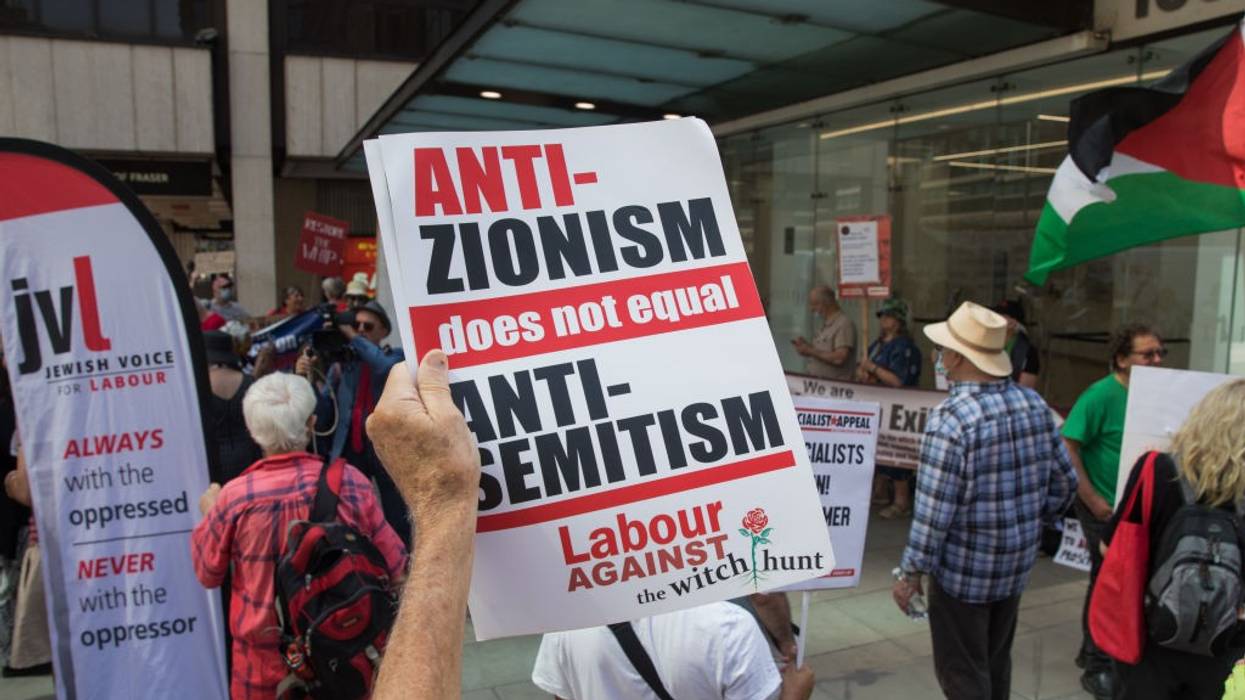
Conflating free speech and hate crimes will not make Jewish students any safer on campus. This bill would stifle First Amendment rights to free speech and distract from the need to confront real antisemitism that exists.
Editor's Note: The following is a statement by the Congresswoman following her vote, alongside nearly 70 Democratic colleagues, against the Antisemitism Awareness Act on Wednesday, May 1, 2024.
As a Jewish woman, I’ve experienced antisemitism all my life. I’ve been called a kike while I was waiting for a drink at a bar when I was at college. I’ve heard too many ‘jokes’ to count about my frizzy hair and my big nose. I remember my classmates who thought it was funny to say people were ‘being Jewed’ when someone was being frugal.
Conflating free speech and hate crimes will not make Jewish students any safer.
I know the hatred and ignorance that lie behind all these comments, and how they can quickly escalate into violence—and I’m deeply concerned about the rise of antisemitism in San Diego and across the country.
But I do not believe that anti-Zionism is inherently antisemitism. I support Israel’s right to exist, but I also know many people who question whether Israel should exist as a Jewish state who are deeply connected to their Judaism.
Today, I voted against H.R. 6090, because it fails to effectively address the very real rise of antisemitism, all while defunding colleges and universities across the country and punishing many, if not all, of the non-violent protestors speaking out against the Israeli military’s conduct. Conflating free speech and hate crimes will not make Jewish students any safer. This bill would stifle First Amendment rights to free speech and free assembly. And it would distract from real antisemitism and our efforts to address it.
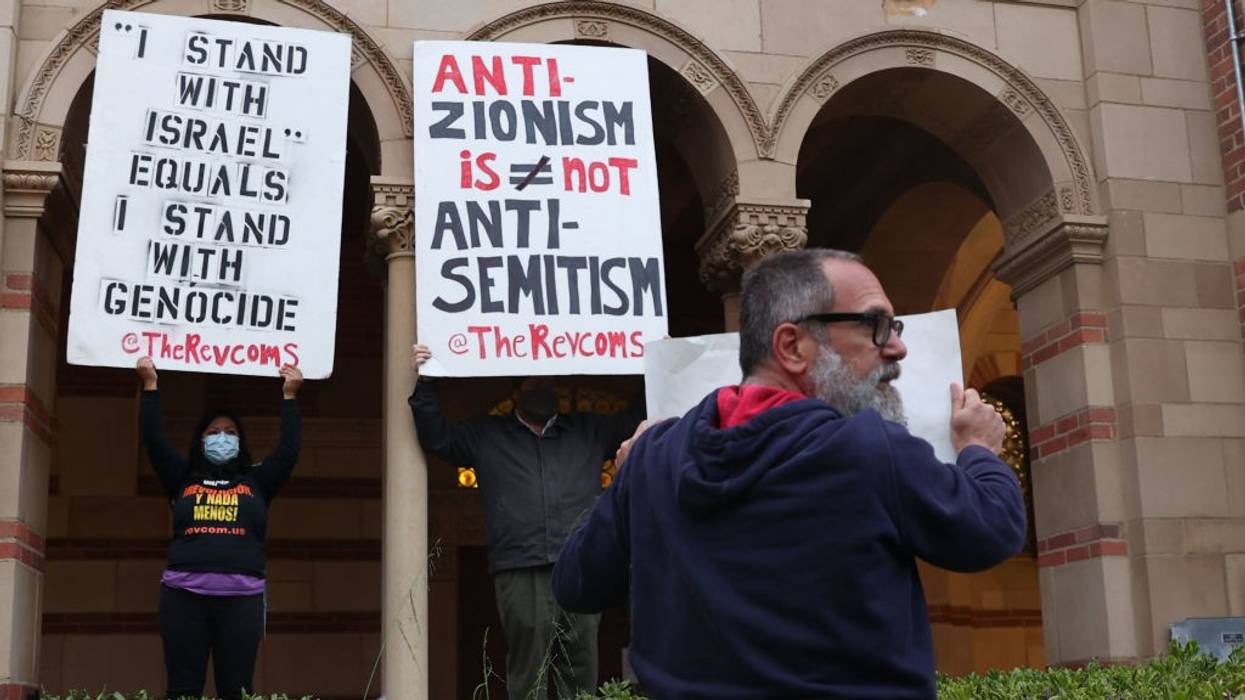
"Antisemitism is a serious problem, but codifying a legal definition could have dangerous implications for free speech," said one campaigner.
House lawmakers voted overwhelmingly Wednesday to approve legislation directing the U.S. Department of Education to consider a dubious definition of antisemitism, despite warnings from Jewish-led groups that the measure speciously conflates legitimate criticism of the Israeli government with bigotry against Jewish people.
House members approved the
Antisemitism Awareness Act—bipartisan legislation introduced last year by Reps. Mike Lawler (R-N.Y.), Josh Gottheimer (D-N.J.), Max Miller (R-Ohio), and Jared Moskowitz (D-Fla.) in the lower chamber and Sen. Tim Scott (R-S.C.) in the Senate—by a vote of 320-91.
Both progressive Democrats and far-right Republicans opposed language in the bill. The former objected to conflating criticism of Israel with hatred of Jews, while the latter bristled at labeling Christian scripture—which posits that Jews killed Jesus—as antisemitic.
"Antisemitism is the hatred of Jews. Unfortunately, one doesn't need to look far to find it these days. But the supporters of this bill are looking in the wrong places," Hadar Susskind, president and CEO of the Jewish-led group Americans for Peace Now, said following Wednesday's vote.
"They aren't interested in protecting Jews," he added. "They are interested in supporting right-wing views and narratives on Israel and shutting down legitimate questions and criticisms by crying 'antisemite' at everyone, including Jews" who oppose Israel's far-right government.
"With this disingenuous effort, House Republicans have failed to seriously address antisemitism," Susskind added. "I hope the Senate does better."
The legislation—officially H.R. 6090—would require the Department of Education to consider the International Holocaust Remembrance Alliance (IHRA) Working Definition of Antisemitism when determining whether alleged harassment is motivated by antisemitic animus and violates Title VI of the Civil Rights Act of 1964, which "prohibits discrimination on the basis of race, color, and national origin in programs and activities receiving federal financial assistance," including colleges and universities.
Lawler's office called the proposal "a key step in calling out antisemitism where it is and ensuring antisemitic hate crimes on college campuses are properly investigated and prosecuted," while Gottheimer emphasized that "the IHRA definition underscores that antisemitism includes denying Jewish self-determination to their ancestral homeland of Israel... and applying double standards to Israel."
Critics say that's the trouble with the IHRA working definition: It conflates legitimate criticism and condemnation of Israeli policies and practices with anti-Jewish bigotry, and forces people to accept the legitimacy of a settler-colonial apartheid state engaged in illegal occupation and a "plausibly" genocidal war on Gaza.
As the ACLU noted last week in a letter urging lawmakers to reject the legislation:
The IHRA working definition... is overbroad. It equates protected political speech with unprotected discrimination, and enshrining it into regulation would chill the exercise of First Amendment rights and risk undermining the Department of Education's legitimate and important efforts to combat discrimination. Criticism of Israel and its policies is political speech, squarely protected by the First Amendment. But the IHRA working definition declares that "denying the Jewish people their right to self-determination, e.g., by claiming that the existence of a state of Israel is a racist endeavor," "drawing comparisons of contemporary Israeli policy to that of the Nazis," and "applying double standards by requiring of [Israel] a behavior not expected or demanded of any other democratic nation" are all examples of antisemitism.
Jewish Voice for Peace Action
slammed what it called IHRA's "controversial and dangerous mis-definition that does not help fight real antisemitism and is only a tool for silencing the movement for Palestinian rights."
"The Israeli government's bombardment and siege of Gaza has killed over 34,000 people in six months," the group said on social media. "Congress must stop attacking the students and faculty members who are trying to stop this genocide, and instead focus on ending U.S. complicity in Israel's attacks."
Israel's Gaza onslaught has sparked a wave of nonviolent student-led protests across the United States and around the world. Some of these protests have been violently repressed by police, while anti-genocide activists including Jews have been branded "antisemitic" for condemning Israeli crimes or defending Palestinians' legal right to resist them.
Sending in militarized police and snipers to stop students from exercising their First Amendment rights is truly disgusting.
Why are my colleagues and the mainstream media more outraged over these anti-war protests than they are about the over 35,000 Palestinians killed in Gaza? pic.twitter.com/EwLqRrS2we
— Congresswoman Rashida Tlaib (@RepRashida) May 1, 2024
Americans for Peace Now said that while it is "deeply concerned about the escalating antisemitism in the United States and globally," the legislation "poses a significant threat to free speech and open discourse."
"Equating criticism of the Israeli government with antisemitism is a tactic used to stifle important discussions on Israeli policies and actions, thereby hindering the broader effort to combat true instances of hatred and discrimination against Jewish communities," the group added.
Kenneth Stern, director of the Bard Centre for the Study of Hate and lead drafter of the IHRA working definition, warned years ago that "Jewish groups have used the definition as a weapon to say anti-Zionist expressions are inherently antisemitic and must be suppressed."
"Imagine if Black Lives Matter said the most important thing the [Biden] administration could do to remedy systemic racism is adopt a definition of racism, and that definition included this example: opposition to affirmative action," Stern wrote in 2020.
"Obviously, sometimes opposition to affirmative action is racist and sometimes it is not," he added. "The debate about systemic racism would be changed to a free speech fight, and those with reasonable concerns about affirmative action correctly upset that the state was branding them racist."