
SUBSCRIBE TO OUR FREE NEWSLETTER
Daily news & progressive opinion—funded by the people, not the corporations—delivered straight to your inbox.
5
#000000
#FFFFFF
To donate by check, phone, or other method, see our More Ways to Give page.


Daily news & progressive opinion—funded by the people, not the corporations—delivered straight to your inbox.
"We are deeply disappointed in this ruling, but will not be deterred from doing everything in our power to communicate to voters the truth of the Arizona Abortion Access Act," said the campaign behind the ballot measure.
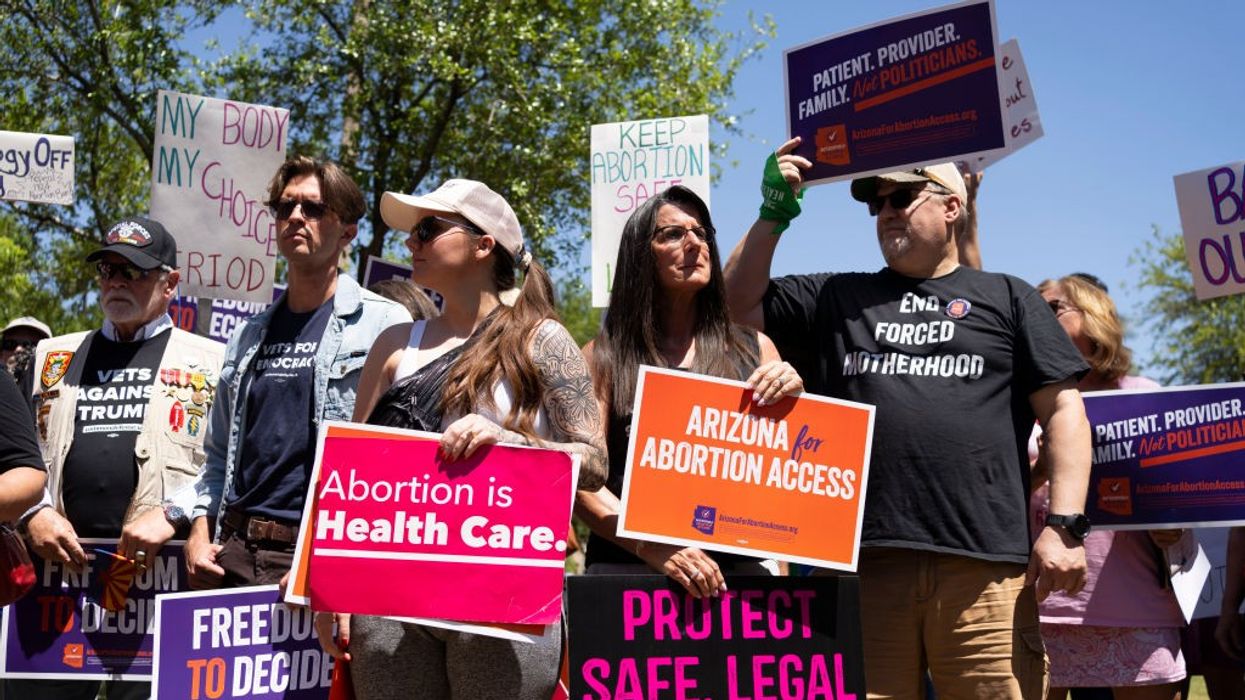
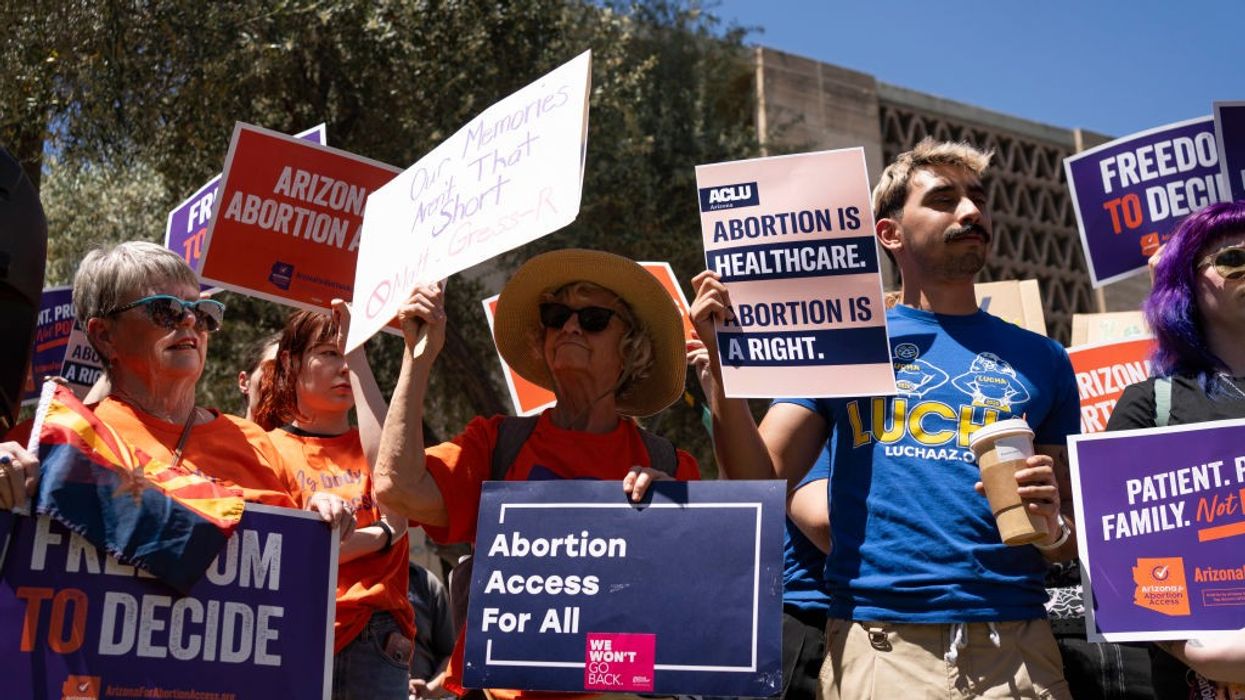
While celebrating that Arizona voters will get to weigh in on an abortion rights ballot measure this November, reproductive rights advocates on Wednesday blasted a state Supreme Court ruling about language in a related informational pamphlet.
Overturning a decision from the Maricopa County Superior Court, the Arizona Supreme Court ruled that Republican legislators' use of "unborn human being" to refer to a fetus in the pamphlet "substantially complies" with the state's impartiality requirements.
"The Arizona Supreme Court today reversed the trial court's well-reasoned ruling and held that the phrase 'unborn human being'—a watchword for anti-abortion advocates with no basis in medicine or science—is somehow impartial or objective," the Arizona for Abortion Access campaign said in a statement.
"This means that Arizona voters won't get to learn about the questions on their ballot in a fair, neutral, and accurate way but will instead be subjected to biased, politically charged words developed not by experts but by anti-abortion special interests to manipulate voters and spread misinformation," the campaign continued.
"We are deeply disappointed in this ruling," the campaign added, "but will not be deterred from doing everything in our power to communicate to voters the truth of the Arizona Abortion Access Act and why it's critical to vote YES to restore and protect access to abortion care this fall."
The Arizona Abortion Access Act is a proposed state constitutional amendment that would prohibit many restrictions on abortions before fetal viability and safeguard access to care after viability to protect the life or health of the patient. The office of Arizona's secretary of state formally certified the proposed ballot measure on Monday.
The campaign to get the measure on the ballot garnered national attention earlier this year, when the Arizona Supreme Court upheld an 1864 abortion ban that includes no exceptions for pregnancies resulting from rape or incest. Although Democratic Arizona Gov. Katie Hobbs signed legislation to repeal the ban less than a month later, reproductive rights advocates have continued to emphasize the importance of passing the amendment.
Arizona is one of several states where reproductive freedom measures are—or soon could be—on the ballot in November. Rights advocates have increasingly pushed and succeeded in passing such measures since the U.S. Supreme Court's right-wing supermajority reversed Roe v. Wade two years ago, which set off a fresh wave of GOP efforts to enact state abortion bans.
The battle over the Arizona pamphlet is connected to a broad push by the anti-choice movement to ultimately end abortion care by recognizing fetuses and embryos as people with legal protections and rights.
This strategy has even influenced the latest Republican Party platform, which says that "we believe that the 14th Amendment to the Constitution of the United States guarantees that no person can be denied life or liberty without due process, and that the states are, therefore, free to pass laws protecting those rights."
The platform was finalized last month, shortly before the Republican nominee, former President Donald Trump, announced U.S. Sen. JD Vance (R-Ohio) as his running mate—a decision that further stoked fears of what a GOP victory in November would mean for abortion rights at the federal level.
Trump and Vance are set to face Democratic Vice President Kamala Harris and Minnesota Gov. Tim Walz, who have strong support from reproductive rights groups. Planned Parenthood Action Fund president Alexis McGill Johnson recently declared that they "are the only people we can trust to ensure that everyone has the freedom to make decisions about their own bodies."
"We cannot afford to celebrate or lose momentum. The threat to our reproductive freedom is as immediate today as it ever was," said the campaign behind the ballot initiative.
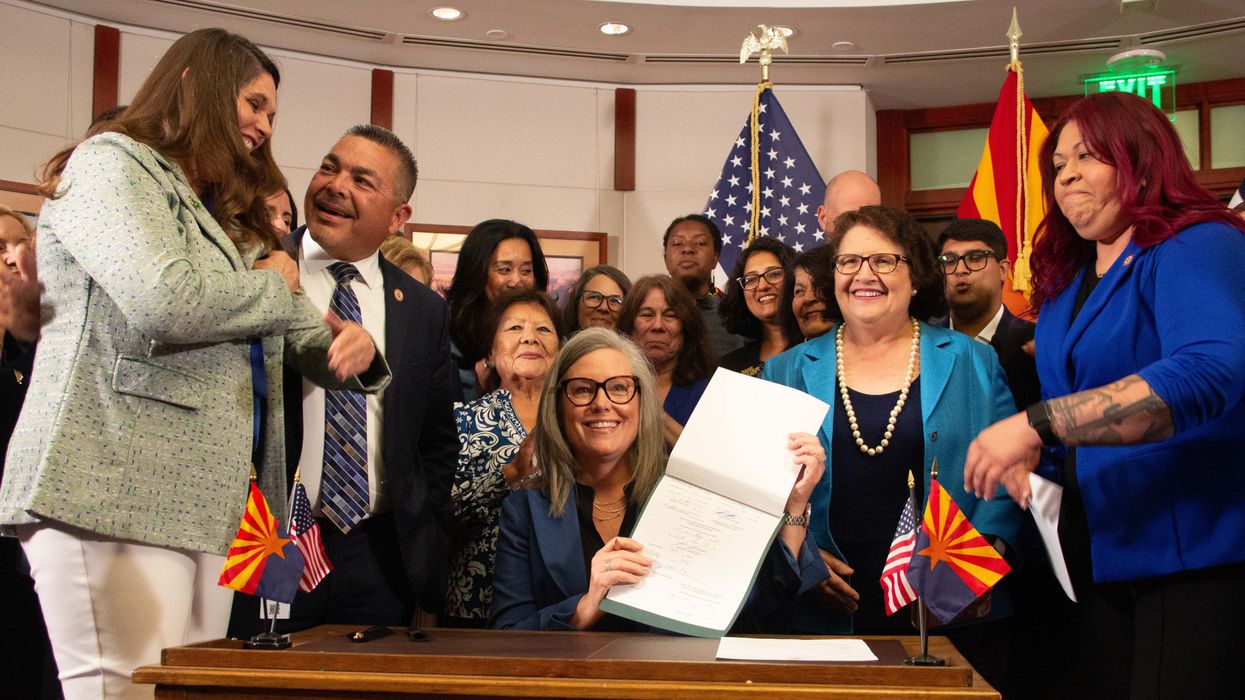
While Democratic Arizona Gov. Katie Hobbs on Thursday signed legislation repealing an 1864 abortion ban, reproductive rights advocates in the state reiterated that fuller freedom over family planning requires passing a November ballot measure.
In response to an
Arizona Republic opinion piece noting that there is no emergency clause in House Bill 2677, the law repealing the ban, "which means it won't go off the books until 90 days after the Legislature adjourns," Arizona for Abortion Access stressed that "Arizonans will still be living under a law that denies us the right to make decisions about our own health."
"We cannot afford to celebrate or lose momentum. The threat to our reproductive freedom is as immediate today as it ever was," the campaign behind the ballot initiative said, adding that only passing the Arizona Abortion Access Act "changes that for good."
The Arizona Abortion Access Act is a proposed state constitutional amendment that would prohibit many limits on abortions before fetal viability and safeguard access to care after viability to protect the life or physical or mental health of the patient. Arizonans were fighting for it even before the state Supreme Court reinstated the 160-year-old ban.
Even Hobbs recognized that the battle for reproductive freedom is far from over, saying Thursday that "today, we should not rest, but we should recommit to protecting women's bodily autonomy, their ability to make their own healthcare decisions, and the ability to control their lives."
"Let me be clear: I will do everything in my power to protect our reproductive freedoms, because I trust women to make the decisions that are best for them, and know politicians do not belong in the doctor's office," the Democrat pledged.
Her signature came just a day after the Arizona Senate approved H.B. 2677, following its state House passage last month. In both cases, a couple of Republican lawmakers voted with Democrats to advance the legislation—defying not only party members in the state but a national GOP that is hellbent on ending access to abortion care.
Democratic Arizona Attorney General Kris Mayes said Wednesday that the Senate vote "to repeal the draconian 1864 abortion ban is a win for freedom in our state" and she was looking forward to Hobbs signing the bill.
"However, without an emergency clause that would allow the repeal to take effect immediately, the people of Arizona may still be subjected to the near-total abortion ban for a period of time this year," Mayes acknowledged. "Rest assured, my office is exploring every option available to prevent this outrageous 160-year-old law from ever taking effect."
Law Dork's Chris Geidner pointed out that "on Tuesday—though technically unrelated—Mayes' office asked the Arizona Supreme Court to stay the issuance of the mandate in the case holding the near-total ban enforceable."
According to Geidner:
If granted, that would push the issuance of the mandate to July 25—90 days beyond the date when the Arizona Supreme Court denied Mayes' request for reconsideration—which would then block enforcement to at least 45 days beyond that, to September 8.
At that point, the repeal law passed on Wednesday likely will have gone into effect—meaning that the 15-week ban would remain the applicable law throughout this entire time—and the expected vote on the proposed constitutional amendment will be less than two months away.
Planned Parenthood Arizona took similar action after the Senate vote on Wednesday. The group's CEO, Angela Florez, explained that "we have said all along that we will use every possible avenue to safeguard essential care for our patients and all Arizonans, and that's exactly what we're doing with today's motion."
"While anti-abortion extremists in the state Legislature will continue to do everything in their power to undermine Arizonans' freedom and criminalize essential healthcare, Planned Parenthood Arizona is taking action to prevent a harmful total ban on abortion from taking effect in our state," Florez continued. "The court's April 9 ruling was both tragic and wrong, but it rested on trying to discern legislative intent. The Legislature has now spoken and clearly does not want the 1864 ban to be enforced."
"We hope the court stays true to its word and respects this long-overdue legislative action, by quickly granting our motion to end the uncertainty over the future of abortion in Arizona," added Florez, whose group supports the ballot measure.
Three Republicans in the Arizona House of Representatives on Wednesday joined with Democrats to advance legislation that would repeal an 1864 ban on abortion—a development rights advocates welcomed while stressing that the fight is far from over.
The 32-28 vote on House Bill 2677—with GOP Reps. Tim Dunn (25), Matt Gress (4), and Justin Wilmeth (2) voting in favor—was the third attempt in as many weeks to pass repeal legislation since the Arizona Supreme Court upheld the ban.
"The state Senate could vote on the repeal as early as next Wednesday, after the bill comes on the floor for a 'third reading,' as is required under chamber rules," according to NBC News. Democratic Gov. Katie Hobbs on Wednesday told The Washington Post that "I am hopeful the Senate does the right thing and sends it to my desk so I can sign it."
Applauding the House passage of H.B. 2677, Planned Parenthood Advocates of Arizona president and CEO Angela Florez said that "today, Arizona is one step closer to repealing the state's Civil War-era total abortion ban. While the repeal still must pass the Senate, this is a major win for reproductive freedom."
"We must celebrate today's vote in support of abortion rights and harness our enthusiasm to spread the word and urge lawmakers in the Senate to support this necessary repeal bill," she continued. "Despite this step forward, Arizonans cannot stop fighting."
Florez noted that "even with the repeal of the Civil War-era ban, the state will still have a ban on abortion after 15 weeks of pregnancy that denies people access to critical care. And lawmakers continue to attack Arizonans' ability to access reproductive healthcare. Our right to control our bodies and lives is hanging on by a thread."
"Thankfully, voters will have the opportunity to take back control if the Arizona Abortion Access Act is on the ballot this November," she added. "Abortion bans are out-of-step with the will of Arizonans and will force pregnant people to leave their communities for essential healthcare. Planned Parenthood Advocates of Arizona will continue fighting to ensure everyone has the right to make decisions about their health and futures."
The Arizona Abortion Access Act is a proposed state constitutional amendment that would prevent many limits on abortions before fetal viability and safeguard access to care after viability to protect the life or physical or mental health of the patient.
The coalition supporting the amendment, Arizona for Abortion Access, highlighted on social media that the House-approved bill "did not include the emergency clause required to stop the 1864 ban from taking effect on June 8," meaning H.B. 2677 wouldn't apply until 90 days after the end of the legislative session.
Coalition campaign manager Cheryl Bruce said that "with a total ban still set to take effect June 8, the Arizona Abortion Access Act is needed now more than ever. We remain committed to taking these decisions out of the hands of extremist politicians."
Arizona is one of multiple states where rights advocates are promoting abortion rights ballot measures this cycle. Reproductive freedom is also dominating political races at all levels, including the presidential contest. Democratic President Joe Biden is set to face former Republican President Donald Trump in November.
" Donald Trump is responsible for Arizona's abortion ban. Women in the state are still living under a ban with no exceptions for rape or incest and have been stripped of the freedom to make their own healthcare decisions," said Julie Chávez Rodriguez, Biden and Vice President Kamala Harris' reelection campaign manager.
While the presumptive GOP nominee has tried to distance himself from the Arizona Supreme Court's reinstatement of a 160-year-old abortion ban, he has also campaigned on his three appointees to the U.S. Supreme Court who helped reverse Roe v. Wade.
"Trump brags that he is 'proudly' the person responsible for these bans and if he retakes power, the chaos and cruelty he has created will only get worse in all 50 states," Chávez Rodriguez said. "President Biden and Vice President Harris are the only candidates who will stop him."
Old laws like an 1864 Arizona statute are being dusted off in the wake of the U.S. Supreme Court’s June, 2022 Dobbs decision that overturned Roe v. Wade’s federal guarantee of the right to abortion.
“When exactly was America great?” is a common question often asked of Donald Trump loyalists sporting MAGA (Make America Great Again) hats. The Republican-dominated Arizona Supreme Court has an answer: 1864. Put aside that the nation was embroiled in a civil war, millions of people were brutally enslaved, native populations were being driven from their lands, and that women were more than a half century from having the right to vote. What apparently made America great in 1864 were extremist anti-abortion laws then in existence.
These old laws are being dusted off in the wake of the U.S. Supreme Court’s June, 2022 Dobbs decision that overturned Roe v. Wade’s federal guarantee of the right to abortion.
This week, the Arizona Supreme Court ruled that an 1864 Arizona abortion ban, including in cases of rape or incest, still stands (with an exception to save the life of the pregnant person). The court stayed its enforcement for two weeks pending final appeals. If those fail, abortions will be criminalized in Arizona, with anyone performing one or even assisting someone in obtaining one facing up to five years in prison.
1864 was a pivotal year in U.S. history, as the tide shifted in the Civil War, leading to Union victory and the abolition of slavery the following year. Yes, the nation made faltering progress then, but it was by no means “great.”
First, some history: Arizona was a territory, not a state, in 1864, and was briefly contested during the Civil War. Confederates wanted it for its vast mineral wealth and for potential access to the Pacific Ocean. Union leaders sent in troops, winning decisive military control in 1862. President Abraham Lincoln appointed William Howell, a Michigan judge, to write Arizona’s laws, specifically including the banning of slavery (with the notorious exception, also included in the Constitution’s 13th Amendment, that prisoners can be subjected to forced labor) and the protection of fugitive slaves from capture and return to the South. Howell also included in the 461-page document, for reasons that are not entirely clear, a short section banning abortion.
While our society has progressed dramatically in the intervening 160 years, four Arizona Supreme Court justices, all appointed by the state’s previous Republican governor, Doug Ducey, ruled that the law is just fine as is.
In 2022, Arizona passed a 15-week abortion ban. That wasn’t extreme enough for some anti-abortion activists, who sought a court order reinstating the 1864 ban.
Arizona Governor Katie Hobbs, a Democrat, said after this week’s ruling, “I promise I will do everything in my power to protect our reproductive freedoms.”
Arizona Attorney General Kris Mayes, also a Democrat, said, “No woman or doctor will be prosecuted under this draconian law.”
U.S. Supreme Court Justice Samuel Alito included the 1864 Arizona ban in a list of other state and territorial laws in his controversial Dobbs decision that overturned Roe. Several historians have pointed out that Alito’s list of laws dating from as far back as 1825 fails to provide any context and misses the point that medicinal abortion was a common and accepted practice throughout the colonial era and into the 19th century.
More importantly, the historical laws Alito relied on to overturn Roe completely ignore two centuries of progress.
“A majority, overwhelming majority, of the population wants abortion to be legal in all circumstances,” Amy Littlefield, abortion access correspondent at The Nation, said on the Democracy Now! news hour. “After Dobbs, that population is angry. They are motivated. They are voting. They are organizing. And Republicans and Democrats alike understand this.”
The impact of the Arizona abortion ban will be enormous. On a clinical level, thousands seeking abortions will be denied access, unless they have the resources to travel to another state.
Politically, the Arizona law could be Earth shattering. Arizona Abortion Access is a group collecting up to 1 million signatures—several times the number needed—to put an amendment on the Arizona ballot in November, to enshrine the right to an abortion in the state constitution.
Voters will flock to the polls to support this abortion access referendum. Arizona Republican Senate candidate Kari Lake understands this, and criticized the state Supreme Court decision this week, despite lauding the 1864 ban in 2022.
Likewise, former President Donald Trump said in a video statement that abortion laws should be left to the states, but then, two days later, said the Arizona Supreme Court went too far.
Arizona is a swing state, and Trump knows abortion has been a winning issue for Democrats since Roe was overturned. An abortion rights referendum will also be on the ballot in Florida, where a six-week ban is about to go into effect, putting that reliably red state back in play for President Joe Biden.
1864 was a pivotal year in U.S. history, as the tide shifted in the Civil War, leading to Union victory and the abolition of slavery the following year. Yes, the nation made faltering progress then, but it was by no means “great.” For true greatness, we can only look to the future.
"This is who the Arizona Senate Republicans are—they are so 'pro-life' they will let women die to appeal to their radical base," said Democratic lawmakers."
Republican lawmakers at the federal and state level have displayed considerable hand-wringing this week over the Arizona Supreme Court's reinstatement of a 160-year-old abortion ban, with presumptive GOP presidential nominee Donald Trump saying the court had gone "too far."
But when given the opportunity to repeal the law that one state representative said "cannot stand" on Wednesday, the party backpedaled.
In the state Senate, Republicansremoved from Wednesday's agenda a bill to repeal the ban and gaveled down state Sen. Anna Hernandez (D-24) as she tried to introduce a motion before the GOP members walked out of the chamber.
"This is who the Arizona Senate Republicans are—they are so 'pro-life' they will let women die to appeal to their radical base,"
said the state's Senate Democrats. "They broke their own rules and ignored Democratic members who attempted to introduce a measure to repeal the territorial ban on abortion. They walked out on Arizona and turned their back on doing the right thing."
This is who the Arizona Senate Republicans are—they are so “pro-life” they will let women die to appeal to their radical base. They broke their own rules and ignored Democratic members who attempted to introduce a measure to repeal the territorial ban on abortion.
The walked… pic.twitter.com/LKKoCJESIQ
— Arizona Senate Democrats (@AZSenateDems) April 10, 2024
In the state House, state Rep. Matt Gress (R-4), who said Tuesday that he rejected "rolling back the clock to a time when slavery was still legal," made a motion to vote on a Democratic bill to repeal the ban.
But as Mary Jo Pitzl of
The Arizona Republic reported, Gress then joined his party in calling for a recess and adjourning until next week, bringing the action to a halt.
Democrats chanted, "Shame!" at the Republicans as they filed out of the chamber.
Democrats protest as Republicans shut down an attempt to bring the 1864 abortion bill to a vote. Although @MatthewGress made the motion, he sided with the GOP to recess the session — bringing action to a halt pic.twitter.com/MtbDTcckjh
— Mary Jo Pitzl (@maryjpitzl) April 10, 2024
State Rep. Charles Lucking (D-5) pointed out that Republicans "immediately brought in the press so Gress could say he called a vote."
Democratic members interrupted Gress' press conference, reminding the media that the Republican "sponsored bills to enshrine fetal personhood into law."
"He's lying!" said state Rep. Analise Ortiz (D-24). "Do not fall for it!"
More action from Arizona House floor pic.twitter.com/JOtlJadisO
— Cameron Arcand (@cameron_arcand) April 10, 2024
State House Speaker Ben Toma (R-27) told Axios on Wednesday that he would not support a repeal—but issued a joint statement with state Senate President Warren Petersen (R-14) saying they were reviewing the high court ruling and "listening to our constituents to determine the best course of action."
Pew Research's latest polling data for the state shows 49% of adults in Arizona believe abortion care should be legal in "most or all cases," while 46% believe it should be illegal.
"Banning all abortion in Arizona has always been the endgame for Republicans in the legislature, and today, they showed their cards by refusing to stop this abortion ban in its tracks," said Reproductive Freedom for All director of Arizona campaigns Athena Salman. "These extremists do not care about the health and wellbeing of the people they are supposed to represent."
The 1864 ban applies to pregnancies starting at the moment of conception, with no exception for pregnancies resulting from rape or incest. Doctors who provide abortion care could be sentenced to up to five years in prison under the law.
After the Senate Republicans walked out of the session, Democrats posted on social media several of the speeches they had been planning to give in support of repealing the ban.
"We had the chance to fix this today, now, and it is long past time to get rid of this territorial-era ban from before women could vote, from when the age of consent was 10 years old, from before we were even a state," said state Sen. Christine Marsh (D-4). "But as we move forward I will remember the Republicans who stood in the way of attempt after attempt to get rid of this destructive legislation that throws doctors in jail for providing healthcare and endangers women."
"And more importantly," she said, "the voters will remember."
"Arizona is what happens when abortion policy is, as Donald Trump claims he wishes, left up to the states," said one columnist.
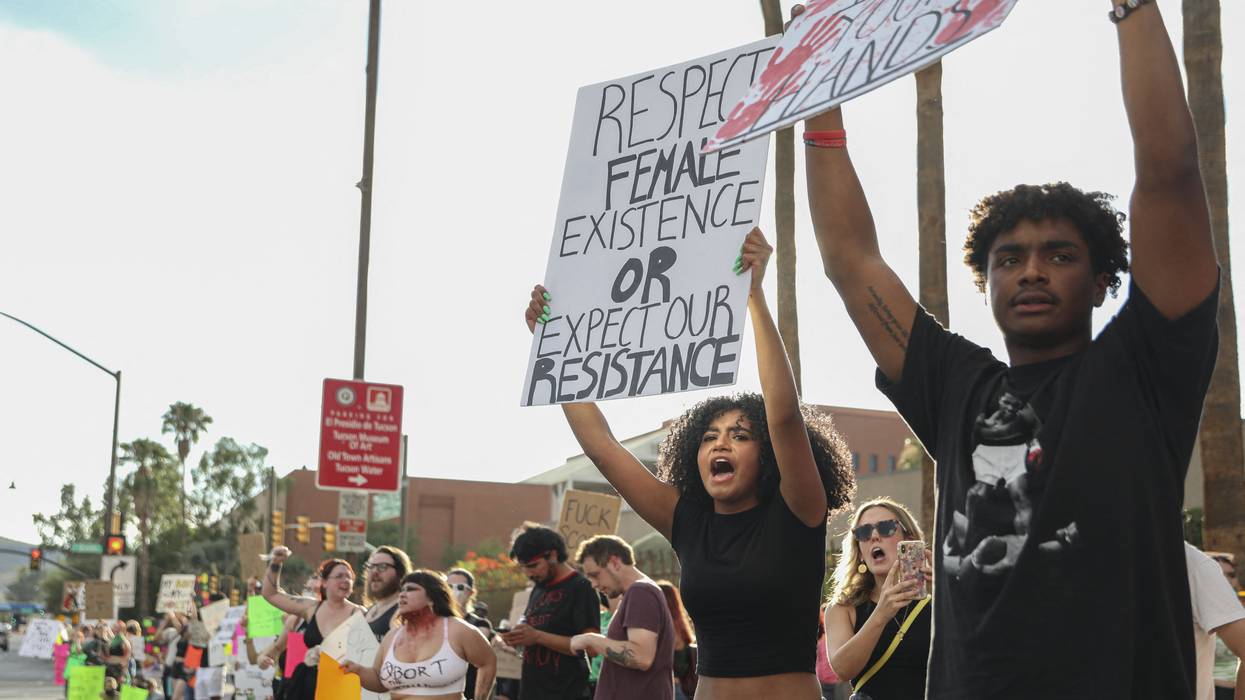
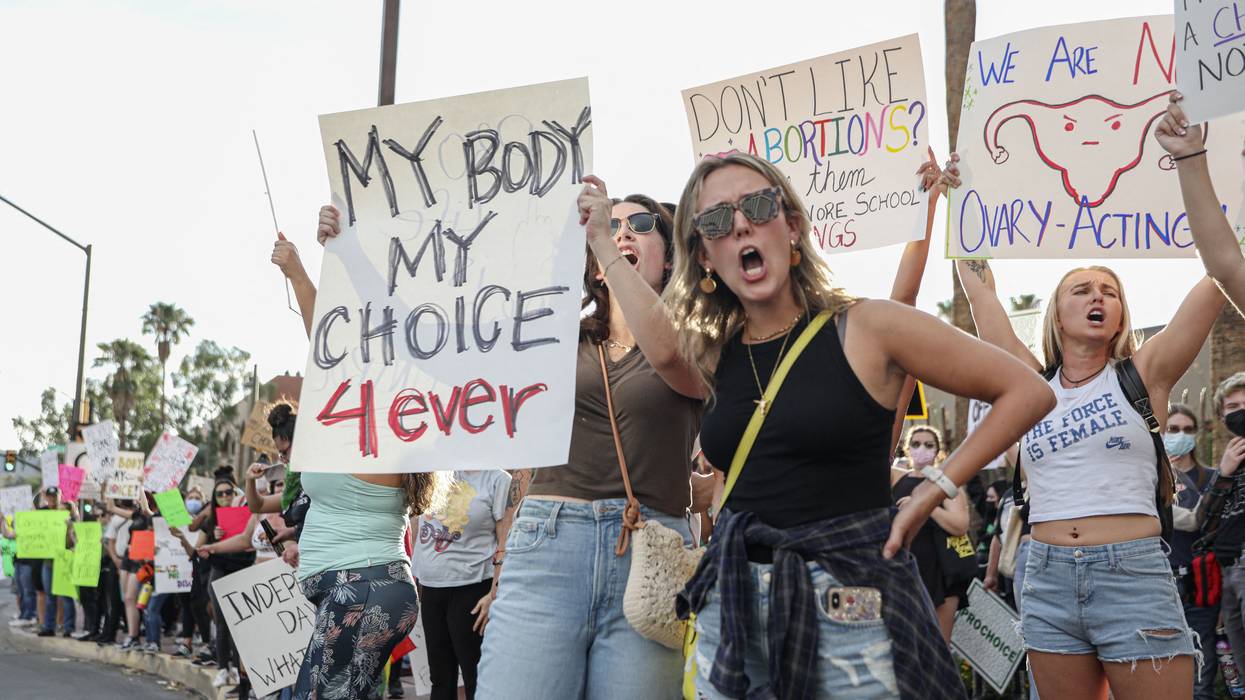
Reproductive justice campaigners in Arizona on Tuesday vowed to make sure voters "have the ultimate say" on abortion rights after the state Supreme Court upheld an 1864 ban that includes no exceptions for pregnancies resulting from rape or incest.
"This is a horrifying ruling that puts the lives and futures of countless Arizonans at risk," said Leah Greenberg, co-founder of progressive advocacy group Indivisible. "It's devastating and cruel—and we're fighting back."
The court ruled that since Roe v. Wade was overturned by the right-wing majority on the U.S. Supreme Court in 2022, no law exists to prevent Arizona from reinstating a measure passed in 1864—before Arizona was even a U.S. state.
The law outlaws abortion care from the moment of conception with exceptions only in cases of a pregnant person who faces life-threatening health impacts. Such "exceptions" have been shown to threaten the health, including reproductive health and future fertility, of pregnant people in several states since Roe was overturned in the Dobbs v. Jackson Women's Health Organization ruling.
Under the Arizona law, doctors who are prosecuted for providing abortion care could face fines and 2-5 years in prison.
State Attorney General Kris Mayes, a Democrat, called the ruling "unconscionable and an affront to freedom."
"Today's decision to reimpose a law from a time when Arizona wasn't a state, the Civil War was raging, and women couldn't even vote will go down in history as a stain on our state," said Mayes. "This is far from the end of the debate on reproductive freedom, and I look forward to the people of Arizona having their say in the matter. And let me be completely clear, as long as I am attorney general, no woman or doctor will be prosecuted under this draconian law in this state."
Democratic organizer Amanda Litman noted that local prosecutors "have jurisdiction to decide whether or not to press charges on people seeking care under this ban."
Last week, organizers with Arizona for Abortion Access announced that they had collected more than the number of signatures needed to support placing a referendum on a constitutional amendment enshrining the right to abortion care on state ballots in November.
The ruling was handed down in Planned Parenthood v. Hazelrigg, a case that centered on an anti-abortion doctor's appeal of a December 2022 ruling which upheld the state's 15-week abortion ban. Dr. Eric Hazelrigg, who owns a chain of anti-abortion clinics in the state, urged the high court to instead reinstate the 1864 ban.
Planned Parenthood Arizona, Inc. said the "deplorable decision will send Arizona back nearly 150 years."
"This ruling will cause long-lasting, detrimental harms for our communities," said the group. "It strips Arizonans of their bodily autonomy and bans abortion in nearly all scenarios. And it does so following the troubling example of the U.S. Supreme Court in Dobbs: with judges ignoring long-settled precedent and principles of law to reach their preferred policy result."
Columnist Helaine Olen noted that the ruling was handed down a day after former President Donald Trump, now the Republican Party's presumptive 2024 presidential nominee, said states should be allowed to impose "whatever they decide" in terms of abortion restrictions and bans.
"Remember," said U.S. Sen. Elizabeth Warren (D-Mass.). "This is brought to you by Trump. He supports cruel bans like these, and he made them possible by overturning Roe."
The ruling was put on hold for 14 days, and advocates emphasized on Tuesday that abortion care is still legal in Arizona for the time being.
Since Roe was overturned, pro-forced pregnancy legislators in Wisconsin and Michigan have supported imposing abortion bans dating back to 1849 and 1931, respectively. A judge ruled last July in Wisconsin that the 19th-century law did not make abortion care illegal, and Michigan voters approved a constitutional amendment protection abortion rights, clearing the way for the 1931 law to be repealed.
Voters in Florida, where the state Supreme Court last week effectively approved a six-week abortion ban, will also vote on a constitutional amendment on abortion rights in November.
Since 2022, voters in states including Kansas and Kentucky have voted in favor of expanding, rather than restricting, access to abortion.
"With abortion on the ballot in November, anti-choice extremists will feel the power of pissed off women voters," said Rep. Becca Balint (D-Vt.). "No doubt about it."
Kari Lake, the Republican Senate candidate in Arizona, quickly attempted to distance herself from the 1864 ban, saying she was calling on the state Legislature to "come up with an immediate commonsense solution that Arizonans can support."
U.S. Rep. Ruben Gallego (D-Ariz.), who is running against Lake, noted that just two years ago after Roe was overturned, the former TV newscaster and gubernatorial candidate said she was "incredibly thrilled that we are going to have a great law that's already on the books... It will prohibit abortion in Arizona except to save the life of a mother."
"This November," said Gallego, "Kari Lake will find out, yet again, that Arizonans have no interest in politicians who threaten their rights."