

SUBSCRIBE TO OUR FREE NEWSLETTER
Daily news & progressive opinion—funded by the people, not the corporations—delivered straight to your inbox.
5
#000000
#FFFFFF
To donate by check, phone, or other method, see our More Ways to Give page.
Daily news & progressive opinion—funded by the people, not the corporations—delivered straight to your inbox.

The US, said a group of senators led by Sen. Chris Van Hollen, must suspend weapons sales to the United Arab Emirates, which arms the Rapid Support Forces in Sudan.
Writing to Secretary of State Marco Rubio, Sen. Chris Van Hollen on Monday led 20 members of the Democratic Caucus in demanding that the Trump administration go beyond simply denouncing the Rapid Support Forces, the paramilitary group in Sudan that has been accused of war crimes in the country's civil war, and take "concrete action" to stop more mass atrocities as the group encircles the city of El Obeid.
"These actions should include ceasing certain US arms sales to external actors that are fueling this war, including the United Arab Emirates, which continues to arm the RSF," wrote the senators, including Sens. Bernie Sanders (I-Vt.), Elizabeth Warren (D-Mass.), and Ed Markey (D-Mass.).
The lawmakers wrote to Rubio as an estimated 500,000 civilians were at risk in El Obeid, where many people have sought safety following RSF attacks across the Kordofan region.
The letter came as the United Nations Office for the Coordination of Humanitarian Affairs said civilians are facing drone attacks in El Obeid, with humanitarian assistance also put at risk by the assault.
A number of the signatories, including Van Hollen and Sanders, have previously called on the Trump administration to end its complicity in RSF attacks like those that occurred in El Fasher last October, which United Nations investigators said bore the "hallmarks of genocide" after the group killed more than 6,000 civilians in the first three days of its offensive in the besieged city.
The senators described attacks like those on El-Saudi Hospital in El Fasher, where RSF forces "proceeded to search the wards and killing those they found, including patients, accompanying persons and medical personnel," killing an estimated 460 people before pursuing civilians who tried to escape.
Reports described "the perpetrators chasing people in open fields, firing at them with automatic rifles and mounted submachine guns, and running over fleeing persons with vehicles, causing mass casualties," the senators wrote.
More than 14 million people have also been forcibly displaced by the civil war.
But the scale of atrocities would likely not have been possible without the RSF's support from the UAE, for which the Trump administration fast-tracked a weapons sale in May after having provided the country with $7 billion in weapons just two months earlier.
Also in May, said the senators, Human Rights Watch released a report showing that the UAE trained hundreds of Colombian mercenaries who then took part in the atrocities in El Fasher and trained RSF recruits, including child soldiers.
Now, they wrote, the RSF's "encirclement and systematic crippling of resources in El Obeid increasingly parallels El Fasher, and this administration must use its leverage and influence to prevent a repeat of El Fasher’s horrors in El Obeid before it is too late."
They pointed out that the administration has acknowledged that further "mass atrocities could be imminent” in Sudan, as a State Department spokesperson said on June 22. In November 2025, Rubio himself said that the RSF was "clearly receiving assistance from outside" and that “something needs to be done to cut off the weapons and the support the RSF is getting as they continue their advances.”
Despite those acknowledgments, said the senators, the Trump administration has shown a "grave failure to act despite the chorus of alarm bells."
"What occurred in El Fasher is a stark warning of what could unfold in El Obeid and across Sudan if this administration—and the international community—continues this current pattern of inaction," wrote Van Hollen and his colleagues.
"While we welcome the State Department’s expression of concern about the escalating situation in El Obeid, words are not enough," they said. "The United States must use the leverage and influence at our disposal to prevent further atrocities in El Obeid and help bring this brutal war in Sudan to an end."
The senators called for a response to their letter by August 17, urging the administration to provide "an update on what other actions the administration is taking, beyond just words, to prevent mass atrocities in El Obeid."
Four years of arms sales data tell the same story: Israel doesn’t pay for most of the weapons the US sells it—US taxpayers do.
The Trump administration expects US taxpayers to fund not only its own military adventurism but Israel’s as well.
Ending American subsidies for Israel’s wars is one reason why Sens. Bernie Sanders (I-Vt.), Chris Van Hollen (D-Md.), Jeff Merkley (D-Ore.), and Peter Welch (D-Vt.) recently filed Joint Resolutions of Disapproval opposing $659 million in President Donald Trump-approved bomb sales to Israel, with many of the bombs coming directly from US stocks.
“Given the horrific destruction that Israel’s extremist government has wrought on Gaza, Iran, and Lebanon, the last thing in the world that American taxpayers need to do right now is to provide 22,000 new bombs to the [Benjamin] Netanyahu government,” Sanders said in a statement.
Van Hollen added that “Congress must use all the tools at our disposal to end Trump’s war, including stopping the transfer… of taxpayer-funded bombs to the Netanyahu government.”
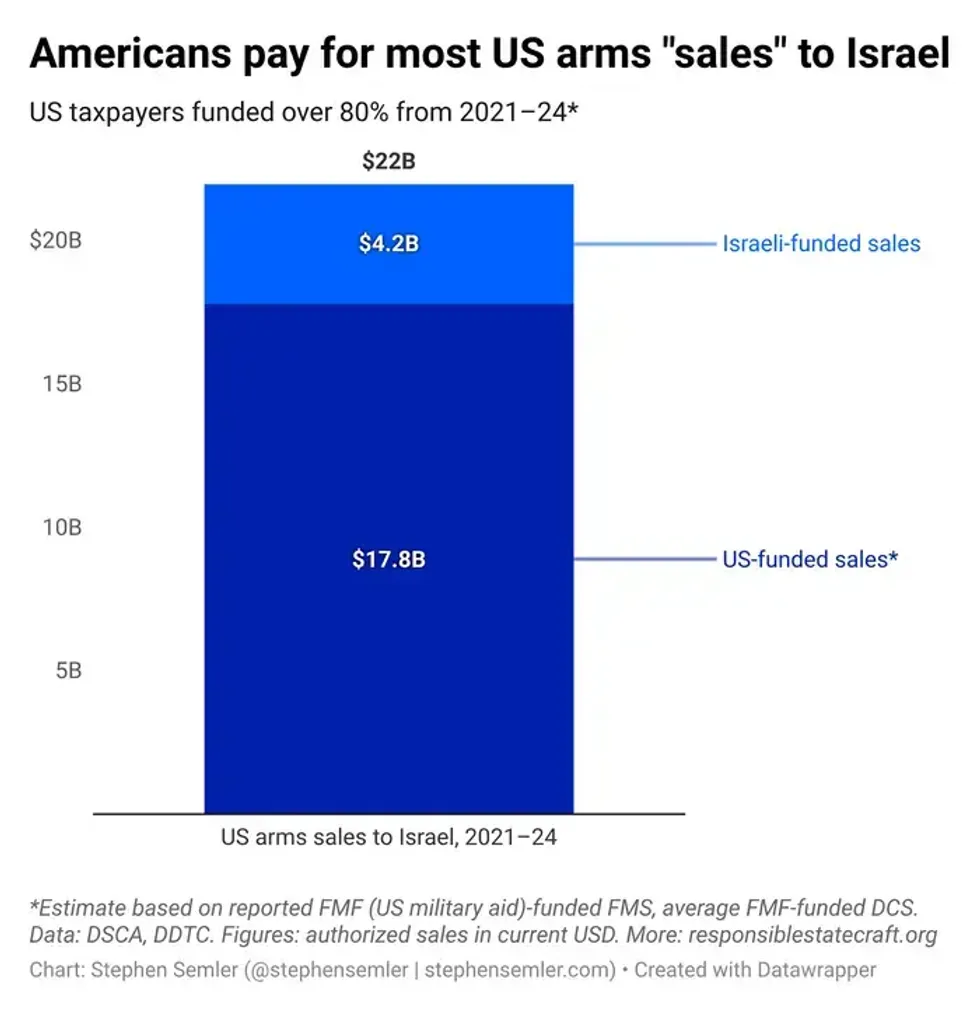
All told, US taxpayers funded $17.8 billion in arms sales to Israel under President Joe Biden—$11.9 billion government-brokered and $5.9 billion commercial—81% of the $22 billion in sales from 2021-2024.
The senators are right to highlight US taxpayers’ role in these arms deals. That they’re reported as sales belies who’s actually paying for them. Americans, not Israelis, pay for the vast majority of US arms sales to Israel.
US arms sales to Israel aren’t really sales, at least not in the typical sense. Israel’s position as purchaser in these weapons deals isn’t synonymous with funder. This is made clear in the arms sales notifications themselves.
Consider the four most recent notified arms sales to Israel published in the Federal Register: $740 million for armored personnel carriers, $1.98 billion for tactical vehicles and accessories, $3.8 billion for attack helicopters and related weaponry, and $150 million for utility helicopters and parts. After “Prospective Purchaser,” all these notifications list Government of Israel. After “Funding Source,” all list Foreign Military Financing—or FMF, the US military aid program through which Israel receives at least $3.3 billion a year.
In practice, FMF functions as a gift card for Israel to spend on weapons. US taxpayers are stuck paying for the gift card. The only trace of Israeli funding in those $6.7 billion in arms sales is in the tactical vehicle deal, where National Funds follows FMF on the funding source line.
What about the pair of sales including 22,000 bombs, objected to by Sanders, et al.? Both deals are funded by FMF, or in other words, US taxpayers.
This is, of course, a small sample size. But four years of arms sales data tell the same story: Israel doesn’t pay for most of the weapons the US sells it—US taxpayers do.
This fact undermines the economic justification for these arms sales. By foreclosing any claims that they bring significant foreign investment into the US, the case for these sales collapses into the same flawed job creations argument that many hawks use to defend lavish government spending on the military.
The jobs argument is itself a tacit admission of a weak national security justification. A policy that truly concerned the nation’s very existence wouldn’t have to be sold in terms as banal as job creation. The security justification alone would be convincing enough.
Military spending is the least efficient way a government can create jobs. Using military aid to boost employment is like buying a plane ticket to watch a film: Yes, there’s an in-flight movie; no, that doesn’t justify the expense.
Even that analogy is generous. The relationship between military spending and jobs is not self-evident. In 1985, the US military budget was $295 billion—$746 billion in today’s dollars—and there were 3 million workers in the US arms industry. By 2021, the US military budget had increased by $132 billion in real terms—to $879 billion—while the number of arms industry workers had dropped to 1.1 million. Despite military spending increasing 18% above inflation, there was a 63% drop in arms industry employment.
American arms sales are either US government brokered (“Foreign Military Sales”) or commercial (“Direct Commercial Sales”). I collected data on both via the Defense Security Cooperation Agency’s (DSCA) Historical Sales Books and the Directorate of Defense Trade Controls’ (DDTC) Section 655 Reports, respectively. Both yearly publications tally the value of authorized arms sales.
The Biden administration authorized $22 billion in arms sales to Israel, including more than $13.2 billion in US government-brokered sales and over $8.7 billion in commercial sales. According to the DSCA report, 90% of the government-brokered deals were funded with US military aid. The DDTC report doesn’t specify the funding source, but 68% is a reasonable estimate based on the average annual share of FMF funding that Israel reportedly spends on commercial sales.
All told, US taxpayers funded $17.8 billion in arms sales to Israel under President Joe Biden—$11.9 billion government-brokered and $5.9 billion commercial—81% of the $22 billion in sales from 2021-2024. That’s nearly $18 billion in subsidies disguised as sales.
US taxpayers deserve a refund, not more of the same from Trump.
The German government has long been one of the most vehement defenders and top financial contributors to Israel's assault on Gaza.
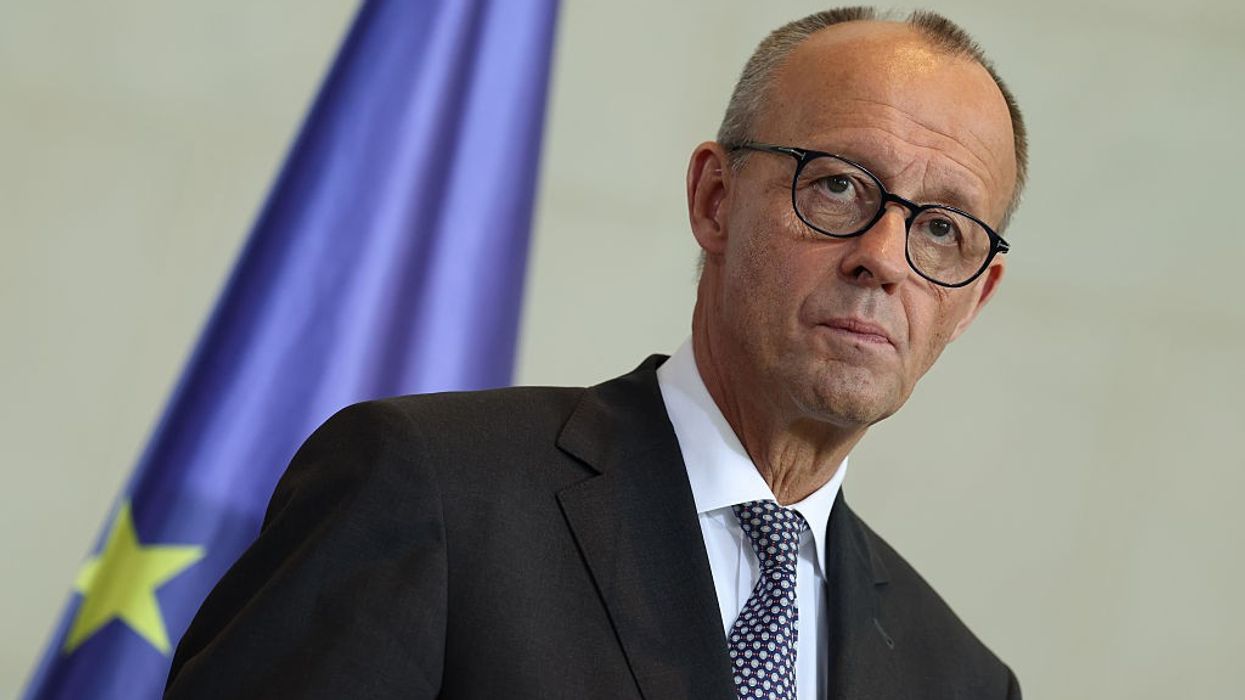
Israel's approval of a plan to take over Gaza City—over the objections of human rights groups and the country's own military leaders—marked a red line for one of its closest allies on Friday, with German Chancellor Friedrich Merz announcing his government would halt sales of weapons that could be used by Israel in its occupation of the besieged enclave.
Merz said that "the even harsher military action by the Israeli army in the Gaza Strip, approved by the Israeli cabinet last night, makes it increasingly difficult for the German government to see" how Prime Minister Benjamin Netanyahu's stated goal of defeating Hamas and securing the release of hostages will be achieved.
Netanyahu's security ministers approved a proposal to direct the Israel Defense Forces (IDF) to fully take over Gaza City in the northern part of the enclave, which has already been badly damaged by the assault Israel began in October 2023 but has not been entirely razed like several other cities. Israeli hostages are believed to be in central Gaza.
The move is thought to be the first step in Netanyahu's plan to fully occupy Gaza, which United Nations human rights chief Volker Türk said Friday would "result in more massive forced displacement, more killing, more unbearable suffering, senseless destruction, and atrocity crimes" against Palestinian civilians.
Merz said Friday that "under these circumstances, the German government will not authorize any exports of military equipment that could be used in the Gaza Strip until further notice."
Germany has been a vehement defender of Israel's bombardment of Gaza, which it began in retaliation for a Hamas-led attack—and which has killed more than 61,000 people, the majority of whom have been women and children. Israeli soldiers have long said they’ve been directed to kill civilians, and Israel's assault has also included a near-total blockade on humanitarian aid which has starved to death nearly 200 Palestinians so far, about half of whom have been children.
"Under these circumstances, the German government will not authorize any exports of military equipment that could be used in the Gaza Strip until further notice."
In the first 19 months of the war, Germany was one of the biggest international suppliers of weapons to the IDF, issuing arms export licenses worth 485 million euros ($564 million). The country has provided firearms, ammunition, weapons components, electronic equipment, and armored vehicles, according to Merz’ government.
Germany has not followed the lead of France, the United Kingdom, and Canada, which have recently signaled they would join the vast majority of U.N. member states in recognizing Palestinian statehood, and it opposed the suspension of the European Union-Israel Association Agreement last month.
Germany's center-left Social Democratic party has been calling on Merz to halt arms sales for months as Israel has blocked nearly all humanitarian aid and escalated attacks, including a ground offensive, following a brief cease-fire. The Integrated Food Security Phase Classification, a U.N.-backed monitor of worldwide hunger, said last month that famine is unfolding across Gaza due to the blockade.
Social Democratic Vice Chancellor Lars Klingbeil said Merz' decision was "just."
"The humanitarian suffering in Gaza is unbearable," said Klingbeil.
The German public has also expressed plummeting support for their government's complicity in Israel's bombardment of Gaza, with 66% of Germans saying Merz should "exert greater influence over Israel to change its actions in Gaza" in a poll published this week by the country's public broadcaster.
German citizens' growing disapproval of Israel's attack on Gaza has matched that of the public in the United Kingdom, which has also supplied military aid to Israel since October 2023, mostly in the form of parts of F-35 fighter jets.
A poll last month by YouGov showed Britons increasingly support and sympathize with Palestinians and oppose the Israeli government's actions in Gaza.
Prime Minister Keir Starmer on Friday denounced the Israeli plan to take over Gaza City, calling for "a cease-fire, a surge in humanitarian aid, the release of all hostages by Hamas, and a negotiated solution."
But Starmer made no mention of ending all arms exports to Israel.
"If the government was truly horrified by Israel's occupation of Gaza, it would stop supplying them with the weapons they need to carry it out," said former Labour Party leader Jeremy Corbyn, now an independent member of Parliament. "The Prime Minister can condemn Israel's plans all he wants. He cannot hide the truth: His government is complicit in genocide."

The world is watching. So are the people of Sudan. The question is whether the United States will choose complicity—or conscience. We must act now.
In a world deluged with crises—each vying for our limited attention—the catastrophe unfolding in Sudan has remained largely invisible to the American public. Yet, by almost any measure, it is among the most severe humanitarian emergencies of our time. Over 30 million people—two-thirds of Sudan’s population—now require humanitarian support. More than 12 million have been displaced, and famine threatens to claim countless lives. This is not a distant tragedy; it is a crisis in which American policy and the interests of American capitalists are deeply entangled.
Now, Congress is poised to vote on a set of resolutions that could finally interrupt the United States’ role in fueling this disaster. You can call your Senator and ask them to support S.J.Res.51, S.J.Res.52, S.J.Res.53, and S.J.Res.54—the Joint Resolutions of Disapproval by Senator Chris Murphy et. al. that would block more than $3.5 billion in proposed arms sales to the United Arab Emirates (UAE) and Qatar. The Congressional Switchboard is at 202-224-3121.
This legislation is likely to come up this week and that makes this a rare moment of real leverage for American activists and concerned citizens. The urgency is clear: unless Congress acts, the U.S. risks deepening its complicity in Sudan’s suffering.
At the epicenter of Sudan’s unraveling is the Rapid Support Forces (RSF), a paramilitary group whose origins trace back to the notorious Janjaweed militias involved in the Darfur genocide in the early 2000s. The RSF has been implicated in a series of systematic atrocities: targeted ethnic violence, mass killings, forced displacement, and widespread sexual violence. Investigations by the United Nations, Human Rights Watch, and Amnesty International have all pointed to the same grim conclusion: the RSF’s actions constitute war crimes, ethnic cleansing, and, in the assessment of the U.S. State Department, genocide.
The mechanics of how these atrocities are sustained have already come into focus. According to Amnesty International, recently manufactured Emirati armored personnel carriers are now in the hands of the RSF. Flight data and satellite imagery have revealed a pattern: cargo planes departing from the UAE, landing at remote airstrips in Chad, and then offloading weapons and equipment that would soon appear on the front lines in Sudan. A New York Times investigation concluded that the UAE was “expanding its covert campaign to back a winner in Sudan, funneling money, weapons and, now, powerful drones” to the RSF.
What makes this all the more alarming is that the UAE is one of America’s closest military partners—and a major recipient of U.S. arms. Despite repeated assurances to Washington that it would not arm Sudan’s belligerents, the UAE has continued these transfers, as confirmed by the Biden Administration in one of its last acts as well as by members of Congress.
There is, however, another angle to this story—an angle that speaks to the corrosion of U.S. foreign policy by incredibly narrow financial interests. President Donald Trump and his family have cultivated deep financial ties with both the UAE and Qatar. The UAE has invested $2 billion in a Trump family crypto venture; Qatar has bestowed a $400 million on that luxury aircraft everyone’s heard about, intended for the U.S. presidential fleet, in a gesture that blurs the line between diplomacy and personal favor. These transactions are not just unseemly; they are emblematic of this new era in which U.S. foreign policy is increasingly shaped by the private interests of a handful of oligarchs.
To call this “kleptocracy” is not hyperbole. The intertwining of arms sales, foreign influence, and personal enrichment undermines both U.S. standing and the interests of the average American. Each weapon sold, each deal brokered, risks making the United States more complicit in the suffering of Sudan’s civilians.
To call this “kleptocracy” is not hyperbole. The intertwining of arms sales, foreign influence, and personal enrichment undermines both U.S. standing and the interests of the average American.
The Sudan crisis is a reminder that America’s actions abroad are neither abstract nor inconsequential—and all the uniqueness of the Trump 2.0 administration hasn’t changed that. U.S. policies still reverberate in the lives of millions. As citizens, we have a responsibility to demand that our leaders act not out of expedience or self-interest, but out of a sense of justice and human dignity. With a congressional vote imminent, the window for meaningful action is open—but it is closing fast.
The world is watching. So are the people of Sudan. The question is whether the United States will choose complicity—or conscience. Please call your Senators today at 202-224-3121.
The Israeli government has displayed clear and unequivocal genocidal intent. Continuing to arm Israel with U.S. weapons means full complicity in what they do with them.
Israel’s renewed assault on Gaza comes several months after both Amnesty International and Human Rights Watch issued reports concluding without equivocation that Israel was engaged in genocide. But very few members of Congress dare to acknowledge that reality, while their silence and denials scream out complicity.
In a New York Times interview last weekend, the Senate’s Democratic leader Chuck Schumer put deep moral evasion on display. Among the “slogans” that are used when criticizing Israel, he said, “The one that bothers me the most is genocide. Genocide is described as a country or some group tries to wipe out a whole race of people, a whole nationality of people. So, if Israel was not provoked and just invaded Gaza and shot at random Palestinians, Gazans, that would be genocide. That’s not what happened.”
Schumer is wrong. The international Genocide Convention defines genocide as “acts committed with intent to destroy, in whole or in part, a national, ethnical, racial or religious group”—with such actions as killing, “deliberately inflicting on the group conditions of life calculated to bring about its physical destruction in whole or in part,” and “imposing measures intended to prevent births within the group.”
It would be untenable to publicly acknowledge the reality of Israeli genocide while continuing to support shipping more weaponry for the genocide.
Such actions by Israel have been accompanied by clear evidence of genocidal intent—underscored by hundreds of statements by Israeli leaders and policy shapers. Scarcely three months into the Israeli war on Gaza, scholars Raz Segal and Penny Green pointed out, a database compiled by the Law for Palestine human rights organization “meticulously documents and collates 500 statements that embody the Israeli state’s intention to commit genocide and incitement to genocide since October 7, 2023.”
Those statements “by people with command authority—state leaders, war cabinet ministers and senior army officers—and by other politicians, army officers, journalists and public figures reveal the widespread commitment in Israel to the genocidal destruction of Gaza.”
Since March 2, the United Nations reports, “Israeli authorities have halted the entry of all lifesaving supplies, including food, medicine, fuel and cooking gas, for 2.1 million people.” Now, Israel’s horrendous crusade to destroy Palestinian people in Gaza—using starvation as a weapon of war and inflicting massive bombardment on civilians—has resumed after a two-month ceasefire.
On Tuesday, children were among the more than 400 people killed by Israeli airstrikes, and Prime Minister Benjamin Netanyahu proclaimed that “this is only the beginning.”
It’s almost impossible to find a Republican in Congress willing to criticize the pivotal U.S. backing for Israel’s methodical killing of civilians. It’s much easier to find GOP lawmakers who sound bloodthirsty.
A growing number of congressional Democrats—still way too few—have expressed opposition. In mid-November, 17 Senate Democrats and two independents voted against offensive arms sales to Israel. But in reality, precious few Democratic legislators really pushed to impede such weapons shipments until after last November’s election. Deference to President Biden was the norm as he actively enabled the genocide to continue.
This week, renewal of Israel’s systematic massacres of Palestinian civilians has hardly sparked a congressional outcry. Silence or platitudes have been the usual.
For “pro-Israel, pro-peace” J Street, the largest and most influential liberal Zionist organization in the United States, evasions have remained along with expressions of anguish. On Tuesday the group’s founder and president, Jeremy Ben-Ami, issued a statement decrying “the decision by Netanyahu to reignite this horrific war” and calling for use of “all possible leverage to pressure each side to restore the ceasefire.” But, as always, J Street did not call for the U.S. government to stop providing the weapons that make the horrific war possible.
This week, renewal of Israel’s systematic massacres of Palestinian civilians has hardly sparked a congressional outcry. Silence or platitudes have been the usual.
That’s where genocide denial comes in. For J Street, as for members of Congress who’ve kept voting to enable the carnage with the massive U.S.-to-Israel weapons pipeline, support for that pipeline requires pretending that genocide isn’t really happening.
While writing an article for The Nation (“Has J Street Gone Along With Genocide?”), I combed through 132 news releases from J Street between early October 2023 and the start of the now-broken ceasefire in late January of this year. I found that on the subject of whether Israel was committing genocide, J Street “aligned itself completely with the position of the U.S. and Israeli governments.”
J Street still maintains the position that it took last May, when the International Court of Justice ordered Israel to halt its military offensive in Rafah. “J Street continues to reject the allegation of genocide in this case,” a news release said.
It would be untenable to publicly acknowledge the reality of Israeli genocide while continuing to support shipping more weaponry for the genocide. That’s why those who claim to be “pro-peace” while supporting more weapons for war must deny the reality of genocide in Gaza.
Not only should the FCPA be vigorously enforced to stop bribery of foreign officials by U.S. companies, but the law must also be strengthened to combat the flip side of the corruption coin—foreign bribes accepted by American officials.
On February 10, U.S. President Donald Trump issued an executive order that directed Attorney General Pam Bondi to pause the enforcement of the Foreign Corrupt Practices Act. The FCPA was the first law in modern history to ban a country’s own citizens and companies from bribing foreign officials.
Citing the law as one of the “excessive barriers to American commerce abroad,” President Trump has instructed the attorney general to—at her discretion—“cease the initiation of any new FCPA investigations or enforcement actions.” The executive order further requires the DOJ to provide remedial measures for those who have faced "inappropriate" penalties as a result of past FCPA investigations and guilty verdicts.
This move by the Trump administration to pause enforcement of the foreign bribery law now and allow it to be put on the shelf later risks a revival of the pre-1970s period, when bribery was a routine practice among major U.S. arms contractors.
If President Trump is serious about his campaign pledge to “stop the war profiteering and to always put America first,” it is the worst possible time to shelve the FCPA, given that bribery by U.S. companies is alive and well.
In the post-Watergate reform period in Congress, in late 1975 and early 1976, Idaho Sen. Frank Church’s Subcommittee on the Conduct of Multinational Corporations of the Senate Foreign Relations Committee exposed widespread foreign bribery on the part of U.S. oil and aerospace firms, with the starring role played by Lockheed Martin, which bribed officials in Japan, Germany, Italy, the Netherlands, Saudi Arabia, Nigeria, Indonesia, Mexico, and Colombia in pursuit of contracts for its civilian and military aircraft.
The revelations caused political turmoil in the recipient countries, led to the resignation of Lockheed’s two top executives, and prompted Congress to pass the Foreign Corrupt Practices Act of 1977.
The repercussions were most severe in Japan, where Prime Minister Kakuei Tanaka was arrested and convicted of receiving bribes in the scandal—the first time a sitting Japanese prime minister had been arrested, in what one analyst called “Japan’s biggest scandal of the postwar era.”
Sen. Church made it clear that in his mind, the problem went far beyond the question of corruption: “It is no longer sufficient to simply sigh and say that is the way business is done. It is time to treat the issue for what it is: a serious foreign policy problem.”
Among the issues he cited were potential destabilization of democratic allies and closer ties with reckless, dictatorial regimes driven by financial motivations rather than careful consideration of U.S. security interests.
As noted above, President Trump’s primary reason for freezing enforcement of the anti-bribery law is that he believes it has been used unfairly, to the detriment of U.S. companies and U.S. security. This argument does not hold up to scrutiny.
First of all, there is no evidence that outlawing bribery has hurt the U.S. arms industry. The United States has been the world’s largest arms supplier by a large margin for 25 of the past 26 years, and major U.S. arms offers reached near record levels of $145 billion last year.
The real issue is how to stop dangerous, counterproductive arms transfers, not how to make it easier to cash in on sales that too often undermine U.S. interests.
A 2022 Quincy Institute study found that U.S.-supplied weapons were present in two-thirds of the world’s active conflicts, and that at least 31 clients of the U.S. arms industry were undemocratic regimes. Fueling conflicts and supporting reckless authoritarian regimes are destabilizing to regions of importance to U.S. security. They also risk drawing the United States into a direct, boots-on-the-ground conflict.
If President Trump is serious about his campaign pledge to “stop the war profiteering and to always put America first,” it is the worst possible time to shelve the FCPA, given that bribery by U.S. companies is alive and well. Just last October, RTX (formerly known as Raytheon) was forced to pay over $950 million in fines after it was found to have engaged in multiple schemes to defraud the Department of Defense and violate the FCPA and the Arms Export Control Act by paying bribes to Qatari officials in pursuit of major military contracts with that nation.
Not only should the FCPA be vigorously enforced to stop bribery of foreign officials by U.S. companies, but the law must also be strengthened to combat the flip side of the corruption coin—foreign bribes accepted by American officials. The recent sentencing of former Sen. Bob Menendez (D-N.J.) to 11 years in prison after being found guilty of bribery, extortion, obstruction of justice, and acting as an unregistered foreign agent for Egypt and Qatar underscores the need for stronger enforcement mechanisms.
Menendez’s guilty verdict as well as Rep. Henry Cuellar’s (D-Texas) indictment on charges that included unlawful foreign influence and bribery reveal how those who wield influence over American foreign policy can be paid off in exchange for exerting unwarranted influence on behalf of a foreign government.
The debate over bribery may be obscuring a larger truth: U.S. arms sales policy is in desperate need of an overhaul. The governing legislation—the Arms Export Control Act—was passed in 1976, when the world was a very different place than it is today.
The law gives Congress the authority to block a major arms sale by passing a joint resolution of disapproval in both houses. But given that they would be opposing a sale already approved by the Executive Branch, they would likely need a veto-proof majority. This standard is too hard to meet. For example, when Congress voted against a sale of precision-guided munitions to Saudi Arabia in the midst of that nation’s brutal intervention in Yemen, the measure was vetoed by President Trump
A major change that could have a significant impact on U.S. arms sales decisions is legislation that would “flip the script” by requiring an affirmative vote of Congress before major sales to key countries are allowed to go forward. This would strengthen Congress’ hand and make it easier to stop reckless sales that might fuel conflict or enable human rights abuses.
Instead of lifting restrictions on bribery to grease the wheels for additional foreign arms sales by U.S. weapons makers, Congress and the Trump administration should be crafting a policy designed to make sure overseas arms sales are governed by U.S. national interests, not special interests that profit from selling ever more weaponry to any and all customers.
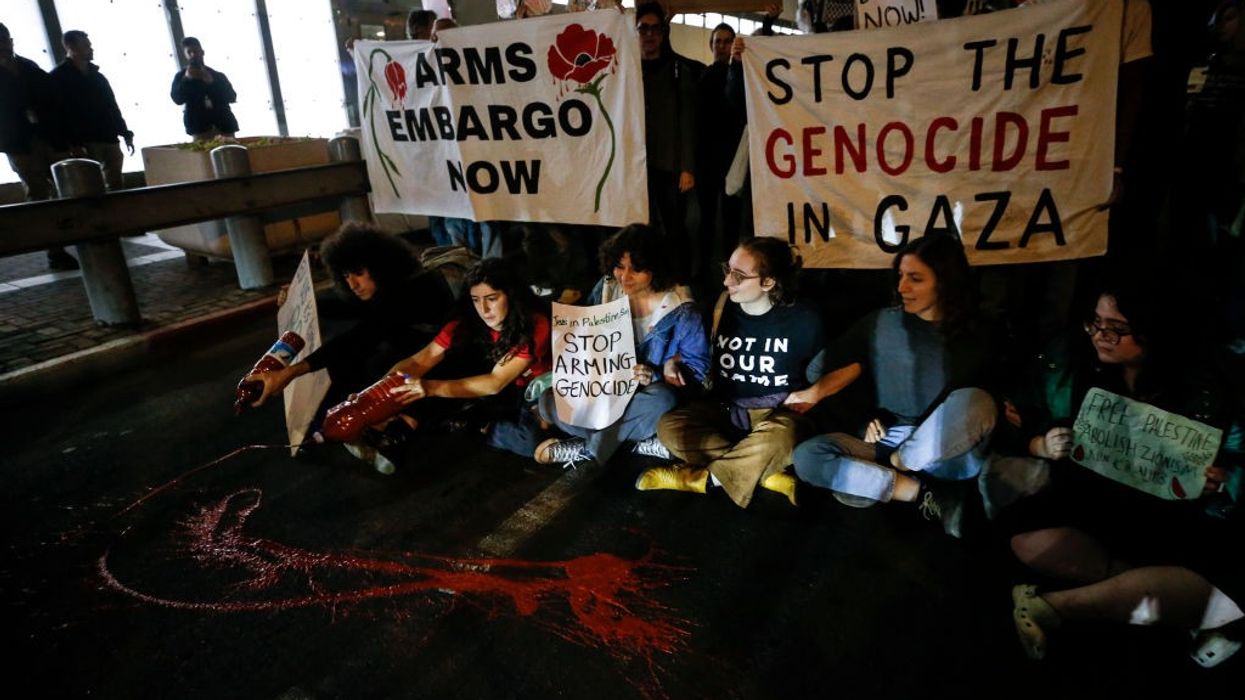
Multiple human rights organizations and international bodies have accused Israel of committing genocide in Gaza
The administration of US President Joe Biden announced on Saturday an arms sale to Israel valued at $8 billion, just ahead of President-elect Donald Trump's return to the White House.
Biden has repeatedly rejected calls to suspend military backing for Israel because of the number of civilians killed during the war in Gaza. Israel has killed more than 45,000 people in Gaza, primarily women and children.
The sale includes medium-range air-to-air missiles, 155mm projectile artillery shells for long-range targeting, Hellfire AGM-114 missiles, 500-pound bombs, and more.
Human rights groups, former State Department officials, and Democratic lawmakers have urged the Biden administration to halt arms sales to Israel, citing violations of US laws, including the Leahy Law, as well as international laws and human rights.
The Leahy Law, named after former Sen. Patrick Leahy, requires the US to withhold military assistance from foreign military or law enforcement units if there is credible evidence of human rights violations.
The Council on American-Islamic Relations (CAIR), the nation’s most significant Muslim civil rights and advocacy organization, today called Biden’s new $8 billion arms deal “racist” and “sociopathic.”
Multiple human rights organizations and international bodies have accused Israel of committing genocide in Gaza. The International Criminal Court (ICC) issued arrest warrants for Israeli Prime Minister Benjamin Netanyahu and former Defense Minister Yoav Gallant for committing war crimes.
The US is, by far, the biggest supplier of weapons to Israel, having helped it build one of the most technologically sophisticated militaries in the world.
CAIR National Executive Director Nihad Awad said on Saturday:
“We strongly condemn the Biden administration for its unbelievable and criminal decision to send another $8 billion worth of American weapons to the government of indicted war criminal Benjamin Netanyahu instead of using American leverage to force an end to the genocide in Gaza.
“Only racists who do not view people of color as equally human, and sociopaths who delight in funding mass slaughter, could send Netanyahu even more bombs while his government openly kidnaps doctors, destroys hospitals, and exterminates the last survivors in northern Gaza.
“If President Biden is actually the person who approved this new $8 billion arms sale, then he is a war criminal who belongs in a cell at The Hague alongside Netanyahu. But if Antony Blinken, Brett McGurk, Jake Sullivan, and other aides are making these unconscionable decisions as shadow presidents, then anyone with a conscience in the administration should speak up now about their abuses of power.”
According to the Stockholm International Peace Research Institute (SIPRI), the US accounted for 69% of Israel's imports of major conventional arms between 2019 and 2023.
On the other hand, incoming President-elect Donald Trump has also pledged unwavering support for Israel and has never committed to supporting an independent Palestinian state.

"The Biden administration is not only complicit in genocide. It's knowingly complicit," said one analyst.
When the U.S. State Department, headed by Antony Blinken, told Congress earlier this year that "we do not currently assess that the Israeli government is prohibiting or otherwise restricting the transport or delivery of U.S. humanitarian assistance," it was directly contradicting the internal findings of its own experts and those of USAID.
Blinken's decision to publicly reject conclusions by other U.S. officials despite the compelling evidence they marshaled highlighted "a deep rift within the Biden administration on the issue of military aid to Israel," ProPublica reported Tuesday in a detailed story examining internal communications and other private documents.
Under U.S. law—specifically Section 620I of the U.S. Foreign Assistance Act—the federal government is barred from approving arms transfers to any country that "prohibits or otherwise restricts, directly or indirectly, the transport or delivery of United States humanitarian assistance."
Blinken's official denial that Israel is restricting the flow of U.S. humanitarian aid allows the Biden administration to maintain that its weapons transfers are lawful.
ProPublica obtained emails showing that, prior to Blinken's statement to Congress denying that Israel was impeding the delivery of U.S. humanitarian aid, the head of the State Department's Bureau of Population, Refugees, and Migration had "determined that Israel was blocking humanitarian aid and that the Foreign Assistance Act should be triggered to freeze almost $830 million in taxpayer dollars earmarked for weapons and bombs to Israel."
USAID, headed by the prominent liberal interventionist Samantha Power—who authored a book on American leaders' failure to act in the face of genocide—separately concluded in both a report and a 17-page memo to Blinken that Israel deliberately restricted U.S. humanitarian aid shipments to Gaza, which is now facing famine, the reemergence of polio, and other crises.
"The memo described instances of Israeli interference with aid efforts, including killing aid workers, razing agricultural structures, bombing ambulances and hospitals, sitting on supply depots, and routinely turning away trucks full of food and medicine," ProPublica reported Tuesday. "The USAID officials wrote that because of Israel's behavior, the U.S. should pause additional arms sales to the country."
USAID sent its memo to Blinken less than a month before the U.S. State Department told Congress that, contrary to the findings of administration experts as well as scores of outside groups, the Israeli military was not restricting U.S. humanitarian aid.
Trita Parsi, executive vice president of the Quincy Institute for Responsible Statecraft, wrote that the new ProPublica reporting underscores that "the Biden administration is not only complicit in genocide. It's knowingly complicit."
Filmmaker Alex Gibney accused Blinken of "rank dishonesty on Gaza."
"Providing more offensive weapons to continue this disastrous war would be immoral. It would also be illegal."
ProPublica's reporting also details the role Jack Lew, the U.S. ambassador to Israel, played in ensuring that U.S. weapons continued to flow to the Israeli military. In March, the investigative outlet noted, Lew "sent Blinken a cable arguing that Israel’s war cabinet, which includes Prime Minister Benjamin Netanyahu and Defense Minister Yoav Gallant, should be trusted to facilitate aid shipments to the Palestinians."
While Lew conceded that "other parts of the Israeli government have tried to impede the movement" of humanitarian assistance, he argued that on the whole "Israel will not arbitrarily deny, restrict, or otherwise impede" aid provided or backed by the U.S.
That statement, according to United Nations figures and assessments by aid organizations on the ground, has proven to be false.
Last week, a coalition of humanitarian groups estimated that Israel's siege is blocking 83% of food aid from reaching the Gaza Strip, where most of the population is hungry and at growing risk of starvation.
An update released Monday by the U.N. Relief and Works Agency for Palestine Refugees in the Near East (UNRWA) notes that 46% of "humanitarian movements have been either denied or impeded in August, making it the most challenging month for humanitarian access since January 2024."
Meanwhile, U.S. arms are still flowing to the Israeli military as it continues to assail Gaza and expand its attacks on Lebanon.
Earlier this month, the U.S. State Department announced the approval of $165 million in weapons sales to Israel, a decision that came less than 30 days after the Biden administration signed off on a sprawling $20 billion sale of U.S. arms.
The latter transfer is the target of a resolution of disapproval announced last week by U.S. Sen. Bernie Sanders, who said in a floor speech that Israel's restrictions on humanitarian aid to Gaza amount to a "clear violation of U.S. and international law."
"Providing more offensive weapons to continue this disastrous war would be immoral. It would also be illegal," Sanders said. "The sales would reward Netanyahu's extremist government even as it flouts U.S. policy goals at every turn and drags the United States closer to a regional war."
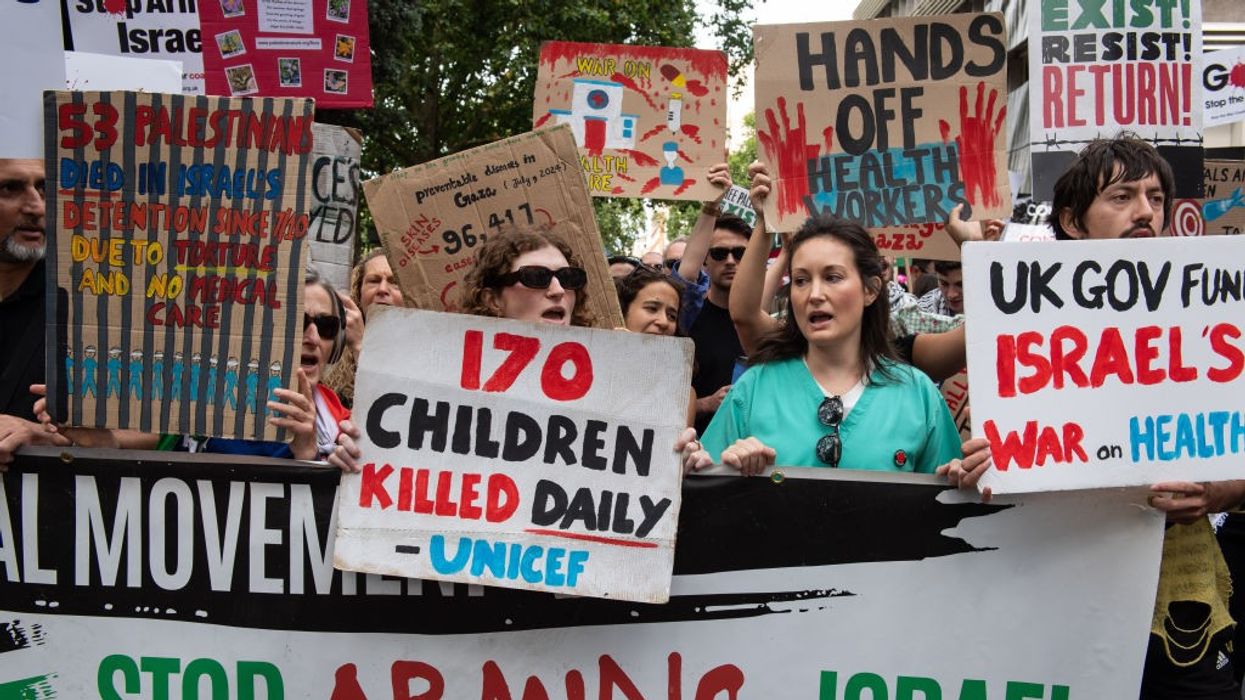
Mark Smith, a diplomat, is the first known U.K. official to resign over Gaza.
A British diplomat on Friday resigned in protest of the United Kingdom's arm sales to Israel, saying that there is "no justification" for the sales and that Israel has committed war crimes.
Mark Smith, who was a second secretary at the U.K. embassy in Dublin, had a previous official role working on arms export licensing assessments for the Middle East, he said. He is the first known British official to resign over the war in Gaza.
He sent an email to a long list of fellow officials in the Foreign, Commonwealth, and Development Office (FCDO). Iraqi-British journalist Hind Hassan obtained the email and published it on social media.
"It is with sadness that I resign after a long career in the diplomatic service; however, I can no longer carry out my duties in the knowledge that this department may be complicit in war crimes," says the email, which was later verified by other sources.
"There is no justification for the U.K.'s continued arms sales to Israel yet somehow it continues," it says.
Full resignation letter from FCDO British diplomat Mark Smith: pic.twitter.com/k9y7varCHC
— Hind Hassan (@HindHassanNews) August 16, 2024
In an interview with BBC Radio 4 on Monday, Smith said that "anybody who has a kind of basic understanding of these things can see that there are war crimes being committed" and it was "not once, not twice, not a few times, but quite flagrantly and openly and regularly."
At least a dozen officials in the United States have resigned over the Biden administration's handling of the war in Gaza that began last year. Last month, twelve of them issued a joint statement calling out the U.S.' "undeniable complicity" in the killings and forced starvation of Palestinians.
More than 40,000 Palestinians have been killed by Israeli forces since October 7, according to the Gaza health ministry. In late October, Craig Mokhiber, a top U.N. official in New York, resigned his position over the U.N.'s response to Israel's assault on Gaza. Another estimate put the likely death toll much higher. More than 1,100 Israelis were killed by Hamas and allied groups on October 7.
However, no British officials had made a similar move until Smith on Friday.
Since 2008, the U.K. has granted export licenses for $727 million in arms sales to Israel, largely for aircraft and radar systems; U.K. parts are also used in U.S.-manufactured F-35 combat aircraft destined for Israel, according to the Campaign Against Arms Trade.
The U.K. government recently "played down" its supply of weapons to Israel, saying it was "relatively small" at $53 million in 2022, the BBC reported. That's just a fraction of the weapons transfers to Israel made by the U.S., which approved another $20 billion worth last week.
The U.K. government, led by the center-left Labour Party since last month, is conducting a review of its weapons sales policy to Israel to determine if it's in compliance with international law. Foreign Secretary David Lammy reportedly ordered the review on his first day in office and has raised the possibility of cutting off sales of offensive weapons to Israel, while allowing the sale of defensive weapons to continue.
Led by the Conservative Party for the first nine months, the U.K. was in lockstep with the U.S. on the assault on Gaza but has taken steps that show a bit of divergence since Labour took power. The government has reestablished funding for the U.N. Relief and Works Agency for Palestine Refugees in the Near East and announced that it would not, despite an earlier pledge, challenge the International Criminal Courts plan of seeking arrest warrants for Israeli and Hamas leaders.
In response to Smith's resignation, an FCDO spokesperson told the BBC that the department was committed to upholding international law and "will not export items if they be used to commit or facilitate a serious violation of International Humanitarian Law."
The Middle East Eye reported that the FCDO promised officials in the department a "listening session" after Smith's email was sent. Smith criticized the organization for not listening to repeated pleas for a change of course on weapons sales to Israel.
"I have raised this at every level in the organization, including through an official whistle blowing investigation and received nothing more than 'thank you we have noted your concern'," Smith wrote in the email.
British newspapers reported that Smith was a "junior" diplomat but Hassan wrote on social media that this was in an attempt to undermine him.
"For one, he is a mid-level diplomat: Second secretaries can often have a decade of experience, if not more," she said.
"Furthermore the point of focus should be that Mark Smith is experienced in arms licensing; he knows what he's talking about when it comes to arms sales and governments," she added.

It appears that the decades of costs in arming and defending dictatorships in the Middle East remain entirely lost on the Democratic leadership.
Perhaps we should be grateful that it took President Biden over four years to fully abandon his campaign pledge to end arms sales to Saudi Arabia, eroding the promise bit by bit before finally announcing at the end of the day on Friday, August 9, that the administration would resume sales of offensive air-to-ground munitions to the Kingdom.
In reality, the ban was merely the last vestige of a long-abandoned policy to isolate and sanction Saudi Arabia for its various, gruesome atrocities and abuses both at home and abroad. In its place, the Biden administration’s courtiers doubled down on their embrace of Crown Prince Mohamed bin Salman (MBS), offering up a never-ending basket of concessions and goodies, as the golden ticket for continued U.S. primacy in the Middle East, come what may to everyone and everything else.
What follows will be their rush to the finish line, bestowing on the prince the biggest prize of all — an unprecedented U.S. security guarantee — before the clock runs out on Joe Biden’s presidency.
Cutting off the biggest U.S. weapons purchaser in the world carried well-understood costs of its own, upsetting not only U.S. defense companies deprived of the Saudi cash cow, but also encouraging MBS to retaliate by flaunting closer ties with China and Russia. And so just a few months into the first year of the Biden administration, his national security team walked back the arms embargo, clarifying that they only intended to block “offensive” weapons, not “defensive” ones.
Queries from members of Congress about the distinction between these terms went unanswered. Soon, billions in weapons were flowing, paving the way for a further mending of relations with the Saudi ruler, culminating in the now infamous July 2022 Biden/MBS “fist bump” in Jeddah.
Once the Biden team announced that it too would follow Trump’s lead to make adding Saudi Arabia to the Abraham Accords its number one Middle East foreign policy priority, any lingering concerns about rewarding the Kingdom with new military support despite its widespread horrors in Yemen and at home, or fueling its further belligerence in the region, were swept under the desert sands.
Coupled with national security adviser Jake Sullivan’s open admission of his secondary priorities — cheap oil and keeping China out of the region — the only answer to MBS’s “jump” was to ask “how high?” MBS turned to a hardball game of reverse leverage, not only refusing to open his oil spigot to relieve global oil prices ahead of the 2022 November primaries despite Biden’s pleas, but prominently hosting Chinese President Xi Jinping in a multiday red carpet affair, announcing China would build a civilian nuclear plant and support missile development in the country, and refusing to sanction Russia for its invasion of Ukraine.
And so it was time for the Biden team to bow to MBS’s wishes. The first major concession was to grant the Crown Prince immunity from U.S. prosecution, squashing several lawsuits against him for the murder of Jamal Khashoggi, the attempted murder of Saad Aljabri, and the targeted harassment and attacks against Al-Jazeera journalist Ghada Oueiss. The next was for the Biden team to secure the ultimate prize in the Saudi bucket list: a NATO Article 5 treaty level U.S. security guarantee for the Kingdom. Efforts by the Biden team to woo the Crown Prince with a mere aerial security umbrella was not sufficient to persuade him; only a bilateral, treaty level guarantee would work, he made clear.
The Hamas attacks on Israel on October 7, and the nine months of relentless Israeli bombardment and starvation of Gaza’s civilian population that it precipitated, upended these plans. A humiliated Sullivan, who only days before the cataclysmic assault pronounced that the Middle East was “quieter today than it has been in two decades now” and boasted that “the amount of time that I have to spend on crisis and conflict in the Middle East today compared to any of my predecessors going back to 9/11 is significantly reduced,” was forced to shelve the plans for a Saudi/Israeli peace agreement.
Even MBS could not dare to openly endorse Israel in the face of near universal Saudi sympathy for Palestinian suffering.
While a largely AIPAC-funded Congress would likely have supported a U.S. security guarantee for Saudi Arabia in exchange for its joining the Abraham Accords, without this, ratification of a treaty level commitment would be a very hard sell. The Biden team is now considering the idea of delinking the security guarantee, as well as poaching China’s development of the civilian nuclear plant, from normalization with Israel in a “less for less” deal.
Under a proposed “Strategic Alliance Agreement” the U.S. would commit to helping defend Saudi Arabia if it were attacked, in exchange for Saudi granting Washington access to Saudi territory and airspace, prohibiting China from building bases in the Kingdom or pursuing security cooperation with it, and signing a parallel “Defense Cooperation Agreement,” to boost weapons sales, intelligence sharing and strategic planning on terrorism and Iran.
Such a move strips away the cover of “regional peace for Israel” as the motivation for the Saudi security guarantee, more nakedly exposing the underlying motivations driving the Biden team: a stale but cemented worldview that U.S. interests require military hegemony in the Middle East, alongside cheap oil and defense industry profits. It’s hard to discount the siren call of personal profiteering for Biden officials, who will no doubt consider multi-million payouts from the UAE and Saudi, even if they’re not as lucrative as the billions in take-home by Trump officials Stephen Mnuchin and Jared Kushner. (Recall also that Secretary Blinken’s WestExec Advisors, whose client list Secretary Blinken has never disclosed, is now partly owned by Teneo, a firm that works for the MBS controlled Saudi public investment fund.)
It appears that the decades of costs in arming and defending dictatorships in the Middle East — from the mass slaughters of civilians and perpetual war-footings, encouraging destabilizing bellicosity, entrapping our country in zero-sum military conflicts, and undermining U.S. global standing as a credible force for human rights and democracy — remain entirely lost on the Democratic leadership.
With the clock ticking on the expiration of the Biden term as the Gaza war rages on, it’s doubtful that the administration will be able to deliver any expansion of the Abraham Accords or a security agreement for MBS. It’s not even clear MBS will accept these rewards, saving them for the next round of haggling with a new administration. For now, we’ll just have to hope that “Mr. Bonesaw” will show more sense than the Biden administration and avoid any new wars in the region.