
SUBSCRIBE TO OUR FREE NEWSLETTER
Daily news & progressive opinion—funded by the people, not the corporations—delivered straight to your inbox.
5
#000000
#FFFFFF
To donate by check, phone, or other method, see our More Ways to Give page.


Daily news & progressive opinion—funded by the people, not the corporations—delivered straight to your inbox.
"Millions of lives are at risk this week as extreme heat scorches our country," said one campaigner. "Trump and his billionaire buddies will have blood on their hands."
With extreme temperatures fueled by human-caused global heating gripping much of the United States, a coalition of more than 150 advocacy groups on Tuesday urged federal, state, and local elected leaders to ban potentially deadly utility disconnections, increase worker protections, and tax polluters to finance renewable energy.
The Center for Biological Diversity (CBD) led two letters—one to Democratic congressional leaders and another to governors and mayors—arguing that U.S. President Donald Trump "has put millions of lives at risk by dismantling federal agencies and lifesaving programs that help working families keep their homes cool and survive deadly heatwaves like the one this week."
"Since taking office Trump has stripped Americans of access to lifesaving measures, including the Low-Income Home Energy Assistance Program and Low-Income Household Water Assistance Program, which help more than 8 million working families pay their utility bills," CBD noted.
"Every day of extreme heat in the United States claims about 154 lives."
The Trump administration has also laid off staff at the Federal Emergency Management Agency, "crippling the agency's ability to help communities before and after disaster strikes. And the country's first-ever proposed federal heat standard, which would prevent heat-related illness and injury in workplaces, is stalled after staff cuts at the Occupational Safety and Health Administration."
CBD said that extreme heat is the deadliest weather-related phenomenon, "claiming more lives each year than hurricanes, tornadoes, and floods combined."
"Every day of extreme heat in the United States claims about 154 lives," the group added. "In the past seven years there has been a nearly 17% increase each year in heat-related deaths. Among those most harmed by extreme heat are outdoor workers and children."
The diverse groups signing the letter—which include Climate Justice Alliance, Food & Water Watch, Free Press Action, Friends of the Earth U.S., Sunrise Movement, and Utility Workers Union of America—centered the voices of people who are most vulnerable to exposure to extreme heat, including outdoor workers like José, a Florida roofer.
"I've felt dizzy, weak, unable to breathe, with cramps, and my heart beats very fast, desperate," the 24-year-old said. "The heat suffocates me and many times I've been close to going to the hospital. While working on the roofs, it feels like the heat is over 110°F or 115°F and we only take one or two short breaks. I need this work to survive, but as the summers get hotter, I worry that one day I will collapse."
CBD senior attorney and energy justice program director Jean Su said in a statement Tuesday that "millions of lives are at risk this week as extreme heat scorches our country. Trump and his billionaire buddies will have blood on their hands."
"Corporations are taking advantage of working people and stripping them of access to lifesaving utilities, clean water, and a safe and resilient future," Su added. "Congress and especially state leaders must deliver emergency relief and tax greedy polluters who are endangering our lives and the climate. Everyone deserves heat-resilient homes, schools, and workplaces."
Will Humble, executive director of letter signatory Arizona Public Health Association, said: "We're not asking for the moon here. We're just looking for state and federal officials to help keep people alive during the summertime."
"Heat kills as many people in Arizona as influenza and pneumonia, and every one of those heat deaths is preventable," Humble added. "The least our elected officials can do is make sure people have places of refuge from these deadly fossil fuel-driven heatwaves. We also need stronger limits on summertime electricity shutoffs, so people aren't dying because the utility company has turned off their power."
"We're just looking for state and federal officials to help keep people alive during the summertime."
Last week, Oregon became the latest of more than two dozen states to ban power disconnections during high summer heat. However, as CBD and others have noted, utilities still find ways to shut off utilities during hot periods.
Six major investor-owned utilities—Georgia Power, DTE Energy, Duke Energy, Ameren Corporation, Pacific Gas & Electric, and Arizona Public Service—"shut off power to households at least 400,000 times during the summertime," according to a CBD report published in January. Those six utilities raked in $10 billion in profits while collectively hiking their customers' rates by at least $3.5 billion since 2023.
"Mayors and governors must act now with bold, local solutions, including expanded public transit and community-centered strategies like neighborhood cooling hubs," Climate Justice Alliance executive director KD Chavez said in a statement. "We also urge stronger labor protections, including municipal and state-level heat standards, to protect postal workers, farmworkers, and all outdoor workers who are increasingly exposed to deadly heat without adequate safeguards."
"Extreme heat has been endangering communities across the country," Chavez added. "We're feeling it closely this week and know it will only get worse. Our growing dependence on aging buildings, air conditioning and a fragile, fossil fuel-dependent power grid is putting lives at risk, especially in frontline, low-income neighborhoods and U.S. territories without government representation."
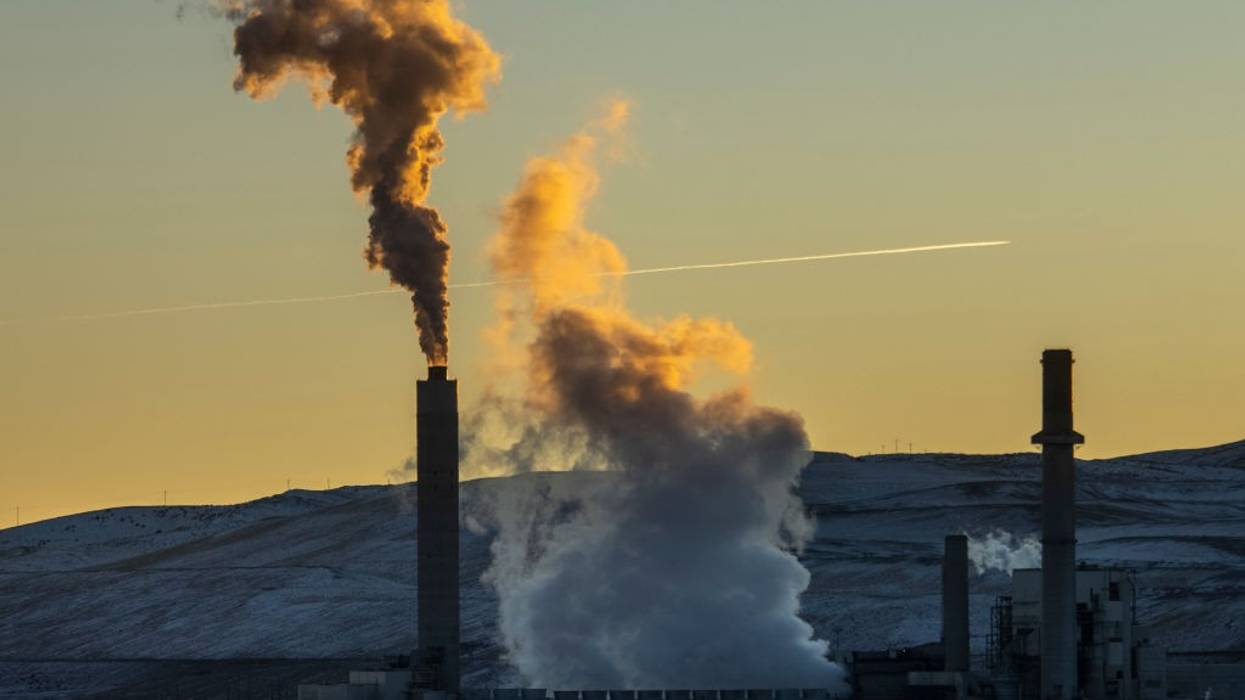
"Fossil fuel interests lost, and clean air won," one group declared.
The climate movement on Wednesday welcomed a victory at the U.S. Supreme Court, the third temporary win for the Biden administration's environmental policies this month.
Although the right-wing justices have a record of rulings that have alarmed environmental and public health groups, the high court declined to block an Environmental Protection Agency (EPA) rule intended to limit power plants' planet-heating pollution as a legal challenge to the April policy plays out.
"Given its rulings in recent years undercutting environmental protections, the refusal of the majority on the Supreme Court to block this vital rule is a victory for common sense. This warrants a sigh of relief from the millions of Americans experiencing the impact of the climate crisis," said Meredith Hankins, a senior attorney at the Natural Resources Defense Council.
"Today's ruling rejects the latest abuse of the Supreme Court's shadow docket by industry and some state attorneys general. The high court made the right call," she continued. "The Supreme Court evidently saw through their phony arguments."
"Power producers don't need immediate relief from modest standards that kick in eight years from now. And states have plenty of time to begin their planning process," Hankins stressed. "Now the case goes back to the D.C. Circuit Court of Appeals, which is moving quickly to decide the merits of this case. We will be helping to defend the standards there. The climate crisis demands that we do."
Margie Alt, director of the Climate Action Campaign, similarly said that "the climate crisis is actually an emergency affecting tens of millions of people across the globe every day. Today the court rejected the big polluters' attempt to seek an emergency stay based on their trumped-up allegations. We are in the middle of what will be the hottest year on record, with devastating and deadly extreme storms occurring regularly."
"The EPA's carbon pollution standards for power plants set reasonable targets for utilities and states to cut their carbon pollution, allowing years for them to meet those goals. The Supreme Court's decision rejected the big polluter arguments against slashing carbon pollution and paved the way for less climate pollution in the future," Alt added. "Of course, the fight isn't over. The D.C. Circuit must still rule on the merits. We support the EPA's authority to set commonsense pollution protections to slash climate pollution and protect our kids and communities from climate change and other dangerous air pollution."
The decision came after the justices in early October rejected industry-backed petitions to issue injunctions on new Biden administration rules for methane and mercury. However, conservative Justice Samuel Alito did not participate in Wednesday's decision due to financial conflicts and Justice Clarence Thomas said he would have granted the emergency request from GOP-led states and groups to block the rule.
Additionally, Justice Brett Kavanaugh, joined by Justice Neil Gorsuch, said the states and groups "have shown a strong likelihood of success on the merits as to at least some of their challenges," but there is no need for emergency action at this time "because the applicants need not start compliance work until June 2025," so "they are unlikely to suffer irreparable harm" before a final decision.
As The New York Times reported Wednesday:
The dispute was the latest bid by Republican-led states to undercut the Biden administration's ambitious climate agenda. The challenge carries similarities to a case the Supreme Court considered in the term that ended in July. Three states, Ohio, Indiana, and West Virginia, joined with industry groups to challenge an EPA proposal aimed at limiting the flow of air pollution across state lines, asking the Supreme Court to intervene even as the challenge continued to be litigated in lower courts.
In June, the justices paused the proposal, known as the "good neighbor" plan, which requires factories and power plants in the West and Midwest to cut ozone pollution that makes its way into Eastern states.
Although green groups are pushing to preserve the April policy, some have argued that the Biden administration should have gone further with its actions to combat the fossil fuel-driven climate emergency.
Climate Justice Alliance interim executive director KD Chavez said Wednesday that while the group applauds the path the latest Supreme Court decision "charts for what can be construed as a coal phaseout, this rule is still riddled with loopholes that give a lifeline to the fossil fuel industry to continue operations and experiment on frontline communities by exposing them to the dangers and health effects of unproven technologies such as carbon capture and storage."
"The rule does not go far enough to push the needle towards a fossil fuel phaseout and a just transition for the energy sector, the communities where energy projects are sited, and the workers who could tap into renewable energy jobs," Chavez emphasized. "Frontline communities deserve more, and given this rule won't be applied until next year, we will continue to work to ensure stronger power plant regulations that meet the growing threat of climate catastrophe we all currently face."
"The United States refuses to acknowledge historic responsibility for the decades of damage that has been done to communities bearing the brunt of climate change and the fossil fuel industry," said one advocate.
Climate justice advocates, outraged over the inadequate funding that was pledged to the "loss and damage" fund as the United Nations Climate Change Conference opened this week, reserved particular disdain on Friday for the United States delegation and its refusal to contribute a meaningful amount to the fund.
The Climate Justice Alliance said the U.S. contribution of just $17.5 million for the loss and damage fund—a tiny fraction of the nearly $900 billion President Joe Biden requested for his military budget earlier this year and the annual fossil fuel subsidies distributed by the U.S. government—sent a clear message to the Global South: that "the U.S. is completely uninterested in prioritizing or being accountable to the climate impacts frontline communities are facing."
"The amount pledged by the United States is insulting," said Bineshi Albert, co-executive director of the organization. "It is a paltry, shameful amount of money... By comparison, island nations have requested at least $100 billion over the first four years."
The sum also made clear that the Biden administration is following through on Special Presidential Climate Envoy John Kerry's remarks at a hearing in July, in which he said that "under no circumstances" would the U.S. provide funding to countries in the Global South that are increasingly facing prolonged droughts, rising sea levels, and severe storms, among other climate impacts as a result of planetary heating.
"The United States refuses to acknowledge historic responsibility for the decades of damage that has been done to communities bearing the brunt of climate change and the fossil fuel industry," said Albert.
The U.S. is by far the largest historic emitter of planet-heating emissions, while many countries that are already facing the worst impacts of the climate emergency, such as small Pacific island nations, shoulder the least blame for the crisis.
Albert called the $17.5 million pledged by the U.S. "a drop in the bucket compared to the annual $20.5 billion in fossil fuel subsidies handed out by the US government, which recently surged to $7 trillion in 2022."
To help governments in the Global South rebuild damaged communities, prevent further destruction, and relocate displaced people, developing countries have said they will ultimately need about $400 billion annually.
$17.5 million "is not only ineffective to address these harms and injustices but it is minuscule compared to the hundreds of billions in loan, grants, and tax breaks available from the Inflation Reduction Act to corporations to further build out or prolong the life of fossil fuel infrastructure and energy intensive fuels like hydrogen," said Albert.
She added that it is not lost on advocates that the U.S. government pushed for contributions to the loss and damage fund to be voluntary: "another clear sign that the United States does not take responsibility for its harmful past actions nor does it consider the needs of the most impacted and marginalized communities seriously."
With contributions from other wealthy governments ranging from just $10 million (Japan) to $245 million (the European Union), Amnesty International climate adviser Ann Harrison said wealthy countries committed "barely enough to get the fund running, and little more."
"Billions of dollars are needed to make a substantive difference to communities in desperate need of help to rebuild homes after storms, or to support farmers when their crops are destroyed, or those permanently displaced by the climate crisis," said Harrison. "Considering the vast and excess profits accrued by fossil fuel companies last year while they continue to trash the climate, and that some the donor states today were responsible for a large proportion of historical greenhouse gas emissions, this is a disappointingly small initial sum."
High-income countries that continue to produce fossil fuels despite clear warnings from energy and climate experts, said Harrison, must "make new and additional commitments to the fund on a scale which reflects the global nature of climate crisis, and the threat it presents to billions of people."
"Now more than ever, we need real leadership from the Department of Energy to end fossil fuels," said one organizer.
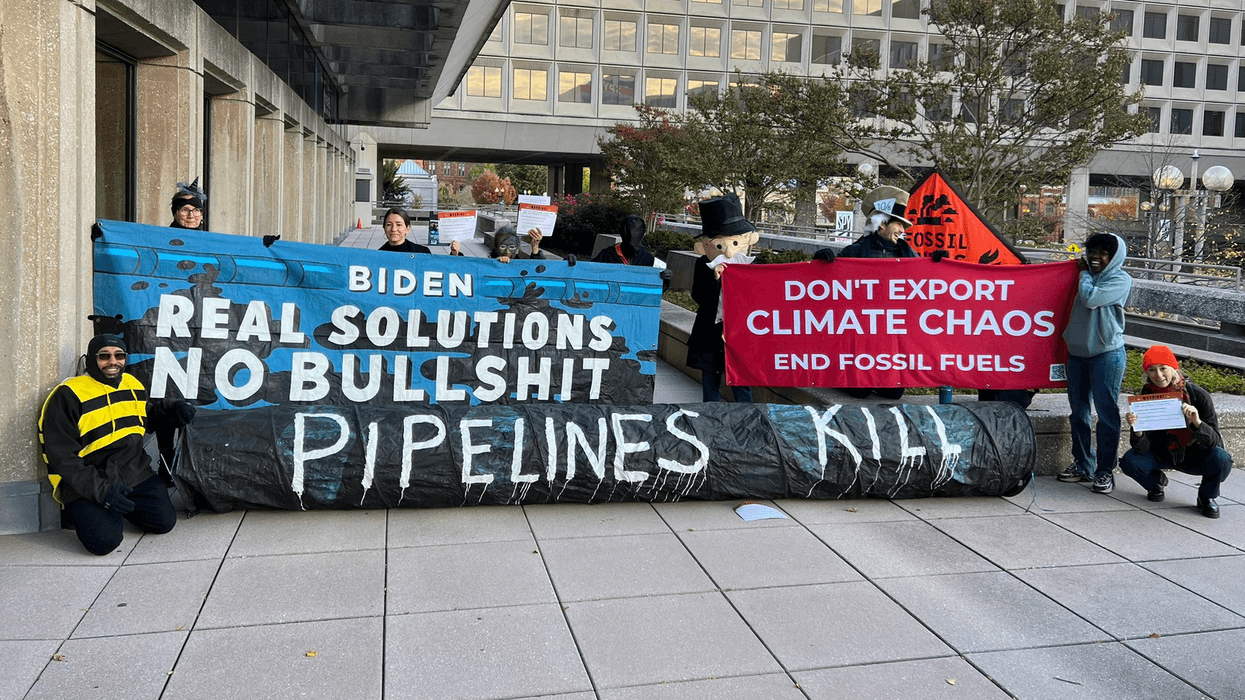
Climate advocates on Tuesday donned Halloween costumes to greet attendees of the U.S. Department of Energy's "Justice Week," but the organizers assembled outside the agency will be urging guests to demand far more from Energy Secretary Jennifer Granholm and the Biden administration, who they say are "greenwashing" efforts to further equity and environmental justice.
The department's Office of Economic Impact and Diversity is holding the five-day event, where officials plan to highlight efforts to move "toward a more equitable, clean, and just energy future."
The week will include discussions of the Low-Income Communities Bonus Credit Program, which pushes for more access to renewable energy facilities in underserved communities, and executive actions President Joe Biden has taken to promote environmental justice.
All those actions, however, have happened alongside the administration's push in favor of so-called climate "solutions" that scientists say are unproven and serve only to perpetuate fossil fuel extraction under the false assumption that it can do so while still addressing greenhouse gas emissions and planetary heating.
The DOE, noted Basav Sen, a climate justice project director at the Institute for Policy Studies (IPS) who took part in the action, is "the biggest funder of false solutions such as carbon capture and storage, hydrogen, and direct air capture."
"These are scams. We know that the real solution to the climate crisis is to keep fossil fuels in the ground and make a rapid, just transition to real renewable energy controlled by communities," said Sen, wearing zombie face paint at the direct action. "Instead what were seeing from the Department of Energy is a continuation of the fossil fuel economy."
As Common Dreams reported in May, analysts say that just running the machinery to operate a carbon capture and storage project—like the ones the Biden DOE announced a $1.2 billion investment in earlier this year—would increase energy consumption by 20%, adding to carbon dioxide emissions.
Smog, benzene, and formaldehyde emissions also increase with carbon capture technology, biologist Sandra Steingraber said—three types of pollution that disproportionately affect people in low-income neighborhoods, the very communities the DOE says it's targeting with environmental justice programs and events like "Justice Week."
Additionally, noted Sen, the DOE is continuing to license exports of fossil gas.
"We are here today to tell attendees of the Department of Energy's Justice Week that the version of environmental and energy justice that they're going to hear from the Department of Energy in the event is greenwashing, pure and simple," said Sen. "The Department of Energy cannot pretend to be on the side of environmental justice while they are actively licensing more fossil gas exports, which means more fracking, more air and water pollution, more pipelines, more export terminals, more sacrifice zones in frontline communities."
Some of the campaigners displayed the organizers' message succinctly on a banner reading, "Real Solutions. No Bullshit."
"Now more than ever, we need real leadership from the Department of Energy to end fossil fuels, quit peddling climate scams and advance energy justice," said Climate Justice Alliance (CJA), one of the groups behind the action.
Addressing Granholm, the group added that the secretary "can't cover up [her] record with greenwashing events like Justice Week 2023 while undermining real climate and environmental justice with [her] actions."
"We demand an end to fracked gas exports, carbon capture, and hydrogen energy," CJA said.
"The Biden administration has clearly fallen for this scam hook, line, and sinker," said one campaigner. "This multibillion-dollar bet on greenwashed dirty energy will undermine efforts to address the climate crisis."
As U.S. Energy Secretary Jennifer Granholm on Friday celebrated the "historic investment" of up to $7 billion for seven regional hydrogen hubs as a key to achieving President Joe Biden's "goal of American industry powered by American clean energy," some climate campaigners warned that the administration is falling for—or participating in—a fossil fuel industry scam.
Roughly two-thirds of the H2Hubs investment will go toward green hydrogen, which is made using renewable energy, according to the White House. However, the bipartisan infrastructure legislation Biden signed in 2021 requires broader support, including for pink (nuclear) and blue (gas) hydrogen projects, the latter of which includes carbon capture, utilization, and storage.
"At face value—and according to the Biden playbook—the hydrogen hub grants aim to help transition the United States to clean energy. In reality, they amount to another corporate scam, one that preserves and extends the life of the extractive economy and prevents the frontline communities most impacted by climate disaster from having input," said Marion Gee, co-executive director at the Climate Justice Alliance, representing 89 rural and urban environmental justice groups.
"Hydrogen development is energy intensive to produce, could present a public safety risk in transit, can produce health-damaging air pollution when combusted, and is a play by the fossil fuel industry to extend its viability and profits," Gee stressed. "We must work to move capital and power into the hands of local communities who will center traditional ecological and cultural knowledge and create a pathway toward a regenerative future."
"The fossil fuel industry is working to continue our nation's reliance on fossil fuels by any means necessary—and hydrogen offers yet another possible inroad for Big Oil and Gas."
Earthworks policy director Lauren Pagel also asserted that "prioritizing hydrogen hubs across the United States is more about extending the life of oil and gas companies than addressing the climate crisis. These hubs are a dangerous distraction from the obvious consensus solution that the world must stop expanding fossil fuels that are warming the atmosphere."
Food & Water Watch policy director Jim Walsh was similarly critical, declaring that "the massive build-out of hydrogen infrastructure is little more than an industry ploy to rebrand fracked gas. The Biden administration has clearly fallen for this scam hook, line, and sinker. This multibillion-dollar bet on greenwashed dirty energy will undermine efforts to address the climate crisis, while increasing pollution of our air and water, and milking taxpayers for billions in new fossil fuel subsidies."
"Even the cleanest forms of hydrogen present serious problems—most notably the massive amount of water that would be waste," Walsh added. "As groundwater sources are drying up across the country, there is no reason to waste precious drinking water resources on hydrogen when there are cheaper, cleaner energy sources that can facilitate a real transition off fossil fuels."
The seven selected projects are the Appalachian (West Virginia, Ohio, and Pennsylvania), California, Gulf Coast (Texas), Heartland (Minnesota, North Dakota, and South Dakota), Mid-Atlantic (Pennsylvania, Delaware, and New Jersey), Midwest (Illinois, Indiana, and Michigan), and Pacific Northwest (Washington, Oregon, and Montana) hydrogen hubs.
As The New York Times detailed:
Not all of the $7 billion in funding will be spent at once. As a first step, the Energy Department will give awardees initial grants to create more detailed proposals for their hydrogen hubs. If the agency deems the projects viable, it will disburse more money over time—but that money is not guaranteed if any of the hubs prove unworkable.
"We're still a long, long ways away from creating a large-scale hydrogen economy," said Alex Kizer, a senior vice president at the Energy Futures Initiative, a Washington nonprofit organization. "Think of these hubs as laboratories of sorts to experiment with potential business models for hydrogen and to try to figure out some of the technological and infrastructure hurdles."
Even groups that support green hydrogen raised concerns over funding longtime polluters. Sierra Club executive director Ben Jealous warned that "the fossil fuel industry is working to continue our nation's reliance on fossil fuels by any means necessary—and hydrogen offers yet another possible inroad for Big Oil and Gas to lock in polluting and noneconomic uses of gas for decades to come."
"Decision-makers in the administration and at the local level must be wary of these attempts and ensure as much hydrogen-specific funding as possible goes to green hydrogen and its most efficient end uses to ensure this investment actually addresses climate change," he said.
Jill Tauber, vice president of litigation for climate and energy at Earthjustice, suggested that "hydrogen can be a clean energy solution, or it can drive us deeper into the climate crisis and hurt communities," and that green projects powered by renewables "can play an important role cleaning up what we cannot electrify, like steel manufacturing."
Julie McNamara, deputy policy director of the Climate and Energy Program at the Union of Concerned Scientists, joined the chorus of alarmed critics on Friday, saying that "billions of taxpayer dollars are at risk of perpetuating fossil fuel industry injustices and harms while subsidizing fossil fuel greenwashing."
"Today's announcement also sets in stark relief the significance of upcoming administration decisions around implementation of the Inflation Reduction Act's hydrogen production tax credit, which could be a bulwark against heavily polluting hydrogen—or a backdoor subsidizing it," she noted. "The Department of Energy and the Biden administration now must set rigorous implementation, evaluation, and engagement criteria to ensure the development of a hydrogen industry that is unequivocally aligned with our climate objectives and that serves our collective goal to secure a safe, clean, just, and healthy future for all."
"Fossil fuel interests see a clear benefit in promoting direct air capture as a means to preserve the dominance of dirty fossil fuels," said one advocate.
The department said it will invest $1.2 billion to build the nation's first commercial plants that will conduct "direct air capture," in which "giant vacuums... can suck decades of old carbon pollution straight out of the sky," as Energy Secretary Jennifer Granholm told reporters on Thursday.
The unproven technology has been a key focus of oil and gas lobbyists, who argue that fossil fuel companies can continue their planet-heating extraction activities if plants are built to remove the pollution they cause.
Advocacy group Food & Water Watch noted that one oil company, Occidental, stands to benefit directly from the grants because its wholly owned subsidiary, 1Point5, was selected by the Energy Department as one of the recipients.
"Direct air capture is expensive, unproven, and will ultimately make almost no difference in reducing climate pollution... Capturing just a quarter of our annual carbon emissions would require all of the power currently generated in the country."
"Fossil fuel interests see a clear benefit in promoting direct air capture as a means to preserve the dominance of dirty fossil fuels," said Jim Walsh, the group's policy director. "The federal government is handing them hundreds of millions of dollars in subsidies, when it should be pursuing policies to end the era of fossil fuels."
Occidental plans to build one of the plants in Kleberg County, Texas, while nonprofit research firm Battelle will build another in Calcasieu Parish, Louisiana—one of the state's air pollution hotspots, according to New Orleans Public Radio.
"Frontline communities that have borne the brunt of environmental racism and climate change for generations say, 'Enough!'" said Marion Gee, co-executive director of the national grassroots coalition Climate Justice Alliance. "In an effort to move quickly and carelessly to balance a 'carbon budget,' the backyards that he's talking about building in won't be [White House Deputy Chief of Staff John] Podesta's, President [Joe] Biden's, or their neighbors. It'll be Black folks, Indigenous communities, and poor BIPOC neighbors—sacrificed, yet again, in the name of protecting corporate interests."
Critics note that carbon capture is expensive and requires a huge amount of energy to run the "capturing" mechanisms, increasing the very emissions companies aim to remove from the atmosphere.
Former Vice President Al Gore said in a TED Talk last month that turning to carbon capture—as the Biden administration did when it included $3.5 billion to fund a total of four direct air capture plants in the 2021 bipartisan infrastructure law—is a "moral hazard" that will give fossil fuel giants "an excuse for not ever stopping oil."
Basav Sen, climate justice policy director at the Institute of Policy Studies, accused the Biden administration of playing "cynical political game of squandering public funds on unproven, expensive, and potentially dangerous schemes such as direct air capture, purportedly to gain credibility for backing climate solutions, while doubling down on expanding fossil fuels."
The grants were announced days after President Joe Biden angered campaigners by claiming that "practically speaking," he has already declared a climate emergency, despite his approval earlier this year of a massive oil drilling project in Alaska and his recent proposal to update rules for—but not end—fossil fuel leasing on public lands.
"Direct air capture is expensive, unproven, and will ultimately make almost no difference in reducing climate pollution," said Walsh on Friday. "Capturing just a quarter of our annual carbon emissions would require all of the power currently generated in the country."
"Even if the technology was effective, there are still serious questions about whether there is a safe and effective way to store the captured carbon dioxide," he added. "A more practical and effective approach would be to invest money in wind and solar energy—which would be far more effective in actually reducing climate pollution."
"That is how solidarity philanthropy works—we show up for each other," said one campaigner.
A grassroots climate justice fund on Monday announced its inaugural slate of grants totaling more than $5 million for 48 organizations working to tackle the worsening planetary emergency, while calling on "big green groups" to redirect investment to frontline climate initiatives.
The Fund for Frontline Power (F4FP) supports "community-based, equitable climate solutions that cut greenhouse gas emissions, facilitate resilience, strengthen local regenerative economies, and build power on the frontlines of the climate crisis."
More than 400 climate justice groups have applied for F4FP grants totaling over $60 million since the program's launch.
According to F4FP:
The Fund for Frontline Power is a leading example of "solidarity philanthropy" in action. Traditional philanthropy revolves around donors rather than recipients, imposing potential solutions from outside, and putting recipients in the position of having to "prove" that they are worthy of funding. In contrast, solidarity philanthropy centers leaders from impacted communities as experts and decision-makers—honoring their lived experience, following their lead, and trusting that they know best what their own communities need.
In order for a group to qualify for F4FP funding, it must:
"We put meeting the needs of our fellow frontline communities at the heart of every decision we made—from designing the grantmaking process to selecting grantees," F4FP governing body member Julia Ho, founder of Solidarity Economy St. Louis and co-founder of STL Mutual Aid, said in a statement marking the $5 million milestone.
"The communities and places represented are only a small sample of the power and wisdom across frontline communities, and so are the impactful climate justice projects we are honored to fund," Ho added. "It was exciting to collaborate with fellow frontline leaders and learn about the wide range of innovative climate solutions envisioned and led by frontline communities."
Antonio Diaz, a director at People Organizing to Demand Environmental & Economic Rights (PODER) in San Francisco, said that "those of us serving on the governing body know from firsthand experience that smaller, community-based organizations are successfully working at the intersection of climate justice and racial justice to create equitable, practical climate solutions that are ready for immediate investment."
"Our solutions are grounded in justice, equity, sustainability, and systemic change," Diaz added.
Oscar Londoño, co-executive director of F4FP recipient WeCount!, a South Florida workers' campaign that helped win the nation's first countywide heat standard for outdoor workers, said that "in Miami-Dade County, we average 41 days per year with a heat index over 100."
"Our solutions are grounded in justice, equity, sustainability, and systemic change."
"But in a couple of decades, scientists say we'll have 141 days a year with a heat index over 100. That's a tremendous increase in risk for a state that already leads the nation in heat-related hospitalizations," Londoño added. "Our work will focus on ensuring that the food on our tables, the plants in our homes, and the buildings in our cities won't come at the cost of workers' health or lives."
Marion Gee, co-executive director of the Climate Justice Alliance—which supports the F4FP on fundraising and communications—called on "big green groups that received grants from the Bezos Earth Fund to redirect a portion of their funds to a pooled Fund for Frontline Power designed to move funding to powerful, yet under-resourced, frontline organizations."
Bezos Earth Fund is a $10 billion grant launched by multibillionaire Amazon.com founder Jeff Bezos that bills itself as "the largest philanthropic commitment ever to fight climate change and protect nature."
Seven Bezos Earth Fund recipients have contributed to F4FP: the Hive Fund for Climate & Gender Justice, ClimateWorks Foundation, Building Equity & Alignment for Environmental Justice, the Union of Concerned Scientists, Rocky Mountain Institute, the Natural Resources Defense Council, and the Solutions Project.
"That is how solidarity philanthropy works—we show up for each other," said Gloria Walton, who leads the Solutions Project. "Philanthropy needs to move in unity with the movements we support, and rapidly scale up our support while building greater trust through transparency and accountability."
"Billions of dollars have been wasted trying to prove that this technology is real—and all we have to show for it are a series of spectacular failures," said one campaigner.
The Biden administration on Thursday unveiled a power plant emissions rule whose effectiveness at slashing planet-warming pollution would heavily depend on a major expansion of carbon capture, an oil industry-backed technological scheme that climate advocates view as wasteful, ineffective, and actively harmful.
The Environmental Protection Agency's newly proposed emission standards for coal- and gas-fired power plants were described as the most strict ever proposed in the U.S., and the rule garnered praise from major environmental groups.
If implemented—far from a sure thing given the Supreme Court's recent decision hamstringing the EPA's ability to regulate greenhouse gas pollution—the rule would require most new and existing fossil fuel power plants to capture 90% of their emissions by between 2035 and 2040. Coal- and gas-fired power plants are the nation's second-largest source of greenhouse gas emissions.
"The draft rules offer utilities years of lead time to build out carbon capture or hydrogen infrastructure—or to take their plants offline," E&E News reported.
Climate campaigners expressed dismay that the EPA rule relies so significantly on the large-scale adoption of unproven carbon capture and storage technology, which would entail the construction of thousands of miles of new pipelines to carry the trapped emissions.
"Carbon capture is nothing more than a fossil fuel industry propaganda scheme," said Wenonah Hauter, executive director of Food & Water Watch (FWW), an environmental group that has described the technology as a "dangerous fantasy."
"Billions of dollars have been wasted trying to prove that this technology is real—and all we have to show for it are a series of spectacular failures. Throwing good money after bad is not a climate solution—it's an industry bailout," Hauter argued. "Even if the technology managed to meet even the lowest thresholds for emissions capture, the energy required to power the facilities would negate much of the supposed benefit."
Last year, President Joe Biden and congressional Democrats approved large subsidies for the carbon capture industry via the Inflation Reduction Act, a law that proponents said would slash U.S. carbon emissions by 40% by the end of the decade.
But critics at the time cast doubt on that projection given that it hinges on the effectiveness of largely unproven carbon capture initiatives—and similar questions will likely be raised about EPA estimates of the power plant rule's potential impact. The EPA said the rule "would avoid up to 617 million metric tons of total carbon dioxide (CO2) through 2042."
Ozawa Bineshi Albert, co-executive director of the Climate Justice Alliance, said that "if we are to combat climate change we must do so with real, viable solutions—not unproven technologies that only promise to continue the legacy of dumping pollutants onto frontline communities."
"Let's be clear: Carbon capture and sequestration technologies are harmful and unproven," Albert added. "They do not operate at scale, and to expand carbon capture to a fraction of what is envisioned by this order would require constructing thousands of miles of polluting pipelines into communities already most impacted by the burning of fossil fuels. A study in the European Union showed that adding carbon capture to power plants increased nitrogen oxides by 44%, particulate matter by 33%, and ammonia by a whopping 30-fold increase. CCS projects will exacerbate environmental disparities and lead to more environmental racism. This is a distraction—one that will let fossil fuel extraction continue unchecked."
"There is no technological quick fix for our climate crisis. We must cut fossil fuels off at their source and transition to clean, renewable energy now."
In a recent report, FWW analyzed major carbon capture projects and found that the technology's "track record makes it appear to be a handout to fossil fuel corporations, publicly financing their attempts to keep their harmful product viable."
Despite such findings, the EPA determined in its new rule proposal that "carbon capture represents a 'best system of emissions reduction,' which means it's been adequately proven," Politico noted Thursday.
"In the U.S., only one power plant has ever captured carbon dioxide at scale: the W.A. Parish Generating Station near Houston," the outlet observed. "The carbon capture technology at Petra Nova, bolstered by nearly $200 million in federal money, grabbed coal-produced CO2 and piped it to an oil field to be used for crude oil production."
In a statement, EPA Administrator Michael Regan ignored concerns about the efficacy of carbon capture, declaring that the new rule would harness "proven, readily available technologies to limit carbon pollution and seizes the momentum already underway in the power sector to move toward a cleaner future."
The EPA rule will undergo a 60-day public comment period after it is formally published in the Federal Register.
Instead of resting its climate agenda on dubious carbon capture schemes, Hauter said the Biden administration should be prioritizing "immediate actions to limit the supply of dirty fossil fuels" and expand renewable energy, which research has shown to be a much better climate investment than carbon capture.
"This requires using existing federal authority to halt new drilling and fracking, and stop new fossil fuel infrastructure like power plants, pipelines, and export terminals," Hauter continued. "There is no technological quick fix for our climate crisis. We must cut fossil fuels off at their source and transition to clean, renewable energy now."
Jason Rylander, legal director at the Center for Biological Diversity's Climate Law Institute, said it is "no surprise" that the EPA's proposed standards "fall far short of what the climate emergency demands given the right-wing Supreme Court's restrictions on power plant rules."
"The EPA needs to get serious about cutting carbon emissions by creating a national science-based cap on greenhouse gas pollution through the National Ambient Air Quality Standards program," said Rylander. "That's the best way to spur the economy-wide decarbonization we need now."
Other environmental groups were less critical of the Biden administration's proposal as a whole, welcoming it as a meaningful step in the right direction while acknowledging that more ambition is needed to fend off the worst of the climate emergency.
"We're pleased to see the Biden Administration continue to address climate pollution in a serious way. Now, the administration must finish the job and ensure the final standards are as strong as possible," said Ben Jealous, executive director of the Sierra Club. "But we know the work to confront the climate crisis doesn’t stop at strong carbon pollution standards. The continued use or expansion of fossil power plants is incompatible with a livable future. Simply put, we must not merely limit the use of fossil fuel electricity: we must end it entirely."
Julie McNamara, the deputy policy director of the Climate and Energy Program at the Union of Concerned Scientists, called the release of the power plant rule "a pivotal turning point, with Administrator Regan rightfully and necessarily moving to hold coal- and gas-fired power plants to account for their ongoing carbon pollution."
But McNamara also implored the administration to "prioritize robust environmental justice protections and environmental and public health safeguards, especially when it comes to carbon capture and sequestration and hydrogen co-firing."
"The agency must protect against greenwashing attempts by fossil fuel interests that would worsen, not lessen, environmental injustices," McNamara said.
"As we celebrate today's victory, we must also recognize that Biden has come to be known worldwide as the fossil fuel president, having approved more drilling projects on federal land than Trump during their first two years."
Climate advocates who have centered environmental justice for decades on Friday said they will continue to fight "false solutions" to the climate crisis—and expressed hope that the newly announced White House Office of Environmental Justice will usher in a new era in which President Joe Biden ends his support for fossil fuel projects.
Biden announced the creation of the Office of Environmental Justice (OEJ) at the White House Friday as he signed an executive order titled "Revitalizing Our Nation's Commitment to Environmental Justice for All."
The office, said the White House, will be tasked with "coordinating the implementation of environmental justice policy across the federal government, ensuring that federal efforts can evolve alongside our understanding of environmental justice"—a concept which recognizes the disproportionate impacts that pollution and the climate emergency have on low-income communities, Indigenous tribes, and people of color, and strives for the "meaningful involvement of all people... with respect to the development, implementation, and enforcement of environmental laws, regulations, and policies."
The president also said the executive order will make environmental justice a focus of every federal agency and will require them to "consider measures to address and prevent disproportionate and adverse environmental and health impacts on communities, including the cumulative impacts of pollution and other burdens like climate change," and to notify communities of the release of toxic substances from federal facilities nearby.
"We're investing in air quality centers in communities near factories so people who live near them know what the risk is and how safe the air is," said Biden. "Because we know historically redlined communities are literally hotter because there's more pavement and fewer trees, we're planting millions of new trees to cool down our city streets."
"Environmental justice will be the mission of the entire government, woven directly into how we work with state, local, tribal, and territorial governments," he added.
The Wilderness Society was among the groups that applauded the announcement as a "huge win" for the environmental justice movement.
Ozawa Bineshi Albert, co-executive director at the Climate Justice Alliance (CJA)—a coalition of 89 rural and urban climate organizations—credited "frontline organizing power" with pushing the White House to adopt a policy aimed at centering support for communities that are disproportionately impacted by pollution, the public health issues resulting from it, and effects of the climate emergency such as catastrophic flooding and extreme heat.
"Today's executive order is the result of nearly two decades of organizing by the environmental justice movement," said Bineshi Albert. "This win belongs to our communities who have been on the frontlines of the climate crisis, creating solutions, building local power, and engaging lawmakers for decades."
But Bineshi Albert pointed out that the executive order also follows a number of actions by the Biden administration that completely disregarded outcry from and dangers posed to frontline communities.
Biden has been condemned this year for approving the Willow project, an oil drilling operation on federal land in Alaska that could support the production of more than 600 million barrels of crude oil over 30 years—leading to about 280 million metric tons of carbon emissions, even as energy and climate experts warn that continuing to extract fossil fuels instead of beginning a rapid drawdown will ensure the Earth warms by more than 1.5°C, locking in the loss of ice sheets, sea-level rise, and more extreme weather.
The president has also angered climate action groups as he has backed new offshore drilling.
"As we celebrate today's victory, we must also recognize that Biden has come to be known worldwide as the fossil fuel president, having approved more drilling projects on federal land than [former President Donald] Trump during their first two years in office," said Bineshi Albert. "The recent approval of harmful, extractive drilling leases such as the Willow project in Alaska, in the Gulf, and the LNG pipeline demonstrate the need for coherent and aligned policies that move us toward a truly just transition, not an expansion of fossil fuel infrastructure."
Jean Su, director of the Center for Biological Diversity's Energy Justice program, expressed wariness of the White House's new "Environmental Justice Scorecard," which will assess federal agencies' efforts to further environmental justice.
No agency should be scored highly if it approves fossil fuel infrastructure like the Willow project, as the Department of the Interior did, suggested Su.
"A White House Office of Environmental Justice is a hard-fought victory that's long overdue, but it needs to be empowered," she said in a statement. "A fundamental part of the president's first-ever Environmental Justice Scorecard needs to be saying no to the fossil fuel projects that pollute communities of color and sow climate chaos. If the president wants to distinguish himself from oily Republicans, let's see him reverse the Willow project, stop approving massive Gulf drilling and gas exports, and phase down public lands drilling."
"It's high time Biden showed up for environmental justice communities and the planet instead of fossil fuel companies," she added.
Bineshi Albert warned that the White House risks creating an office that is "just performative," and said CJA will double down on ensuring it is not.
"The new office of environmental justice must ensure strong, consistent procedures are implemented across agencies moving forward," she said. "Our communities will continue to organize to stop false solutions, support regenerative economic solutions, and ensure that justice and equity are codified and implemented at the rate and speed needed to meet the moment."
"This bill wraps climate denial and corporate giveaways into one tidy, toxic package as the world burns," said the Michigan Democrat. "I urge my colleagues in the Senate to not take this legislation up."
Climate campaigners and congressional Democrats on Thursday called out House Republicans for approving energy legislation that would, as U.S. Rep. Rashida Tlaib warned, "put polluters over people" by "further poisoning of our air and water."
The lower chamber passed the GOP-led Lower Energy Costs Act (H.R. 1) with a 225-204 vote mostly along party lines: The only Republican who opposed it was Rep. Brian Fitzpatrick (Pa.) and the only Democrats who supported it were Reps. Henry Cuellar (Texas), Jared Golden (Maine), Vincente Gonzalez (Texas), and Marie Gluesenkamp Perez (Wash.).
"It's hard to overstate the catastrophic impact H.R. 1 would have on our public lands and our ability to address the most severe effects of the climate crisis."
"This bill is nothing more than a cheap political stunt to pad the profits of the same greedy oil and gas companies that are gouging my residents at the pump and poisoning the air they breathe and the water they drink," said Tlaib (D-Mich.), noting that her constituents "are sick of respiratory issues, their children developing asthma, the unbearable odor, and the other public health impacts of pollution."
Highlighting Big Oil's historic 2022 profits, Tlaib continued:
The same oil companies that donated hundreds of thousands of dollars to House Republicans made nearly half a trillion dollars in profits last year alone, but their servants across the aisle don't think that's enough.
Residents know the truth is clear: Health protections for you and your family aren't making gas expensive, corporate greed is. Oil and gas companies have gotten away with price gouging and stock buybacks that enrich their shareholders but make everything less affordable for the rest of us, and they don't plan to stop. And Republicans are helping them to keep doing so.
This bill wraps climate denial and corporate giveaways into one tidy, toxic package as the world burns. I urge my colleagues in the Senate to not take this legislation up. I hope congressmembers on the other side of the aisle get serious about tackling climate change. People are dying and we are running out of time.
Several other House Democrats also spoke out against what critics have dubbed the "Polluters Over People Act," with Democratic Whip Katherine Clark (Mass.) saying on the floor: "Americans know that securing our future means investing in clean energy. Families know their health depends on it. Economists know our prosperity depends on it. And the Pentagon knows our national security depends on it. It's only MAGA Republicans who don't understand our future depends on a thriving clean energy economy."
The vote came a day after Democratic Sens. Catherine Cortez Masto (Nev.), Joe Manchin (W.Va.), Jacky Rosen (Nev.), and Jon Tester (Mont.) along with now-Independent Sen. Kyrsten Sinema (Ariz.) joined with Republicans to send a House-approved resolution that would gut federal water protections to President Joe Biden's desk, despite his threat to veto the measure.
The administration also "strongly opposes" H.R. 1 in its current form and said in a policy statement earlier this week that Biden would veto the bill, adding: "It would raise costs for American families by repealing household energy rebates and rolling back historic investments to increase access to cost-lowering clean energy technologies. Instead of protecting American consumers, it would pad oil and gas company profits—already at record levels—and undercut our public health and environment."
However, it seemed unlikely Thursday that the GOP energy bill will even get a vote in the divided upper chamber, with Senate Majority Leader Leader Chuck Schumer (D-N.Y.) declaring on the floor that H.R. 1 is "a giveaway to Big Oil" and "dead on arrival."
Still, climate action advocates—many of whom have lost some faith in Biden due to his administration's recent approval of ConocoPhillips' Willow oil project in Alaska—stressed the dangers of H.R. 1 and urged federal Democrats to block it.
"Even after Big Oil brought in over $400 billion in profit last year, their allies in Congress are racing to stuff their pockets with more giveaways at the public's expense," said Jordan Schreiber of Accountable.US. "It's hard to overstate the catastrophic impact H.R. 1 would have on our public lands and our ability to address the most severe effects of the climate crisis. We applaud both the Senate Majority Leader and President Biden for their pledges to stop this disastrous bill from ever becoming law."
Noting that "in 2022, Chevron alone raked in $6.3 million per hour and the five largest Big Oil corporations made a record $200 billion in profits," People's Action campaigner Sophia Cheng concurred that "Leader Schumer must hold firm to defeat this bill and President Biden must follow through on his commitment to veto any version of this dangerous policy."
The GOP push for the so-called Lower Energy Costs Act, spearheaded by House Majority Leader Steve Scalise (R-La.), comes after climate campaigners and progressives in Congress last year thrice defeated Manchin's "dirty deal" on permitting reforms.
"We stopped Manchin's dirty energy deal, and we will stop this heinous package that endangers frontline environmental justice communities," Grassroots Global Justice's Adrien Salazar vowed Thursday. "To deter the worst impacts of climate change requires a full phaseout of fossil fuels immediately, and we call on our climate champions in the Senate to uphold their promise to stand with our communities, oppose this terrible bill, and fight for real climate solutions that protect and invest in communities."
Louisiana Bucket Brigade executive director Anne Rolfes specifically called out the House majority leader for this "outrageous assault on ordinary people in Louisiana in defense of big business," while adding that it's "no surprise coming from Steve Scalise."
"We are one of the most polluted states in the country, with cancer risks that are skyrocketing. People should understand that Scalise has introduced this bill at this moment explicitly to make the destruction of our coast easier," Rolfes said. "The oil and gas industry has a plan to build over a dozen gas export terminals along the Louisiana coast. That's what this bill is about. He wants to make that happen faster. Does this make sense for a state being destroyed by hurricanes? Absolutely not. This bill puts all of us in danger of more flooding via coastal destruction, and only serves Scalise's greedy ambitions."
"If industry were so good for our state, we would long ago have led the nation in health, education, and other meaningful categories. Instead, we remain mired in poverty, mired in pollution, and mired in dysfunctional and disgusting politics that prioritizes the destruction of our state," she added. "Steve Scalise and the Louisiana representatives who voted for this bill should be ashamed."