

SUBSCRIBE TO OUR FREE NEWSLETTER
Daily news & progressive opinion—funded by the people, not the corporations—delivered straight to your inbox.
5
#000000
#FFFFFF
To donate by check, phone, or other method, see our More Ways to Give page.
Daily news & progressive opinion—funded by the people, not the corporations—delivered straight to your inbox.

"Why is it that cinema, a breeding ground for socially committed works, seems to be so indifferent to the horror of reality and the oppression suffered by our sisters and brothers?"
On Monday, in the lead-up to the annual Cannes Film Festival in France, nearly 400 international actors, directors, and producers released an open letter condemning Israel's genocide in the Gaza Strip.
The letter—published by French newspaper Libération and U.S. magazine Variety—begins with Fatma Hassona a 25-year-old Palestinian freelance photojournalist killed in an Israeli military strike on April 16, 2025, just a day after it was announced that Sepideh Farsi's film Put Your Soul on Your Hand and Walk, in which she stars, was selected to premiere at a section of the festival.
Just weeks earlier, in March, "Palestinian filmmaker Hamdan Ballal, who won an Oscar for his film No Other Land, was brutally attacked by Israeli settlers and then kidnapped by the army, before being released under international pressure," the letter details, noting that the Academy of Motion Picture Arts and Sciences was pushed to apoloize for not adequately supporting him.
"We are ashamed of such passivity," asserted the signatories, including Pedro Almodóvar, Javier Bardem, Ralph and Sophie Fiennes, Richard Gere, Jonathan Glazer, Viggo Mortensen, Cynthia Nixon, Ruben Östlund, Guy Pearce, Laura Poitras, Mark Ruffalo, and Susan Sarandon.
"Let us collectively dare to look at it with the precision of our sensitive hearts, so that it can no longer be silenced and covered up."
"Why is it that cinema, a breeding ground for socially committed works, seems to be so indifferent to the horror of reality and the oppression suffered by our sisters and brothers?" they asked. "As artists and cultural players, we cannot remain silent while genocide is taking place in Gaza and this unspeakable news is hitting our communities hard."
In addition to condemning silence in the face of genocide, they argued that "far-right, fascism, colonialism, anti-trans and anti-LGBTQIA+, sexist, racist, islamophobic, and antisemitic movements are waging their battle on the battlefield of ideas, attacking publishing, cinema, and universities, and that's why we have a duty to fight."
"Let's refuse to let our art be an accomplice to the worst," the letter declares. "Let us rise up. Let us name reality. Let us collectively dare to look at it with the precision of our sensitive hearts, so that it can no longer be silenced and covered up. Let us reject the propaganda that constantly colonizes our imaginations and makes us lose our sense of humanity."
 Iranian filmmaker Sepideh Farsi looks at a portrait of the late Palestinian photographer Fatima Hassona at her home in Paris, France on May 5, 2025. (Photo: Joel Saget/AFP via Getty Images)
Farsi—who also signed the letter—welcomed the impact of her film featuring Hassona but also called on Cannes organizers to denounce Israel's ongoing assault on Gaza, which has killed over 52,900 Palestinians since October 2023 and left the enclave's more than 2 million survivors struggling to access essentials, due to an Israeli blockade on humanitarian aid.
"There needs to be a real statement," Farsi
told Agence France-Presse. "Saying 'the festival isn't political' makes no sense."
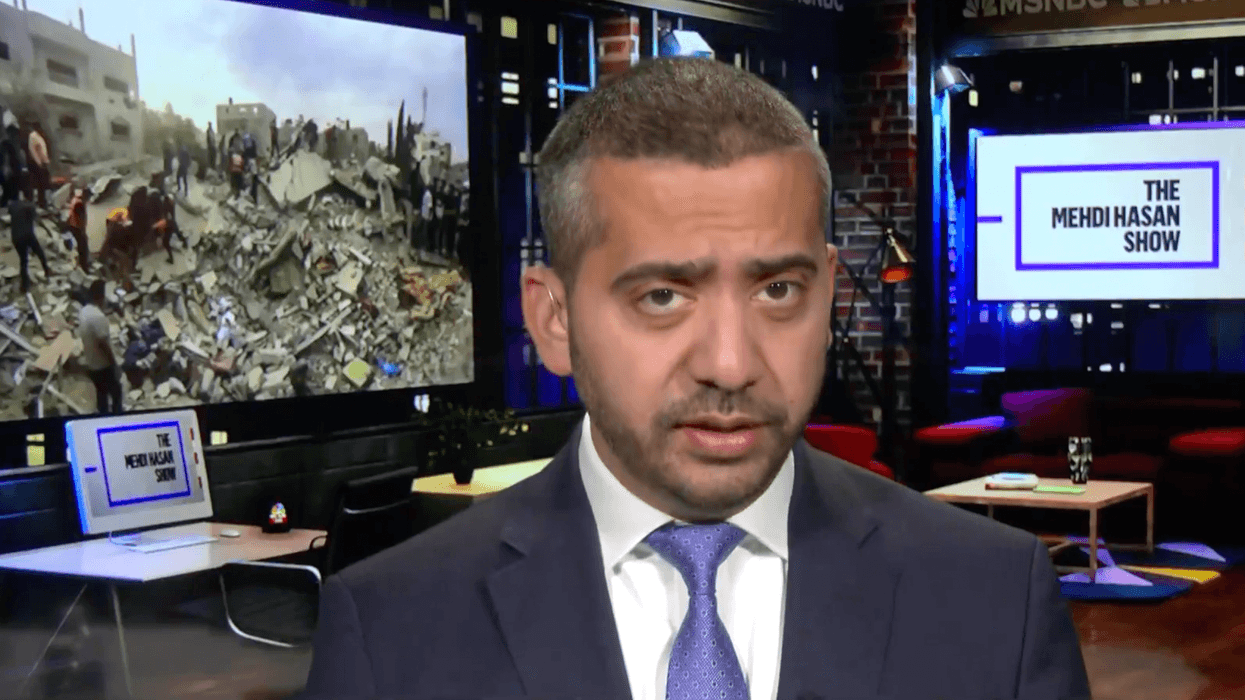
The journalist says Zeteo will feature "hard-hitting interviews and unsparing analysis" in op-eds, podcasts, and streaming shows.
After a few weeks of "soft launch" mode, journalist Mehdi Hasan on Monday officially debuted his new media platform, Zeteo, and declared that "this is not a one-man band."
The former MSNBC and Peacock host—whose show was canceled in November and wrapped up in January, after his incisive criticism of Israel's assault on the Gaza Strip—revealed nine of the contributors he has lined up so far, calling them "some of the biggest, boldest, and best names from media, activism, entertainment, and beyond."
They are Pulitzer Prize-winning journalist Spencer Ackerman, comedian and podcaster W. Kamau Bell, Palestinian Canadian lawyer Diana Buttu, former CNBC and CNN correspondent John Harwood, foreign policy analyst Rula Jebreal, author Naomi Klein, novelist Viet Thanh Nguyen, actor and activist Cynthia Nixon, and Swedish climate campaigner Greta Thunberg.
"The tough interviews and knowledgeable analysis are all coming back, along with a global cast of contributors," Klein said on social media Monday. "I was honored when Mehdi asked me to be one of them, along with Rula Jebreal and Greta Thunberg and many others yet announced."
"Mehdi and I will be having a regular conversation called 'Unshocked,'" noted Klein, who authored The Shock Doctrine.
Hasan—who has also produced content for Al Jazeera, The Guardian, and The Intercept—has said Zeteo will feature "hard-hitting interviews and unsparing analysis" in a variety of forms, from op-eds and podcasts to streaming shows, beginning with "Mehdi Unfiltered."
“What else do we call this other than the deliberate dehumanization of the Palestinian people?”
I called out media bias and racism, on Gaza, and brought receipts!, in the opening monologue of my new show #MehdiUnfiltered today.
Watch/share/subscribe:https://t.co/20UUcW06TK pic.twitter.com/oHA1bfZqWK
— Mehdi Hasan (@mehdirhasan) April 15, 2024
"To keep
Zeteo's journalism independent and free of advertiser and corporate influence," Hasan explained ahead of the formal launch, "and to allow us to continue investing in the future, we have to rely on our individual paid subscribers."
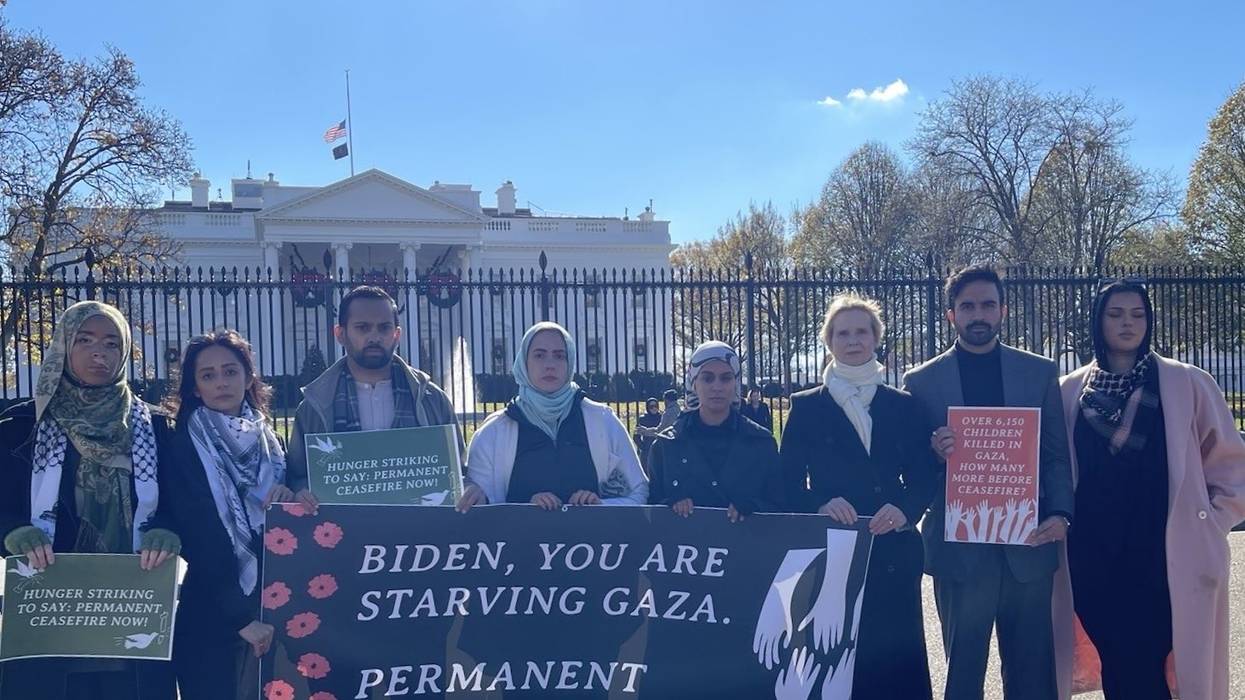
"As the mother of Jewish children whose grandparents are Holocaust survivors, I have been asked by my son to use my platform," said actor and activist Cynthia Nixon.
As Israel and Hamas on Monday agreed to extend their temporary pause of fighting in the Gaza Strip, advocacy group leaders, U.S. state lawmakers, and actor and activist Cynthia Nixon were among those who launched a hunger strike demanding a permanent cease-fire in Washington, D.C. outside the White House.
"As the mother of Jewish children whose grandparents are Holocaust survivors, I have been asked by my son to use my platform to project as loudly as possible that 'never again' means never again for everyone," said Nixon, one of more than 260 artists who signed a letter asking U.S. President Joe Biden and Congress to call for a cease-fire in Gaza.
"As an American, I am here to demand that our president stop funding the mass killing and starvation of thousands of innocent Palestinians, the majority of whom are children and women," she continued. "President Biden must use this moment to negotiate a permanent cease-fire that will bring all the hostages and political prisoners home and start to lay the foundation for a lasting peace."
"Palestinians in Gaza deserve to be grieved and it's astonishing that we even have to say this, but Palestinians in Gaza deserve to live."
Other supporters of the five-day hunger strike include Palestinian organizer and activist Linda Sarsour, Delaware state Rep. Madinah Wilson-Anton (D-26), Oklahoma state Rep. Mauree Turner (D-88), Virginia state Rep. Sam Rasoul (D-11), Adalah Justice Project (AJP), the American-Arab Anti-Discrimination Committee, Democratic Socialists of America, Dream Defenders, IfNotNow, the Institute for Middle East Understanding, Jewish Voice for Peace, and the U.S. Campaign for Palestinian Rights (USCPR).
"By every measure, this moment is the greatest loss of life and devastation in the history of the Palestinian people," said Iman Abid-Thompson, director of advocacy and organizing at USCPR. "We have been calling on Congress and President Biden to demand a total cease-fire since the beginning of October. While we welcome the 48 statements of support from members of Congress who have called for a total cease-fire, it is not enough. Time is of the essence."
"We know that Congress and President Biden could have called for a cease-fire weeks ago, but they haven't," she added. "We have all watched the destruction of Gaza and seen entire families, every generation, buried in mass graves. We cannot escape the images of children laying lifeless and in pieces. We are haunted by the dead and the living, and we will never forget what we have witnessed."
Since the October 7 Hamas-led attack that killed around 1,200 Israelis, Israel's retaliatory war on Gaza has killed over 14,850 Palestinians, including at least 6,150 children, and devastated civilian infrastructure in the besieged enclave. Both sides agreed to a four-day cease-fire that began Friday and have since exchanged hostages taken by Hamas last month and Palestinians imprisoned by Israel.
On Monday, Majed Al-Ansari, a spokesperson for the Qatari Ministry of Foreign Affairs, confirmed the two-day extension of the truce on social media. The Associated Press reported that "Israel will resume its operations with 'full force' as soon as the current deal expires if Hamas does not agree to further hostage releases, government spokesperson Eylon Levy told reporters."'
Hunger strike supporter Rana Abdelhamid, an ex-New York congressional candidate, stressed that "a temporary cease-fire is not enough. Israel has made it abundantly clear that it has no intention of stopping its bombing of Gaza as long as it enjoys the full backing of the U.S. government. We will not allow the Biden administration to continue to fund the killing and starvation of Palestinians with impunity. We need a permanent cease-fire to save lives, and we need it now."
In the wake of Hamas' attack last month, Biden affirmed his "unwavering" support for Israel—currently controlled by the most far-right government in its history—and asked Congress for $14.3 billion for the war effort, on top of the $3.8 billion in annual military assistance that the country gets from the United States.
The Intercept reported Saturday that Biden has also asked Congress to lift most restrictions on Israel's access to a U.S. stockpile of weapons there, which "would essentially create a free-flowing pipeline to provide any defense articles to Israel," according to Josh Paul, a former U.S. State Department official who resigned over arms transfers to the country.
"Our government should not be supporting the mass murder of tens of thousands of Palestinians in Gaza," AJP director of strategy and communications Sumaya Awad declared Monday. "No one is spared by Israel's bombs, not journalists, not doctors, not children and NICU babies."
"As a Palestinian, as an American, and as a mother, I am on hunger strike to demand that President Biden call for a permanent cease-fire," she said. "Without a lasting cease-fire, Israel will continue the unfolding genocide in Gaza. Palestinians in Gaza deserve to be grieved and it's astonishing that we even have to say this, but Palestinians in Gaza deserve to live."
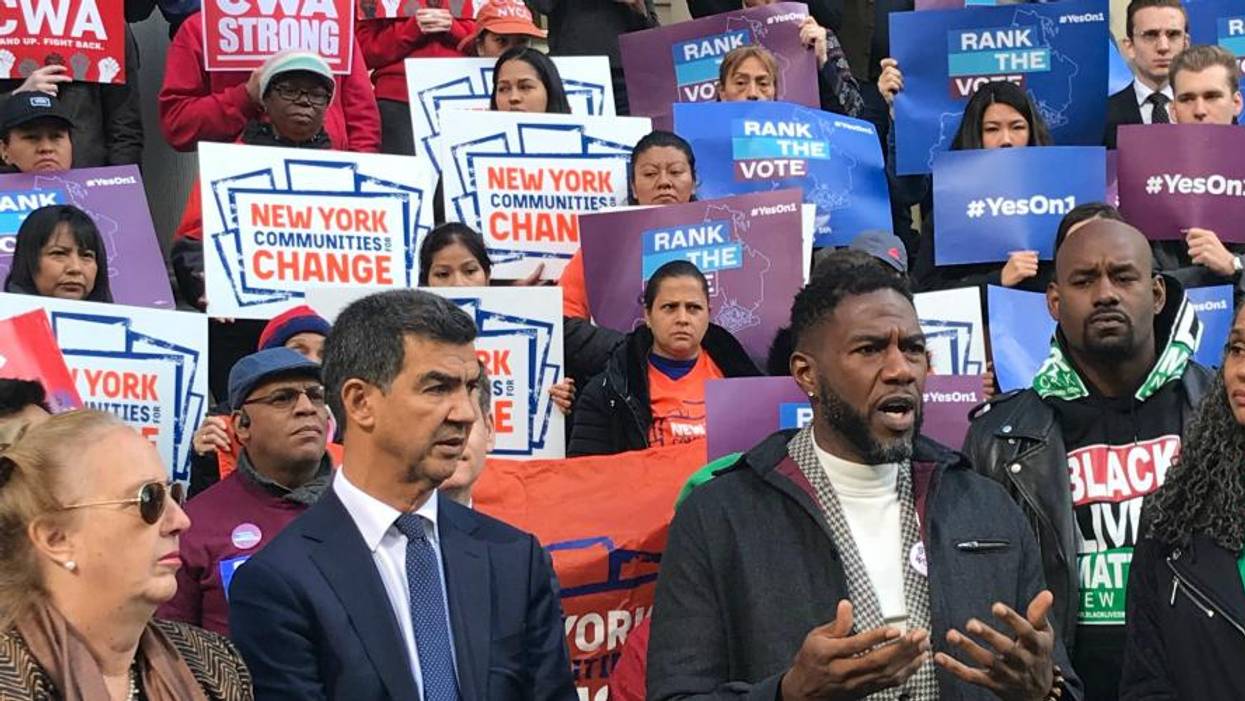
Voting rights advocates celebrated a "huge win for democracy" Tuesday after New Yorkers approved a ballot measure that would establish ranked-choice voting in the nation's most populous city.
"It's been too easy for candidates to ignore marginalized communities, including LGBTQ voters, because they didn't think they needed every vote to win. Ranked-choice voting ends that mindset."
--Rod Townsend, Stonewall Democratic Club of NYC
With 90% reporting as of Wednesday morning, New York City's Ballot Question 1 won approval from 73.5% of voters.
NYC's ranked-choice voting (RCV) measure was supported by a number of advocacy groups, politicians, and even The New York Times editorial board, which called the question the "most exciting proposal" of the five measures considered by city voters Tuesday.
In an RCV system--also known as an instant runoff voting system--voters rank candidates for each office in order of preference on their ballots. If no candidate secures a majority of first-choice votes, an elimination process is triggered and continues until one candidate has majority support.
RCV has been growing in popularity across the United States in recent years. It is used in local and party election in some places around the country and statewide in Maine.
In addition to establishing RCV in primary and special elections for all local offices beginning in 2021, the ballot measure will "increase the time between a city office vacancy and the special election to fill it from 45 days (60 for mayor) to 80 days" and "change the timeline for city council redistricting to complete it prior to city council nominating petition signature collection."
Celebrating the ballot measure's passage on Tuesday night, Common Cause NY executive director Susan Lerner said that RCV "is the simple solution that puts power back in the hands of the people where it belongs. We look forward to working with our diverse partners and elected officials to educate New Yorkers on how this important reform will work in the local 2021 elections and beyond."
The RCV provision garnered support from New Yorkers and national advocates alike. Backers included Rep. Alexandria Ocasio-Cortez (D-N.Y.)--a widely popular freshman congresswoman who represents parts of the Bronx and Queens--2020 Democratic presidential primary candidate and city resident Andrew Yang, Rep. Nydia Velasquez (D-N.Y.), state Attorney General Letitia James, Democratic state Sen. Julia Salazar, NYC Public Advocate Jumaane Williams, and actor, activist, and city resident Cynthia Nixon.
The advocacy group FairVote, which fights for fair elections and supports RCV, declared on Twitter: "This is huge for the #RankedChoiceVoting movement!"
Supporters of an RCV system argue that it pushes candidates to focus on engaging voters rather than negative campaigning. FairVote president Rob Richie told Politico, "You've got to be, I think, a better candidate."
"You as a candidate have a lot more reasons to have conversations and engagements with people," he said. "The candidates that run traditional campaigns that involve using money and not using people have not done as well."
Rod Townsend, president of the Stonewall Democratic Club of NYC, said in statement ahead of the vote Tuesday that "it's been too easy for candidates to ignore marginalized communities, including LGBTQ voters, because they didn't think they needed every vote to win. Ranked-choice voting ends that mindset because with RCV, every vote matters."
"With ranked-choice voting, marginalized communities will be engaged by every candidate," Townsend added. "Candidates will have to knock on the door of not just a certain plurality, but on the diverse doors of NYC's mosaic majority."

Though New York Gov. Andrew Cuomo overcame progressive challenger Cynthia Nixon in Thursday night's gubernatorial primary, he is likely to face a fundamentally transformed state legislature when he returns to office after many of his fellow GOP-collaborating corporate Democrats were trounced by bold left-wing insurgents.
"The IDC was the vehicle Andrew Cuomo used for eight years to keep Republicans in power. Today, we changed Albany forever."
--Bill Lipton, New York Working Families Party
For years, the Independent Democratic Conference (IDC)--a powerful group of New York state senators--caucused with the New York GOP and effectively handed Republicans a majority in the legislature, allowing them to kill progressive legislation.
On Thursday, "invigorated" progressive New Yorkers turned out in record numbers and delivered a major rebuke to this group of deep-pocketed "turncoat" Democrats by upsetting six of the eight IDC members--victories that could help shift the balance of power in Albany to the left.
"If this doesn't prove that political currency is people over money, I do not know what does," declared Alessandra Biaggi, a progressive lawyer who toppled prominent state Sen. Jeffrey Klein, former head of the IDC. "We have now cut the head off the IDC snake."
"The IDC was the vehicle Andrew Cuomo used for eight years to keep Republicans in power. Today, we changed Albany forever," added Bill Lipton, director of the New York Working Families Party. "He's going to return to an Albany he doesn't recognize, where he's no longer the center of debate. He's going to have to respond to us."
While Nixon, attorney general candidate Zephyr Teachout, and lieutenant governor candidate Jumaane Williams--a trio that was viewed as a progressive slate--were all defeated Thursday night, they were credited with driving voter enthusiasm and turnout down the ballot and helping to knock off establishment incumbents.
"This is an incredible moment for progressives, but it's not just a moment--it's a movement, and this movement is only growing stronger," Nixon wrote on Twitter following her loss. "Thank you all for believing and fighting and leaving it all on the field. We started something here in New York, and it doesn't end today. This is just the beginning. And I know that together, we will win this fight."
In addition to ousting six IDC members in the New York state Senate, the progressive movement also propelled 27-year-old democratic socialist Julia Salazar to victory over corporate Democratic Sen. Martin Dilan, who was not an IDC member but was drowning in cash from the real estate industry.
Salazar--who ran on a platform of combating homelessness in New York and guaranteeing healthcare to all as a right--overcame both a massive fundraising disadvantage and a vile right-wing smear campaign that outed her as a survivor of sexual assault just days before Thursday's election.
"This is a victory for workers," Salazar told supporters after her upset win Thursday night. "This is a victory for all of you, who every day have knocked on doors and have had meaningful conversations with our neighbors about these issues."
In a statement on Thursday, the New York City chapter of Democratic Socialists of America (DSA) celebrated the victories of Salazar and other down-ballot progressives as further evidence that New Yorkers "are ready for bold, visionary leadership and will no longer tolerate candidates who are in the pockets of corporations and billionaires."
"This primary was about the movement of socialists, tenants, immigrants, and working New Yorkers who are ready for a change in Albany," Bianca Cunningham, co-chair of New York City DSA, said in a statement. "We are excited to hit the ground running with new leadership in Albany to make the priorities of working people a reality."

Sen. Bernie Sanders (I-Vt.) on Monday waded into New York's upcoming statewide primary elections to offer enthusiastic endorsements of Zephyr Teachout for attorney general and Jumaane Williams for lieutenant governor, but progressives were quick to notice that one prominent name was absent from the Vermont senator's announcement: Cynthia Nixon.
"I was proud to support Bernie Sanders when he started a rising progressive tide in 2016. That tide is now a blue wave, and I'm honored to receive his endorsement as we ride that wave to defeat an establishment afraid of the real change we can create."
--Jumaane WilliamsWhile Sanders said in a statement that "we need to elect all the progressives running" in New York, the nation's most popular politician didn't mention or endorse Nixon, a self-described democratic socialist who is fighting an uphill battle against Gov. Andrew Cuomo in the Democratic gubernatorial primary.
"The progressive movement today is transforming American politics from coast to coast. This Thursday, New York state voters can take us a major step forward by supporting all those candidates who are prepared to transform the Democratic Party and fight for economic, social, racial, and environmental justice," Sanders said. "I would like to offer specific endorsements to two candidates I have known for many years, who are leaders of the progressive movement in New York and who stood with us in 2016: Jumaane Williams for lieutenant governor and Zephyr Teachout for attorney general."
Williams, who is Nixon's running mate, "has shown himself to be a bold and independent leader who will fight for working people in every corner of the state," Sanders noted. "Zephyr's work to reform our campaign finance system demonstrates her commitment to ensuring that the government works for all people and not just the wealthy and the powerful."
Teachout and Williams both took to Twitter to welcome Sanders' endorsement, which comes just three days before New Yorkers head to the polls.
"I was proud to support Bernie Sanders when he started a rising progressive tide in 2016," Williams wrote. "That tide is now a blue wave, and I'm honored to receive his endorsement as we ride that wave to defeat an establishment afraid of the real change we can create.
According to a new Siena College survey out on Monday, the attorney general primary is still a tossup, with Teachout currently polling in third place--just seven points behind frontrunner and Wall Street favorite Rep. Sean Patrick Maloney (D-N.Y.).

After the New York State Democratic Party--which Gov. Andrew Cuomo controls--sparked a torrent of outrage by sending voters a campaign mailer smearing progressive challenger Cynthia Nixon as an anti-Semite just ahead of Thursday's gubernatorial primary, Nixon on Sunday denounced Cuomo for deploying "Trump-style divide and conquer tactics" to stoke fear among New York's Jewish community.
"I am incredibly angry and sad that Governor Cuomo and his official New York State Democratic Party would engage in the kind of Trump-style divide and conquer tactics at a time when we need to come together."
--Cynthia Nixon"This is an attack not only on my children and my character, but on all New Yorkers. It's sickening, at a time when anti-Semitic, Islamophobic, and other hate crimes are on the rise, to exploit people's real fears like this," Nixon said in a statement. "Our children's grandparents escaped the Holocaust but many of their family members did not. The accusation that my family promotes anti-Semitism is deeply, deeply offensive."
"I am incredibly angry and sad that Gov. Cuomo and his official New York State Democratic Party would engage in the kind of Trump-style divide and conquer tactics at a time when we need to come together," concluded Nixon, who is raising her two children in the Jewish faith.
The mailer--which was reportedly sent to around 7,000 households and cost the state party $11,000 to create and circulate--accused Nixon of being "silent on the rise of anti-Semitism" and proclaimed that the progressive education activist and actress "won't stand strong for our Jewish communities."
While it is well-known that Cuomo effectively directs the New York state Democratic Party, the governor insisted during a press conference on Sunday that he had no idea the mailer was being sent and said he hadn't even seen it.
"The shameful smear attacks on Cynthia Nixon and her family are beyond the pale--and the New York Times is complicit in those baseless attacks so long as it maintains its support for Gov. Cuomo's re-election effort."
--The Jewish Vote
Echoing the widespread condemnation of the mailer by progressives and New York state officials, Democratic state Sen. Liz Krueger wrote on Twitter that she is "doubly offended and aghast that my party organization would produce and mail such a false, damaging attack on Ms. Nixon and then watch the governor and key staff act surprised they had done this. Shameful."
New York congressional candidate Alexandria Ocasio-Cortez also denounced the state Democratic Party's leadership for feigning ignorance of the mailer:
Not even the New York Times editorial board--which endorsed Cuomo last week--bought the governor's assertion that he played no role in orchestrating the smear.
In an editorial published late Sunday, the Times called the state Democratic Party's flier "nearly as sleazy as it gets" and said Cuomo's claim that he was unaware of the attempt to smear Nixon as an anti-Semite "strains credulity."
"Mr. Cuomo dominates the state Democratic Party. It acts ethically or abominably at his direction, or at the very least, with his campaign's blessing," the Times noted. "Given all the ethical lapses in Mr. Cuomo's administration, of which he has also pleaded ignorance, this smear is appalling."
And yet, shortly after denouncing his party's "dirty politics," the Times doubled down on its endorsement of Cuomo, vaguely citing the seven-year governor's "potential."
In an open letter on Sunday, The Jewish Vote--a New York-based sister organization of Jews for Racial and Economic Justice--called on the Times editorial board to "immediately withdraw and rescind their endorsement" of Cuomo.
"The shameful smear attacks on Cynthia Nixon and her family are beyond the pale--and the New York Times is complicit in those baseless attacks so long as it maintains its support for Gov. Cuomo's re-election effort," the group wrote. "If the New York Times maintains its endorsement, it will signal to Cuomo there's no serious price to be paid for engaging in this kind of hateful smear or trafficking in lies."
Attempting to clean up the mess made by his party's smear tactic ahead of Thursday's election, Geoff Berman--executive director of the New York state Democratic Party--wrote on Twitter that the mailer was "inappropriate" and promised to "work with the Nixon campaign to send out a mailing of their choosing to the same universe of people" who received the anti-Nixon flier.
It is unclear whether the Nixon campaign will be able to send out a counter-mailer before Thursday.
Brad Lander, a Democratic New York City council member, ripped Berman's attempt to backtrack as "classic dirty politics."
"Send a mailing you know is heinous and false at the last minute. Hope you don't get caught. If you do, promise 'it will not happen again' when it's too late to matter," Lander wrote. "This is indeed, 'not the tone the Democratic Party should set.' But you set it."
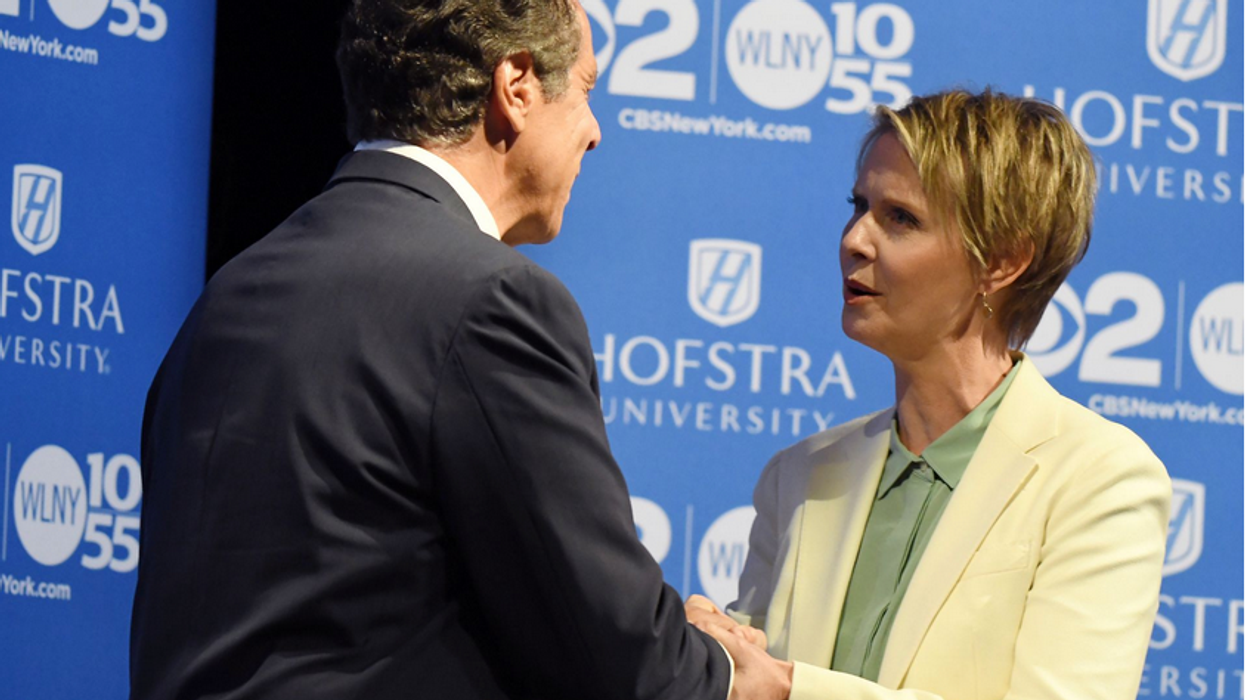
The debate was nasty even before it started. Actress-turned-politician Cynthia Nixon wanted the temperature in the debate hall at Hofstra University to be 76 degrees, apparently because Governor Andrew Cuomo "likes a cold room." She also asked for a debate format that involved the two candidates standing.
Instead, both candidates were seated, would not shake hands and were backdropped by drapery -- Cuomo's preferred press conference setting.
"I was really looking forward to going toe-to-toe with Andrew Cuomo" Nixon said. "I guess we'll be going tush-to-tush."
The debate gained extra intrigue before it started when it was revealed that Cuomo had received $25,000 from Harvey Weinstein's lawyer. This was prior to Cuomo's decision to end a probe into Manhattan District Attorney Cyrus Vance's handling of the case (Vance had accepted $100,000 from the same source).
The Weinstein issue didn't come up in the debate. Neither did the temperature. Nor tushes. But it was a nasty affair.
The tone was set when Nixon took the first question from Maurice DuBois of WCBS, and turned it back at her opponent. Asked what experience qualified her to govern a state of "20 million people, and a budget of almost $170 billion," Nixon replied:
"I'm not an Albany insider like Governor Cuomo, but I think that experience doesn't mean that much, if you're not actually good at governing."
She added that "Governor Cuomo is a very astute politician, he's a crackerjack fundraiser," before adding a slew of buts: he'd "broken the New York City subway" (an odd criticism with which to lead off), he had enabled Republicans in the State Senate, he was corrupt, etc.
But Nixon fumbled the dismount, saying, "I think you see that actually an Albany insider is [sic] the kind of a person that has a chance to clean up the corruption in Albany, and a person who is not accepting, as I am not, any corporate contributions."
This slip gave Cuomo just barely enough room to wriggle off the hook on the central question of the race: money.
The Nixon-Cuomo race has been heavily covered because both candidates are celebrities. Nixon was a star of the HBO hit Sex and the City, and Cuomo is one of America's leading hereditary/legacy politicians, who seemingly has been destined to reach the presidential ambitions his father Mario never fulfilled.
But the race is about something else: a near-perfect demonstration of the financial imbalance of political power in America, in which candidates committed to purely ideas-based campaigns are easily overwhelmed by corporate cash.
But the race is about something else: a near-perfect demonstration of the financial imbalance of political power in America, in which candidates committed to purely ideas-based campaigns are easily overwhelmed by corporate cash.
At first glance, you wouldn't notice the discrepancy. The most recent fundraising numbers on Cuomo and Nixon show a remarkably close race, in terms of grassroots support.
Between July 13th and August 9th, Cuomo received $393,367.98 in contributions, while Nixon took in $391,236.68 -- a virtual dead heat. If one goes by individual donations, the race looks tilted sharply to Nixon: Cuomo received $192,083.01 in 180 individual donations during that period, while Nixon took in nearly $100,000 more, earning $291,099.19 across 1,193 donations.
Nixon, in fact, has received over 42,000 individual donations, more than Cuomo has over the course of four election cycles.
But the race has turned on corporate money: Nixon has refused it, and Cuomo has not.
Cuomo, who had over $30 million at the start of the year, still has over $24 million in his campaign war chest, much of it from large donors in real estate, the pharmaceutical industry, hedge funds and accounting firms like KPMG and Ernst & Young. He's had at least 18 donors giving more than $100,000, many of them from the real estate or financial sectors.
Nixon had just over $441,000 left at last count. She has had 50 times less money than Cuomo at various times throughout the year, and has not been able to counter the $6 million the governor has spent to date.
Nixon had just over $441,000 left at last count. She has had 50 times less money than Cuomo at various times throughout the year, and has not been able to counter the $6 million the governor has spent to date.
This should have been the central issue of the debate. But Cuomo used a series of cunning and brazen tactics to confuse the issue.
In response to a question about former Cuomo aide Joseph Percocco, who was convicted in March of accepting $300,000 in bribes, Cuomo stared right at the moderator (and famed New York muckraker Marcia Kramer) and said, "Public trust comes job one."
Then the man who has hoarded tens of millions from big-dollar donors -- including, years ago, from Donald Trump -- said his ethics plan included "campaign finance reform, because we have to take the money out of politics, it's that simple."
That the audience did not gasp in horror at this statement -- nor did WCBS provide a rim-shot soundtrack -- told us that Cuomo likely has this race won already. Until voters learn to understand the dynamics of money in politics better, the better-funded candidate will always be able to skate by, just paying lip service to campaign finance reforms they know will never come.
Until voters learn to understand the dynamics of money in politics better, the better-funded candidate will always be able to skate by, just paying lip service to campaign finance reforms they know will never come.
Having slipped in this line, Cuomo went on the attack. He turned the tables and blasted Nixon -- who, like many artists and freelancers, pays her taxes through what's known as an S corporation -- as a corporate elitist.
"The point is the undue influence of corporate donors," he said. "My opponent, as a corporate donor, called the mayor, and asked for special favors for her friends."
He was referencing the fact that Nixon had called the mayor's office to ask that helicopters not be flown above "Shakespeare in the Park."
Nixon haltingly tried to explain this, seeming not to realize she'd been caught in a Trumpian trap.
Just as the billionaire Trump solved his own accessibility problem with low-income voters by turning attention on so-called cultural elites like the media, so did Cuomo -- one of the all-time hooverers of corporate cash -- coyly paint Nixon as a rich, out-of-touch actress who uses her influence to stop helicopters from stepping on Shakespeare lines.
Shakespeare fans, of course, are probably somewhere below NPR listeners, spotted owls and whales on the list of the common man's most hated liberal constituencies. Cuomo knew what he was doing.
Cuomo is frightening to look at, with the face of a Dungeons & Dragons character -- an Orc or a Bugbear, with leather skin six-inches thick and facial lines you'd need a crowbar to pry loose. The face fits his political brawling style. He'll gladly take one to the head to land two to the body.
In the debate with Nixon, he continually parried accusations of corruption and insiderism by hammering the theme of Nixon as a "corporation."
"Are you a corporation?" he demanded, about halfway through.
Nixon paused maybe a half-second too long. "I am a person!" she replied.
"And you're a corporation!"
The debate ended in similar fashion. After Nixon stepped into another trap, agreeing in seemingly spontaneous fashion to work for free if elected -- a noble and charitable gesture that might not fly with the average voter, who obviously can't afford to work for free -- Cuomo returned to the corporate theme.
"I have a suggestion," he said. "If my opponent is a socialist, and she's for higher taxes, why doesn't she have her corporation... make up its mind, dissolve, and stop the corporate loopholes and pay her fair share of taxes?"
Nixon now finally replied that having a corporation is something that "actors have all the time, it's like ... being a small business owner, or a freelance worker."
"Working men and women don't have corporations," Cuomo snapped.
On the whole, Nixon did well. She was composed throughout, and, for a political newcomer, remarkably quick and eloquent.
This, of course is untrue, as there are fewer and fewer W-2 jobs out there, with more people filing as individual businesses. But the damage was done.
On the whole, Nixon did well. She was composed throughout, and, for a political newcomer, remarkably quick and eloquent. She handled a question about legalizing marijuana beautifully, noting that it was primarily a racial justice issue, since drug use is equal across demographics but 80 percent of marijuana arrests involve black or Hispanic residents.
Her one mistake was that she appeared to be embarrassed by her wealth and celebrity, and fumbled when Cuomo pressed her about her famous friendships. (Cuomo delighted in bringing up the words "Sarah Jessica Parker" and "teahouse" in the same sentence).
Robert Frost once said that a liberal is "too broadminded to take his own side in a quarrel." If there's been any lesson in the Trump years, it's that voters embrace candidates who are proud of their riches and celebrity pals, and don't try to act like ordinary people.
Had Nixon played up her connections, and said something like, "The kind of people I hang out with wouldn't use your face for an ashtray," she might have done better. Cuomo instead had her running from her lifestyle, while obscuring his own political relationship to money.
The debate was an angry affair, with unusually pointed barbs (Nixon continually told Cuomo to "stop lying"). This mirrors the real frustrations below the surface of a Democratic party that is dealing for the first time in ages with a serious challenge from the left. Those frustrations are largely about the seemingly intractable influence of corporate funding. It's too bad that theme was obscured last night.

Just two weeks before New Yorkers head to the polls to decide who will be their state's Democratic gubernatorial nominee, actress and activist Cynthia Nixon offered an ambitious alternative to the toxic status quo entrenched by Gov. Andrew Cuomo, who she characterized during Wednesday night's highly anticipated debate as emblematic of the kind of "corrupt corporate Democrat" who has prevented the party from achieving necessary objectives like criminal justice reform and Medicare for All.
"We already have a corrupt corporate Republican in the White House. We don't need a corrupt corporate Democrat in Albany as his main opposition."
--Cynthia Nixon
"We already have a corrupt corporate Republican in the White House," Nixon said at the start of the hour-long debate, which was the first and likely only time Cuomo and Nixon will share a stage before next month's election. "We don't need a corrupt corporate Democrat in Albany as his main opposition."
Asked how a newcomer to electoral politics could govern a state as significant as New York, Nixon noted that she is "not an Albany insider like Governor Cuomo" and argued that "experience doesn't mean that much if you're not actually good at governing."
In addition to highlighting what she described as the "incredible corruption" of Cuomo's seven-year tenure as governor, Nixon clearly detailed her positive progressive agenda, which includes single-payer healthcare, support the right of public workers to strike, staunch advocacy for women's reproductive rights, and protection of undocumented immigrants from Trump's cruel, xenophobic agenda.
Nixon--a long-time advocate for public schools who identifies as a democratic socialist--also delivered an impassioned monologue on the necessity of legalizing marijuana and ending the so-called war on drugs, which she characterized as an urgent "racial justice issue."
Watch:
In response to Nixon's claims that he has "broken the New York City subway" and "handed over control of the State Senate to the Republicans," Cuomo insisted that Nixon is the real "corporate Democrat," despite the fact that she does not accept campaign contributions from corporations.
One of the debate's most remarkable and "painful" moments of the debate came when Cuomo repeatedly insisted that Nixon is "a corporation."
"You are a corporation," Cuomo said repeatedly. Nixon--who, like everyone else watching the exchange, appeared baffled by Cuomo's attack line--responded, "I am a person."
Watch:
Bolstering Nixon's claim that Cuomo is subservient to the interests of corporate donors, Capital & Main reported just hours before Wednesday's night's debate aired that Cuomo halted an investigation into the Manhattan district attorney's decision not to prosecute Hollywood producer and accused serial abuser Harvey Weinstein on sexual assault charges, just as the firm of Weinstein's lawyer gave Cuomo's campaign $25,000.
In response to Capital & Main's explosive report, The Intercept's Glenn Greenwald argued that Cuomo embodies everything "wrong with the Democratic Party."
Watch Nixon and Cuomo's full debate:
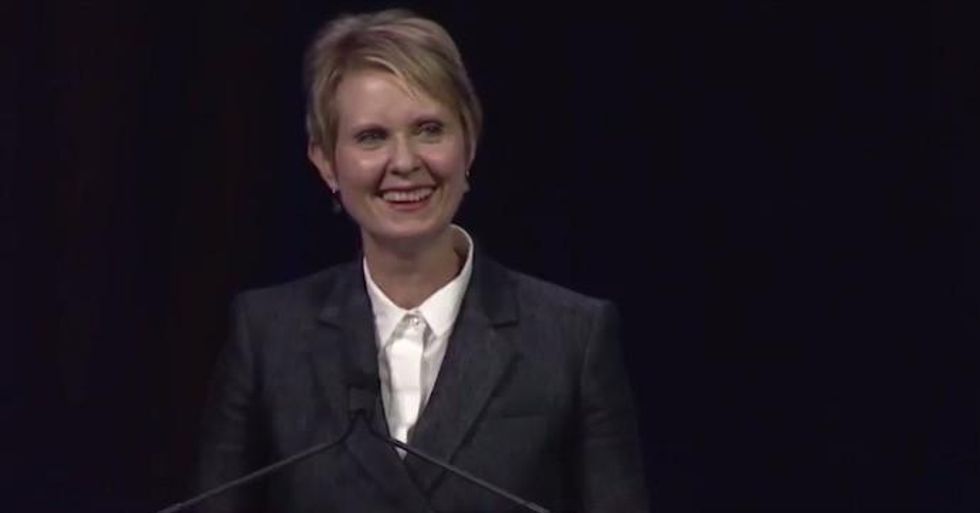
The actress and activist, who's hoping to beat Gov. Andrew Cuomo in New York's Democratic primary next month, made the remarks at the Netroots Nation annual conference taking place in New Orleans.
"The Democratic establishment doesn't like primaries," she argued, because it sees a challenge to incumbents as hurting the party. In her view, however, it's "centrist, corporate Democrats [that] hurt the party, and I think they need to be held accountable."
"We are witnessing an incredible moment for the progressive movement right now," she said, because "people are rejecting the status quo, and establishment Democrats, and a party leadership that is so often whiter and wealthier and more male than the party base." That situation, she said, has driven hundreds of progressive-minded newcomers to seek office and put forth a better "vision."
"This movement that we are building around the country isn't just about the next election--it's about offering a vision of the ways things could work if only we had the leadership and political courage to make that vision a reality."
"Because it can't just be business as usual anymore. We have to turn the system upside down. We have to uproot the broken establishment," she continued. "And we have to usher in a new generation of leadership. We have to transform the Democratic Party into a vehicle not just for corporations, not just for Wall Street, but a vehicle for all working people in this country," she said.
She chastised the party for putting "their thumb on the scale" by picking "candidates based on nothing more than their ability to fundraise from big donors," and for warning candidates not to run on progressive issues like single-payer healthcare and abolishing U.S. Immigration and Customs Enforcement (ICE). "This is the same Democratic establishment that once up on a time told us not to talk about civil rights, or same-sex marriage, or abortion, or a $15 an hour minimum wage," she noted.
"This is the same Democratic establishment that says we can't win with candidates like [New York congressional candidate] Alexandria Ocasio-Cortez," she said to cheers, "because she's too far to the left. I have to say to them, 'Please.'"
"A lack of moderation was not the problem" in 2016, she said. "We tried it their way and we lost to a racist extremist."
"If Democrats are going to win this year, it's not enough to just be better than [President] Donald Trump. We can't just give people something to vote against. We have to give them something they're going to want to show up and vote for."
After embracing the democratic socialist label, she laid down a challenge to the audience, saying, "This is not a time to settle for the way things are. This is a time to fight."
"This year progresives want power, not concessions," she said, "and if we want real change, we dont just need to elect more Democrats. We need to elect better Democrats"
Watch Nixon's full speech below in the video uploaded by Netroots Nation: