

SUBSCRIBE TO OUR FREE NEWSLETTER
Daily news & progressive opinion—funded by the people, not the corporations—delivered straight to your inbox.
5
#000000
#FFFFFF
To donate by check, phone, or other method, see our More Ways to Give page.
Daily news & progressive opinion—funded by the people, not the corporations—delivered straight to your inbox.

The autopsy did not diagnose the cause of failure, it smothered it.
The Democratic National Committee's 192-page post-mortem on the 2024 election, titled "Build to Win. Build to Last," failed to build, to win, or to learn. It never answered the only question that mattered: how did a twice-impeached, multiply-indicted former president walk back into the White House with more votes than prior to his indictments?
The report, authored by Democratic strategist Paul Rivera and released in May 2026 after months of stonewalling by DNC Chair Ken Martin, reads less as a serious political reckoning than as a confirmation-bias pamphlet drafted by people determined not to upset the party's old guard. It calls for renewed focus on "Middle America," criticizes years of disinvestment in state parties, and faults poor economic messaging. It is not wrong on any of these points, but these points alone is not what cost the party so dearly.
The report boasts of conducting more than 1,200 interviews to assess the health of state parties in every state, district, and territory. While it seems to be an impressive number, it remains questionable if the interviews were of local party leaders, or general democratic voters? Did it include micro-level analysis of competitive districts? Did it account for 6.8 million voters who supported Biden in 2020 but refused to support Harris in 2024? Where did they go and why?
There was no breakdown of Harris's collapse by age. No independent examination of what drove young voters away, particularly in university towns where Gaza protests defined the political atmosphere of 2024. How many of the 6.8 million were from Generation Z? And not a word on the Zionist bubble around Biden and how that funded and shielded Israel as it carried out a live-streamed genocide in Gaza.
This was not a methodological oversight. This is how the autopsy was engineered. University towns and young voter precincts were precisely where the Democratic coalition was visibly disintegrating. Most likely the reason they lost states like Wisconsin, Michigan, and Pennsylvania. Students who watched ‘Genocide Joe’ enable the starvation of children in Gaza, did not stay home out of apathy. They made a calculated judgment: that on the question of war crimes, there was no daylight between the two candidates. The autopsy never acknowledged that this question even existed.
Instead, it retreated into campaign mechanics: Harris "was not well prepared"; Democrats assumed Trump was unacceptable, and the party deluded itself that undecided voters would hold their noses and choose the lesser of two evils. Observations about messaging and strategy, carefully constructed to avoid touching the one issue that led the Arab-American vote in Michigan to split evenly between Harris and Trump when it favored Biden by a large margin in 2020.
The autopsy's authors, like much of the Democratic establishment, prefer to frame the party's youth problem as a generational disconnect, a cultural or communication failure that better social media spending might fix. That framing is both disingenuous and lazy. There is no generational disconnect. There is a massive divide between the old guard and the young generation—and the base at large—when it comes to Israel.
Recent primary results could not be clearer exposing the failure of the DNC autopsy. More than 80% of Democratic voters hold a negative view of Israel. That is not a fringe position within the party. That is the party. More than four out of five of the Democratic voters’ regard the long-held ‘sacred cow’ unfavorably, and the post-election study does not contain a single mention. That is dismissive of 80% of the party. The analysis is not seeking lessons learned, it is a whitewash.
The Gaza omission was not an oversight. It was a cover-up. The IMEU Policy Project’s executive director was blunt, demanding the release of findings that the autopsy’s own author had reportedly acknowledged in private: DNC officials’ internal data showed Biden’s support for Israel was a net negative for Democrats in 2024. That finding never appeared in the report. It was buried. Former DNC Vice Chair David Hogg said publicly that he told Rivera directly, “We need to acknowledge the role that Gaza played in us losing younger voters.”
This is not an outlier critique. It is coming from people who participated in the process and are now openly saying its central finding was suppressed. When the contributors to an autopsy publicly declare that the finding is edited out, the document becomes a cover-up.
The autopsy's Gaza omission collapses entirely when measured against what Democratic primaries have screamed in 2026. Candidates running on explicitly anti-Israeli-policy platforms have toppled incumbents and dethroned members of Congress backed by Democratic leadership and bankrolled by AIPAC. These are not noble protest campaigns falling short. They are winning Democratic voters, in Democratic primaries, on an explicitly pro-Palestine platform and making AIPAC a radioactive word and political liability.
The autopsy did not diagnose the cause of failure, it smothered it. Fifty-thousand words telling Democrats to organize better, message harder, and court the working-class voters they lost. Sound advice, and entirely beside the point, as long as the party establishment continues to dismiss the verdict of 80% of its rank and file.
Without an honest accounting of the party's failures in 2024, and without acknowledging the winning streak for anti-genocide democratic candidates in 2026, there can be no realistic path forward. The DNC must root out AIPAC funding in Democratic primaries and recognize the views of the party’s majority on Israel. It must confront the political cost of a foreign policy that millions of Americans now see not only as wrong, but as criminal.

Stay as far away as you can from this DNC report. Trust me.
After an extended pressure campaign, Democratic National Committee Chair Ken Martin finally agreed to release the DNC’s “autopsy report” on the 2024 election. It’s the first document I’ve ever read that would have been better if it had been written by AI. Martin himself said the report “does not meet my standards, and it won’t meet your standards.” That’s for damn sure. As we’ll see, however, that doesn’t let Martin off the hook.
I downloaded the document before reviewing my news feed, where I quickly learned that many like-minded people began exactly as I did: by searching for the word “Gaza.” Result? “Not found.” I then tried “Palestine.” Result? “Not found.” How about “Israel”? “Not found.”
These omissions are particularly striking since one activist group was told by report author Paul Rivera that DNC data showed that the administration’s support for the Gaza genocide was, “in their words, a ‘net-negative’ in the 2024 election.” Axios, which reported on that exchange, added that it “independently verified that Democratic officials conducting the autopsy believed the issue harmed the party’s standing with some voters.”
RootsAction was one of the groups pressing for the autopsy’s release, and co-founder Jeff Cohen called the document “almost worthless.” Cohen condemned the failure to mention “the Biden/Harris administration’s Israel policy that abetted the Gaza massacre,” Biden’s initial decision to run for re-election, and what he called Kamala Harris’ “lack of principles.”
Other words that can’t be found in the autopsy include “war,” “military,” “defense” (in the military sense), “peace,” “Medicare,” and “Social Security.” The report fails to address either the US’ runaway military spending or the ongoing attempts to undermine the country’s social contract.
The report’s only conceivable value will be for future anthropologists, who will find it provides considerable insight into the culture and folkways of the professional Democratic class. Its introduction reads like the kind of word salad a teenager might come up with when asked to write a 1200-word essay on a topic they forgot to study. There’s a lot of meandering, some restatements of the assignment, and a hastily looked-up quotation. Don’t read it unless you’re prepared to wade through prose like this:
... the voters decide which choice is most resonant. One party declares itself the winner, and the other party declares that the fight is far from finished.
Effective parties, understanding history rarely repeats itself, it does often rhyme, make it a point to study electoral outcomes after each cycle to identify potential improvements to every aspect of their campaigns. John Adams argued ‘"Liberty cannot be preserved without a general knowledge among the people, who have a right…and a desire to know."
Believe me, it doesn’t get any better from there.
The document is 192 pages long, but many of those pages are blank. The page called “Leadership Message”: blank. (Any comment about that would be like shooting fish in a barrel.) “Executive Summary”: blank. And so on.
The section entitled “Electoral Landscape” includes sentences like this: “We must organize everywhere to Win Anywhere”—which doesn’t make any sense. You don’t have to organize everywhere to win anywhere. And Democrats already win somewhere! Those “somewheres” are called “Blue States.” The problem is they have to win more “somewheres,” and you can’t win somewhere if you’re “everywhere”! You have to be there to win there!
The next sentence begins, “Winning Anywhere means providing for a renewed focus on the voters of Middle America and the South ...” Wait. One sentence ago we were everywhere. Now we’re in Middle America and the South, which happen to be two readily-identifiable somewheres.
That’s what consultant-speak will do to the human mind.
The document, perhaps unsurprisingly, praises the centrist Democratic orientation of the late 1980s and 1990s. But the same pro-corporate orientation contributed heavily to the party’s 2024 losses. That’s what you get what you call on a party to emulate the centrists’ “future-focused directive”—by adopting a 40-year-old strategy.
The report also states that “the DNC and ASDC (Association of State Democratic Parties) have conducted more than 1200 interviews to assess the health of our 57 state parties—in every state, district, or territory.” Where are those interviews?
Martin reportedly told DNC members that Rivera no longer “is with or advises the DNC in any capacity.” But the buck stops with the boss, not the consultant.
I get it; Martin has a tough job. But he campaigned for his position by promising an autopsy. When Rivera’s proved to be unusable, Martin was obliged to have it re-done. By failing to do so, he reneged on his campaign promise. In the meantime, a little transparency would have gone a long way toward avoiding the mess he now faces.
Don’t read the DNC document unless you’re a masochist or a journalist (provided there’s a difference between the two). Read this one instead. Stay far away from the DNC report. Trust me, you’ll “win somewhere” by being anywhere else.
There is plenty in the report to show that the Democratic Party took lessons from its defeat in 2024. The problem is that it learned all the wrong lessons because the party refuses to ask the right questions.
This week the DNC released its autopsy of the 2024 election. DNC chair Ken Martin sat on it for months, assured us there was no smoking gun, promised he’d already been sharing the lessons, and then finally dropped the 48,000 words on a Thursday with a note on the front saying the findings don’t reflect the views of the DNC. He released the autopsy and disowned it simultaneously.
I get why he’d disown it. It’s a big turd. But the whole time he buried it, Martin kept saying the lessons from this report were already being put to work. Lessons. We’re keeping the focus on the lessons, he’d say. We’ve been releasing the lessons. I read it, most of it. It’s not that there are no recommendations. There are plenty. Go heavier on digital and connected TV, lighter on broadcast. Organize earlier. Rebuild the state parties. Those are the lessons. If they’ve taken any of them, they’ve taken the wrong ones, and there’s a reason for that.
Every question in the report is a variation on the same question. How do we campaign better with what we’ve got? How do we market this thing more effectively to the people we’re trying to sell it to? Never once do they stop and ask whether the thing they’re selling is bullshit. Whether the product is any good. Whether a single promise in it would fix a single person’s life.
Every problem this autopsy was built to diagnose is still here in 2026, we’ve yet to solve a damn one of them.
It was never about governing. It was about winning for the sake of winning, with no theory of what to do with the power once they have it. The DNC still isn’t looking for a mission of its own. It tells the campaigns to build their own contrast and definition and leaves the meaning to everyone else. The party is a machine with no idea what it’s for.
To the contrary, it’s pretty pleased with itself. The report never once treats the Biden record as a failure. Its gripe about Bidenomics isn’t that it failed people, it’s that the message leaned on big macro statistics instead of the daily reality people were actually living. When the party lost down the ballot, the report decided strong local candidates just needed to define themselves better. They’re certain Democrats are doing a great job, and that it’s just their inability to explain how awesome they are that keeps them out of power.
What I see in this report is the Biden administration in miniature. Biden was sold to us, by the press and by his own people, as proof of what Democrats could do if they got back to their FDR roots. We got the CHIPS Act. We got the IRA. We got the bipartisan infrastructure law. We were told it was the most historic spending in generations. But the rubber never hits the road. Lives weren’t transformed. Why? Because these people refuse to admit that the systems they are funding are no longer productive.
They refuse to look at the difference between an input and an output. Effort and results. You can pour trillions into a financialized housing market and a six-trillion-dollar healthcare industry, but if you never touch the monopolies and the middlemen and the rot underneath, nothing useful comes out the other side. It’s worse than that. Pour more money into an out-of-control healthcare industry and all you’ve built is a stronger monopoly, a more powerful opponent.
It was never about governing. It was about winning for the sake of winning, with no theory of what to do with the power once they have it.
The net result of all that historic spending is a Democratic Party that seventy percent of voters can’t stand and that can’t get above water with its own base. A lot of money. A lot of effort. Nothing delivered. Same as the report.
If you doubt where the party’s head is, count the words. The report runs 48,000 of them. “Spend” shows up 350 times. “Data,” 226. “Organizing,” 211. “Fundraising,” 150. “Monopoly,” zero. “Cost of living,” zero. “Affordability,” four. “Healthcare,” twice. That’s not an analysis of a country in pain. That’s a sales team studying its own pipeline.
Then there’s the New York Times, coming to the rescue with much-needed polling and data. The paper of record put out a poll a few days ago, I assume in an effort to find out how Americans actually feel and what they want from their politics and government. Among people who plan to vote for Democrats, socialism runs favorable by twenty-seven points, 49 to 22. Those same people turn around and say, 52 to 25, that the party should move to the center to win. The Times wants you to read that as confused voters. They aren’t confused. The question is garbage. This is the paper that fancies itself the one asking the hard questions and uncovering the real America, and the hard question it managed to come up with was whether the party should move left, right, or not at all on healthcare.
What does that mean? What’s the policy? What changes in your life? They don’t say. You decide. They never asked whether you want a zero-copay, zero-cost national health plan. They never asked whether we should go back to a country where the states and the cities and the government own some of the hospitals and the clinics and the research labs. They asked left or right, defined nothing, and then acted stunned when people handed them a tangle.
They asked exactly one real policy question in the whole poll. Whether you’d rather have a candidate who lowers prices by going after corporate monopolies and price gougers, or one who lowers prices by deregulating and building more. Better than two to one, people said go after the ones with the power. The reason was sitting right there. The good sense was sitting right there. They just wouldn’t go looking for it anywhere else.
The good sense was sitting right there. They just wouldn’t go looking for it anywhere else.
They keep us trapped in left and right because it’s the frame they know how to sell. But the world isn’t left and right, and I’m not sure it ever was. It’s something they lay over the top of us, the same way they sort us into black, white, Latino, Jew, Gentile, Muslim, Quaker, the way a zoologist sorts fish into types. It might be a fine theory for eking out a marginal election here and there. It’s a useless theory for fixing a broken system. And there’s overwhelming agreement out there that the system is broken.
Every problem this autopsy was built to diagnose is still here in 2026, we’ve yet to solve a damn one of them. The NYT poll proves it. Same disgust, same broken trust, same party underwater with its own people. Nothing got fixed because nothing got understood. And they’re going to win anyway. Not because they earned it. Because the other side is handing it to them.
So they’ll win in November, call it proof the model works, and walk right back into the same wall in 2028 having learned nothing. Winning is the very thing that lets them skip getting better.
We’re in a deeply unpopular war in the Middle East. Gas is climbing. The president is corrupt as hell and everyone can see it. The headwind is so strong that, as Pelosi once put it, you could run a glass of water with a D next to its name and win in half these districts. So they’ll win in November, call it proof the model works, and walk right back into the same wall in 2028 having learned nothing. Winning is the very thing that lets them skip getting better.
So no, I don’t think we live in a left-right world anymore. We live in a world of capacity, of competency, of outcomes. That’s the whole game now, and it’s exactly where the government and the corporations have failed us, over and over, while the political class argues about a spectrum that means nothing to a family trying to buy groceries. It is not baked in. I’ve spent ten years trying to build something that takes that seriously, and I’m going again, harder, with my latest political project: A Fight Worth Having.
How we do it, and why I think the people telling us to keep our hands clean have it exactly backwards, is next.
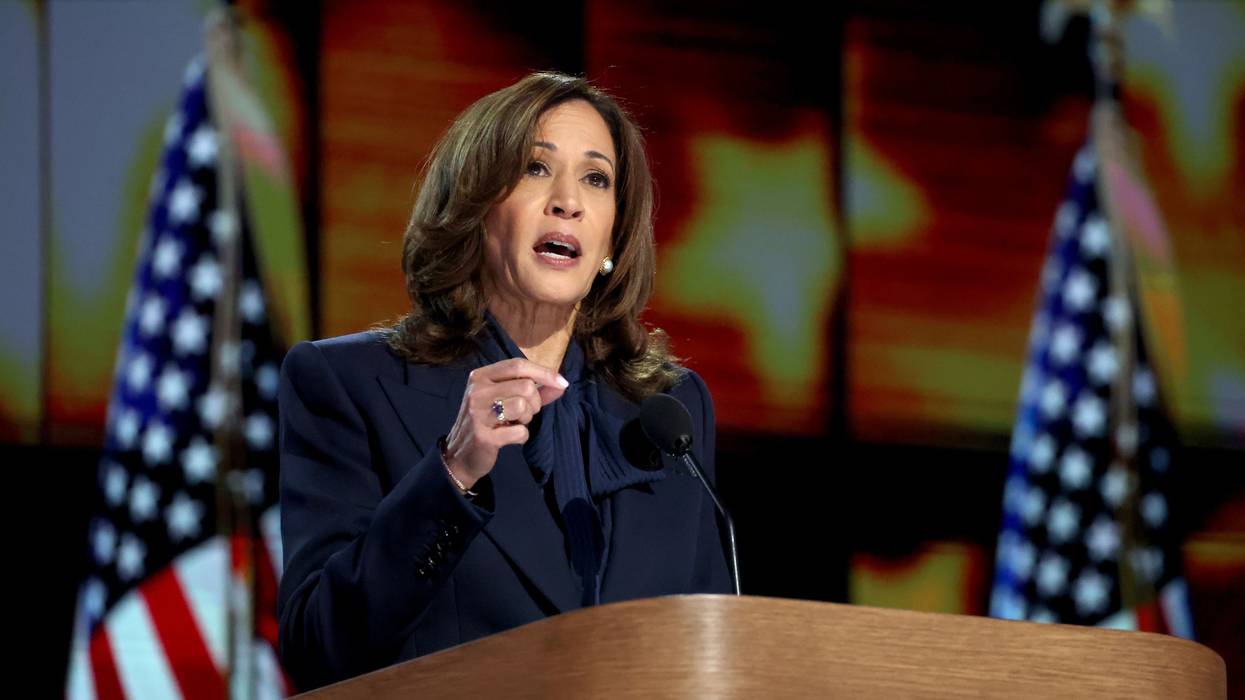
"At a time when Republicans are polling at historic lows, Democrats need to capitalize and offer a better vision for the country," said one critic. "This isn’t it."
Critics on Thursday slammed the controversial—and until now secret—Democratic National Committee autopsy of the 2024 election, which completely omitted some of the biggest issues affecting the contest, including President Joe Biden's decision to seek reelection, the manner in which Vice President Kamala Harris replaced him atop the ticket, and the Gaza genocide.
The 2024 postmortem—which was written by strategist Paul Rivera and ostensibly examines why and how Democrats lost the White House to President Donald Trump and control of Congress to Republicans—was published online Thursday after it was obtained CNN. DNC Chair Ken Martin told CNN that he was "releasing the report as we received it, in its entirety, unedited and unabridged,” for the sake of "full transparency."
“It does not meet my standards, and it won’t meet your standards, but I am doing this because people need to be able to trust the Democratic Party and trust our word," Martin said. “After last November’s massive Democratic wins, I didn’t want to create a distraction, but by not putting the report out, I ended up creating an even bigger distraction. For that, I sincerely apologize."
RootsAction, the progressive advocacy group that led the push to release the autopsy, said Thursday that "to call the report a disgrace would be an understatement."
"The report focuses extensively on ad spending and fundraising, without discussing the Democratic platform, policy positions, or political context of the 2024 election," the group noted. "The word 'affordability,' arguably the most important issue in the 2024 election, appears twice in the 129-page report."
"Martin and the DNC are trying to wash their hands of the report and its contents," RootsAction continued. "In a hasty, almost amateurish markup, the DNC has gone out of its way to poke holes in the legitimacy of the very report it commissioned... While Martin may feel that this absolves him of the responsibility to answer for this pitiful document, it should only intensify scrutiny of his leadership of the DNC."
Speculation abounded that the report contained damning findings about the electoral harm caused by the Biden-Harris administration's support for Israel as it waged both a genocidal war in Gaza and expanded its illegal occupation, colonization, apartheid, and ethnic cleansing in the West Bank.
Opposition to the administration's complicity in the slaughter, as well as Biden and Harris' refusal to acknowledge the genocide or seek a ceasefire, was embodied by the Uncommitted movement and its 30 Democratic National Convention delegates.
There isn't a single mention of Gaza, Palestine, Israel, genocide, or Uncommitted in the autopsy.
"We needed a serious DNC autopsy. This alleged autopsy is almost worthless," Jeff Cohen, co-founder of RootsAction—which led the battle for the DNC to release the report—told Common Dreams on Thursday.
"There's no mention of the Biden/Harris administration's Israel policy that abetted the Gaza massacre," Cohen continued. "That cost votes, and helped Trump win. Earlier leaks suggested that the DNC autopsy would discuss Gaza's impact on voters."
Establishment Democrats don't get it.There is no amount of consulting, brand management, influencer outreach, or narrative shaping that can save a campaign with no message at its core. www.commondreams.org/opinion/why-...
[image or embed]
— RootsAction (@rootsaction.org) May 20, 2026 at 9:26 AM
The Institute for Middle East Understanding (IMEU) noted that "polls and reporting leading up to and after the 2024 election showed Biden and Harris’s support for providing weapons to Israel was deeply unpopular with their own voters and an electoral liability."
“Ken Martin should release the information that the author of the autopsy told us clearly and unambiguously, which is that DNC officials’ review of their own data found Biden’s support for Israel to be a net-negative for Democrats in 2024," IMEU policy project executive director Margaret DeReus said Thursday.
While the autopsy mentions inflation 18 times, it does so within the context of adjusting fundraising figures for inflation and not the affordability crisis—arguably the number one issue Trump campaigned on, before exacerbating the crisis via trade wars and actual wars once back in office.
The DNC postmortem argues that Democrats have steadily lost the trust of working-class and non-college voters since the high-water mark of former President Barack Obama's historic 2008 victory.
"The Democratic Party has always tried to be seen as the party of the people, the party of workers, fair play, and civil discourse," the report states. "The party’s connections with working Americans and their families were forged through decades of organizing and engagement, the development of a vibrant and inclusive party infrastructure, and a relatable agenda which helped us connect in homes, workplaces, and neighborhoods across the country."
However, the report argues that the party defined itself as anti-Trump while failing to define what Harris and Democrats stood for, while underinvesting in state and local organizing and failing to build and maintain relationships with voters outside its coastal and urban strongholds.
"Harris wrote off rural America, assuming urban/suburban margins would compensate," the publication notes. "The Harris campaign appears to have relied on Trump being unacceptable rather than building an affirmative case for Harris.”
The autopsy concluded that so-called "identity politics" don't resonate with white male voters. The report noted the success of Trump's attack ads, particularly the anti-trans spots with the kicker, "Kamala is for they/them, President Trump is for you."
"If the vice president would not change her position—and she did not—then there was nothing which would have worked as a response," the report asserts.
Some observers worried that the DNC was suggesting throwing trans people under the bus in pursuit of electoral gains. Worryingly, the only time the publication mentions transgender people, it uses an antiquated term that is offensive to many trans folk.
They used the term "transgendered." This is exactly why the Republicans attack Dems on this issue because for many their support for trans people is hollow and thus they can't defend it. Contrast that with Mamdani or AOC whose support is genuine and can wrap it in a message of economic populism.
[image or embed]
— Alejandra Caraballo (@esqueer.net) May 21, 2026 at 9:17 AM
Amid relentless Republican attacks on transgender people and the wider LGBTQ+ community, reproductive freedom, voting rights—especially for Black Americans—immigrants, and others, the DNC postmortem encourages future Democratic candidates to "focus less on abstract issues and identity politics, and connect with voters on the issues they say matter most, including the economy, disaster relief, and addressing housing affordability."
The autopsy's assertion that "the problem wasn't Democratic policy or party brand" drew incredulous derision from observers including gun control activist and former DNC co-vice chair David Hogg:
Taking aim at the autopsy's many failures, RootsAction asserted that the DNC had "a responsibility to turn in a report that truly grapples with the mistakes of the past so that the Democratic Party can learn from those mistakes and emerge stronger in its fight against Trumpism," but ultimately, "the DNC has utterly failed in that respect."
"The only serious autopsy so far remains the one that RootsAction published," the group said.
The RootsAction 2024 postmortem, authored by San Francisco journalist Christopher Cook, covers some of the same issues as the DNC autopsy. However, it argues that Democrats lost in 2024 because of voter disenchantment, Biden's decision to run for reelection, Democrats' abandonment of their working-class base, loss of younger voters, and "the Gaza effect."
While the DNC autopsy makes no mention of Biden's fateful decision, RootsAction's report states that "a key factor hobbling Harris’s chances in 2024 was the short timeline she had to execute her campaign—just 107 days."
"That her nomination was secured not via the traditional Democratic Party primary, but through some process of intra-administration succession, exacerbated this challenging chronology," the publication adds. "This was, of course, due to President Biden’s betrayal of his 2020 promise to be a 'bridge' president, and his tragic decision to continue running for reelection despite cognitive decline and plunging approval ratings."
Cohen lamented these omissions from the DNC report.
"There's no criticism of Biden for his insistence on seeking reelection, or the lack of any kind of open process to choose Biden's replacement," he told Common Dreams. "No analysis of Harris for her lack of principles—leading to her avoiding media platforms reaching millions of potential voters."
Criticism of the DNC report mounted throughout the day Thursday as more and more people read it.
“What’s important is what’s missing, what they’re not releasing,” former Harris communications director Ashley Etienne told Politico. "It feels like what the DNC is doing is cherry-picking the parts of it that it wants to actually release, that [are] less problematic for the party going forward."
Zenith Research founding partner Adam Carlson called the paper "an absolute mess in every sense of the word" and added that "anyone that is using its findings as justification to follow their ideological preferences for the future of the party should be laughed out of every room they go into."
Hafiz Rashid, a writer at The New Republic, said that "Martin seems to be right about the report’s flaws."
"But hiding it and not commissioning a new one—or at least not editing this one to a passable standard—is a scandal in itself," he added. "At a time when Republicans are polling at historic lows, Democrats need to capitalize and offer a better vision for the country. This isn’t it."
Here is the DNC document, as posted by CNN:

Who are party leaders protecting most by not releasing an autopsy of the former vice president's 2024 loss to Donald Trump?
More than four months after Democratic National Committee chair Ken Martin announced that he was breaking his promise to release its autopsy report on the 2024 election, the decision remains highly controversial. Arguments swirl around whether it’s wise to proceed without public scrutiny of what went wrong during the last presidential campaign. But scant attention has focused on how hiding the autopsy provides an assist to Kamala Harris, who currently leads in polling of Democrats for the party’s 2028 nomination.
As Harris eyes another run, she has a major stake in the DNC continuing to keep the autopsy under wraps—and has a lot to lose if it reaches the light of day. She must feel gratified when Martin defends keeping the autopsy secret, saying that the party should not “relitigate” the 2024 election and claiming that release of the 200-page document would result in “navel-gazing.”
Release of the entire autopsy would likely be a blow to Harris’s chances of becoming president in January 2029. Partly based on interviews with more than 300 prominent Democrats and others in all 50 states, it reportedly concludes that Harris’s unwavering support for US weapons shipments to Israel was a significant factor in her loss to Donald Trump.
While she pursued an unsuccessful strategy of wooing scarce “moderate” Republican voters, many in the Democratic base were repelled by the full backing that Harris gave to President Biden’s massive arming of Israel as civilian deaths mounted in Gaza. She adhered to Biden’s admonition that there be “no daylight” between the two of them as she campaigned for president after he withdrew from the race.
The DNC’s scrapping of the autopsy is a political gift that keeps on giving to Harris as she appears to be gearing up for the 2028 campaign.
At the time, polls showed that Harris was harming her election prospects by refusing to distance herself from Biden’s policy toward Israel. She evades that reality in her post-election book 107 Days, which dismisses antiwar protesters at her rallies as mere “hecklers.”
Harris’s protracted book tour has been beset by disruptions as well as her inability to provide cogent responses. At one appearance last fall, protesters yelled “Your legacy is genocide! Your legacy will always be genocide!” Her rejoinder was, “You know what, I am not president of the United States. You want to go to the White House and talk to him, then go on and do that.” Weeks later, speaking in Chicago, when a protester accused her of complicity in the Gaza horrors, she fired back: “Are you the same person that was telling people not to vote?”
Renewed attention to the Harris 2024 finances would also be unwelcome. Thirteen months after the election, the New York Times reported, “some Democratic donors have demanded a more thorough accounting of how exactly the party and Ms. Harris spent $1.5 billion in 15 weeks en route to losing every battleground state in 2024.” In mid-April, NBC News noted that “to date, a full accounting has not been made of who was paid what from the $1.5 billion, though the DNC later disclosed it carried more than $20 million in debt from Harris’s loss.”
A few weeks ago, Harris told an audience of influential black leaders that she’s “thinking about” running for president again and said that “I know what the job is and I know what it requires.” Politico described those comments as “the most explicit sign yet she’ll run for president in 2028.”
Release of the entire autopsy would likely be a blow to Harris’s chances of becoming president in January 2029.
Just about the last thing Harris would need is enormous publicity about an authoritative audit from the DNC—the governing body of the Democratic party—about what was wrong with her 2024 campaign. Such an autopsy would stoke fires of negativity and apprehension about making her the party’s standard-bearer again.
The DNC’s scrapping of the autopsy is a political gift that keeps on giving to Harris as she appears to be gearing up for the 2028 campaign. A straw in the wind: The DNC national coalitions director, Gabriel Uy, recently emailed colleagues that he will leave that job in early May to “be working for VP Harris again, so let’s keep in touch.” Uy was the Nevada political director for Harris’s presidential campaign in 2019 and then deputy director of public engagement and intergovernmental affairs for Harris when she was vice president. Other high-level DNC employees will probably also be migrating to the Harris staff.
Under ongoing pressure from a variety of Democrats, Martin has begun to indicate that he will supply “top lines” summarizing the autopsy. Such a move would do little to placate critics, raising pointed questions about what was omitted and why the DNC was only willing to engage in cherry-picking instead of fully informing the party faithful.
During an MS NOW television interview in late April, while he used head-spinning illogic to defend concealing the autopsy, Martin went out of his way to say “I’m not here to protect anyone.” The interviewer had not asked if he was protecting anyone. It seemed to be an instance of “the chairman doth protest too much.”
Martin has properly emphasized that the Democratic National Committee should maintain strict neutrality in relation to presidential primaries, unlike what happened in 2016 when the DNC secretly assisted Hillary Clinton against Bernie Sanders. A year ago, in a well-publicized dustup with David Hogg, then in a brief stint as DNC vice chair, Martin insisted that Hogg could not run a funding operation for candidates in party primaries and remain a DNC officer.
“I am determined to make sure we don’t repeat the same errors of the past,” Martin wrote in Time magazine. He explained that “I've spent the past decade making sure our party cannot ever again be perceived as having a thumb on the scale for one candidate.”
But now, in effect, Martin’s concealment of the autopsy report puts a thumb on the scale for one candidate: Kamala Harris.

Why did pro-Israel groups voice so much pleasure and praise—not only for the sidelining of pro-human-rights resolutions but also for the process that sidelined them? Because, of course, the sidelining worked.
In the aftermath of last week’s big meeting of the Democratic National Committee in New Orleans, supporters of the US-Israel alliance have been quite content. “We’re pleased that the DNC Resolutions Committee rejected a set of divisive, anti-Israel resolutions,” the president of Democratic Majority for Israel said. The CEO of the Jewish Democratic Council of America, a former national security advisor to Kamala Harris, expressed gratitude to the DNC’s leadership.
Why did pro-Israel groups voice so much pleasure and praise—not only for the sidelining of pro-human-rights resolutions but also for the process that sidelined them? The answer has to do with the DNC’s mechanism that thwarted changes in positions on Israel. A panel named the Middle East Working Group gummed up all efforts to align the DNC with the views of most Democratic voters, even while supposedly hard at work.
Last Friday, the transparent thinness of the pretense caused Politico to headline an article this way: “Inside the DNC’s Middle East (Not) Working Group.” But the not-working group had been functioning quite well—as a charade for delay and obfuscation.
The day before the derisive headline appeared, the DNC Resolutions Committee dispensed with a resolution about events in Gaza and the West Bank. Its provisions included a declaration that the DNC “supports pausing or conditioning US weapons transfers to any military units credibly implicated in violations of international humanitarian law or obstruction of humanitarian assistance.”
Given the crystal-clear polling, the failure of the Democratic Party leadership to oppose military aid to Israel threatens to seriously damage the turnout needed to defeat Republicans at election time.
That resolution critical of Israel went nowhere, which is to say it went to the so-called working group, also known as a “task force.”
Assisting the diversion as chair of the Resolutions Committee was political strategist Ron Harris, described in his home state of Minnesota as a “longtime Democratic Party insider.” He made false claims during the meeting: “I know that the task force has met once a month since it was created…. I have the confidence that work is happening…. These are people working really really hard over a very thorny issue…. They are doing their work…. They’re hearing from experts and all sorts of things.”
The falsehood that the task force had met “once a month,” when actually it had scarcely met, was enough reason for me to contact Harris and ask where he’d gotten that (mis)information. He replied that it was “according to the DNC staffer coordinating the process.”
The basic problem with the working group is not only that it hasn’t done much of anything in the nearly eight months since DNC Chair Ken Martin announced it with great fanfare. The underlying hoax is that it was set up not to reflect the views of registered Democrats nationwide.
Polling is clear. Three-quarters of Democrats agree that “Israel is committing genocide,” and a large majority are more sympathetic to Palestinians than to Israelis by a 4-to-1 margin. But only a minority of the Middle East Working Group’s eight members has a record of supporting Palestinian rights, while several are firm supporters of Israel. The oil-and-water mix seems destined for stalemate or mere platitudes. But stalemate and platitudes appear to be just fine from here to the horizon for DNC leadership.
Such stalling mechanisms and scant real representation are as old as the political hills. In this case, an unfortunate boost has come from James Zogby, who for decades bravely worked inside the Democratic Party and elsewhere to advocate for the human rights of Palestinians, in sharp contrast to US foreign policy.
As the most prominent person in the Middle East Working Group, Zogby has hailed it as an important step forward. Aligning himself with Martin’s approach from the outset, he said that the new chair’s move to set it up was “politically thoughtful.”
Zogby can remember when, in the 1980s, party leaders did not want to hear the “p-word”—Palestinians. He has portrayed the current sparse intra-party discussion related to Israel as major progress. “Don’t count me among those who left New Orleans complaining of defeat,” Zogby wrote in an April 14 piece for The Nation.
After that article appeared, I spoke with Zogby, and he summarized his approach this way: “I have a tendency to feel like sometimes there are little victories, and I latch onto them. Moving to catch up to where Democrats are.”
Compare that approach to this assessment days ago from Mike Merryman-Lotze, the American Friends Service Committee’s director of Just Peace Global Policy: “The failure of the DNC to take even minimal action in the face of ethnic cleansing and genocide is shameful.”
When my RootsAction colleague India Walton loudly interrupted the DNC’s business as usual during its general session a week ago, she was challenging a political culture of conformity that has ongoing deadly consequences. The context involves a simple and crucial choice—between excessive patience or urgency that’s grounded in life-and-death human realities. Those realities exist very far away from the transactional atmosphere of entrenched political institutions.
All this matters for at least two profound reasons: One is that, on the merits, silent or euphemistic complicity with Israel’s methodical policies of ethnic cleansing and genocide is abhorrent.
And given the crystal-clear polling, the failure of the Democratic Party leadership to oppose military aid to Israel threatens to seriously damage the turnout needed to defeat Republicans at election time (as polls have shown was the case with Kamala Harris’s 2024 campaign for president). “Eight-in-10 Democrats and Democratic-leaning independents currently have an unfavorable view of Israel, up from 69 percent last year and 53 percent in 2022,” the Pew Research Center reported last week.
In these exceedingly dystopian times, when realism is more important than ever, it’s a grave mistake to let rose-colored glasses distort vision and substitute undue patience for vital urgency.

No matter how much the DNC leadership tries to shunt it aside, the burning issue of US policy toward Israel will not go away.
When the governing body of the Democratic Party convenes next month, it will face a challenge to its support for Israel. The Democratic National Committee has evaded the fact that large majorities of Democrats oppose continuing military aid to Israel and believe it has committed genocide in Gaza. The stage is set for jarring discord when the DNC’s 450 members gather in New Orleans.
An NBC poll released this week underscores the depth of the DNC’s political folly. The results were lopsided, by a 67-17 percent margin in favor of Palestinians, when the survey asked Democrats: “Are your sympathies more with the Israelis or more with the Palestinians?”
The DNC leadership has stayed on a collision course with political realities about Israel. Last August, while a Gallup poll was showing that just 8 percent of Democrats approved of Israel’s military actions in Gaza, DNC chair Ken Martin said at a meeting of delegates from across the country that “there’s a divide in our party on this issue.” He didn’t acknowledge that the crucial divide is actually between the party’s leadership and Democrats nationwide.
At that summer meeting, amid contention over US policies toward Israel, Martin withdrew his party-line resolution after it won and after a pro-Palestinian rights measure lost. He called for “shared dialogue” and “shared advocacy,” announcing that he would appoint a task force “comprised of stakeholders on all sides of this to continue to have the conversation.” Martin declared that “this crisis in Gaza is urgent” and an “emergency.”
But the “emergency” lost its urgency as soon as the DNC adjourned and the media spotlight disappeared. Six months passed before the first meeting of the task force, which by then had been downgraded to a “working group.”
The working group’s convener (selected by Martin) is James Zogby, a longtime advocate for Palestinian rights. Zogby had greeted Martin’s task-force announcement with praise, calling it “politically thoughtful” and a recognition of “the reality that the status quo has become unacceptable and untenable.”
But more than six months later, the status quo remains undisturbed as the DNC’s Middle East Working Group proceeds at a snail’s pace. And the composition of the eight-member panel makes it foreseeably incapable of reaching its purported goal to “help us sort out how our party deals with America’s policies in the Middle East.”
The working group is an oil-and-water mix of fully incompatible views on Palestinian rights and Israeli power. Some on the DNC panel want an embargo on US arms to Israel, while others firmly oppose any such step. One member of the working group, Andrew Lachman, has led fights inside the California Democratic Party to thwart actions or statements critical of Israel. He is currently the president of Democrats for Israel-California.
How the DNC’s appointed group is supposed to “sort out” a Democratic Party position on US policy in the Middle East is inexplicable. But the project does have an evident function. The Middle East Working Group has proven itself to be a stalling mechanism. And the pretenses behind it have become even more fanciful as the US-Israel military alliance persists with a war of aggression on Iran that has been setting the region on fire.
No matter how much the DNC leadership tries to shunt it aside, the burning issue of US policy toward Israel will not go away. This year, it has become key in one Democratic primary race after another, putting incumbent members of Congress on the defensive for their timeworn efforts to justify support for Israel or acceptance of funding from the AIPAC lobby. Yet the DNC stance is that the party establishment is wise to seal itself off from such unpleasantness.
The DNC’s refusal to make public its autopsy of the 2024 election is tangled up in dodging the autopsy’s reported conclusion that Kamala Harris’ rigid support for arming Israel was a significant factor in her defeat. Keeping the official autopsy under wraps, supposedly in order to improve the prospects of future election victories, actually makes such victories less likely by mystifying instead of clarifying electoral history.
Martin told Fox News viewers in late February that concentrating on the future would be better than trying to “relitigate” the 2024 election. But hiding the autopsy amounts to condescension, assuming that only a small elite party circle should be privy to the results of the party’s extensive (and expensive) research. Many Democratic activists and candidates would benefit from candor instead of stonewalling.
Weeks ago, the annual convention of the California Democratic Party responded to growing pressure from grassroots activists by adopting a platform that advocates for “an immediate end to the mass civilian casualties, destruction, displacement and starvation of Palestinians in Gaza.” The platform says that “Palestinians in Gaza should be able to rebuild without displacement, with international humanitarian, economic and security assistance,” and it calls for “the immediate rebuilding of Gaza with the provision of humanitarian aid, restoration of funding for an UNRWA that serves the Palestinian people.”
But the Democratic National Committee, like the bulk of Democrats in Congress, lags far behind such grassroots outlooks. The top-down culture that prevails in the national party has stultified internal debate, rendering it scarce and pro forma. Despite Martin’s reform talk, whatever the DNC chair says goes. “I’ve been more and more disappointed with him,” a progressive DNC member told me days ago. “He says he loves internal debate and small-d democracy. I think it’s a talking point. I don’t know that he really wants that.”
After a little more than a year in the job, Martin has cleared the low bar set by his immediate predecessor, Jaime Harrison, who dutifully served President Biden for four years. But the DNC is still largely paralyzed with pressure from its old guard and insistence on being unaccountable to the party’s rank-and-file. The Democratic Party is in dire need of democracy.
On no issue is that more apparent than the DNC’s insistence on treating Israel as above serious reproach. The ruse of forming and then slow-walking the Middle East Working Group may have bought some time for the Democratic Party’s status quo of complicity with genocide in Gaza and US-Israeli war crimes elsewhere in the region. But party activists genuinely committed to human rights will not be fooled and will not be silent.

"We are demanding a roll-call vote so that every DNC member is accountable for where they stand in this historic moment."
Those hoping that Democratic Party leaders have finally learned some lessons in the political thrashing they received in last year's elections are not yet done fighting for a resolution they argue would put the party back on the right side of moral history and also improve its prospects going forward against an increasingly authoritarian Republican Party led by President Donald Trump.
A day following a failed vote in the resolutions committee, members of the Democratic National Committee and grassroots groups demanding the DNC to take a stronger stand against US complicity with Israel's genocide in Gaza are not giving up—pushing now for a full floor vote to take place Wednesday on a resolution which calls for an immediate ceasefire, an arms embargo, and suspension of military aid to Israel.
"The DNC membership has the power to stand up and let the public see where Democrats really stand," said Allison Minnerly, the 26-year-old DNC member from Florida who introduced Resolution 18 before the resolutions committee, in a statement Tuesday night after the measure was rejected earlier in the day with a voice vote at the party's summer gathering in Minneapolis.
"A roll-call vote is the minimum standard of transparency in a democracy," said Minnerly in her statement, backed by allies within the DNC ranks as well as outside groups.
"A roll-call vote is the minimum standard of transparency in a democracy." —Allison Minnerly
Following the committee vote rejecting Resolution 18, chair of the College Democrats, Sunjay Muralitharan, bemoaned the defeat, including that no chance was offered for friendly amendments. "This move isn't just unjust, it's politically ineffective," he said. "Support for Israel's actions is in the single digits within our party's base. Deeply disappointed in this decision."
DNC chairman Ken Martin, who had introduced a competing resolution, Resolution 3, later took the unusual step of withdrawing his milqetoast proposal on Gaza after it passed the committee. In its place, he called for the creation of a task force to further discuss the issue.
"There's divide in our party on this issue," Martin said as he withdrew his resolution in favor of further discussion. "We have to find a path forward as a party, and we have to stay unified."
Minnerly and her coalition, however, say the issue is too important—and the conditions in Gaza, where a famine has been designated by the world's leading authority on such matters, too horrific—for the full membership of the Democratic Party leadership not to weigh in publicly and on the record.
As the daily massacres and starvation continue in Gaza, the coalition says there is no better moment for all DNC voting members to put themselves on the record.
"Resolution 18 represents the voices of not only young Democrats but all Democrats who believe that Palestinian lives matter too," said Zayed Kadir, chair of the High School Democrats. "It's time for the DNC to stand on principle and stop shying away from the conversation—the moment is now."
As such, in a statement released overnight, the coalition—which includes the American Muslim Democratic Caucus National, Roots Action, Florida Young Democrats, leaders of the High School and College Democrats, and many individual members—is calling for every member of the DNC to:
The coalition began circulating a petition Tuesday night calling on members to tell "the DNC that the humanitarian crisis in Gaza needs urgent attention by sending a letter asking them to bring Resolution 18 back into the conversation and support it tomorrow (Wednesday)."
Aftab Siddiqui, representing the American Muslim Democratic Caucus National, suggested that taking up the resolution by the full DNC at the meeting would begin to show the party is learning from its past mistakes and start forging a new direction.
"Resolution 18 represents exactly the kind of principled politics that wins elections," Siddiqui said. "While Democrats lost ground in 2024 by wavering on core values, New York City's mayoral candidate, Zohran Mamdani, proved that moral courage on Gaza builds winning coalitions. The DNC must learn this lesson."
Ahead of and during Wednesday's plenary session, the coalition said it will publish "a transparency scorecard" to track which DNC members commit to demanding the roll-call vote. Those who do not, the group said, will be noted as opposing transparency.
Polling has shown that Democratic voters strongly favor the demands outlined in Resolution 18, a fact the coalition says the DNC must acknowledge if it wants to represent the people it claims to represent truly.
Nadia Ahmad, a delegate from Florida, said Democrats "cannot claim to stand for justice and human rights while blocking a resolution that calls for an arms embargo and humanitarian aid to Gaza."
The fight before the DNC, she added, "is about whether our party has the moral courage to listen to its members and the American people. We are demanding a roll-call vote so that every DNC member is accountable for where they stand in this historic moment.”
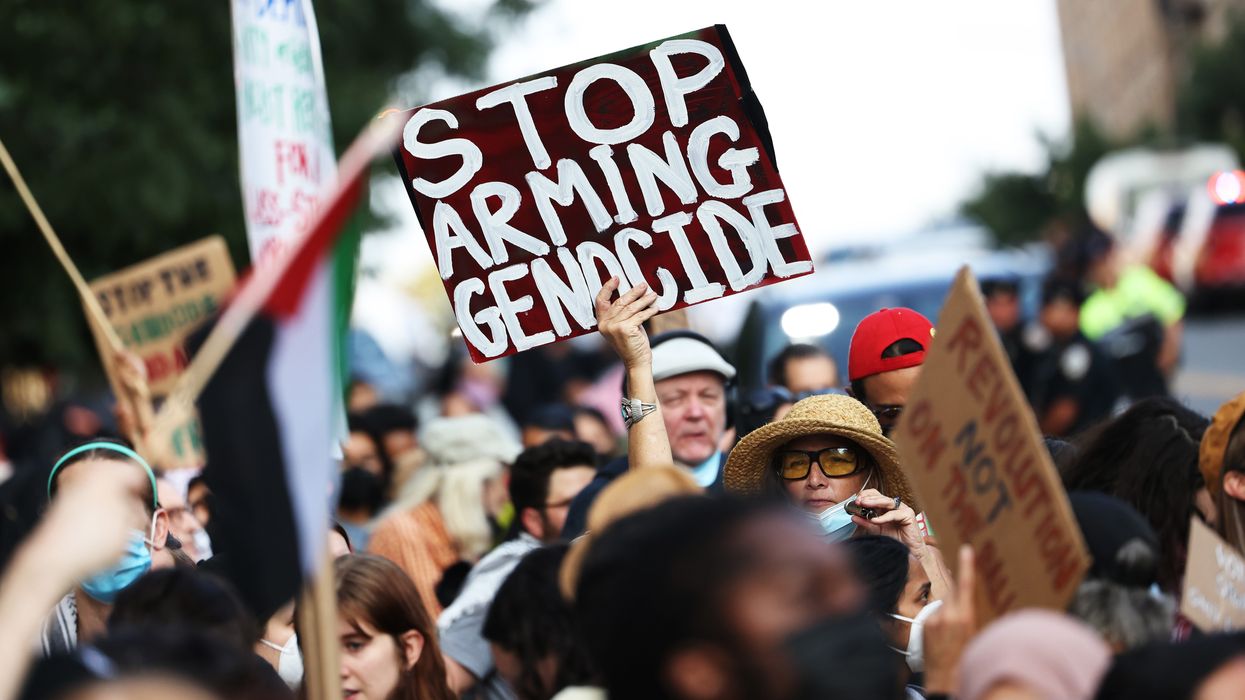
Party leaders continue to show how out of step they are with the opinions of the overwhelming majority of their voters.
Even though the bottom has fallen out of Democrats’ support for Israel, some in the party still can’t bring themselves to recognize this reality.
While support for Israeli policies has been in decline for more than a decade, the war on Gaza has resulted in a dramatic sea change in opinion. In a recent Gallup poll, only 8% of Democrats said they approve of Israel’s military actions in Gaza. When another recent poll conducted by Quinnipiac asked Americans whether their sympathies were more with Israelis or Palestinians, only 12% of Democrats said Israel while 60% said their sympathies were more with the Palestinians. And when The Economist magazine asked voters how they feel about a range of issues related to the conflict between Israel and the Palestinians, the results among those who say they are Democrats or lean toward Democrats were staggering:
(It’s important to note that with regard to each of the above questions, either majorities or strong pluralities of all respondents were in favor of cutting military aid to Israel, were opposed to Israel’s actions in Gaza, supported recognition of Palestinian statehood, etc.)
This change in the opinion of Democrats toward Israel and its policies has translated into congressional action. Last month, 27 of the 47 Democrats in the US Senate voted to block sending US military equipment to Israel. And a companion bill in the House of Representatives calling for withholding US offensive weapons to Israel now has 35 Democratic co-sponsors. Additionally, a number of Democratic State Party conventions have passed similar resolutions as did the national Young Democrats of America.
Given these developments, it should not have been surprising that a newly elected member of the Democratic National Committee would introduce a “Gaza Resolution” calling on the national party to support an immediate ceasefire in Gaza, a suspension of military aid to Israel, and a call to members of Congress to recognize Palestine as a nation state. The resolution concludes by urging the party to:
“affirm its commitment to international law, human rights for all people, an immediate … delivery of … humanitarian-focused, life-saving food and medical care in Gaza, and the pursuit a just and lasting peace for all in the region.”
What’s also unsurprising is how pro-Israel groups and some Democratic leaders have responded. For example, the group calling itself the Democratic Majority for Israel (DMFI)—which may need to change its name to the Democratic Minority for Israel—issued a strongly worded statement saying that they were:
"deeply troubled by the introduction of a flawed, irresponsible resolution at a Democratic National Committee meeting that will further sow division within our Party and do nothing to help bring an end to the Israel-Hamas war nor end the suffering on both sides.”
With polls showing that by margins of 10-to-1 or more Democrats support the positions taken in the Gaza Resolution, it is patently false to suggest that the resolution will “sow division.” In fact, it’s more accurate to say that defeating the resolution will create division. And when it comes to sowing division, it’s DMFI that in the last two elections teamed up with other pro-Israel PACs to spend tens of millions of dollars to defeat Democratic members of Congress whom they deemed as insufficiently pro-Israel.
It’s disappointing that party leaders, in an effort to defeat the Gaza Resolution, have introduced a resolution of their own as a “substitute.” While their alternative focuses heavily on humanitarian aid, most of its prescriptive language would have been seen as somewhat constructive and even positive five years ago. But in the face of Israel’s massive destruction of Palestinian homes, hospitals, universities, places of worship, and infrastructure in Gaza, the “substitute” is no substitute at all. It ignores Israel’s responsibility for (and the US culpability in) the ongoing genocide. And, of equal importance, it is out of step with the opinions of the overwhelming majority of Democratic voters.
It’s not clear how this will play out when the party meets this week to discuss and vote on resolutions. There is an effort being made to bring the two sides together. But the young Democratic supporters of the Gaza Resolution, while open to some modification of their effort, are determined that the issue of Gaza be debated. They are right to do so.

As apologists for Israel, Democratic leaders in Congress and at the DNC are doing major damage to the party's prospects for next year’s midterm elections or defeating the Republican ticket in 2028.
This week will go down in history as a time when the governing body of the Democratic Party had a chance to oppose the U.S. government’s arming of Israel. But with the first Democratic National Committee meeting in seven months getting underway on Monday, the DNC’s leadership is determined to derail a resolution calling for “an arms embargo and suspension of military aid to Israel.”
Maneuvering to sidetrack that resolution, DNC Chair Ken Martin and all five vice chairs are sponsoring a counter-resolution that does little more than repeat the kind of hollow rhetoric that President Biden and Vice President Harris offered about Israel and Gaza last year.
Martin and the vice chairs “have aimed to blunt the power of the resolution on Gaza by introducing their own, watered-down resolution that stops far short of calling for an end to arms shipments to Israel,” my RootsAction colleague Sam Rosenthal points out. It’s an approach that helped to defeat the Democratic ticket last year, as polling clearly shows. Recycling it now is even more oblivious to the roar of public opinion.
But the half-dozen top DNC officers are eager to scuttle the arms-embargo resolution as fast as possible without having to vote on it themselves. If the Resolutions Committee rejects the resolution on Tuesday, as appears likely, it won’t get to the entire 448-member DNC for a vote.
That seems to explain the response from DNC Vice Chair Shasti Conrad a few days ago, when I asked whether she would cosponsor the arms-embargo resolution. “I haven’t decided,” she replied. “Will probably see how the [resolutions] committee votes and the discussion, and will make a real-time decision.” Waiting to “see how the committee votes” is a way to stall until the resolution is no longer on the table.
A different but no less evasive response came from the most powerful DNC vice chair, Jane Kleeb, who is also the president of the ASDC association of state party chairs (“the only national party organization focused exclusively on the current and future needs of State Democratic Parties”). When I asked Kleeb whether she supported, opposed or was neutral about the arms-embargo resolution, she would only say: “I've sponsored a resolution on Gaza with other officers. I hope everyone comes to the table with agreed upon joint language.”
Martin and his allies have already tried—and failed–to drastically weaken the arms-embargo resolution. Its sponsor is a new DNC member, Allison Minnerly, a 26-year-old youth organizer in Central Florida. On her way to Minneapolis for the meeting, Minnerly told me that—while she wasn’t closed to the possibility of accepting amendments to her resolution—it must “keep the core message.”
The resolution’s core message—“an arms embargo and suspension of military aid to Israel”—is exactly what has provoked such strong opposition from the DNC leadership. In sharp contrast, the counter-resolution from party leaders doesn’t even slightly criticize Israel for its methodical large-scale killing of Palestinian people, now in its 23rd horrendous month.
Just days ago, the Guardian reported that “figures from a classified Israeli military intelligence database indicate five out of six Palestinians killed by Israeli forces in Gaza have been civilians, an extreme rate of slaughter rarely matched in recent decades of warfare.”
The official estimate of the carnage in Gaza—60,000 direct deaths, including 18,500 children—is very likely a significant undercount. Meanwhile, by providing upwards of 69 percent of Israel’s arms imports, the United States has been making it all possible.
Chair Martin and three of the DNC vice chairs—Pennsylvania state representative Malcolm Kenyatta, attorney Reyna Walters-Morgan in North Carolina, and Nevada-based labor advocate Artie Blanco—did not respond to repeated requests for comment on whether or not they support the arms-embargo resolution.
Along with backing from all the vice chairs, Martin’s resolution got some outside help in the drafting process. “This resolution was crafted with the input of Democratic Majority for Israel, a group whose super PAC worked to oust former Representatives Jamaal Bowman and Cori Bush,” The Nation reports. Naturally, DMFI has put out a press release denouncing the arms-embargo resolution.
More than ever, on the subject of Israel and Palestinian people, it’s DNC leadership versus a huge majority of Democrats nationwide. One poll after another this year has found that—in the words of a headline over a Brookings analysis this month—“support for Israel continues to deteriorate, especially among Democrats and young people.”
A Gallup poll in July found that only 8 percent of Democrats said they approved of Israel’s military action in Gaza. That poll lines up with the conclusions from Human Rights Watch, Amnesty International, and other (including Israeli) human rights organizations that have reported Israel is committing genocide in Gaza.
Minnerly’s resolution for suspending military aid has gained notable support from young Democratic leaders.
Midway through last week, the president of the official College Democrats of America organization (who is also a DNC member), Sunjay Muralitharan, tweeted: “As the National President of @CollegeDems I'm proud to co-sponsor the DNC Resolution calling for an arms embargo and explicit recognition of a Palestinian State. Young Americans have made their voices clear. A modern Democratic Party must stand against global injustice.”
On Friday, the leader of the official group High School Democrats of America put out a similar statement. “As National Chair of @hsdems, I represent American youth in the Democratic Party,” Zayed Kadir tweeted. “That’s why I’m proud to co-sponsor a DNC Resolution demanding an Arms Embargo and recognition of Palestine. The youth voice is clear. Our party must stand against injustice—at home and abroad.”
The top of the DNC power structure has exerted pressure on Minnerly to dilute or withdraw her resolution, but she has refused to be intimidated. When we spoke over the weekend, her tone was measured, emphatic, and resolute. And in response to follow-up questions about her approach to organizing, she emphasized that “we don't wait for change: we create it. It isn't easy, but it's worth fighting for policies and ideals that represent you.”
Minnerly added: “The reality is that not many folks know that resolutions can relate to policy. This experience has taught me—and many watching from the sidelines—that even within the party structure there is the ability to work towards the future we want as Democrats.”
But the counter-resolution from DNC leaders shows that they are continuing to drift into a sealed-off political galaxy, very far from where Democrats actually are now in the United States. Consider the responses this month when the Economist/YouGov Poll asked Democrats this question: “Do you think that Israel is committing genocide against Palestinian civilians?” Here are the results: Yes, 65 percent. No, 8 percent. “Not sure,” 27 percent.
Those numbers show that, on the subject of Israel and Gaza, the DNC’s officers are guilty of political malpractice—and actively complicit with what most Democrats in the nation see as genocide.
At the same time, to put it mildly, the party can hardly afford to further alienate its base.
The New York Times has just published an in-depth analysis of voter registration data, with stunning conclusions: “The Democratic Party is hemorrhaging voters long before they even go to the polls. Of the 30 states that track voter registration by political party, Democrats lost ground to Republicans in every single one between the 2020 and 2024 elections—and often by a lot. That four-year swing toward the Republicans adds up to 4.5 million voters, a deep political hole that could take years for Democrats to climb out from.”
The possibility that the Democratic Party will actually climb out of the “deep political hole” is especially remote because its leaders —not only DNC Chair Martin but also Sen. Chuck Schumer and Rep. Hakeem Jeffries—are functioning as if navigating politics in some bygone era. As apologists for Israel, they’re doing major damage to Democratic prospects for next year’s midterm elections or defeating the Republican ticket in 2028.
Meanwhile, Israel continues with mass killing and genocide made possible by the US government.