

SUBSCRIBE TO OUR FREE NEWSLETTER
Daily news & progressive opinion—funded by the people, not the corporations—delivered straight to your inbox.
5
#000000
#FFFFFF
To donate by check, phone, or other method, see our More Ways to Give page.
Daily news & progressive opinion—funded by the people, not the corporations—delivered straight to your inbox.
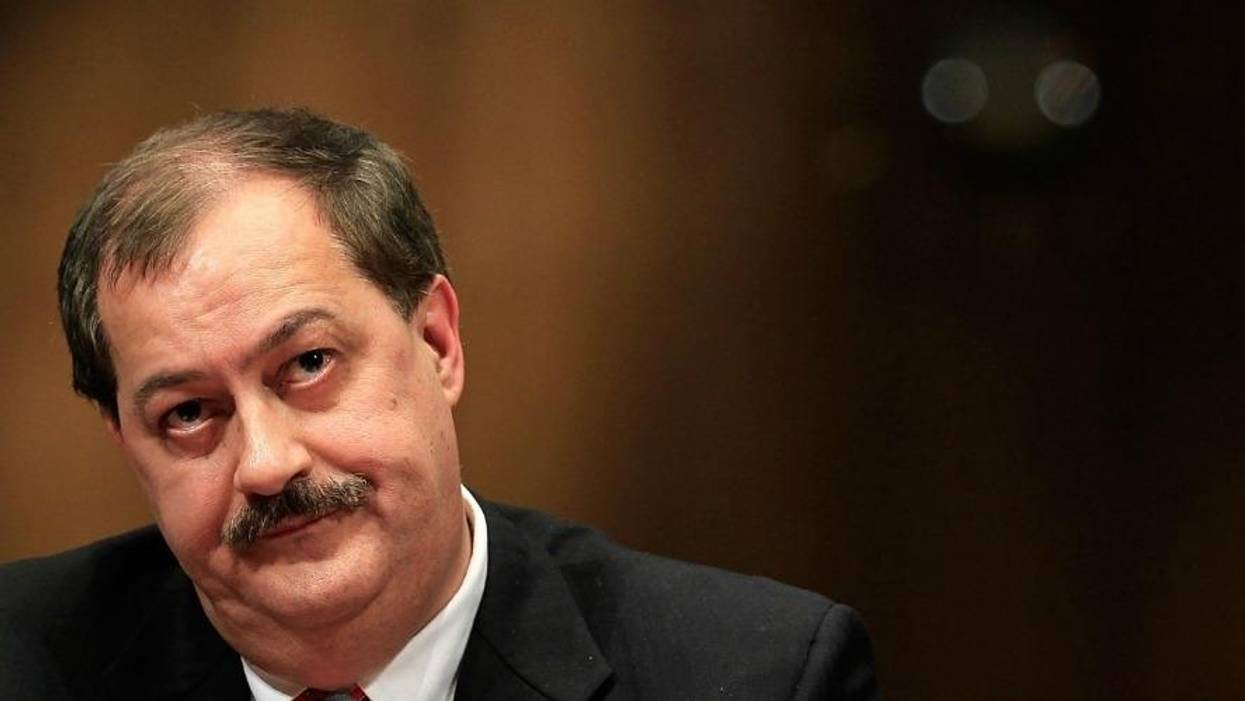
I was sitting at home in West Virginia tonight when a call came in from the U.S. Senate campaign for Don Blankenship.
The campaign wanted to know if I wanted to participate in a phone call town hall with Don.
Sure, why not.
The man in charge of the town hall - a man Don referred to as Greg - said if I wanted to ask Don a question I should punch in star three on my phone.
I punched in star three and waited my turn.
During his opening remarks, Don laid out his conservative credentials - NRA member, pro-life, tough on liberals, on immigration illegal means illegal, drug test teachers, put America first and West Virginia first.
And he took all kinds of calls from around the state - from a father whose kids were dealing with heroin and opioids, from a man who was complaining about high utility bills, from another man who complained about liberals wanting to take away our guns.
Don was gracious and even tempered.
My notes indicate he even railed against "the corporations."
People were given ample time to ask their questions - one man went on for a couple of minutes before Don interjected to answer.
How democratic, I thought.
Here was Don Blankenship, the CEO of Massey Energy, a man convicted of a federal crime that led to the deaths of 29 miners at the Upper Big Branch mine in 2010, a man who spent a year in jail for his crime, taking questions from random citizens from around the state. And letting them ask their questions, listening and actually answering the questions.
The question I wanted to ask was - Don do you actually think you can pull the wool over the eyes of West Virginians and win a Senate seat from West Virginia - the scene of the crime?
I actually think he can, because the Democrats are likely to nominate the corporatist Joe Manchin. And it's very difficult in a red state, in the age of Trump, for a corporate Democrat to defeat a corporate Republican - even if the Republican is multimillionaire CEO convicted of a crime connected to the deaths of 29 miners.
A new poll shows Blankenship is in second place (27 percent) in the May 8 Republican primary, gaining on Congressman Evan Jenkins (29 percent) who is in the lead, with West Virginia Attorney General Patrick Morrisey trailing in third place at 19 percent.
But before asking my question, I opened with what was on my mind at that moment when Greg said - up next, Russell in Berkeley Springs.
"Hey Don," I said.
"Hey," Don said.
"Do you understand the term humility?" I asked.
"Yes," Don responded.
"What does it mean to you?" I asked.
"Well, it means when you are put in a position of power that gives you more power than you should have, you need to remember to be humble," Don said. "And when you are in a situation, some of the situations I've been in, it will create a lot of humility."
"The reason I raise it is because you have been convicted - " I started to say.
But then Greg cut me off and said - next Don we have Joy from Charleston who has a question about the economy.
And reporters and news organizations in West Virginia are circling the wagons, looking to overturn it.
The criminal indictment of former Massey Energy CEO Don Blankenship for his role in the April 2010 Upper Big Branch explosion has been the top story in West Virginia since it was filed on November 13.
Cecil Roberts and Ellen Smith on Blankenship IndictmentCecil Roberts and Ellen Smith on Blankenship Indictment MetroNews Talkline November 17, 2014 see story at ...
But it is Judge Irene Berger's gag order that is drawing fire from the West Virginia press.
West Virginia Press Association executive director Don Smith told MetroNews Talkline that he and other news organizations are looking closely at possible legal avenues to challenge it.
The gag order prohibits the parties and their lawyers from talking with reporters.
But it also prohibits "actual and alleged victims, investigators, family members of actual and alleged victims" from making "any statements of any nature, in any form, or release any documents to the media or any other entity regarding the facts or substance of this case."
Judge Berger also put the documents filed in the case, including the indictment, under seal, available only to the lawyers in the case.
The Charleston Gazette's Ken Ward first reported on the gag order.
Ward reported that U.S. Attorney Booth Goodwin's office even "removed a news release about the indictment from its website, but the Gazette has posted that release online."
"Blankenship's blog, which he uses to criticize federal regulators and labor unions and to promote his theories about mine safety and what caused the Upper Big Branch Mine Disaster, remains online," Ward reported.
University California Irvine Law Professor Erwin Chemerinsky has written on gag orders, including a seminal 1997 law review article titled Lawyers Have Free Speech Rights Too: Why Gag Orders on Trial Participants Are Almost Always Unconstitutional.
"The secrecy of the documents clearly violates the First Amendment," Chemerinsky told Corporate Crime Reporter when asked about Judge Berger's gag order. "The law is unclear on the constitutionality of the gag order on lawyers and parties. But the judge does not have authority over those who are not parties, such as family members of victims. That is clearly unconstitutional. The judge's order goes much further than the Constitution allows."
Katie Townsend, the litigation director at the Reporter's Committee for Freedom of the Press, called Judge Berger's order "egregious."
"In addition to a plainly overbroad gag order that would seem to prevent family members of individuals killed in the Upper Big Branch Mine explosion from speaking publicly about their loved ones' deaths, the district court has ordered that the entire docket in this case be kept under seal," Townsend said. "The press and the public have a right to access the court's records and to observe Mr. Blankenship's criminal proceedings. It is antithetical to the First Amendment for basic information about this case to be kept from the public."
The gag order hasn't stopped reporters and others from airing their views of the Blankenship case.
(This father of a UBB miner who died in the April 2010 explosion refused to abide by the gag order.)
United Mine Workers President Cecil Roberts went on MetrosNews' statewide radio Talkline show yesterday and said point blank that Blankenship belongs in jail.
The UMW released its report on the disaster in October 2011. The report was titled simply -- Industrial Homicide: Report on the Upper Big Branch Mine Disaster.
"Ninety-five percent of the CEOs in this country want to do the right thing," Roberts said. "But we have laws in the country for the CEOs who have decided they do not want to do the right thing. Don fell into the category of the five percent."
"Don's attitude happens to be that he knows more than everybody else," Roberts said. "He knows how to run a coal mine better than anybody else -- now leave me alone. And that kind of attitude, particularly in a coal industry where people are doing extremely dangerous work, leads to what we saw in Upper Big Branch."
Talkline host Hoppy Kercheval asked Roberts -- do you believe he belongs in jail?
"I've said that Hoppy," Roberts responded. "I wouldn't say it if I didn't believe it. Why is it in our society that people who violate laws outside of the workplace are charged with crimes, but if they violate laws inside the workplace -- well, you are not supposed to do anything to a CEO just because a mine blew up?"
Ellen Smith, publisher of the Mine Safety and Health News, told Kercheval that "these managers knew that by not focusing on ventilation or rock dusting, they clearly knew what they were doing was wrong and illegal."
Smith quoted a February 2008 memo cited in the indictment in which Blankenship says -- "We'll worry about ventilation or other issues at an appropriate time. Now is not the time."
"If they were ignoring a known ventilation problem, clearly they were breaking the law," Smith said.
Kercheval said that if he were defending Blankenship in court, he would argue -- "Okay, so he's a brutish guy, he's heavy handed, he's under pressure to produce coal and he probably shouldn't have done some of these things and pushed his people so hard, but there is a difference between being that kind of boss and being responsible for an explosion that killed 29 miners."
Smith said that she gets tired of people talking about "how dangerous underground coal mining is."
"In the same year when UBB was getting 47 or 48 withdraw orders, the Deer Creek mine had none," Smith said. "And they produced about the same amount of coal. These were both gassy mines. In that year, when the UBB mine had almost 800 citations, the Deer Creek mine has something like 55 -- just the comparison of a mine that can do it right and a mine that does it so wrong. And to say that you can't mine by the rules and the law and make money is simply not true. And not only can you make money, but you will not kill 29 miners while you are doing it."
Blankenship is being represented by William W. Taylor III, a partner at the law firm of Zuckerman Spaeder in Washington, D.C.
Taylor said that Blankenship is innocent and will fight the charges in the indictment.
"His outspoken criticism of powerful bureaucrats has earned this indictment," Taylor said. "He will not yield to their effort to silence him."
Blankenship is scheduled to appear in federal court in Beckley, West Virginia on Thursday at 1 pm for his arraignment.
Don Blankenship, the former CEO of coal giant Massey Energy, faces up to 31 years in prison after a federal grand jury indicted him Thursday on four criminal charges related to the worst coal mine disaster in decades.
Twenty-nine workers were killed in an explosion at the non-union Upper Big Branch (UBB) Mine near Montcoal, West Virginia in April 2010.
A 2011 investigation by the federal Mine Safety and Health Administration found the disaster was "the result of a series basic safety violations [...] and were entirely preventable." It continues:
The tragedy at UBB began with a methane ignition that transitioned into a small methane explosion that then set off a massive coal dust explosion. If basic safety measures had been in place that prevented any of these three events, there would have been no loss of life at UBB.
The Justice Department stated Thursday: "The indictment charges Blankenship with conspiracy to violate mandatory federal mine safety and health standards, conspiracy to impede federal mine safety officials, making false statements to the United States Securities and Exchange Commission (SEC), and securities fraud."
From January 1, 2008, through about April 9, 2010, the Justice Department continues, the then-CEO "conspired to commit and cause routine, willful violations of mandatory federal mine safety and health standards" at the mine, and also conspired to cover up safety violations from federal inspectors.
After the deadly 2010 explosion, the Justice Department continues, Blankenship gave false statements and made misleading omissions to the SEC.
"Blankenship knew that [Upper Big Branch] was committing hundreds of safety-law violations every year and that he had the ability to prevent most of the violations," the Washington Post quotes the indictment as reading. "Yet he fostered and participated in an understanding that perpetuated UBB's practice of routine safety violations, in order to produce more coal, avoid the costs of following safety laws, and make more money."
"The carnage that was a recurring nightmare at Massey mines during Blankenship's tenure at the head of that company was unmatched."
--Cecil E. Roberts, United Mine Workers of AmericaIn the wake of the disaster, Amy Goodman described Blankenship a "poster boy for malevolent big business trampling on communities, the environment and workers' rights."
United Mine Workers of America International President Cecil E. Roberts issued a statement commending the "strong message" the indictment sends and blasting Blankenship's disregard for safety.
"The carnage that was a recurring nightmare at Massey mines during Blankenship's tenure at the head of that company was unmatched. No other company had even half as many fatalities during that time. No other company compared with Massey's record of health and safety violations during that time," Roberts stated.
When the April disaster occurred, Roberts continued, "all Americans learned what we in the coalfields already knew: For coal miners, working for Massey meant putting your life and your limbs at risk. Indeed, far too many suffered just that fate."
Gary Quarles, who lost his son in the explosion, told local ABC affiliate WCHS, "I will never be able to get over my son being killed--never."
Blankenship's attorney, William W. Taylor, III, said that his client "has been a tireless advocate for mine safety" and that the indictment was the result of his "outspoken criticism of powerful bureaucrats."
* * *
This video from 2010 originally produced for the Charleston Gazette by Douglas Imbrogno offers a memorial to the workers who died at the UBB disaster:
Memorial to miners killed in the 2010 Upper Big Branch Mine disaster in West VirginiaHere's a memorial slideshow to the 29 miners, ages 20 to 61, who died in the April 5, 2010, explosion at the Massey Energy ...
I hear Mother Jones calling. The deadbeat coal barons still need to be called out.
[Yesterday] was Coal Miner's Day -- or used to be: October 12th marks the day a small band of striking coal miners in southern Illinois called out Chicago coal barons and stood their ground at Virden in 1898. By the end of the day, seven miners lay dead, but the the strike-breaking barons had been stopped. For most historians, the defiance of union coal miners at the Virden Massacre marked the turning point in the labor movement, impacting the lives of untold thousands of laborers over the next century.
A century later, the coal barons are up to their same games -- billionaire coal baron Chris Cline, in fact, named his 164-foot yacht, Mine Games.
Mother Jones, the miner's angel, may be gone, but Mother Jones magazine just called out International Coal Group -- who gave us the Sago, WV tragedy -- for 20,000 clean water violations.
And Illinois is now dealing with the billionaire coal king Cline, who recently praised Massey Energy's Don Blankenship for his "moral" convictions in one of the bloodiest years of coal mining, and on the 10th anniversary of the Martin County coal sludge disaster; in Ohio, Murray Energy's coal slurry leaks continue to wipe out aquatic life.
After removing thousands of indigenous people on Black Mesa, Arizona and around the nation, Peabody Energy has now set its sights on plundering Mongolia.
Amid mind-boggling strip-mining destruction in Wise County, Virginia, Dominion Resources is building a new coal-fired plant as a monument to yesterday. Check out this trailer from the forthcoming film documentary, The Electricity Fairy:
Electricity Fairy Trailer.movTrailer for The Electricity Fairy, a 2010 Appalshop documentary that examines America's national addiction to fossil fuels through ...
"WHEN MINING BEGAN,"noted a U.S. Coal Commission report in the 1920s, examining the conditions before the union movement in 1897, "it was upon a ruinously competitive basis. Profit was the sole object; the life and health of employees was of no moment. Men worked in water half-way up to their knees, in gas-filled rooms, in unventilated mines where the air was so foul that no man could work long without seriously impairing his health. There was no workmen's compensation law, accidents were frequent. . . The average daily wage of the miner was from $1.25 to $2.00."
Francis Peabody, the namesake of the world's largest coal company today, called it "survival of the fittest."
Miners not only lived and worked in deplorable conditions. They were subjected to the whims of the market, often out of work for the long summer months and forced to migrate for poorly paid day labor. Displaced and unorganized, the miners faced a situation of extreme vulnerability. They often lived in company-owned houses, held in debt, compelled to patronize company-owned shops, and were paid in a company script only valid at company businesses.
To address this miserable situation, the United Mine Workers of America called for a general strike across the nation in 1897. Founded in Columbus, Ohio, in 1890, they counted less than four hundred members in Illinois. Little did the district leaders know that a flamboyant thirty-one-year-old miner in southern Illinois, a veteran of hunger marches on the nation's Capitol in Washington, DC, in 1894, would don a silk top hat, a Prince Albert topcoat, and an umbrella and declare himself "General" Alexander Bradley.
Bradley led marches from mine to mine in southern Illinois, in a crusade to unionize the workers. Thousands of miners swept across the coalfields, attentive to Bradley's spellbinding speeches and flashy attire, assisting in setting up a union vote. He forbade any violence. And the mines unionized. By the end of 1897, the union ranks grew from 400 to over 30,000. With the backing of the militant southern Illinois contingent, the United Mine Workers ironed out a deal with coal operators for an eight-hour day, a six-day week, and major concessions for better working conditions. And a 30 percent increase in wages.
Bradley's rank and file, though, and the United Mine Workers nationwide, were tested later that year. While the "General" and the UMWA had successfully bridged ethnic differences among various European and non-English-speaking miners, the Chicago-based company for a mine in Virden, Illinois, looked south of the Mason-Dixon Line for an old tactic of division. Recognizing that black laborers had been used in the mines in Alabama and Tennessee -- many in a decades-long scandal of convict labor, or rather, laborers who had been framed for minor offenses and sent to the coal prison labor camps -- the Chicago company sent a recruiter to Birmingham, Alabama, to hire non-union black coal miners and break
Bradley's strike.
The black coal miners were mistakenly told that the regular miners had left their jobs to serve in the Spanish-American War. They boarded the trains. So did their armed escorts, Thiel Detective Service agents out of St. Louis.
The coal barons' intentions were clear; they planned to test the mettle of the striking union, and the resolve of the governor. In the coal company's mind, the lives of the strikebreakers were as expendable as the miners.
When the escorted strikebreakers arrived at an armed stockade set up near the train station in Virden around midday on October 12, 1898, a shootout erupted. It lasted ten minutes. The company gunmen overpowered the strikers with their modern Winchester rifles; the striking miners returned fire with shotguns and hunting rifles. Twelve men were killed; seven were miners, five were armed guards. Forty strikers were wounded. None of the black strike-breakers were wounded. The National Guard arrived several hours later. The governor's inaction was ultimately denounced across the country.
At her request, the nation's coal miners buried Mother Jones at Mount Olive in the south-central Illinois coalfields -- the burning ground of unionism -- at the only Union Miners' Cemetery in the nation. It had been established after the Virden battle, when a Mount Olive church refused to inter the bodies of the seven strikers. A local coal miner raised the money to buy the plots, which soon spread across the fields; an arching gate declared it the terrain of union miners.
"When the last call comes for me to take my final rest," Mother Jones had written, "will the miners see that I get a resting place in the same clay that shelters the miners who gave up their lives on the hills of Virden, Illinois. . . They are responsible for Illinois being the best organized labor state in America. I hope it will be my consolation when I pass away to feel I sleep under the clay with those brave boys."
Alexander Bradley died in 1918 from black lung disease, having returned to the mines as a front loader. His role in building the United Mine Workers disappeared from most history texts. But the militant southern Illinois mine workers had become the most powerful vanguard in the union movement and churned out new generations of leaders.
And coal mining communities in southern Illinois today, under a new onslaught of coal barons like Cline, remember his legacy.
The worship of money is the will of God according to Don Blankenship, CEO of Massey Energy Company that owns and operates the Upper Big Branch mine in West Virginia where 29 miners were killed on April 5 in a mining explosion. Blankenship is a member of the US Chamber of Commerce Board of Directors and a rabid, right-wing Republican. Blankenship calls public officials concerned about climate change "greeniacs", says "greeniacs are taking over the world," and that Al Gore, Harry Reid and Nancy Pelosi are "crazy". He accuses his critics of communism and atheism.
President Barack Obama says the pattern of management and oversight failures led to the mining disaster and called the company's safety record troubling. He instructed Mine Safety and Health Administration (MSHA) Chief Joe Main to immediately send more inspectors to check a number of mines the agency believes are dangerous to ensure against conditions that might cause another disaster. On April 15, Obama said, "We all understand that underground mining is by its very nature dangerous. But we know what can cause mine explosions and we know how to prevent them. I refuse to accept any number of miner deaths as simply a cost of doing business,'' he continued, vowing to step up scrutiny of coal-mine safety standards. Obama pointed out that mining regulations are riddled with loopholes that allow companies to continually put miners in harm's way. The president has demanded that MSHA "streamline the rules" for a pattern of violations orders and take steps to eliminate the backlog of appeals by mine operators.
Gov. Joe Manchin has ordered the immediate inspection of all underground coal mines in West Virginia. He also asked for the state's more than 200 underground coal mines to cease production to mourn the victims of the nation's worst coal mining disaster in 40 years. The order tells state regulators to check mines that have repeatedly had combustion risks over the last year which will be partially evacuated or closed. In the past 18 months the Upper Big Branch mine was cited for over 600 safety violations, with 124 this year. Several citations were for the two chief causes of mine explosions, inadequate ventilation of explosive methane gas and illegal concentrations of coal, according to Federal records. They reveal that up to 2 million cubic feet of methane gas enter the Upper Big Branch mine every 24 hours. The ventilation system circulates less than half the volume of air needed to keep levels of combustible coal dust and methane within a safe range.
Pat McGinley, of West Virginia University law school and coal industry expert, said, "When a mine's ventilation system isn't working properly or there is an unacceptable accumulation of coal dust even for an hour, miners' lives are put at risk." It appears the giant explosion was caused by a buildup of methane gas, with high levels of coal dust. MSHA ordered the mine to temporarily cease operations at least 60 times in the last 16 months. The mine was cited for 458 violations in 2008 and 50 were "unwarrantable failures to comply."
An MSHA official said the mine had more than 11 times the national rate for the most serious type of safety violation. However, MSHA has not cited the Upper Branch Mine for a "pattern of violations" under the Miners Act of 2006, which allows closing the mine.
In Blankenship's weird world: School children can inhale coal dust while playing at school because Massey Coal "already pays millions of dollars in taxes each year." Government regulation means "we all better learn to speak Chinese." It's ok to pay $3 million to elect Brent Benjamin to the West Virginia Supreme Court just ahead of a hearing of his appeal to overturn a large damage award for driving competitor Harman Mining Corporation into bankruptcy. It's fine to hate unions and spend millions to keep them out of Massey's workforce even if he gets sued and loses. Virtually all of the major accidents in the coal industry took place in non-union mines.
Jeff Biggers, author of Reckoning at Eagle Creek, The Secret Legacy of Coal in the Heartland, says that virtually all the major accidents and disasters have taken place in non-union mines. He said, "Massey Energy...were part and parcel of being aggressive about breaking up the unions in the 1980s and the 1990s."
He explained that, "In a union mine, you had union fire bosses who came in, who pointed out the violations. And it was a brotherhood to really make sure that those violations were corrected and you have a safer mine, because those were members of the union that were in there." Now less than 20 percent of coal miners belong to a union. In seven of the last 10 years, Massey's nonfatal injury rate has been worse than the national average for similar operations.
Massey told employees that if they missed work to attend the funerals of fellow workers they would be fired. A Massey worker, who did not give his name because he is afraid of losing his job, said that his coworkers were outraged that they were not given time off to mourn their friends and brothers. He said it was all about Massey's profits. "Is a lump of coal that valuable to you that you can't even give miners a day off to mourn their friends?"
How about a few days in jail for Blankenship who committed criminal negligence that caused the deaths of 29 coal miners?