

SUBSCRIBE TO OUR FREE NEWSLETTER
Daily news & progressive opinion—funded by the people, not the corporations—delivered straight to your inbox.
5
#000000
#FFFFFF
To donate by check, phone, or other method, see our More Ways to Give page.


Daily news & progressive opinion—funded by the people, not the corporations—delivered straight to your inbox.
Defying the international call for an arms embargo over war crimes concerns, the U.S. Department of Defense (DoD) announced Tuesday it has approved an $11.25 billion deal to sell combat ships to Saudi Arabia, which has been waging a military assault against Yemen for more than six months.
"The selling of arms in the middle of a war will obviously send the message that the Saudis can do whatever they want and get away with it," Farea Al-Muslimi, Beirut-based Yemeni writer and visiting scholar with Carnegie Middle East Center, told Common Dreams.
The U.S. Defense Security Cooperation Agency, which is part of the DoD, announced Tuesday that is has rubber-stamped the export of four "Multi-Mission Surface Combatant (MMSC) Ships and associated equipment, parts and logistical support for an estimated cost of $11.25 billion" to Saudi Arabia.
"This proposed sale will contribute to the foreign policy and national security goals of the United States by helping to improve the security of a strategic regional partner, which has been, and continues to be, an important force for political stability and economic progress in the Middle East," the U.S. agency stated.
The ships will replace older naval models, also built in the United States. While the transfer is being reported as a U.S. effort to bolster Saudi Arabia's defenses in the wake of the nuclear deal between world powers and Iran, the arms sales are part of an ongoing trend. The IHS Jane's 360 report, released in March, found that Saudi Arabia was the "number one" defense trading partner with the United States in 2014.
U.S. Congress now has 30 days to block sale of the ships before the deal goes into effect. While both Lockheed and Austal Ltd. manufacture such vessels, the deal applies to the "Freedom" versions produced by Lockheed.
"The selling of arms in the middle of a war will obviously send the message that the Saudis can do whatever they want and get away with it."
--Farea Al-Muslimi, Carnegie Middle East Center
The tentative deal comes despite mounting evidence that Saudi Arabia and its coalition partners--including the United States--are responsible for widespread war crimes in Yemen.
A report released by Amnesty International earlier this month concludes: "Damning evidence of war crimes by the Saudi Arabia-led coalition, which is armed by states including the USA, highlights the urgent need for independent, effective investigation of violations in Yemen and for the suspension of transfers of certain arms."
What's more, the announcement came just days after the U.S. Navy admitted that Saudi-led warships are enforcing a naval blockade that is "slowing" aid to Yemen, which is facing critical shortages of food, water, and life-saving medicines.
Rooj Alwazir, a Yemeni activist and co-founder of Support Yemen Media, emphasized to Common Dreams that the Saudi coalition has already bombed hospitals, schools, homes, and factories, in a conflict that has killed 5,000 people, including 500 children, according to United Nations estimates.
"If what we've been seeing in Yemen is any proof," said Alwazir, "Obama's 'democracy' gift will only enable Saudi Arabia to intensify its illegal war and its heart-wrenching atrocities against the people of Yemen."
A Saudi-led aerial bombing campaign has entered its second day in Yemen. The Saudi-led airstrikes are intended to thwart the advance of Shiite Houthi rebels after they seized control of the capital Sana'a last year and deposed President Abdu Rabbu Mansour Hadi last month. On Thursday, Hadi left his refuge in Aden for Saudi Arabia. At least 39 civilians have reportedly been killed so far in the airstrikes. Amnesty International reports the dead include at least six children under the age of 10. Saudi's bombing campaign has been backed by the United States, Gulf states, Egypt, Turkey, Pakistan and Sudan. We go to Sana'a to speak with Farea Al-Muslimi, a visiting scholar at Carnegie Middle East Center. He recently tweeted: "I'm a 25 year old Yemeni man. I've seen at least 15 wars in my country. I don't need more. I need some help and education & economy; not guns."
Updated (8:11 PM EST): Saudi Arabia and Gulf allies launch airstrikes inside Yemen, says Saudi ambassador to the United States
Adel al-Jubeir, Saudi Arabia's Ambassador to the United States, confirmed in a press briefing on Wednesday night that the Saudi military, along with regional allies, has begun airstrikes against targets in Yemen. Reports from the ground in the capital city of Sanaa confirm that a wide-scale bombing operation was currently underway with explosions rattling buildings across the city.
Al-Jubier said the bombing campaign was designed to protect what he described as the "legitimate government" of Yemen from rebel forces.
"We have air assets from a number of countries in the [Saudi] kingdom and we have military assets that are on their way to the kingdom to participate in these operations," Jubeir said.
A U.S. official who asked not be named told Reuters that the United States was providing support to Saudi Arabia as it carries out its operation, but gave no details.
The New York Times reports:
Saudi Arabia announced on Wednesday night that it had begun military operations in Yemen, launching airstrikes in coordination with a coalition of 10 nations.
The strikes came as Yemen was hurtling closer to civil war after months of turmoil, as fighters and army units allied with the Houthi movement threatened to overrun the southern port of Aden, where the besieged president, Abdu Rabbu Mansour Hadi, has gone into hiding.
Yemen shares a long border with Saudi Arabia, a major American ally, and the Saudis had been reported to be massing forces on the Yemen frontier as Mr. Mansour's last redoubt in Aden looked increasingly imperiled.
Live-tweeting in response to the development of the bombing of capital city of Sanaa by Saudi and allied forces, Yemeni human rights activist Farea Al-Muslimi expressed horror and critical dismayat the unfolding situation:
Amid the complex and fast-moving situation in Yemen, this curated Twitter feed by Common Dreams hopes to serve as a source of quality updates and trusted perspectives:
Updated (4:23 PM EST): Yemen's embattled president may have fled stronghold in southern city of Aden as 'all-out civil war' all but officially declared
Reuters reports:
Houthi militia forces in Yemen backed by allied army units seized an air base on Wednesday and appeared close to capturing the southern port of Aden from defenders loyal to President Abd-Rabbu Mansour Hadi, residents said.
The United States said that Hadi, who has been holed up in Aden since fleeing the Houthi-controlled capital Sanaa last month, was no longer at his residence. It offered no other details on his movements.
After taking al-Anad air base, the Houthis and their military allies, supported by heavy armor, advanced to within 20 km (12 miles) of Aden.
Soldiers at Aden's Jabal al-Hadeed barracks fired into the air to prevent residents from entering the base and arming themselves, witnesses said, suggesting that Hadi's control over the city was fraying.
Houthi fighters and allied military units had advanced to Dar Saad, a village a half-hour's drive from central Aden, residents there said.
Earlier, unidentified warplanes fired missiles at the Aden neighborhood where Hadi's compound is located, residents said. Anti-aircraft batteries opened fire on the planes.
According to the Guardian's Kareem Shaheem:
Yemen has edged closer to all-out civil war as Shia Houthi rebels seized a key military base in the southern port city of Aden and reports suggested that President Abd-Rabbu Mansour Hadi had fled the country.
Rebels seized al-Anad airbase, which lies between Taiz - Yemen's third-largest city, which fell under rebel control last week - and Hadi's stronghold of Aden, in a renewed push for control of the country's south.
The Washington Post adds:
On a broader level, Yemen represents a potential proxy battlefield for the wider regional rivalries between Shiite power Iran and the Gulf Arab states backed by Washington, which had counted on Hadi as a partner in coordinating drone strikes against al-Qaeda.
Amid the widening chaos, Hadi's whereabouts remained unclear.
Senior security officials told The Washington Post that Hadi had left his stronghold in Aden, where his government sought a foothold after being driven from the capital, Sanaa, by the Houthis.
Looters soon swarmed the presidential buildings, and fighting flared on several fronts on the edge of the city, said Anis Mansour, editor of the port city's Huna Aden newspaper.
Earlier (7:45 AM EST):
As Houthi forces in Yemen reached the port city of Aden on Wednesday amid conflicting information of the whereabouts of embattled President Abed Rabbo Mansour Hadi, separate reporting indicated that Saudi Arabia is mobilizing its military forces along its southern border--fulfilling predictions of a total breakdown of peace efforts and stoking fears for a wider and more protracted conflict.
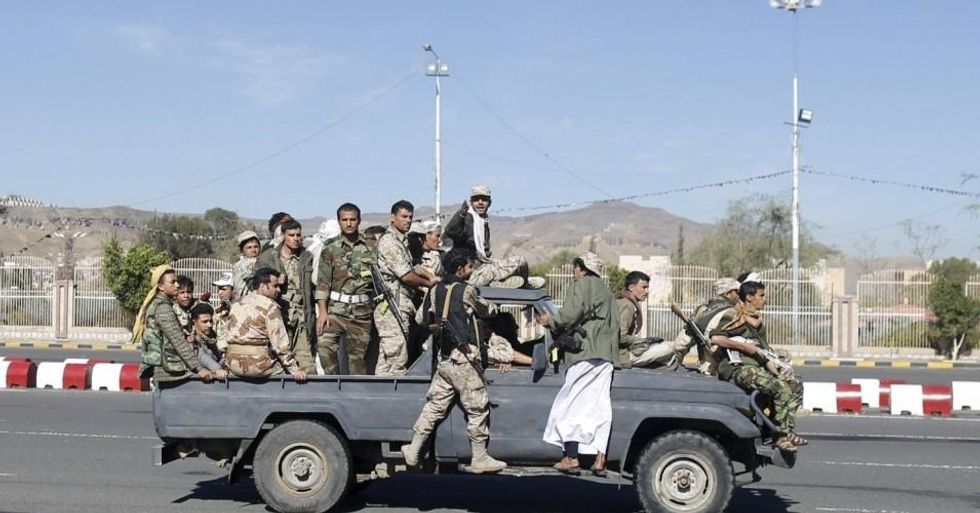
Alarms have been ringing this week that the breakdown of peace talks between the government of President Hadi--which has received backing and patronage from the U.S. and Saudi Arabia--and the Shi'ite factions from the north, backed by Yemen's former President Ali Abdullah Saleh and thought to be receiving at least tacit support from Iran, could lead to a full-scale war inside the country. On Sunday, UN special envoy to Yemen declared that continued fighting and the inability to bring a complex array of Yemeni factions to the table was pushing the impoverished nation to the "edge of civil war".
According to reporting by Reuters late Tuesday, citing U.S. officials familiar with the developments, Saudi Arabia was "moving heavy military equipment including artillery to areas near its border with Yemen," a move seen as raising the risk that the Sunni monarchy and powerful U.S. ally--also the region's wealthiest and most heavily-armed country--could soon enter the worsening Yemeni conflict.
Reuters reports:
The [Saudi] buildup follows a southward advance by Iranian-backed Houthi Shi'ite militants who took control of the capital Sanaa in September and seized the central city of Taiz at the weekend as they move closer to the new southern base of U.S.-supported President Hadi.
The slide toward war in Yemen has made the country a crucial front in Saudi Arabia's region-wide rivalry with Iran, which Riyadh accuses of sowing sectarian strife through its support for the Houthis.
The conflict risks spiraling into a proxy war with Shi'ite Iran backing the Houthis, whose leaders adhere to the Zaydi sect of Shi'ite Islam, and Saudi Arabia and the other regional Sunni Muslim monarchies backing Hadi.
On Wednesday morning, Al-Jazeera reports information suggesting Hadi and his top commanders had fled Aden after Houthi forces entered the city, though other reports indicated this was not the case.
As Iona Craig, a UK-based independent journalist who has covered Yemen for years and followed recent developments closely, noted on Twitter:
According to Al-Jazeera:
The developments [in Aden] came just hours after a television station said Houthi fighters and their allies had seized an airbase where US troops and Europeans helped the country in its fight against al-Qaeda.
The Al-Masirah TV station reported that the Houthis had "secured'' the al-Annad airbase near the town of Lahij, and claimed the base had been looted by both al-Qaeda fighters and troops loyal to Hadi.
That airbase is only 60km away from Aden, the port city where President Abd- Rabbu Mansour Hadi had established a temporary capital.
Witnesses said they saw a convoy of presidential vehicles leaving Hadi's palace, located at the top of a hill in Aden overlooking the Arabian Sea, the Associated Press news agency reported.
The advance of the Houthis threatens to plunge the Arab world's poorest country into a civil war that could draw in its Gulf neighbours. Already, Hadi has asked the UN to authorise a foreign military intervention in the country.
Saud Al Faisal, Saudi Arabia's foreign minister, had previously warned that his country would take "necessary measures" if the Houthis did not resolve the crisis peacefully, without elaborating further.
I had only been back in Yemen for a few hours. Until then, I had been lucky enough to escape the recent round of violence, having been abroad for medical treatment.
But that January morning my alarm call was a bomb that targeted the Iranian embassy in the usually quiet part of town where I live. The whole building shook when the explosives detonated. Most of the windows in the neighbouring buildings shattered. I felt as if someone had lifted me out of bed and thrown me to the ground.
Violence has slowly become the norm in Yemen. It has spread around the country, motivating militias to commit atrocities and paralysing any form of accountability. It has made Yemen one of the most dangerous places on the planet.
Over the past two years, many Yemenis, myself included, have warned of the dangers of the political path the UN has brought to Yemen: a "transitional model" that has ultimately brought more violence than peace and killed any aspirations of democracy, social justice and cohesion.
In 2014, Barack Obama suggested Yemen as a model of peace that could be implemented in Iraq. Months later, Yemen fell into the hands of militias.
The UN's policy in Yemen has done more harm than good. After putting Yemeni lives at the mercy of militias this year, all diplomats left Sanaa, heading to safe places while ordinary people are unsure if they'll be able to safely return to their families each day.
Some embassies spent days shredding documents trying to leave nothing behind, but in doing so sent a terrifying signal of their lack of faith in the process of transition they had previously backed so wholeheartedly.
Before the embassies were evacuated, and around the same time as the bombing of the Iranian embassy, I had spent Friday paying condolences to four different families whose sons had been killed in a bomb blast outside a Sanaa police academy.
One, Wael, was an old school friend who had only gone to register at the academy on that fateful day. Wael is survived by a young wife and family. Another, Ameer, left behind a sick wife and two children to his brother's family and his parents. I spent that whole day in a depressed state of mind.
In January, clashes broke out in the capital. As Houthi forces kidnapped a senior government official, fighting erupted around the presidential palace. The president resigned, as did Khaled Bahah, the prime minister, who was one of the few popular figures in Yemen. The country collapsed again.
After years of selling false hope to Yemenis and enforcing a political reality that created conflicts rather than peace, the UN began to seek a new senseless deal. Yemenis, meanwhile, were busy wondering where all of this left them.
And no matter how bad it seemed at that point, we had not yet reached rock bottom.
Last Friday, Sanaa witnessed the bloodiest terrorist attack yet on two mosques, killing more than 140 worshippers and injuring over 200. The same day, army jets flew from Sanaa under Houthi control with the intention of trying to kill Abdrabu Mansur Hadi in Aden.
Four years after the 2011 Karama Massacre, a tragic event in Yemeni history when more than 50 protesters lost their lives at the hands of the former president's security forces, it is hard to believe that Yemen has slipped even further into the abyss.
Violence and a declining quality of life have come to represent Yemen. The number of Yemenis now subsumed by the country's continuing humanitarian crisis numbers 16 million. Basic functioning services have all become as rare as birthdays - a once a year event.
At the moment, Yemen's once quiet streets and civic spaces have turned into spaces for militias and unknown suicide bombers. In Sanaa, no one but death walks freely or safely.
In order for peace to exist in Yemen, the ingredients of the political transition - its tools and its godfathers - should first admit that the path they have forced Yemen into has led to nothing but catastrophe and has taken the country directly into hell.
The world has walked Yemenis into this process and should take responsibility for that. They have broken Yemen and it is time to pay for it.
A policy of running loose and meaningless dialogues while the state institutions are under occupation - as has been happening - is simply a waste of time and a path that is only killing more Yemenis.
Those who dreamt up the "Yemen model" should be made to fix the damage they have caused.
During an emergency meeting of the United Nations Security Council on Sunday, the UN special envoy for Yemen, Jamal Benomar, warned that the country is fast approaching "the edge of civil war" and urged all parties to redouble diplomatic efforts before it is too late.
Speaking to the council via videolink, Benomar said that unless immediate steps are taken to save stalled peace talks between Houthi rebels, who are Shiite and now control the capital of Sana'a and the ousted Sunni-dominated government of President Abd-Rabbu Mansour Hadi, which has taken up headquarters in the southern port city of Aden, the resulting situation could be similar or worse to the sectarian-violence and proxy-wars that have gripped other countries in the region.
"I urge all sides at this time of rising tensions and rhetoric to de-escalate and exercise maximum restraint, and refrain from provocation," Benomar said.
With tensions and violence escalating each day, Benomar said that neither faction could realistically take control of the whole country, but that with militants associated with al-Qaeda and the Islamic State taking credit for a deadly series of bombings on Friday, he warned that if a negotiated settlement is not found soon or if one side is pushed too far in one direction or the other, it "would be inviting a protracted conflict in the vein of an Iraq, Syria, Libya combined scenario."
According to the Associated Press:
Yemen's turmoil and political crisis has deepened since the Houthis seized Sana'a in September and put Hadi under house arrest and eventually dissolved the country's parliament. The country's al-Qaeda branch, considered by the United States the terror network's most dangerous offshoot, has stepped up attacks against the Shiite rebels.
The Houthis newly announced move to take the rest of the country follows the suicide bombings of a pair of mosques in Sana'a that killed 137 people which were claimed by the Islamic State group. It also followed clashes around Aden's airport and planes from Sana'a dropping bombs on the city's presidential palace which Benomar said fortunately did not injure Hadi, who is strongly supported by the security council.
"Following the suicide bombings and fighting," Benomar warned, "emotions are running extremely high, and unless a solution can be found in the coming days the country will slide into further violent conflict and fragmentation."
He said Yemenis believed the situation was "on a rapid downward spiral," and were concerned that the conflict "has taken on worrying sectarian tones and deepening north-south divisions."
The UN meeting on Sunday took place as the rebel forces pushed south over the weekend. As Al-Jazeera reports:
Benomar's address came as the Houthis seized parts of the southern city of Taiz and its airport on Sunday after clashes with forces loyal to President Hadi.
Tens of tanks and armoured personnel carriers carrying Houthi fighters had crossed into al-Dhalie and Aden governorates, Al Jazeera's correspondents said.
Ahmed al-Wafi, a Yemeni political activist told Al Jazeera that the Houthis had taken full control of Taiz military airbase, which lies around 180km north of Aden, and had deployed fighters to man checkpoints at the city's entry points and streets.
In a televised address on Sunday, the Houthi leader Abdulmalik al-Houthi called on his supporters to mobilise towards the south of the country, a stronghold of Hadi's allies.
On Saturday, the U.S. military ordered the evacuation of approximately 125 special forces soldiers which had been acting as advisers to Yemeni Army forces loyal to Hadi.
"Due to the deteriorating security situation in Yemen, the U.S. government has temporarily relocated its remaining personnel out of Yemen," State Department spokesman Jeff Rathke said in a statement on Saturday.
The U.S. military presence in the country, including years of drones strikes by the CIA, has been consistently highlighted as a major source of the political instability and increasing levels of violence inside Yemen.
In an op-ed on Sunday, Farea Al Muslimi, a Yemeni human rights activist and currently a visiting scholar at Carnegie Middle East [Center], said western nations and regional powers like Saudi Arabia must take responsibility for the damage they have inflicted on Yemen, one of the poorest nations on the planet. According to Al Muslimi:
Violence and a declining quality of life have come to represent Yemen. The number of Yemenis now subsumed by the country's continuing humanitarian crisis numbers 16 million. Basic functioning services have all become as rare as birthdays--a once a year event.
At the moment, Yemen's once quiet streets and civic spaces have turned into spaces for militias and unknown suicide bombers. In Sana'a, no one but death walks freely or safely.
In order for peace to exist in Yemen, the ingredients of the political transition--its tools and its godfathers--should first admit that the path they have forced Yemen into has led to nothing but catastrophe and has taken the country directly into hell.
The world has walked Yemenis into this process and should take responsibility for that. They have broken Yemen and it is time to pay for it.
The Financial Times offered this breakdown of the stalled negotiations:
Both camps have called for peace talks but have quibbled over where they should be held and who should lead them. Mr. Hadi has described negotiations in Sana'a led by the UN envoy Jamal Benomar as "illegitimate," demanding Saudi-sponsored talks be held in Riyadh.
The Houthis have called for talks with the country's power brokers, but say they no longer view Mr. Hadi as the country's legitimate president, accusing him of attempting to turn Yemen into a "puppet regime". The Saudis have endorsed Mr. Hadi's plan for talks, but have demanded the Houthis quit Sana'a as a precondition for their participation in negotiations.
And Middle East historian Juan Cole, offering context for the complex violence in Yemen, explains the importance of understanding how what's brewing in Yemen is not a "sectarian war" but a "political" conflict being fought along religious lines. According to Cole:
The Houthi movement has politicized Zaidi Islam, after the Saudis politicized hard line Sunni Islam. The Houthis have all kinds of enemies now- secular Arab nationalists loyal to the Aden government, Sunnis who resent Houthi dominance of largely Sunni cities like Taizz, southern secessionists, and al-Qaeda in the Arabian Peninsula. Any of these could have hit the mosques, not because they hate Shiism but because they oppose the Houthi take-over of Yemen's government in the north.
When religion is deployed for political purposes and there is no separation of religion and state, religion acts like a political movement and throws up political opposition. Where politics is violent, so is religious politics.
Countries were there is a separation of religion and state have much less religious violence, because there is no point in deploying religion for political purposes where religion is barred from attaining them.
;
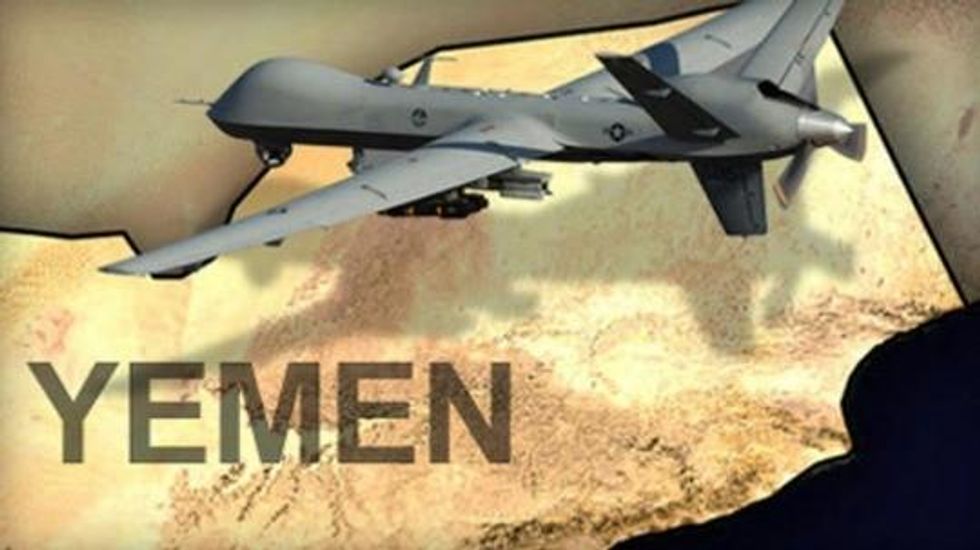
As the U.S. continues to bombard Yemen with drones this weekend, one Yemeni activist says that for ordinary people of Yemen, there is very little difference between what al-Qaeda and the U.S. are doing to the country.
On Saturday, the U.S. unleashed its ninth drone strike in two weeks on the poverty- and water crisis-stricken country, striking a car traveling through Lahj province and killing at least two people described by corporate media reports as militants or suspected militants.
Whether or not the charred remains of those killed were actually Al-Qaeda militants is unknown, and the U.S., while acknowledging the use of drones on Yemen, "does not publicly comment on the practice."
One Yemeni tweets that at least two civilians, including one child, have been killed in this recent drone blitz, with possibly three other civilians among the dead.
In an op-ed titled "Who Are US Drones Killing in Yemen -- and Why?," Daphne Eviatar of Human Rights First writes that
while U.S. government officials have happily reported intercepting an alleged phone conversation among al Qaeda leaders (the details of which keep changing) that prompted the embassy closures and evacuations, they've provided no information on who the United States has killed in retaliation with its latest drone strikes, or why.
That's no small omission.
As a matter of international law, the United States only has the right to kill members of armed forces it's at war with, or civilians directly participating in hostilities in war. And it is hardly clear that the U.S. is "at war" with anyone in Yemen. Outside of war, the rules for killing are much stricter: The U.S. can only kill individuals who pose an imminent threat to human life that cannot be ameliorated by means other than lethal force.
So is that who the military and CIA have killed over the past two weeks? Who knows?
McClatchy reported on Friday on how the drone surge "has ignited widespread outrage in the country":
Outrage over the strikes has spread to the capital, where the dismay over their frequency was heightened by their timing, during the final days of Ramadan and the start of the Eid al Fitr holiday, one of the holiest and most festive times of the Islamic year. The anger built on tensions caused by two days of unprecedented flyovers of the capital by one or more manned, American-made spy planes.
Further, U.S. actions to wipe out "terrorists" are counter-productive. Yemeni youth activist and writer Farea al-Muslimi writes that "in its recent actions, the US has become al-Qa'ida's public relations officer."
In an op-ed in the Independent on Sunday, al-Muslimi continues:
As the country was waiting for Eid to finish so that the US-funded and supported National Dialogue Conference could resume and eventually finish negotiations on the coming constitution, the US suddenly, via the drones, sent a message that such an entity and its delegates were much less important, and would be taken less seriously, than the shared enemy of both Yemenis and the US - al-Qa'ida.
It is obvious, as never before, that outside interference in Yemen has been intended not to create a better, democratic and stable Yemen, but instead to prevent its security problems getting worse in the eyes of pilots of drones based thousands of miles away.
The gap between the US - the US of hovering planes and deadly drones - and al-Qa'ida has actually shrunk in the eyes of many Yemenis: there is very little difference between what the two are doing to ordinary people. Innocent lives are lost due to the actions of both. They are both hurting people and distorting the image of Yemen. The only difference is that the US shapes its thinking on Yemen by studying statistics. The other knows Yemen's history, culture, memories, sensitivities, laws and traditions. Both are now seen to destabilise the country almost equally and lead it toward less peaceful choices.
Al-Muslimi brought his powerful voice to a Senate Judiciary Committee hearing on drones in April, when he described the terror and anger they have brought Yemenis.
In his testimony, he said that "the drone strikes are the face of America to many Yemenis."
The Bureau of Investigative Journalism estimates that as many as 52 civilians have been killed by confirmed drone strikes in Yemen from 2002 through July 2013.
Testimony of Farea Al-Muslimi[WASHINGTON, DC] Farea Al-Muslimi, a Yemeni youth activist and writer, testified today at a hearing of the Senate Judiciary ...
Among those who testified at a Tuesday Senate subcommittee hearing on the Obama administration's drone and targeted killing program was a Yemeni national named Farea Al-muslimi.
The young man described how a suspected US drone last week fired missiles on his small village of Wessab in Yemen and told the bipartisan panel of Senators that, "What radicals had previously failed to achieve in my village, one drone strike accomplished in an instant: There is now an intense anger and growing hatred of America."
Al-Muslimi's story gave credence, and personal voice, to other expert witnesses who testified about how the US drone program is likely harming, not helping, national security.
"Most of the world has never heard of Wessab. But just six days ago, my village was struck by a drone, in an attack that terrified thousands of simple, poor farmers," Muslimi said in prepared testimony. "The drone strike and its impact tore my heart, much as the tragic bombings in Boston last week tore your hearts and also mine."
He continued: "The drone strikes are the face of America to many Yemenis."
"If America is providing economic, social and humanitarian assistance to Yemen, the vast majority of the Yemeni people know nothing about it," he said. "Everyone in Yemen, however, knows about America and its drones."
The hearing, titled "Drone Wars: The Constitutional and Counter-terrorism Implications of Targeted Killings," also received testimony from the New America Foundation's foreign policy expert Peter Bergen who, as Reuters recounts, explained "that in 2012 Obama authorized at least 46 drone strikes in Yemen, while former President George W. Bush launched only one there."
Offering his advice on how to better handle the situation in Yemen, Al-Muslimi suggested the US government take the following steps:
Al-Muslimi's full testimony can be read here (pdf). Additional witness testimony for the panel available here.

Following reports of two US drone bombings in Yemen on Wednesday, a deeper look at the situation in the country reveals just how little critical reporting is done in the aftermath of such airstrikes in a country that few Western readers well understand.
While prominent news outlets reported that "unnamed officials" speaking "on the condition of anonymity" claim the bombings killed "suspected Al Qaeda operatives," more critical observers of the developments--and the press treatment they received--used the episode to make deeper comments about the role of the US drone program abroad.
According to a widely reprinted Associated Press report:
Four were killed in the first strike while riding a vehicle in the desert area of Oussab al-Ali, about 90 miles south of Sana, the official said.
The second strike killed a fifth suspected jihadist, Hamed Radman. A drone bombed his house, the official said.
Radman is known to security authorities as an influential al Qaeda member and played a role in recruitment, he said.
A witness in a nearby village said he saw columns of smoke rising after two explosions rocked the area.
The region south of the Yemeni capital has become a hideout for the militants.
He said that US drones have been flying over his village for three days and are still in the sky.
Responding to the news, however, investigative journalist Jeremy Scahill tweeted:
Scahill has been a vocal critic of the US drone program in Yemen and elsewhere. His upcoming book, Dirty Wars, is an in-depth look at the covert wars of the US military and intelligence agencies in the post-9/11 era.
In addition, Scahill retweeted this from Farea Al-muslimi, a English-speaking Yemeni who lives in the village where the strikes took place:
Giving a Yemeni perspective on the events, Al-muslimi continued to tweet from Wednesday into Thursday, responding to online chatter about the attacks and pointing out inconsistencies of official accounts and commenting on the manner in which the details of the story were being conveyed in Western circles: