

SUBSCRIBE TO OUR FREE NEWSLETTER
Daily news & progressive opinion—funded by the people, not the corporations—delivered straight to your inbox.
5
#000000
#FFFFFF
To donate by check, phone, or other method, see our More Ways to Give page.
Daily news & progressive opinion—funded by the people, not the corporations—delivered straight to your inbox.

"BreakThrough News is not the first, nor will it be the last, to come under official attack," said one press freedom advocate.
Press freedom groups are issuing dire warnings on Thursday that House Republicans' efforts to subpoena the nonprofit left-wing news organization BreakThrough News represent a dangerous new step in a McCarthyite war on political dissent.
On Wednesday, Fox News reported that BreakThrough, a New York-based outlet, was one of three nonprofits that had been issued subpoenas by the GOP-controlled House Ways and Means Committee as part of an investigation into $39 million worth of donations from tech mogul Neville Roy Singham, a self-described socialist who has used his wealth to fund left-wing nonprofits.
In letters sent Tuesday, the committee, led by Rep. Jason Smith (R-Mo.), said that BreakThrough, as well as two other organizations—the People’s Forum Inc., a New York-based activist hub, and Tricontinental: Institute for Social Research—had not turned over any documents that had been requested as part of an investigation into whether rules around tax exempt status for nonprofits should be tightened to protect against foreign influence.
The committee has accused Singham, an American who now lives in Shanghai, of exploiting the tax code and using shell companies and donor-advised funds to hide foreign money that has been used to promote the interests of the Chinese Communist Party. It does not, however, make any specific accusation of legal wrongdoing.
The subpoena requires BreakThrough News to turn over records about its finances, foreign donors and grant recipients, fiscal-sponsorship arrangements, and communications with Singham and any foreign entities.
In a statement on Wednesday, BreakThrough News said it was "under attack."
"For years, Republican lawmakers have painted a target on our backs, falsely claiming that our political views and reporting are part of some foreign plot," the outlet said. "Now, the MAGA-dominated House Ways and Means Committee has issued us a subpoena—demanding internal communications, financial records and more. Make no mistake, this is a flagrant abuse of power, and a direct attack on our work as journalists and on the First Amendment generally."
BreakThrough said it does not receive any funding from foreign governments or institutions and that it already complies with all the tax and public reporting requirements that nonprofits have to follow.
"We are not charged with any crime, because our only 'crime' has been to tell the truth–by covering the activities of the Palestine solidarity movement, unmasking the truth of ICE’s terror in our streets, and exposing Washington’s crimes around the world, from Cuba to the Congo," the outlet said. "That’s the journalism they want to shut down. Their goal is to saddle us with legal proceedings and hostile media to drain our resources and stop this important work."
While the committee stated that they are investigating BreakThrough over its financing rather than its politics, letters sent to the organization have treated the content of its reporting as circumstantial evidence of malign foreign influence, referring to it as "anti-American" and claiming that its negative coverage of Israel was "sowing division within the United States."
Chip Gibbons, the policy director of the free speech advocacy group Defending Rights & Dissent, told Common Dreams that the subpoena of BreakThrough was a "deeply chilling assault on the First Amendment."
"Such tactics are, quite literally, a throwback to the House Un-American Activities Committee, which today is mostly viewed as a disgrace," Gibbons said. "I say mostly, because just three days ago [Secretary Marco] Rubio's State Department released a report preposterously attacking the US left, including some of these groups, as Cuban fronts that cited old HUAC reports."
He further emphasized in a press release that there was "no plausible need" for a news organization to provide documents as part of a broad congressional inquiry.
"The only thing these groups are accused of is essentially receiving donations from a US citizen who has been the subject of an intensive campaign of demonization," Gibbons said. "It is lawful for Americans to donate to activist causes and media projects while holding views disfavored by Congress. This is clearly not a valid legislative inquiry at all, but an attempt to intimidate and chill dissenting opinions."
Seth Stern, the chief of advocacy for the Freedom of the Press Foundation, agreed that “Congress shouldn’t be using a tax investigation as a pretext to dig through a newsroom’s internal communications or financial records.
"Freedom of the press," he said, "applies to all journalists, regardless of whether politicians like their editorial slant or their politics."
In what it has portrayed as a fight against "left-wing terrorism," the Trump administration has increasingly blurred the lines between violent activity and protected political speech that they claim "incites" violence.
National Security Presidential Memorandum 7, signed by Trump in September, designates large swathes of left-wing viewpoints on race, gender, immigration, and other topics as "indicators" of domestic terrorism that have been used to link entire groups of people to violent acts they themselves did not commit.
Rubio said last week that the administration would soon be designating more left-wing organizations as terrorist groups, while senior Trump adviser Stephen Miller said that the full force of the state would be used to "disrupt, identify, defund, de-bank, arrest, prosecute" those deemed to "foment" political violence, not just those who actually commit it.
He has previously pledged to use the law to "dismantle" organizations that use heated rhetoric to refer to their right-wing opponents, including calling them "fascist" or "authoritarian."
Nora Benavidez, senior counsel at Free Press, described the subpoena of BreakThrough as an extension of a "retaliatory ethos" Trump has taken towards critical journalists "with the goal of shutting down criticism and dissent."
She told Common Dreams, "BreakThrough News is not the first, nor will it be the last, to come under official attack for bringing people alternative and useful news coverage about ICE abuses, foreign policy, Palestinian rights, and other topics."
"Allowing a congressional committee to harass an independent newsroom with a broad subpoena sets an awful precedent," Stern said. "If lawmakers can abuse tax oversight to single out outlets whose reporting offends them today, no newsroom in America is safe from government intimidation tomorrow.”

“The cryptocurrency industry has facilitated the Trump family’s corruption at every turn. Lawmakers should be wary of creating new tax loopholes to benefit the Trump family and their donors in the crypto industry."
A government watchdog is warning that new cryptocurrency policies being considered in the House of Representatives would be a major boon to the ultrawealthy, including President Donald Trump's family.
In an analysis published on Monday, the Revolving Door Project (RDP) highlighted new crypto-related tax bills being discussed in the House Ways and Means Committee, including one that "would create a functional subsidy for cryptocurrency firms by allowing them to defer taxes owed on their mined coins indefinitely and without interest, so long as the firms do not sell the coins."
This would allow coin owners to raise money by borrowing against these assets without having paid a cent of taxes on them, the analysis explains, which could be particularly beneficial for Trump's two eldest sons.
"Eric and Donald Trump Jr. reportedly hold a 20% stake in the bitcoin mining firm American Bitcoin, which mined 817 bitcoin in Q1 of 2026 alone," RDP writes. "At current prices, this represents a value of more than $50 million, while the company has stated that it already intends to hold assets it mines. If passed, this loophole could mean millions of dollars in taxes owed by the Trump sons’ firm could be deferred endlessly."
RDP also published a list of crypto donations to lawmakers on the House Ways and Means Committee. Rep. Steven Horsford (D-Nev.) has received nearly $2 million in support from the industry since 2023, more than any other committee member.
Other top recipients of crypto cash include Reps. Tom Suozzi (D-NY), Jimmy Gomez (D-Calif.), Adrian Smith (R-Neb.), and Jason Smith (R-Mo.), chairman of the committee.
Jeff Hauser, executive director of RDP, said that the bills currently under consideration in the House are essentially a return on the crypto industry's investment in political campaigns.
"The cryptocurrency industry believes it is owed massive tax loopholes and functional subsidies," said Hauser, "because it has bought the president, paid for his ballroom project, and has funded dozens of congressional campaigns. The lack of campaign finance reform is the principal reason that the ludicrously corrupt Trump family is set to enjoy yet another tax loophole to exploit."
Timi Iwayemi, assistant director at RDP, said that "the cryptocurrency industry has facilitated the Trump family's corruption at every turn," while warning members of Congress against doing the industry's bidding.
"Lawmakers should be wary of creating new tax loopholes to benefit the Trump family and their donors in the crypto industry," said Iwayemi. "Rewarding this behavior will embolden the crypto industry and other corporate lobbies eager to seize on our elected representatives’ prioritization of donor interests at public expense."
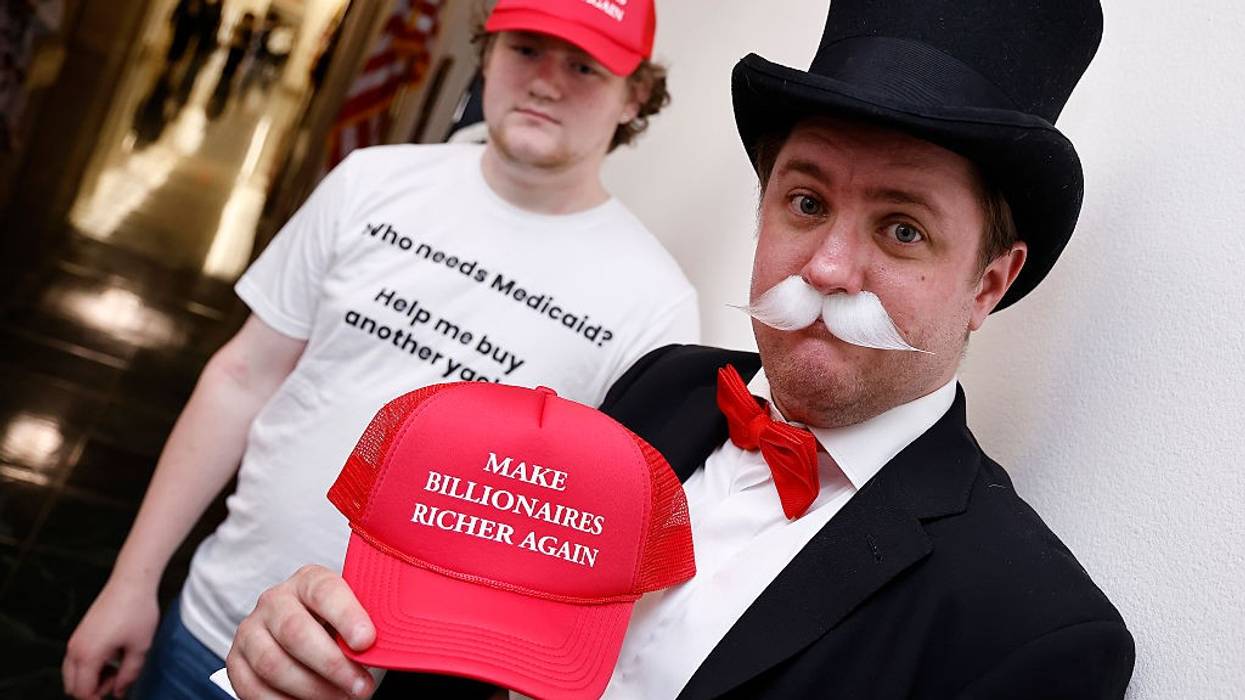
"The unavoidable truth is that Republicans' core priority with this legislation was to benefit the wealthy at the expense of everyone else, and that is exactly what their bill does," said Democratic Rep. Don Beyer.
House Republicans on Wednesday advanced legislation that would deliver a slew of tax breaks to the wealthiest Americans and large corporations, giveaways that the party aims to fund with unprecedented cuts to Medicaid and federal nutrition assistance.
Throughout the marathon markup hearing that began Tuesday afternoon and ended with Wednesday morning's party-line vote, Democratic members of the House Ways and Means Committee offered amendments aimed at closing the carried-interest loophole, preventing a major tax break for rich heirs, blocking any handouts to centimillionaires, and reverting the top marginal tax rate to its pre-2017 level of 39.6%.
Republicans—many of whom stand to reap significant personal benefits from another round of tax cuts—rejected the Democratic amendments.
"At every turn, Republicans voted down amendments designed to prevent the majority of benefits of their tax bill from flowing to rich people," Rep. Don Beyer (D-Va.), a member of the committee, said following Wednesday's vote. "The unavoidable truth is that Republicans' core priority with this legislation was to benefit the wealthy at the expense of everyone else, and that is exactly what their bill does."
Shortly after the hearing kicked off on Tuesday, the nonpartisan Joint Committee on Taxation released a distributional analysis showing that the Republican tax bill—part of the GOP's sprawling reconciliation package—would disproportionately benefit the wealthiest Americans while doing little for low- to middle-income families.
Beyer noted on social media that "a dirty little secret" of the Republican tax legislation is that it would actually raise taxes on the bottom 20% of Americans in 2029—the year President Donald Trump leaves office.
The bill is even more regressive when you look at 2029 when tax cuts for families expire & tax increases resulting from cuts to ACA premium tax credits grow larger. pic.twitter.com/3BDz1bFina
— Brendan Duke (@Brendan_Duke) May 14, 2025
The House Ways and Means Committee vote came as Republicans on the Energy and Commerce and Agriculture Committees simultaneously worked to advance their respective sections of the GOP reconciliation package, the centerpiece of Trump's legislative agenda.
The bills before the latter two committees would enact combined cuts of around a trillion dollars to Medicaid and the Supplemental Nutrition Assistance Program over the next decade, stripping critical benefits from millions of people across the country.
Kobie Christian, a spokesperson for the Unrig Our Economy coalition, said Wednesday that the GOP reconciliation package is "a reverse Robin Hood of the highest order."
"From cutting healthcare to ripping away food assistance to rubberstamping cost-raising tariffs, Republicans in Washington are making life more expensive for working- and middle-class Americans by handing over their tax dollars to the super-rich," said Christian. "Families need lower costs, not cuts to healthcare and billionaire tax breaks. Congress should be fighting to help working families, not the ultra-wealthy."
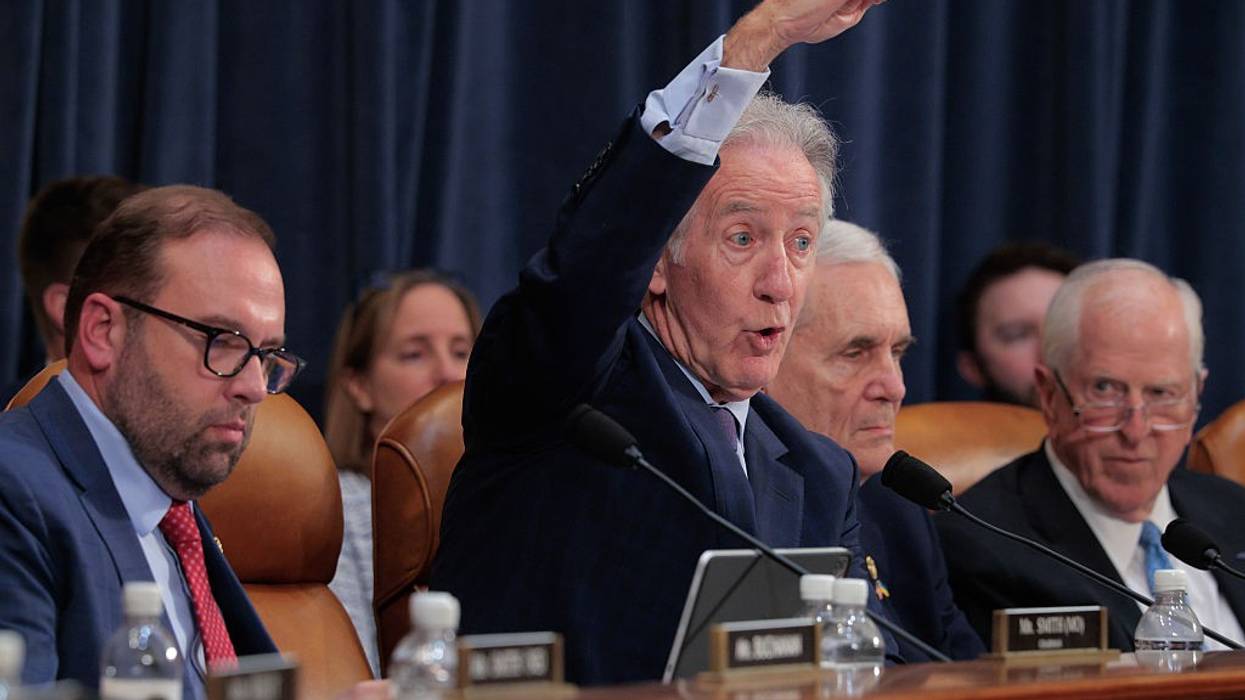
"This bill gives enormous additional tax cuts to wealthy people and corporations, spikes the deficit, and strips healthcare from millions of Americans," said one critic.
While Republicans on Capitol Hill—including the leaders of both chambers of Congress—have long argued for reducing the national debt, the GOP is now pushing a tax bill that would not only fund giveaways to the rich by gutting programs that serve the working class, but also add $3.8 trillion to the U.S. deficit.
The national debt is currently $36.2 trillion. The Joint Committee on Taxation (JCT) on Tuesday released an analysis showing that the Republican bill would cost $3.8 trillion through 2034, or 1.1% of gross domestic product.
The JCT document notes that some estimates—such as the impact of modifications to de minimis entry privilege for commercial shipments and to Medicare, including limiting coverage—will be provided by the Congressional Budget Office.
The JCT's release coincides with a key meeting in the U.S. House of Representatives. As Politico detailed:
The newly revised estimate released Tuesday afternoon is up slightly from the $3.7 trillion price tag budget forecasters had previously put on the plan, and it comes as the tax-writing Ways and Means Committee began formally debating the package. Additional changes are possible there, and also later, when Republicans are preparing to take the legislation to the House floor."
[...]
Under the House GOP's budget, the size of their tax cuts is contingent on lawmakers simultaneously cutting spending, and Republicans are hoping to match $4 trillion in tax cuts with $1.5 trillion in spending reductions.
Ahead of the markup, Amy Hanauer, executive director of the Institute on Taxation and Economic Policy (ITEP), said in a statement that "this bill gives enormous additional tax cuts to wealthy people and corporations, spikes the deficit, and strips healthcare from millions of Americans."
"Reckless tax cuts for the top and new corporate loopholes appear to be the big features of this bill, and they're paid for by cutting our healthcare and making American communities more vulnerable to floods, fires, and storms," she stressed. "The revenue raisers—which don't stop this from being extremely expensive—seem to be about picking winners and losers, rather than passing rational, consistent policies."
ITEP's statement also lists the bill's major provisions, including making changes to personal income tax rates and brackets from the GOP's 2017 Tax Cuts and Jobs Act permanent; making permanent and increasing the "pass-through" business deduction; increasing the estate tax exemption; and temporarily increasing the child tax credit, but excluding millions of children.
Americans for Tax Fairness (ATF) similarly listed provisions on social media Tuesday—and highlighted their impacts.
What's the result of maintaining the top income tax rate cut? "25% of the benefits go straight to the top 1%," the group noted. "The average top 1% household makes $2.5 million a year. They would get a $55k tax break. The top 400 taxpayers would get an $800 MILLION tax cut each year."
"Since they're deficit-financing most of this, every penny of the 'savings' DOGE has found... is paying for tax breaks for the wealthy."
What about widening the "pass-through" loophole? "Half of this break goes to millionaires," ATF continued. "The top 0.1% would get a $107,000 tax cut. The top 1% would get an average $22,500 tax cut. Working families would get around $40 to $50. White households get 90% of the benefit."
The group pointed out that "the package doubles how much rich heirs can inherit without paying taxes. That means a couple could pass on $30 MILLION without paying a penny in taxes. This tax break ONLY benefits the richest 0.2% of households. Weakening the estate tax is projected to cost $200 BILLION."
"It also gives corporations $642 BILLION in tax breaks," ATF said. "Most of the benefit of corporate tax cuts goes to CEOs, rich shareholders, and foreign investors. One provision gives Apple, Amazon, Google, Meta, and Tesla alone a $75 BILLION tax cut. Another encourages offshoring."
ATF also tied the proposal to supposed cost-cutting efforts by President Donald Trump's Department of Government Efficiency (DOGE) and its de facto leader, Elon Musk—who also happens to be the CEO of Tesla and the richest man on Earth.
"The part they won't say out loud?" the group wrote. "Since they're deficit-financing most of this, every penny of the 'savings' DOGE has found by cutting the [the Department of Veterans Affairs], Department of Education, and Social Security Administration is paying for tax breaks for the wealthy. Really."
Although Republicans control both chambers and the White House, their majorities are slim, meaning absences and disagreements over issues like increasing the deficit or cuts that will anger constituents in swing districts could slow or even impede their ability to send "one big, beautiful bill" to Trump's desk.
As Common Dreams reported earlier Tuesday, U.S. Sen. Bernie Sanders (I-Vt.) is deploying organizers to mobilize opposition against the GOP's emerging reconciliation package, focusing on districts he has visited as part of his Fighting Oligarchy Tour.
Materials that organizers plan to distribute encourage constituents to call their representatives and request they vote no "on a bill to cut Medicaid, nutrition assistance, and education to pay for hundreds of billions of dollars in more tax breaks for billionaires."
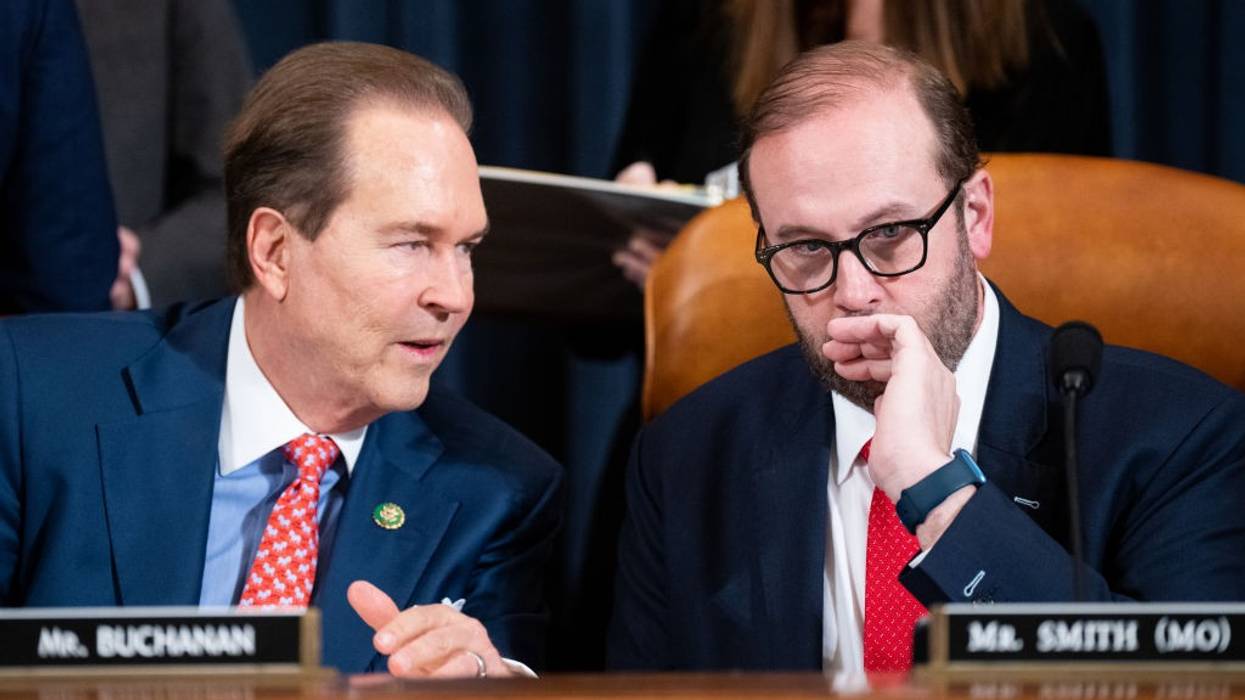
"The multimillionaire Republicans in charge of these key committees cannot properly represent average Americans' tax and spending interests," said the executive director of Americans for Tax Fairness.
An analysis published Thursday shows that Republicans on key committees in the House and Senate are poised to reap huge windfalls for themselves and their families if the trillions of dollars in tax breaks they've been tasked with crafting become law.
The Americans for Tax Fairness (ATF) report examines GOP members of the House Ways and Means Committee and the Senate Finance Committee. The group found that the average net worth of the committees' Republican members is close to $15 million.
Over two-thirds of the 26 members of the House Ways and Means Committee are millionaires, according to ATF.
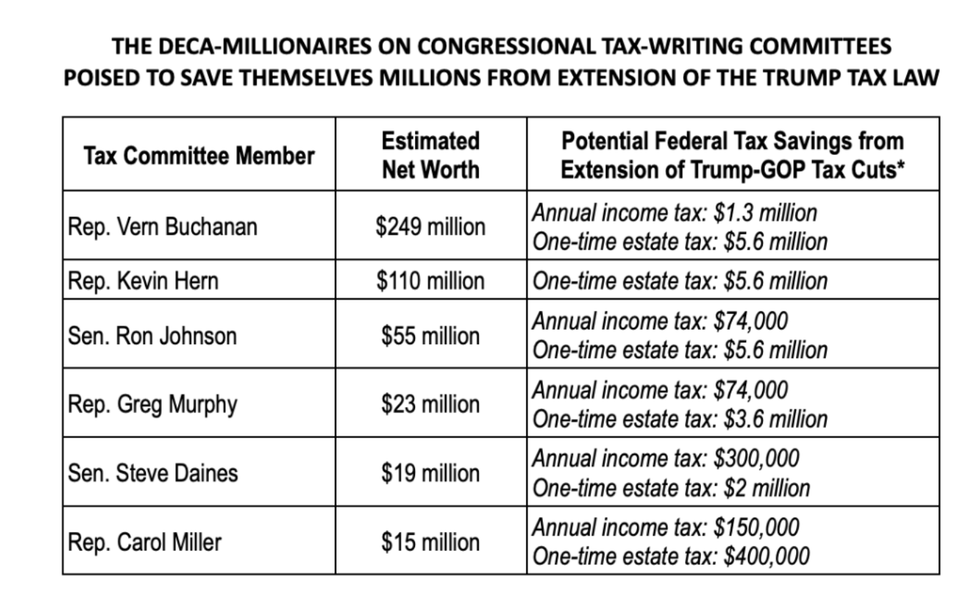
"The wealthiest GOP members could give themselves a roughly $1.8 million annual income tax cut and their families a potential one-time estate tax cut of $22.8 million—a potential total of $24.6 million in tax cuts if they pass legislation to extend the Trump tax bill," ATF's analysis shows.
The number two Republican on the House Ways and Means Committee, Rep. Vern Buchanan of Florida, is worth nearly $250 million, making him one of the richest members of Congress.
If the tax package that Republican lawmakers are assembling is enacted, Buchanan's family stands to save $5.6 million in taxes thanks to an extension of the 2017 law's estate tax exemptions. Buchanan would personally receive $1.3 million in annual income tax breaks under an extension of the 2017 measure.
Sen. Ron Johnson (R-Wis.), who helped secure a major tax gift for the wealthy in the 2017 law, and his family would also benefit to the tune of nearly $6 million from estate tax provisions and other giveaways.
"The multimillionaire Republicans in charge of these key committees cannot properly represent average Americans' tax and spending interests," David Kass, ATF's executive director, said in a statement Thursday. "Their prioritization of extending Trump's tax scam demonstrates their disconnect from middle and working-class constituents' needs."
"While wealthy Democrats also serve on these committees, they aren't promoting continuing the entire Trump tax legislation which primarily benefits rich individuals like them and giant corporations—legislation that would add trillions to the deficit and threaten funding for Social Security, healthcare, education, housing, and other vital public services," Kass added. "A system where millionaires vote for tax benefits favoring other wealthy elites undermines both our economy and democracy."
Under a resolution that House Republicans approved earlier this week, the House Ways and Means Committee is instructed to "submit changes in laws within its jurisdiction that increase the deficit by not more than" $4.5 trillion over the next decade—which would clear the way for an extension of the 2017 tax law that President Donald Trump signed during his first term.
The resolution also instructs the committees that oversee Medicaid and the Supplemental Nutrition Assistance Program to enact more than $1 trillion in cuts to partially offset the massive cost of the tax giveaways, which would primarily benefit the rich.
According to the Institute on Taxation and Economic Policy (ITEP), "the richest 1% would receive an average tax cut of more than $78,000 in 2026 alone, far outstripping tax cuts to taxpayers in any other income group."
"More than two-thirds of the benefits of these changes would go to the richest fifth of Americans, with 21% of the benefits flowing to the richest 1% alone," Steve Wamhoff, ITEP's federal policy director, wrote in a blog post on Wednesday. "Meanwhile, the middle fifth (20%) of Americans would get just 10% of the benefits and the poorest fifth of Americans would receive 1%."
Operatives of Elon Musk, warned Sen. Elizabeth Warren, "are attempting to access confidential tax information—tax returns, bank data, Social Security numbers—for millions of Americans."
As Americans prepare to file their taxes ahead of the April 15 deadline, two Democratic senators warned Monday that billionaire tech mogul Elon Musk's arrival at the Internal Revenue Service raises serious privacy concerns and could significantly impact the tens of millions of people who count on their tax refunds each year to pay bills, pad their emergency savings, and afford other essentials.
The Department of Government Efficiency (DOGE), the advisory body created by President Donald Trump and headed by Musk, has set its sights on the IRS as it works to gut agencies across the federal government—with the data of millions of ordinary taxpayers now among the troves of personal information DOGE is trying to seize.
As The Washington Post reported, the IRS is considering a memorandum of understanding (MOU) to give DOGE employees access to agency systems and datasets including the Integrated Data Retrieval System (IDRS).
The system allows a limited number of IRS employees to access IRS accounts of every individual taxpayer, business, and nonprofit in the country, including people's personal identification numbers and bank information, and enables them to change transaction data.
DOGE's "meddling with IRS systems in the middle of tax filing season could, inadvertently or otherwise, cause breakdowns that may delay the issuance of tax refunds indefinitely," said Sens. Elizabeth Warren (D-Mass.) and Ron Wyden (D-Ore.).
The MOU states that Gavin Kliger, a software engineer working with DOGE, should have access to the IDRS, enabling DOGE to "eliminate waste, fraud, and abuse, and improve government performance to better serve the people."
According to the memo reviewed by the Post, Kliger—who sources said had not officially been granted the access mentioned in the MOU as of Sunday night—will be tasked with consulting on modernizing the IRS' systems.
Even though outside contractors are used for technical upgrades or fixes to a system widely recognized as "antiquated," the Post noted that it is "highly unusual" for a political appointee of partisan body like DOGE to obtain access to the IDRS.
"The information that the IRS has is incredibly personal," Nina Olson, who served as the agency's national taxpayer advocate for nearly two decades, told the newspaper. "Someone with access to it could use it and make it public in a way, or do something with it, or share it with someone else who shares it with someone else, and your rights get violated."
In their letter to acting IRS Commissioner Douglas O'Donnell, Warren and Wyden (D-Ore.) noted that the tax code has long prohibited "executive branch influence over taxpayer audits and other investigations."
"These prohibitions have long prevented political appointees in previous administrations from accessing the private tax records of hundreds of millions of Americans, and allowing DOGE officials sweeping access these systems may be in violation of these statutes," said Warren and Wyden, who serve as ranking members of the Senate Banking, Housing, and Urban Affairs and Senate Finance Committees, respectively. "Violations of these taxpayer privacy laws, including unauthorized access to or disclosure of tax returns and return information, can result in criminal penalties, including incarceration."
Without naming Trump, the lawmakers referenced Charles Littlejohn, the IRS contractor who was sentenced last year to five years in federal prison for leaking the president's tax returns to The New York Times after Trump refused to publicly disclose them.
"Until we fought to the Supreme Court and won, the president shielded his tax returns from the people," said the Democrats on the House Ways and Means Committee in a social media post. "Now, he's given yours to the richest man in the world."
Warren and Wyden wrote that "software engineers working for Musk seeking to gain access to tax return information have no right to hoover up taxpayer data and send that data back to any other part of the federal government and may be breaking the law if they are doing so."
In addition to seeking access to the personal financial data of millions of Americans, DOGE is reportedly preparing to oversee the firing of 10,000 probationary employees at the IRS.
"Any delay in refunds could be financially devastating to millions of Americans who plan their budgets around timely refunds every spring," said Warren and Wyden. "We demand that the IRS immediately clarify the extent to which DOGE team members may have inspected or be seeking to inspect the private tax return information of millions of Americans and whether taxpayer privacy laws are being enforced to prevent unauthorized disclosure and intrusions."

"There are 20 years of data showing trickle-down economics doesn't work, yet today will still be a whole lot of revisionist history and wishful thinking on the singular largest failure of fiscal policy in recent memory," said Rep. Richard Neal.
As House Republicans prepare for Donald Trump's possible White House return by plotting to expand the billionaire and corporate tax cuts that were the cornerstone of the former president's first administration, congressional Democrats and advocates for working Americans warned Thursday that a second Trump term would bring more of the same inequality-exacerbating policies.
The GOP-controlled House Ways and Means Committee held a hearing Thursday on "expanding the success" of the 2017 Tax Cuts and Jobs Act (TCJA)—widely derided by opponents as the "GOP Tax Scam." Republican committee members couched a policy that the Center for Popular Democracy said "delivered big benefits to the rich and corporations but nearly none for working families" as "relief to help hardworking American families."
Rep. Richard Neal (D-Mass.), the committee's ranking member, pushed back during Thursday's hearing, noting that "in the last three decades, Republicans have skyrocketed the deficit with trillions in tax cuts for billionaires and big corporations, always with the same result: the top 1% benefits while nothing trickles down for workers."
Neal continued:
In 2017, Ways and Means Democrats saw the GOP corporate tax giveaway for what it was: a scam. We knew that their Tax Scam would disproportionately benefit the wealthy and well-connected. We knew that it wouldn't pay for itself. We knew that big corporations, not their workers, would feel the most benefit. Six years since the GOP Tax Scam was signed into law, we've been proven right on every count. It didn't pay for itself, it didn't increase revenue, and it didn't increase wages.
A recent study whose authors included [Joint Committee on Taxation] economists—let that sink in—found that ALL of the corporate gains from TCJA went to shareholders and high-paid executives, with absolutely nothing flowing to workers. Fifty-six percent of the tax cuts enriched shareholders, and the remaining 44% lined the pockets of execs. Zero percent went to workers. ZERO!
"There are 20 years of data showing trickle-down economics doesn't work, yet today will still be a whole lot of revisionist history and wishful thinking on the singular largest failure of fiscal policy in recent memory," Neal added. "If workers and the middle class are actually your priorities, putting them ahead of big corporations and billionaires is the only way."
Rep. Don Beyer (D-Va.)—who also sits on the committee—agreed, asserting on social media that "the Trump tax cuts were a huge 'success' if you were a billionaire or an executive at a large corporation. They made out like bandits, with a huge amount of the benefits from the GOP tax law going to the wealthiest. Now Republicans want to give the superrich even more tax cuts."
Trump is open about this. At an exclusive fundraiser at his Mar-a-Lago resort in Florida last week, he shouted out his "rich as hell" supporters, telling them, "We're gonna give you tax cuts, we're gonna pay off our debt."
That's the same debt that soared by around $8 trillion during Trump's term—largely as a result of his tax cuts. Meanwhile, U.S. billionaires have collectively gotten $2.2 trillion richer since the GOP tax cuts took effect.
With many provisions of the TCJA set to expire at the end of 2025, progressives are underscoring what's at stake in this November's elections.
"Today the American people got a preview of what's in store for them next year if the Trump Tax Scam expires under conservative leadership," Groundwork Collaborative executive director Lindsay Owens said following the House hearing. "The conservative playbook for the 2025 tax fight is coming into focus, and we can be sure it includes more giveaways for the wealthy and corporations."

Following "recent Republican chaos, we're now back to their regularly scheduled programming: Cutting taxes for millionaires," said Democratic Rep. Bill Pascrell. "They did it in 2017 and now Republicans are again pushing tax cuts for the rich."
House Republicans are poised to advance regressive taxation measures that would increase the federal deficit just weeks after they nearly blew up the global economy over ostensible concerns about the U.S. government's debt, eliciting condemnation from Democratic lawmakers and progressive advocates.
The Republican-led House Ways and Means Committee held a hearing Tuesday to mark up the so-called American Families and Jobs Act (AFJA), which packages three bills: the Tax Cuts for Working Families Act, the Small Business Jobs Act, and the Build It in America Act.
This trio of bills—dubbed the "GOP Tax Scam 2.0" by the panel's ranking member, Rep. Richard Neal (D-Mass.)—would expand Trump-era tax cuts whose benefits flow overwhelmingly to corporations and the wealthy. In the wake of demanding—and winning—sharp reductions in anti-poverty spending along with other reactionary reforms during negotiations to raise the debt ceiling, the GOP-controlled House is now moving to starve the federal government of essential revenue.
"It didn't take long for the MAGA majority's alleged debt 'concerns' to go right out the window in pursuit of more wasteful tax breaks for their billionaire donors and corporations."
"It didn't take long for the MAGA majority's alleged debt 'concerns' to go right out the window in pursuit of more wasteful tax breaks for their billionaire donors and corporations that ship jobs overseas," Liz Zelnick, director of Economic Security & Corporate Power at Accountable.US, said in a statement.
"If the recent past is prologue, the MAGA majority will try to pay for their trillion-dollar corporate tax giveaway on the backs of average Americans, including devastating cuts aimed at seniors, veterans, and the food insecure," said Zelnick. "Once again, the MAGA House majority has only corporations and the wealthy in mind."
Zelnick's sentiment was echoed by Democrats on the House Ways and Means Committee.
"This is the most ill-considered piece of legislation that I've witnessed in years in front of this committee," said Neal. "Just 10 days after our Republican colleagues were prepared to bring the nation to the brink of default... to the precipice, if not over the edge, they now come back with a tax cut."
"Apparently, the debt only matters if it's about spending, never about tax cuts," said Neal, who lamented "$10 trillion of tax cuts" enacted in 2001, 2003, and 2017—years when Republicans held both chambers of Congress and the White House.
Rep. Bill Pascrell (D-N.J.) derided what he called the GOP's "tax scam 2.0" as one of the worst sequels in history.
"After months of some of you actually liking the idea of keeping other people hostage, some of you are back to the single issue that unites your party: Tax cuts for the well-off," Pascrell said in a message to Republicans on the panel. "It's far past time to retire" the argument that "tax cuts 'pay for themselves.' They just don't. You can't prove it."
Among other things, the AFJA would expand corporate and business tax breaks enacted in the Tax Cuts and Jobs Act (TCJA) approved by congressional Republicans and signed into law by then-President Donald Trump in 2017.
If the new proposal were to pass, the richest 1% of U.S. households would receive $28.4 billion in tax cuts (an average of $16,560) next year, compared with $1.4 billion for the poorest 20% ($40, on average), according to Steve Wamhoff, federal policy director at the Institute on Taxation and Economic Policy. Because foreign investors own a substantial share of stock in U.S. corporations, they would also receive $23.8 billion next year under the legislation.
House Ways and Means Chair Jason Smith (R-Mo.) has claimed that the cost of the tax cuts would be offset through a repeal of the Inflation Reduction Act's clean energy tax credits. But as Wamhoff explained in an analysis published earlier this week, deliberately hindering the nation's renewable energy transition would impose additional costs "in the form of greater climate damage."
Moreover, "the true costs are hidden by budget gimmicks," Wamhoff noted. "The most important budget gimmick is that the legislation enacts the biggest tax cuts for only two years even though its proponents plan to extend them in the future, making them, in effect, permanent."
According to the Committee for a Responsible Federal Budget: "The bill would cost $80 billion over a decade with interest ($19 billion before interest), including $320 billion through the end of fiscal year (FY) 2025. The smaller 10-year cost is driven by several factors but mainly by the fact that most of the bill's tax cuts expire at the end of 2025. We estimate that the plan would cost over $1.1 trillion ($950 billion without interest) through 2033 if these temporary tax cuts and extensions were made permanent."
The benefits of the 2017 TCJA "never trickled down," Americans for Tax Fairness tweeted. "Instead, the rich got richer and corporations made bigger profits. We should be repealing the Trump tax cuts, not making them permanent."
In a blog post published Tuesday, Chuck Marr and Samantha Jacoby of the Center on Budget and Policy Priorities also urged lawmakers to "reject this bill and pursue tax policy that works better for the country as a whole—not just wealthy investors and high-income households."
"Trump used questionable or poorly substantiated deductions and a number of other tax avoidance schemes as justification to pay little or no federal income tax," said one House Democrat.
After a protracted legal fight and relentless obstruction by the former president, the House Ways and Means Committee on Friday finally released six years of Donald Trump's individual and business tax returns.
"It is a bittersweet moment," Rep. Bill Pascrell (D-N.J.), a member of the House Ways and Means Oversight Subcommittee, wrote on Twitter, lamenting how long it took for lawmakers to obtain the documents and make them public. "I will read through them today and you should too. Every American deserves this sunlight. This is what democracy is about."
A download link for the returns, which span 2015 to 2020 and are redacted to conceal sensitive personal information such as Social Security numbers, is here (warning: the file is very large—1.1 GB—and in ZIP format).
Citizens for Responsibility and Ethics in Washington (CREW) also published the documents as more easily downloadable PDFs on its website.
The long-awaited release of the documents came after the House Ways and Means Committee voted last week to make them public. The committee also published a summary confirming that Trump—who broke with longstanding tradition by refusing to release the documents voluntarily—paid just $750 in federal income taxes in 2016 and 2017 and $0 in 2020.
The summary made clear that Trump turned to avoidance tactics that the ultra-rich often use to slash their tax bills. In the years covered by the newly published documents, the former president reported massive net operating losses, allowing him to dramatically reduce or completely zero out his tax liabilities.
The House committee, which Democrats control until next week, also revealed earlier this month that the IRS didn't begin auditing Trump's taxes until 2019, despite the agency's mandatory presidential audit policy.
"Trump acted as though he had something to hide, a pattern consistent with the recent conviction of his family business for criminal tax fraud," Rep. Don Beyer (D-Va.), a member of the House tax panel, said in a statement Friday. "As the public will now be able to see, Trump used questionable or poorly substantiated deductions and a number of other tax avoidance schemes as justification to pay little or no federal income tax in several of the years examined."
"These findings underscore the fact that our tax laws are often inequitable, and that enforcement of them is often unjust," Beyer continued. "Trump was able to bypass even the mandatory IRS presidential audit program for years, but many other wealthy and powerful people evade billions in tax dues every year through more quotidian tax avoidance. Congress has so much work to do to make tax enforcement in this country fairer."
In response to the release of his returns, Trump—a 2024 presidential candidate—proudly touted his expansive use of deductions to lower his tax bills.
"The 'Trump' tax returns once again show how proudly successful I have been and how I have been able to use depreciation and various other tax deductions as an incentive for creating thousands of jobs and magnificent structures and enterprises," the former president said.
"The radical, left Democrats have weaponized everything," he fumed, "but remember, that is a dangerous two-way street!"
The former president's returns show that he personally benefited from some of the provisions of the tax-cut measure he signed into law in 2017. As Bloomberg noted, Trump took advantage of the law's "expanded write-offs for business expenses" and "the scaling back of the alternative minimum tax, or AMT, allowing him to claim more individual deductions."
"Trump acted as though he had something to hide, a pattern consistent with the recent conviction of his family business for criminal tax fraud."
Writing for The Atlantic on Friday, CREW president Noah Bookbinder urged the Senate Finance Committee to investigate the IRS' failure to audit Trump in the early years of his presidency.
"The public needs to know whether one more key government function was politicized, allowing a president to shield possible conflicts of interest and escape accountability," Bookbinder wrote. "The American people need reassurances that transparency, oversight, and accountability will once again become matters of course rather than subjects of prolonged litigation."
"Donald Trump attempted to hijack the United States government to keep himself in power, and American democracy almost didn't survive," he added. "His tax returns may have been another part of that effort. That merits investigation—not over another six years, but now."
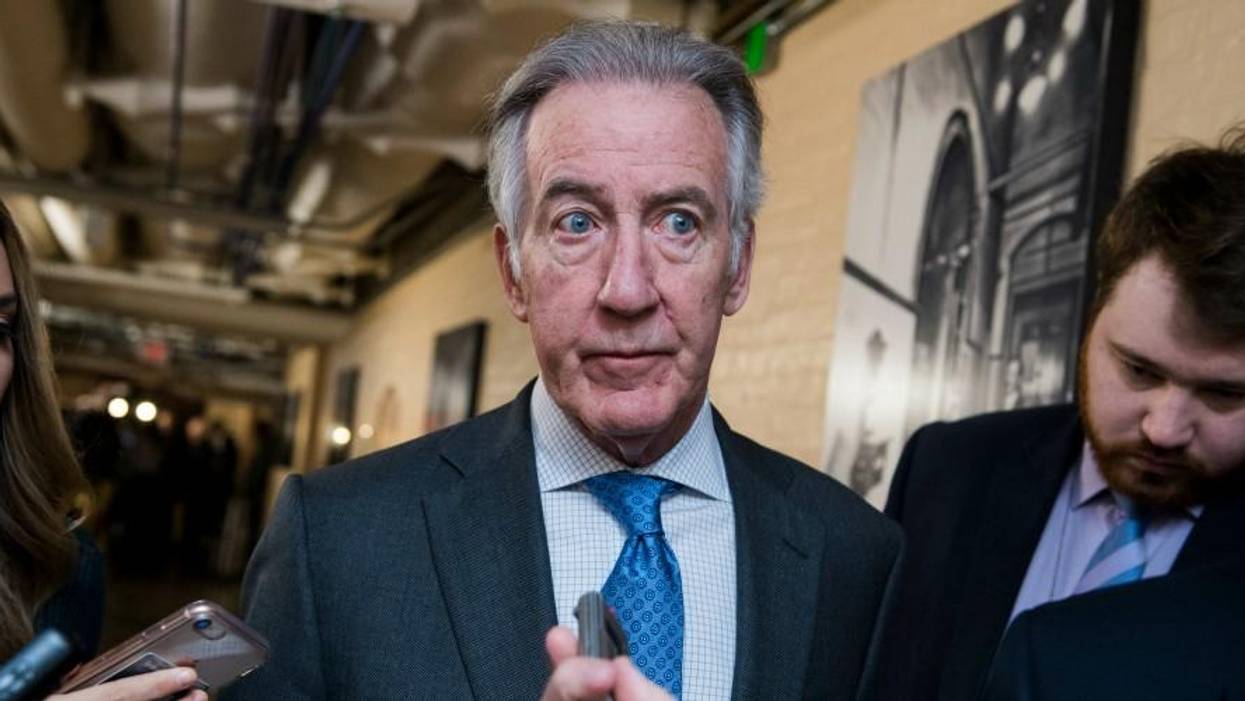
A new $300,000 ad campaign launched by an anti-monopoly non-profit group is taking aim at longtime Rep. Richard Neal, airing in the congressman's home district in western Massachusetts and drawing attention to his stonewalling of anti-surprise medical billing legislation--in favor of a proposal that would have benefited one of his top donors.
As the Fight Corporate Monopolies-sponsored ad explains, late last year the 16-term congressman blocked a bipartisan bill which would have prohibited surprise medical billing. Under the common practice, patients are hit with out-of-pocket medical costs following a surgery or other procedure, after being treated by doctors who aren't covered by their insurance--unbeknownst to the patient.
President Donald Trump was expected to sign the bill, put forward by Sen. Lamar Alexander (R-Tenn.) and Rep. Frank Pallone (D-N.J.), last year. But Neal stopped the legislation in its tracks by proposing his own measure which would have placed billing decisions in the hands of a third party.
The ad suggests that Neal's decision was likely made for the benefit of the private equity firm Blackstone, which--with $48,600 donated from employees--is Neal's biggest contributor this election cycle. Blackstone owns TeamHealth, a physician practice which sent thousands of surprise bills to patients in 2017.
"Neal protected Blackstone's profits by killing a bill that would have saved patients money," the ad's narrator says. "Now Blackstone is Richie Neal's top contributor--and one of Donald Trump's too."
Watch the ad below:
" Corporate power is corrupting democracy and Richie Neal is part of the problem," the ad continues.
According to a study published in February in the Journal of the American Medical Association, one in five Americans with health insurance reported that they had received a surprise medical bill after surgery or another procedure. The bills often demand payment to anesthesiologists or surgical assistants and the average bill was for more than $2,000.
The ad is set to air in western Massachusetts for the rest of July ahead of Neal's Sept. 1 primary in which he faces 30-year-old Holyoke, Massachusetts Mayor Alex Morse. Morse has been endorsed by progressive groups including Justice Democrats, the Sunrise Movement, and Indivisible.
Morse's campaign is not connected to Fight Corporate Monopolies' ad, but he has focused heavily on surprise medical billing as well as Neal's refusal to use his power as chairman of the House Ways and Means Committee to obtain Trump's state tax returns.
Intercept journalist Ryan Grim wrote that the ad by Fight Corporate Monopolies, the political nonprofit arm of the American Economic Liberties Project, will likely catch Democratic leaders in Congress off guard. As a 501(c)4, the group is not required to disclose its donors as long as it doesn't coordinate with a candidate.
"This amount of money coming from nowhere, undisclosed, is going to freak Democratic incumbents out," Grim tweeted.
"All of a sudden taking corporate money and crafting policy to benefit monopolies can now get you in trouble back home," Grim added.