

SUBSCRIBE TO OUR FREE NEWSLETTER
Daily news & progressive opinion—funded by the people, not the corporations—delivered straight to your inbox.
5
#000000
#FFFFFF
To donate by check, phone, or other method, see our More Ways to Give page.
Daily news & progressive opinion—funded by the people, not the corporations—delivered straight to your inbox.
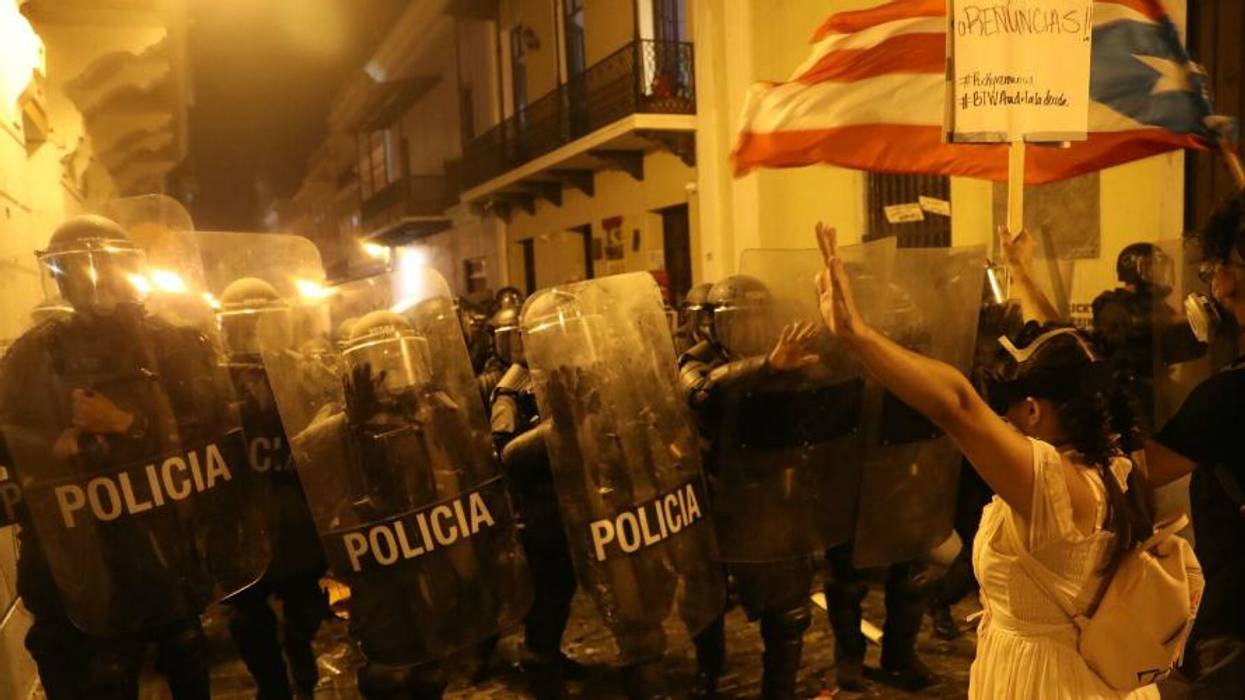
Police deployed tear gas and fired rubber bullets at protesters in Puerto Rico's capital city of San Juan late Wednesday on the fifth consecutive day of mass demonstrations to demand the resignation of Gov. Ricardo Rossello.
The Miami Herald reported from the scene as hundreds of protesters and police faced off on the colonial streets outside La Fortaleza--the governor's mansion--in the neighborhood of Old San Juan.
Some protesters threw firecrackers, bottles of water, beer, and glowsticks at the officers barricaded around the governor's home. Portions of the crowd called for others to stop inciting violence, leading chants like "No tiren" -- stop throwing--as tensions boiled over between rioters and police.
Shortly before midnight, the officers issued a warning to the crowd to disperse. Minutes later, police shot rubber bullets at the crowd, injuring protesters and journalists. The tear gas drove panicked demonstrators away from the barricades and against a nearby chapel. Some climbed the fence or pried open the gates of the iconic Parque de las Palomas.
NBC News producer Annie Rose Ramos shared videos of the confrontation on Twitter:
Wednesday marked the second time this week that police used tear gas outside the governor's mansion amid growing outrage directed at Rossello, a member of Puerto Rico's New Progressive Party who is affiliated with Democrats nationally.
Despite the mounting unrest, Rossello has refused to step down. He told reporters in a news conference on Tuesday, "I have not committed any illegal acts, I only committed improper acts," and "I will continue my work and my responsibility to the people of Puerto Rico."
Calls for Rossello to resign were sparked by Puerto Rico's Center for Investigative Journalism publishing screenshots last week of sexist, homophobic, mocking, and threatening messages from a private group chat that included the governor and several of his top staffers--some of whom have left their positions this week. On Saturday, the center released the full chat thread, which spans 889 pages.
However, as Common Dreams reported Monday, "the chat was the final straw." Since Rossello took office in January of 2017, Puerto Ricans have expressed frustration with government corruption and how he has handled both the island's debt crisis and recovery from Hurricanes Irma and Maria, which devastated the territory nearly two years ago.
The chaos outside La Fortaleza Wednesday night came after thousands of Puerto Ricans marched through the narrow streets of Old San Juan that afternoon, chanting "Ricky Renuncia," which means "Ricky Resign" in Spanish. Some of the island's famous performers--rappers Bad Bunny and Residente, singer Ricky Martin, and actor Benicio del Toro--joined the march.
"The crowd ranged from teenagers to retirees, with some waving the island's flag printed in black and gray rather than red, white, and blue to symbolize their discontent with a government they call corrupt and unresponsive to its people," according to The Associated Press. "Many older protesters went home before nightfall as chanting young people filled Old San Juan's Totem Plaza and the first few blocks leading up to the 16th century fortress where the governor resides."
Demands for Rossello's resignation have come not only from residents of the island but also Puerto Rican communities across the mainland--with protests in California, Florida, New York, and Washington D.C.
The controversy comes as Puerto Rico is only in the second month of this year's hurricane season, which goes through the end of November, and as the island still struggles to rebuild from the devastating 2017 storms.
As 350.org's U.S. national organizer Amira Odeh--who is from Bayamon, Puerto Rico--said Wednesday in a statement supporting the demonstrations, "We are rising up because we deserve better."
Odeh criticized Rossello and "his inner circles" for having "the audacity to joke about the lives of those lost, while doing nothing to ensure our long-term recovery." As she put it: "This is unacceptable and appalling, and as Puerto Ricans, we do not stand for this behavior."
"With hurricane season already upon us, Puerto Ricans are reminded of the toll that the combined effects of colonialism, classism, corruption, environmental destruction, and disaster capitalism have on our communities," Odeh added. "We need leaders and new models of democratic governance that are dedicated to just hurricane recovery, access to health and education services, and to having our human rights and right to safety respected without hurtful austerity measures."
A group of Democratic Senators, led by Elizabeth Warren, are again pushing to have Puerto Rico's debt forgiven in the wake of dual hurricanes that hit the island in 2017--an announcement that came as activists from the U.S. territory were on Capitol Hill to find a solution to the island's economic woes.
The United States Territorial Relief Act of 2019, as Warren's bill is known, would offer comprehensive debt relief to the American territory. Warren was joined by fellow Sens. Kirsten Gillibrand (D-N.Y.), Kamala Harris (D-Calif.), Edward Markey (D-Mass.), and Bernie Sanders (I-Vt.). All but Markey, Warren included, are running for the Democratic nomination for president.
"Our bill gives Puerto Rico and other struggling territories a route to comprehensive debt relief and a chance to recover with dignity," Warren said in a statement. "It's time for Congress to pass this bill."
If passed, according to an overview (pdf) provided by Warren's office, the legislation would forgive the island's debt, establish a fund for those who suffer losses from the debt cancellation, and create an auditing commission on the genesis of the debt and how the crisis got so out of control.
The House version of the legislation is being introduced in the lower chamber by Rep. Nydia Velazquez (D-N.Y.).
"Greedy Wall Street vulture funds must not be allowed to reap huge profits off the suffering and misery of the Puerto Rican people for a second longer." --Sen. Bernie Sanders
"Puerto Rico needs every tool possible to recover economically and physically from Hurricane Maria," Velazquez said.
The same cohort of senators and Velazquez introduced the legislation in 2018. It was ultimately unsuccessful.
Puerto Rico's debt issues are nothing new, as Common Dreams has reported--but things have gotten worse since the 2017 hurricanes and the only legislation in place is outdated and insufficient to address the current problems.
A 2016 bill addressing Puerto Rican debt, the Puerto Rico Oversight, Management, and Economic Stability Act (PROMESA), was signed into law by former President Barack Obama before the storms hit. PROMESA came in for criticism from Sanders, and others, even before the current crisis.
"Over the past several years, Puerto Rico has been living with an economic noose around its neck due to its crippling debt crisis and the devastation created by Hurricane Maria," said the Hispanic Foundation's president Jose Calderon in a statement supporting Warren's bill.
Puerto Rican activists confronted members of the island's Financial Oversight and Management Board (FOMB) about the predatory practices encouraged by PROMESA on Thursday. They were successful in convincing FOMB to take legal action against banks that profited off of Puerto Rican debt illegally.
Jesus Gonzalez, an organizer with the Center For Popular Democracy, pointed out in a statement that tougher action on predatory creditors would not have happened without "Puerto Rican families on the island and of the diaspora who have fought tirelessly for a just recovery," he said more still needed to be done.
"While the FOMB has decided to pursue legal action," Gonzalez said, "there is much information we still need to analyze to ensure that proper action is taken against every single person who profited from the illegal debt."
Sanders, in a statement, took aim at the banks and hedge funds that used the debt to make billions of dollars.
"Greedy Wall Street vulture funds must not be allowed to reap huge profits off the suffering and misery of the Puerto Rican people for a second longer," said Sanders.
The debt also created an impossible situation for Puerto Ricans struggling to recover after Hurricanes Irma and Maria in 2017, said Hispanic Foundation's Calderon.
"Over the past several years, Puerto Rico has been living with an economic noose around its neck due to its crippling debt crisis and the devastation created by Hurricane Maria," Calderon said. "The island government simply does not have the means to pay off its debt and prioritize the well-being of its people."
Warren echoed Calderon's callback to the difficulties faced by Puerto Ricans in their long pursuit of financial justice.
"Puerto Rican families were watching debt crush their futures long before Hurricane Maria hit," said Warren, "and this administration has failed in its response."
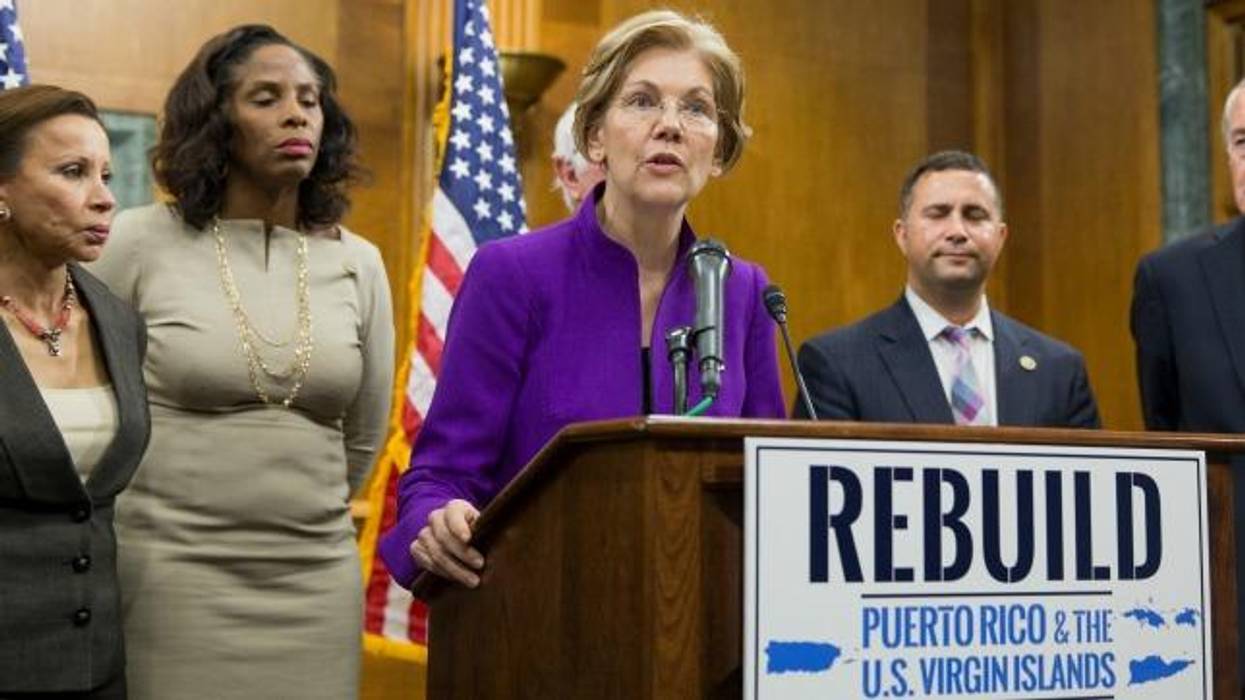
On the heels of a new study showing the federal government gave short shrift to Puerto Rico relief efforts in the wake of Hurricane Maria, Sen. Elizabeth Warren (D-Mass.) on Tuesday delivered a speech on the island in which she blasted the Trump administration for its lack of respect and "cruelty" towards the Puerto Rican people.
The purpose of her talk, said Warren, who recently announced a potential 2020 presidential bid, was "to talk about the dignity and respect this island deserves from our government--and the cruelty that it has been inflicted upon."
It was 16 months ago that Hurricanes Irma and Maria battered the island, she said, yet still "the people of Puerto Rico have not received the help they need to rebuild."
Echoing other observers, Warren noted that "these storms were piled on top of a much longer-running economic devastation of Puerto Rico," and called it "a clear example of how well the federal government works for Wall Street" but not for suffering people who need it most.
She noted for example, the "vulture funds" holding the majority of the island's debt, leaving Puerto Ricans "at the mercy of Wall Street corporate executives who are focused on squeezing out every last penny of profit from this island." She also citicized the fiscal oversight board, which has been slashing "basic government services throughout the island, while generously helping out the Wall Street firms that hold your debt."
Those indignities began before the current administration--she noted the U.S. military's still-toxic caused environmental damage on Vieques. "The legacy of colonialism dies hard," Warren said. Fingering the White House's current inhabitant, she chastized President Donald Trump for blocking nutritional assistance and using his "shutdown as an excuse to delay paying out disaster recovery funds to Puerto Rico."
"Even now, even after the Trump administration has denied how many died and has dragged its feet on sending adequate disaster relief funds, the president of the United States has doubled down on the insult by toying with the idea of diverting your recovery funds to build a wall," she added, calling the barrier "dumb."
"With Trump, cruelty is not an accident," Warren said, "it is part of the plan."
Warren also appeared on CNN's "Anderson Cooper 360" on Tuesday, and reiterated the themes from her earlier talk:
In her San Juan talk, Warren outlined a number of steps to address the cruelty, including giving islanders self-determination in its association with the U.S.; strengthening unions; protecting the island "from pollution and the threats of climate change"; enacting real debt relief; creating a "Marshall Plan" for the island to rebuild; and expanding the safety net including full Medicaid funding.
She also reiterated her call for a 9/11-style commission to probe the federal government's response to the hurricanes, and said accountability for the disaster needs to include getting rid of FEMA Administrator Brock Long, whom she accused of enabling "negligence."
A new analysis may help fuel her call for that probe. Published Friday in the journal BMJ Global Health, researchers found that the government's response to the aftermath of Hurricane Maria in Puerto Rico was slower and less financially generous than its response to Hurricanes Irma and Harvey in Florida and Texas.
Storm severity can't be the explanation, the study noted, as "Hurricanes Harvey and Irma made landfall as category four hurricanes, and Maria hit Puerto Rico as a 'high-end' category 4, or just below the threshold of a category 5 hurricane. Maria caused more damage in Puerto Rico than Irma in Florida or Harvey in Texas in terms of loss of electricity and housing destruction, with overall damage estimates comparable to Harvey, and greater than estimates for Irma."
Regardless of any possible justified barriers to response time, the researchers said "what cannot be contested is that the responses were in fact different across critical time points, and these differences have serious consequences for acute and long-term health outcomes and recovery efforts."

Citing the destruction wrought by last year's uniquely devastating Atlantic hurricane season and other natural disasters, a group of Caribbean religious leaders issued a letter (pdf) on Friday calling on governments and international financial institutions to relieve the debt of island nations and allow them to devote their resources to meeting the needs of their citizens.
"Islands that are struggling to recover after natural disasters and meet basic needs of their people should not be making debt payments."
--Eric LeCompte, Jubilee USA"Across the Caribbean, we still see immense suffering from the hurricanes that landed last year," Jubilee USA executive director Eric LeCompte said in a statement endorsing the Caribbean leaders' call. "Islands that are struggling to recover after natural disasters and meet basic needs of their people should not be making debt payments."
Signed by 22 faith leaders from several Caribbean islands, the letter notes that research "points to the fact that the growing severity of hurricanes in the Caribbean is related to man-made climate change."
"We in the Caribbean, like some other nations elsewhere in the global south, are least responsible for but most affected by climate change," the letter continues. "The few dozen small Island States across the world, for example, have neither the size nor developmental history to have been major contributors to current climate change. Yet these small Island States are the most easily devastated by rising seas and harsher storms. Our brothers and sisters who inhabit these places are in peril, through no fault of their own."
In order to be prepared for the next hurricane season and future disasters caused or made worse by the climate crisis, the faith leaders made three demands:
"As churches in the Caribbean we have witnessed the grief and despair of our people last September, and we are not prepared to enter the next hurricane season without at least being able to tell them that our authorities shall be able to use scarce resources for immediate relief and midterm reconstruction rather than debt service," the statement concludes.
Devastating hurricanes and wildfires--fueled in part by anthropogenic climate change--contributed to more than $300 billion in disaster-related damage across the United States last year, making 2017 the costliest year on record for extreme weather events, according to a government report released Monday.
"We can expect extreme weather events and economic losses and costs associated with them to continue increasing unless we make dramatic reductions in greenhouse gas emissions."
--James McCarthy, climate expert
"During 2017, the U.S. experienced a historic year of weather and climate disasters," according to the National Oceanic and Atmospheric Administration's (NOAA) National Climatic Data Center. "In total, the U.S. was impacted by 16 separate billion-dollar disaster events."
"The cumulative damage of these 16 U.S. events during 2017 is $306.2 billion, which shatters the previous U.S. annual record cost of $214.8 billion," NOAA notes. The previous record--adjusted for inflation--was set in 2005, following Hurricanes Dennis, Katrina, Rita, and Wilma. Last year saw Hurricanes Harvey, Maria, and Irma produce the most expensive hurricane season ever recorded, at $265 billion, while the raging wildfires in California contributed to a record $18 billion in fire damage.
NOAA mapped 2017's billion-dollar disasters, which included not only fires and hurricanes, but also flooding, a freeze, a drought, tornadoes, and general severe weather:
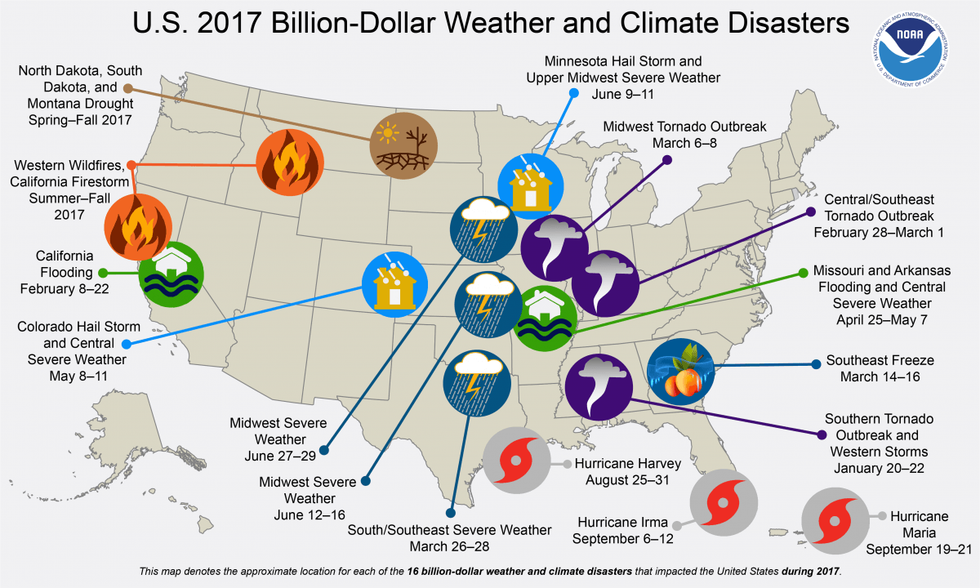
The human cost may not be fully recognized in the NOAA report, which claims, "overall, these events resulted in the deaths of 362 people." In contrast, news reports from Puerto Rico--a U.S. territory devastated by the 2017 hurricane season--indicate the post-hurricane death toll on the island alone could exceed 1,000 Americans.
Though alarming on its own, Ashley Siefert, communications director for the Union of Concerned Scientists (UCS), said NOAA's new report "is even more staggering when reviewed alongside recent reports from the insurance industry, as well as the latest attribution studies examining the connection between climate change and specific extreme weather events."
Rachel Cleetus, UCS's lead economist and climate policy manager, outlined in a blog post how the NOAA report echoes reports from the insurance industry.
"Last week, Munich Re, one of the world's leading reinsurers, stated that the costs to the insurance industry from Harvey, Irma, and Maria, and other 2017 disasters, are expected to reach $135 billion globally, the highest ever, with the U.S. share dominating at 50 percent of these costs. Overall economic losses, including uninsured losses, will amount to $330 billion, the second highest ever for a single year," she writes. "Last month, Swiss Re released a similar report stating that global insured losses for 2017 were $136 billion, and total economic losses are estimated to be $306 billion."
"First and foremost, we must do more to prepare and protect communities ahead of time by investing in risk reduction and disaster preparedness, and by ensuring that our federal, state, and local policies are guided by the best available science."
--Rachel Cleetus, Union of Concerned Scientists
This "historic and unprecedented year of disastrous extremes" reinforces "the fact that climate change is a threat to our health, and also a threat to our economy," Cleetus concludes, emphasizing that in order to mitigate the impacts, "first and foremost, we must do more to prepare and protect communities ahead of time by investing in risk reduction and disaster preparedness, and by ensuring that our federal, state, and local policies are guided by the best available science."
Although NOAA experts who held a media call to discuss the report declined to comment on the extent to which they believe climate change is impacting natural disasters, according to the Washington Post, climate experts were quick to weigh in.
"Hurricanes, wildfires, floods, and severe weather events occur naturally. However, the data shows an overall increased frequency in these events, and an associated increase in intensity," said Robert Watson, the former chairman of the United Nations' Intergovernmental Panel on Climate Change, who co-authored a recent report on the economic consequences of extreme weather disasters influenced by climate change.
"The precautionary principle would suggest," Watson added, "that we should assume a significant contribution from human activities, and prepare to adapt and mitigate."
Harvard oceanographer and climate expert James McCarthy, who co-authored the report with Watson, warned, "We can expect extreme weather events and economic losses and costs associated with them to continue increasing unless we make dramatic reductions in greenhouse gas emissions."

While 56 percent of Americans and the Pentagon hold that the deepening climate crisis is a serious threat to the country's safety, President Donald Trump left the issue out of his speech on his national security strategy on Monday--angering critics and green groups.
"Trump is not just ignoring science and public opinion about the dangers of the climate crisis, he's ignoring American generals and the Pentagon about what it takes to keep our military and our country safe," said Michael Brune, the executive director of Sierra Club, in a statement released after the president's speech.
Trump has regarded the efforts of every other country in the world to combat climate change as an endeavor that would harm American businesses and jobs--despite reports of a burgeoning job market in the renewable energy sector. Even in the Appalachian region, long dependent on the coal industry, Americans have expressed interest in moving on from the dangerous and pollution-causing reliance on mining the earth's natural resources.
The president focused his speech on familiar points--touting his promised border wall, pushing the need to deter North Korea from developing its nuclear capability, and pledging to ensure that economic partnerships with other countries benefit the U.S. first and foremost
The Department of Defense has considered climate change to be a threat at least since 2015, when it released a report on its security implications, arguing that rising global temperatures and its impacts including drought and famine could "aggravate problems such as poverty, social tensions, environmental degradation, ineffectual leadership, and weak political institutions that threaten stability in a number of countries."
"If we want to keep our country safe, Trump should take military advice from the military, not fossil fuel executives who are pushing to deny climate science and boost their profits at any cost," said Brune.
In recent months, the devastation wrought by Hurricane Harvey in Texas and Hurricanes Irma and Maria in the Caribbean offered a clear picture of the direct security threats of climate crisis. As the globe becomes warmer, climate scientists say, hurricanes risk becoming stronger and more frequent, as they did this past season.
On social media, Trump critics and national security experts alike denounced the president's decision to ignore climate change as one of the nation's greatest threats.

The wreckage of Puerto Rico in the wake of Hurricanes Maria and Irma teaches us that there is no such thing as a "natural disaster." This trope drives the federal response to environmental traumas under the Stafford Act, which allows the U.S. president to direct funds to any "state," including Puerto Rico, when it is felled by events such as hurricanes.
The failures of the Federal Emergency Management Agency (FEMA), show the illusions of the "disaster" story: It characterizes environmental traumas as short-term, one-size-fits-all catastrophes that are nobody's fault. It also positions the federal government as a savior of victims, who should be thankful for U.S. aid that is given a matter of largesse. For this reason, President Trump could make the now-infamous complaint that "they" "want everything done for them" via Twitter on Sept. 30, and on Nov. 17 request that Congress provide only $44 billion in aid, a number that Senator Patrick Leahy (D, Vt) describes as "insulting," especially for Puerto Rico.
Reliance on the story may also explain why the colorful FEMA "timeline" describing U.S. aid appears to stop at Oct. 31 as of this writing, and contains perfunctory assessments of efficient debris-clearance.
Interviews with Puerto Rican residents and responders that I conducted in November, however, reveal a different tale -- one where FEMA administrators misunderstood the real dimensions of environmental "disasters," which may begin far before the event, unfold in highly site-specific ways, and can continue for decades if not longer.
Puertorriquenos found themselves vulnerable for reasons that far predate Maria's September 20 landfall. As law professor Maria L. Jimenez Colon, director of legal clinics for the University of Puerto Rico, recently explained to me: What we're seeing now is "probably the worst, the most graphic, consequences of what happens when you are in a situation as we are, and as we were, before the hurricane." In recounting the causes of the island's suffering, she lambasted Puerto Rico's "colony" status as well as its financial crisis, which may illuminate why its insufficiently maintained electrical grid failed, leaving 95 percent of the territory without power.
Moreover, the dangers foretold by austerity were compounded by FEMA's negligence post-Maria. Professor Jimenez Colon reported that "We haven't encountered many FEMA inspectors who speak Spanish."
This complaint was also echoed by Roxanna Garcia, RN, who did aid work in Puerto Rico from Oct. 4-18 with RNRN/NNU, the relief arm of her union: She said to me: "A lot of them didn't speak Spanish, and the only thing they were doing was taking applications."
Along with sending monolingual English speakers to help a territory where approximately 2.8 million people are monolingual Spanish speakers, Garcia complained that FEMA relied on inaccessible technology: "You could fill out applications in person, but (to) follow up the application, (that process) was electronic. (You had to use a) phone, or text, or email. ... But the internet was spotty and unreliable."
And when FEMA handed out supplies, she said, it ignored victims' health conditions : Residents "didn't receive the kind of food that was adequate" in either quality or quantity, particularly considering the size of households or the prevalence of diabetes in Puerto Rico. The FEMA relief boxes contained a paltry amount of "chips and beef jerky and maybe a couple of bottles of water," which often couldn't be eaten since around 40 percent of the people Garcia aided had diabetes or high blood pressure.
Private responders also said FEMA workers could barely be found. Sophia Hau Yau RN, who also traveled with RNRN/NNU, said that aid workers posted a sheet in a common area titled "FEMA Sightings." Only six people wrote in of seeing FEMA employees, whereas Yau worked with a group of 300 volunteers that entered remote mountain locations and rural areas.
The disaster narrative also does not adequately imagine the future created for Puerto Rico by colonialism, austerity, Maria and government carelessness: "You can see the health crisis starting and already growing," Yau said, citing the long-term effects of black mold and tainted water. And Jimenez observed that the hurricane would catalyze "housing (problems), foreclosures and evictions, and with evictions you trigger family relations, with issues with child custodies, and so on and so forth. This ... (is not going to) end soon."
As Puerto Rico residents and responders know, FEMA does not attend to victims of unpredictable "natural disasters" out of generosity. Instead, human-rights considerations obligate the government to respond fully to environmental events that are rooted in government responsibility. Conscious of its own role in creating "disasters," the U.S. must also tailor aid to local conditions, and to respond to an injured community with an appreciation of its history and foreseeable future.

While nearly 70 percent of Puerto Rico remains without power six weeks after Hurricane Maria devastated the island, eleven United Nations human rights experts have issued a joint statement decrying the "absence of adequate emergency response" by the United States.
"We can't fail to note the dissimilar urgency and priority given to the emergency response in Puerto Rico, compared to the U.S. states affected by hurricanes in recent months."
--Leilani Farha, United Nations"Thousands of people are displaced, with homes destroyed, and without any relief in sight," the experts noted. "More than 80 percent of the population, or close to 2.8 million people, continue to live without electricity. Few hospitals are functioning. There are allegations that the water available--for those who have access to it--may be contaminated."
"With winter approaching, we call for a speedy and well-resourced emergency response that prioritizes the most vulnerable and at risk--children, older people, people with disabilities, women, and homeless people," they declared.
In the wake of the storm, a spotlight has been shone on the commonwealth's complex colonial history with the United States. Many, such as the ACLU's Gabriela Melendez Olivera, have argued that "the American citizens living in Puerto Rico and other U.S. territories" are regarded as "second-class citizens," and "the Trump administration and Congress' lack of adequate action to provide aid to the island is a modern-day reflection of that second-class status."
Considering the ongoing recovery efforts in Texas and--to a lesser degree--Florida, which were also hit by storms during this year's hurricane season, the U.N.'s special rapporteur on the right to housing, Leilani Farha, said: "We can't fail to note the dissimilar urgency and priority given to the emergency response in Puerto Rico, compared to the U.S. states affected by hurricanes in recent months."
Farha emphasized that "it's the obligation of all levels of government to act to protect" the 3.4 million U.S. citizens who reside in Puerto Rico, who "need safe and adequate homes--temporary and long-term--with electricity, clean drinking water and sanitation facilities."
Juan Pablo Bohoslavsky, the U.N.'s independent expert on foreign debt and human rights, noted that "even before Hurricane Maria struck, Puerto Rico's human rights were already being massively undermined by the economic and financial crisis and austerity policies, affecting the rights to health, food, education, housing, water, and social security."
The U.N. experts added their collective voice to mounting demands for debt relief for the U.S. commonwealth--which filed for bankruptcy in May--and said, "we call on the United States and Puerto Rican authorities to remove regulatory and financial barriers to reconstruction and recovery."
"All reconstruction efforts should be guided by international human rights standards, ensuring that people can rebuild where they have lived and close to their communities," they said. "Reconstruction should aim to increase the resilience of Puerto Rico's infrastructure, housing, and hospitals against future natural disasters."
The demands of the U.N. experts bolster existing calls for a "just recovery," one that incorporate an awareness of threats posed by future storms and climate change--such as by utilizing solar energy technology rather than a fossil fuel-reliant system--and echo warnings against "disaster capitalism" and privatization that have escalated amid outrage that led to the cancellation of an "astonishingly corrupt" $300 million no-bid contract given to Whitefish Energy to rebuild the island's destroyed electrical grid.

Five former U.S. presidents recently came together to raise money for hurricane relief for the victims of hurricanes Harvey, Irma, and Maria. This generous, bipartisan act is one of true generosity and statesmanship.
And yet, as former presidents, all five men know that there's another way to help hurricane victims, or victims of any natural disaster. The federal government can quickly provide far more in money, personnel, and resources to help disaster victims than even the most generous outpouring of donations by Americans.
Congress recently approved $36.5 billion for disaster relief. That's nowhere near enough given the scale of the crises from California to Puerto Rico. And further funding is going to run up against a GOP plan to cut $1.5 trillion worth of taxes -- about 80 percent of which will go to the richest 1 percent.
It's a sad comment on the current state of our government, when the current president and Congress aren't doing enough to help disaster victims using the full weight and power of the federal government, so five former presidents have to cajole millions of Americans to give voluntarily.
I don't want to demean those efforts. If you gave, you did the right thing. The victims of the hurricanes no doubt need your support and appreciate your generosity.
Enormous trees block roads. Buildings are damaged. After a month of clearing debris and attempting to clean up his own home and neighborhood, my friend is depressed. And, with electricity and internet, he's one of the lucky ones -- some 80 percent of the island still lacks power.
My heart hurts for those who are less fortunate.
As much as we complain about the federal government, it has an important role to play in natural disasters. Paying taxes is never fun, but by paying them, we can create a whole that's worth more than the sum of its parts.
If your home is incinerated by a wildfire in Montana or California, or demolished by a hurricane in Texas, Florida, or Puerto Rico, odds are you can't recover without some form of help.
The fortunate have insurance. Yet in my home of San Diego, many families who lost homes in past fires found that their insurance didn't actually cover the cost to rebuild their homes.
Ultimately, if we are to recover from natural disasters in a timely fashion -- before victims who survived the initial disaster lose their lives in the aftermath, and before children lose days of school and adults lose days at work -- we need each other. We need our government.
Ideally, we need our government for more than just disaster relief. We need it for disaster prevention. The government can buy homes from people who live in places that will repeatedly flood, allowing them to move somewhere else.
It can work to prevent catastrophic climate change so that hurricanes, wildfires, landslides, and other disasters don't become more severe or more common.
Individual, voluntary efforts are great, and they produce needed relief for disaster victims. But we need something more.
Those five former presidents could probably make a much bigger impact if they joined forces to lobby Congress and the White House to fully fund disaster recovery efforts and to then take the action needed to prevent these disasters from becoming more common.

Despite loud and growing demands that Puerto Rico's debt be cancelled outright, President Donald Trump is being blasted for doing the exact opposite by calling on Congress to saddle the U.S. territory with even more loans amid a massive humanitarian crisis on the storm-ravaged island.
On Tuesday, the Trump administration requested that Congress include a $4.9 billion Treasury loan for Puerto Rico in a $36.5 billion disaster relief package, which the U.S. House of Representatives is set to vote on this week. The island would also receive a $150 million loan to cover matching funds for FEMA grants, bringing the loan total to $5.05 billion.
But as the progressive advocacy group Justice Democrats declared, "additional debt isn't relief."
Rep. Ro Khanna (D-Calif.)--who supports the Justice Democrats--has added his voice to the call for major debt relief.
"Puerto Rico's recovery from Hurricane Maria must be driven by direct aid and debt relief," Khanna tweeted, "not more loans and austerity."
Hurricane Maria struck the island three weeks ago, wiping out the island's electric grid and leaving 3.4 million American citizens with limited access to fuel, food, and drinking water. So far, the federal government's disaster relief efforts have been widely condemned as woefully inadequate.
But even before Hurricanes Maria and Irma devastated the territory, it was struggling with its $74 billion in debt. In May, Puerto Rico declared bankruptcy.
Last week, Puerto Rico Gov. Ricardo Rossello sent a letter to congressional leaders to request additional funds. In the wake of "the unprecedented island-wide devastation suffered in Puerto Rico that has led to independent damage assessments in the range of $95 billion," Rossello wrote. "Puerto Rico is on the brink of a massive liquidity crisis that will intensify in the immediate future."
The loan would "address the immediate liquidity issue that Puerto Rico is having," and allow the island's government to make fund payroll and pensions, Office of Management and Budget (OMB) spokesman John Czwartacki told Politico.
"The money cannot be used for debt service," an anonymous Trump administration official told Reuters.
The loan proposal comes just days after Trump suggested on Fox News that the island's debt would need to be wiped out, and Wall Street "can wave goodbye" to future loan payments. The administration quickly walked back the president's remark, with OMB director Mick Mulvaney saying he "would not take [Trump's comment] word for word," and that the government would not "pay off those debts" or "bail out those bond holders."
However, as The Intercept reported Saturday, political support for wiping out Puerto Rico's Wall Street debt is growing. Both Rep. Luis Gutierrez (D-Ill.) and Sen. Bernie Sanders (I-Vt.) have endorsed debt relief.
As Mark Weisbrot, co-director for the Center on Economic and Policy Research, argued earlier this month, "it is the U.S. federal government's current mandate of perpetual austerity and economic shrinkage that is really preventing any economic recovery for the island in the foreseeable future."
And while Puerto Rico was already on "a downward spiral of increasing poverty, unemployment, and deteriorating of public health and education long before the hurricanes hit," he concluded, there will be no adequate recovery for the island unless the debt burden is lifted.
"We cannot solve one crisis," Weisbrot said, "without addressing the other."