

SUBSCRIBE TO OUR FREE NEWSLETTER
Daily news & progressive opinion—funded by the people, not the corporations—delivered straight to your inbox.
5
#000000
#FFFFFF
To donate by check, phone, or other method, see our More Ways to Give page.
Daily news & progressive opinion—funded by the people, not the corporations—delivered straight to your inbox.
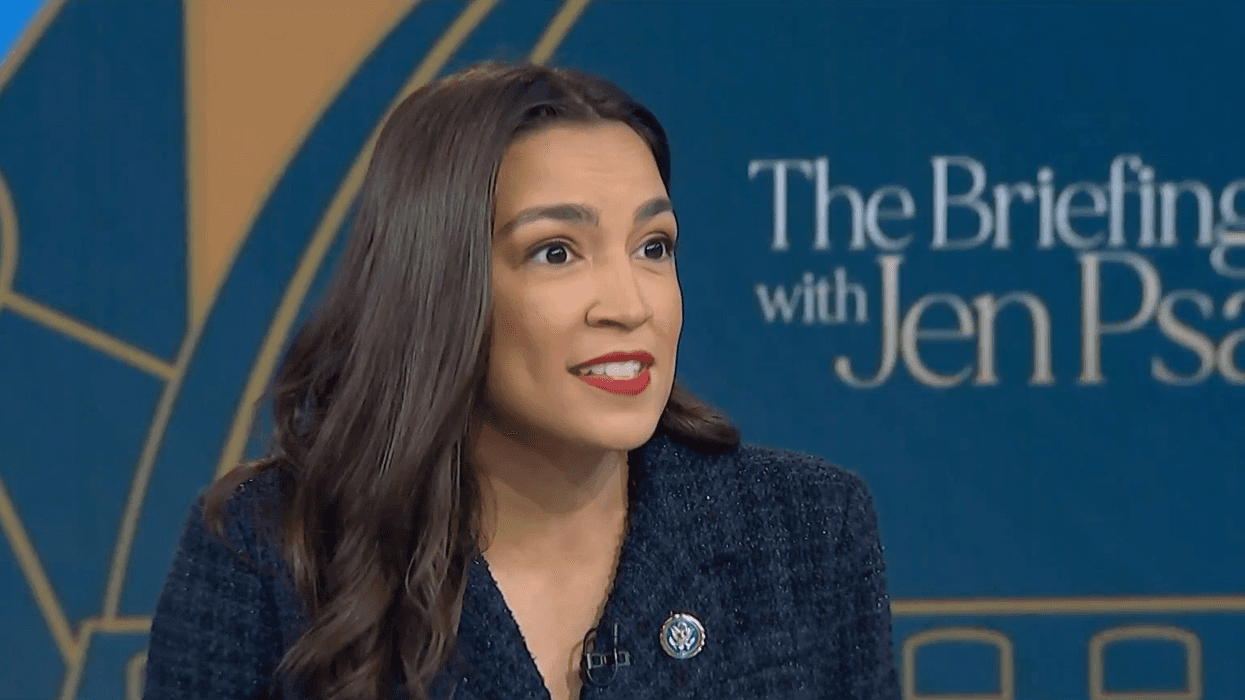
The New York Democrat's comments came in response to the Republican Speaker of the House telling a group of right-wing supporters he "runs the protection program" for the president.
Democratic Congresswoman Alexandria Ocasio-Cortez of New York ripped into Republican Speaker of the House Mike Johnson on Friday night for saying that Republican control of Congress is the only thing keeping President Donald Trump from being held to account for his numerous scandals and abuses of power during his second term in the White House.
Asked about comments made by the Speaker earlier in the day, Ocasio-Cortez told MS-NOW's Jen Psaki that Johnson characterized future efforts to investigate or accountability for possible misdeeds or corruption by Trump, his family members, or members of his administration "as though it’s some partisan witch hunt," she said. "But if you don’t want to be prosecuted for crimes, don’t do crimes."
Ocasio-Cortez, often referred to by her initials AOC, had been asked about remarks Speaker Johnson made at the annual summit of the right-wing Faith and Freedom Coalition, a group with close ties to Trump and the Christian nationalist movement that supports him.
“If we lose the midterms, heaven forbid, these Democrats—y’all, impeachment isn’t even the real concern,” Johnson told the crowd. “They will turn every committee of Congress into an investigative body, and they’ll go after the president’s family, the Cabinet, his donors, friends, half of you in this room will be targeted.”
The House speaker added, “I run the protection program. We’ll take care of you, OK?”
Johnson: If we lose the midterms, these Democrats will turn every committee of Congress into an investigative body, and they'll go after the president's family, the cabinet, his donors, friends, half of you in this room will be targeted. I run the protection program. We’ll take…
— Acyn (@Acyn) June 26, 2026
Johnson's remarks unsurprisingly sparked a series of critical reactions, including AOC's.
"Mike Johnson saying the quiet part out loud: protect the powerful. Screw everyone else," said Rep. Malcolm Kenyatta (D-Pa.).
"The Speaker of the House just talked like a guy guarding a operation that can’t survive daylight," said Rep. Mike Levin (D-Calif.). "Because that’s exactly what he’s doing."
"You don’t need a 'protection program' for people who did nothing wrong," Levin continued. "You need one when you’re afraid of what the books would show. Congress is supposed to be a check on power, not the muscle protecting it. Johnson is a total disgrace to the office. November can’t come fast enough."
What Johnson is "talking about," explained AOC in her interview with Psaki, is a Republican Party in Congress "running a protection racket" for Trump and his cronies, both in and out of government.
"And we are already seeing that this Trump administration has run what some have called one of the largest pedophile protection programs in American history," she continued, referencing the scandal surrounding the disgraced convicted sexual predator Jeffrey Epstein.
AOC: Mike Johnson paints this as though it’s some partisan witch hunt. But if you don’t want to be prosecuted for crimes, don’t do crimes.
And he’s talking about running a protection racket. And we are already seeing that this Trump administration has run what some have called… pic.twitter.com/ZscwBUJNgA
— Acyn (@Acyn) June 27, 2026
"And so when Mike Johnson tells a group of wealthy donors, I'm the only thing standing between you, and a consequence that should rattle at the conscience of every American," she said. "What he wants to do is create—or rather, not even create, because it’s already been created—but protect a class of impunity in America that says, 'You can commit whatever crime, and so long as you pay a check to us, we will protect you.' And that is a model of extortion in American politics. And you know what? That’s their pitch."
Melanie D'Arrigo, executive director of the Campaign for New York Health, responded to Johnson's comments by detailing just a few examples of possible corruption by Trump that deserve much more scrutiny and congressional oversight.
"Trump has almost tripled his net worth during this term. His sons bought drone companies and immediately received military contracts right before Trump started another war. Trump threw a crypto contest to see who could buy the most of his meme coin, with the prize being exclusive access to him in his presidential capacity," D-Arrigo noted.
"His son-in-law is getting billions in business deals from the countries and oligarchs wanting political favors. Large donors are spending millions to get pardons and investigations dropped. Trump is still actively covering up the Epstein files," she added. "And these are just a handful of the things that were publicly reported on—imagine what we don't know about yet."
D'Arrigo called on voters to help "flip the House" away from the Republicans and investigate these examples of grift and corruption as well as others.
As wild and crazy Trump becomes more of a political disaster for the GOP in November, Republicans will want to save their own political skins over Trump’s.
Public support for the Impeachment of Donald J. Trump is growing by the day. A March 9, 2026 Task Force report by the New York City Bar – dominated by powerful corporate lawyers – was titled “The Crisis Deepens: Congress Must Act Now to Address Escalating Abuses of Executive Power.” The recommendation – Immediate Impeachment of Donald Trump. I don’t recall a division on such a serious domestic policy stand between citizen groups, allied with the Democratic Party on one side and the public and a major corporate bar association on the other side.
Several leaders of national progressive citizen groups are counseling delaying such a drive until after the election in anticipation of a Democratic Party victory in both the House and the Senate. This mirrors what the feeble Democratic Party leadership (Hakeem Jeffries and Chuck Schumer) are telling their increasingly restless rank and file in the House and Senate (see the April 11, 2026 article in the New York Times by Annie Karni, “Democrats Warm to Idea of Removing the President”).
Meanwhile, as Trump’s illegal and erratic daily behavior and executive dictates worsen the wrecking of our country, the present majority of Americans favor impeaching Trump and removing him from office is nearing 60 percent.
Consider the pluses for launching an Impeachment drive supported by the people focused on Capitol Hill and a Congress controlled by the Republicans, who are likely to block any vote or formal Committee hearings.
1. It is a great campaign issue – tying together in an authentic way – see Res.1155 – all of Trump’s vicious shredding of the people’s health, safety and economic benefits and constitutional freedoms. Majorities despise openly corrupt Trump, whose support in polls is slumping, but many voters also don’t trust or believe in the wavering Democratic Party, which can’t come up with a credible compact that addresses the needs of the people and a set of political commitments embodied in specific pending bills. A compact with voters should be convincingly advanced and emblazoned across the land.
H.Res.1155’s thirteen Impeachment Articles, introduced by Cong. John Larson (D-CT) and their connection to “kitchen-table necessities” must be highlighted in this year’s political campaigns.
The people want fighters for them who care for them in Washington, D.C., using the citizens’ delegated powers and tax revenues in the interest of the people, the families, and the children. “Impeachment” is our founding fathers’ word for “YOU’RE FIRED,” a phrase used by Tyrant Trump against millions of civil servants, contractors, and other people working to help make a better country.
Regardless of their political labels, just about all families want fair play, justice, protections, and opportunities where they live, work, and raise their children. Articles of Impeachment are constitutional-level MANDATES for a political party and candidates to run on, replacing insincere throw-away lines and bloviating rhetoric so despised by a disgusted populace.
2. Making Impeachment front and center educates and inspires people about how central this Constitution of ours is to their daily lives. The mission of our government is to “promote the general welfare.” Only Congress can spend your money, not the president. Only Congress can take us from peace to war, not the president. Only Congress can define the authority entrenched in the executive branch, not the president or six “Injustices” on the Supreme Court for life. Only Congress can tax or not tax, not the president wielding arbitrary tariffs, charging fees, or riddling the tax code with loopholes and escapes for the super-rich and powerful.
Only “We the People,” not “We the Corporations,” nor “We the Congress,” is in the Preamble to our Constitution, making us the fundamental sovereign power in our country.
3. A grassroots Impeachment movement – already petitions are circulating (see impeachtrumpagain.org) – signals deterrence if Trump, with his rabid, dangerous personality, is thinking of more major disruptions of the November elections. Foreshadowing his invoking the Insurrection Act to take over the gears of the states’ election machinery, the fevered Trump said in January, “…we shouldn’t even have an election” in November. This is subversion of our Republic, and the Constitution for which it stands, beyond the wildest imaginations of our historic overseas enemies.
The most promising reform movements are often sparked and strengthened by the perpetrating outlaws providing continual, incriminating evidence of their own lawlessness. That is the essence of the foul-mouthed, lying, violent, corrupt, delusional, egomaniacal Trump. (See the April 30, 2026 statement from medical professionals in the Congressional Record – “Medical Concerns About President Donald J. Trump and His Fitness For Office.” Remember, with Trump the worst is yet to come as he continues to double down. Even a conservative columnist for the Washington Post, military historian Max Boot, is fearful of what might come abroad from the zigzag actions of an impulsive, fact-deprived Trump with his finger on the nuclear trigger.
All this is to say that what the Democratic Party leadership thinks is prudent to delay until after the election is in reality a very risky position. They are barely in contention to recover the Senate, even with the advantage of having far fewer seats (12) up for election than do the Republicans (20).
The Democrats, who are comfortable taking big bucks from giant corporate PACs, should run WITH and FOR the people. The time for political posturing is over. If their “loser leaders” don’t step aside, they should at least free the rank and file, including the progressive primary winners, to show the way to landslide, by far, the worst GOP in history. That means, for starters, let a willing Rep. Jamie Raskin, ranking member of the House Judiciary Committee, have “shadow hearings” on Trump’s many ongoing impeachable offenses. Such a hearing would draw prominent witnesses and great media attention to further galvanize the people.
Since all Democrats on Capitol Hill, if asked, would say “Yes,” Trump should be impeached, but the Party’s upper echelons say taking it to a vote can’t go anywhere so long as the GOP runs Congress. The push for Impeachment doesn’t have to reach a vote. As wild and crazy Trump becomes more of a political disaster for the GOP in November, Republicans will want to save their own political skins over Trump’s.
That’s what happened with defiant Nixon in 1974, after the one-time Watergate scandal, when the GOP jumped ship and forced his resignation. Trump’s crimes are far worse than Nixon’s and intensifying every day. As in 1974, it is before the elections when the GOP feels more insecure. Today Republican members of Congress know their majority is at risk.
In raw politics, sometimes it doesn’t take a vote. It just takes pressure from a President’s Congressional base and, for Tiring Trump, the public humiliation that comes with abandonment.
In addition to all its collateral benefits, an impeachment drive is a road to Trump’s resignation.

Trump is an unstable lame duck outlaw, including violating congressional authorities. He must be stopped.
Give Dangerous Donald credit. Coming off the floor of his 2020 defeat, under several federal and state indictments, a convicted felon, accused by over sixty women of sexual abuse or worse, his endorsed candidates having lost in the 2022 elections, the Trump business brand wilting along with his polls, Trump displayed more vengeful energy and cunning than the entire feeble, defeatist Democratic Party apparatus. He roared back against all odds in 2024 as an elected dictator to implement his declaration that he “can do whatever I want as president.”
Trump’s wrecking, endangering, and weakening of America worsens by the day, as he doubles down and calls his critics “deranged,” “demented,” “wackos,” “weak,” “low-IQ,” “crazy,” and “treasonous.” Moreover, his vicious expletives expand by the day.
However, the tide is finally turning against the failed gambling Czar and Netanyahu dittohead. Trump’s relentless greed is starting to undermine his dwindling support, despite his control of the Republican primaries. The headlines tell the story of his decline, and not just in the polls, with approval ratings down to 35%. The majority of Americans polled—nearing 60%—want him impeached and removed from office. This demand comes without the backing of the Democratic Party leadership, still skittish about mounting an Impeachment Drive. The case for Impeachment is aided and abetted daily by Trump’s outrages.
Let’s go to the revealing Headlines:
“Millions are Expected to Lose ACA Coverage” (Washington Post, May 20, 2026).
Due to Trump’s GOP ending subsidies.
“Fast-Moving Ebola Outbreak May Prove Difficult to Contain” (Washington Post, May 20, 2026). “People Will Die of Ebola Because of U.S. Cuts to Global Health” (New York Times, May 22, 2026).
Significantly due to Trump cutting USAID’s funding, monitoring, and disbanding critical expert teams.
“Mosque killings follow rise in anti-Islam voices” (Washington Post, May 20, 2026).
Led by chief Islamophobe, Donald Trump, from Day One in 2017.
“Trump’s Deal with Trump,” and “Prison to Pardons to Payouts: Rioters Rejoice” (New York Times, May 21, 2026). “I.R.S. Ordered to Drop Audits Against Trump as Part of Payout Deal” (New York Times, May 20, 2026).
Trump uses the government to reward his lawless supporters and wants to put himself above the law.
“Trump’s War is Punishing the Working Class” (New York Times, May 18, 2026).
Trump cares far more about the super-rich than the working class.
“EPA Wants to Repeal Limits on ‘Forever Chemicals’ in drinking water” (Washington Post, May 19, 2026), “Coal’s Comeback Fouls the Air With Resurgent Levels of Toxic Mercury” New York Times, May 13, 2026), “Chemical Board That Trump Wants to Remove Warns on Disaster Rules’ Rollback” (New York Times, May 18, 2026).
While a deadly chemical spill in California forces evacuation of 50,000 residents in Orange County.
“Trump Ramps UP Lawlessness on the Seas” (Washington Post, May 5, 2026).
Speaks for itself.
Now comes the headline, “A tough week for Trump on Capitol Hill, as Republicans deal him setbacks” (Washington Post, May 23, 2026) that must worry Trump. The $1.8 billion slush fund for violent, convicted felons and immunity for Trump and his extended family from IRS audits and enforcement proved too much for Trump lackey Majority Leader John Thune (R-SD). At the same time, Trump endorsed Texas Attorney General Ken Paxton, a crook impeached by his own Party in the Texas House, an adulterer under suit by his wife for divorce (see the Post article of May 19, 2026) over former judge, Sen. John Cornyn, popular with the Senate GOP. Earlier, Trump came out against Sen. Bill Cassidy (R-LA), helping Cassidy lose the primary. To Thune and allies, a president coming out against his own incumbents is treachery.
So, the water in the Senate GOP’s cauldron may be starting to boil. They know about Nixon’s experience in 1974 coming off winning 49 out of 50 states in the 1972 election. With Nixon’s polls sinking after the Watergate scandal (a quaintly modest one-time crime, compared to Trump’s hundreds of continuing scandals), the Congressional GOP saw itself sinking in the 1974 elections. A delegation of GOP Senators went to the White House and told Nixon, “Mr. President, your time is up.” Nixon resigned days later.
One can envision something similar today. Trump is an unstable lame duck outlaw, including violating congressional authorities. Republicans have to face the voters in November. They are likely to lose the House. The Senate has 20 Republican Senators up for election compared to only 12 Democrats. They have a three-vote margin now. Trump, given his economy, his chosen wars, his unrestrained greed and self-enrichment, is making prospects of a Democratic win in the Senate more possible.
Had the Democrats not ceded half the states (the red states) to the Republicans decades ago, leaving behind remnants of their organized presence, almost all the Republican Senators running this year could be at risk. Instead, only about six have competitive races—thank you, obtuse Democratic Party.
In any event, most politicians, however servile they may have been to a President, prefer saving their own political skins to falling on their swords for an unpopular president losing his cognitive grip and voter sensitivity by the day. (See the April 30, 2026 statement from medical professionals in the Congressional Record – “Medical Concerns About President Donald J. Trump and His Fitness For Office.” Do you know any other president who would say “I don’t care about the financial condition of Americans” in the midst of surging inflation, rising food, health care, rental, and gasoline prices? A president who is using the White House to massively enrich himself and his family. (See Cashing in on the presidency: here).
Unless Hakeem Jeffries and Chuck Schumer open the Party to input from labor and advocacy groups to help sharpen a stronger, authentically advanced agenda (Compact for America, anyone?), the Democrats may eke out a 51 to 49 win, with erratic John Fetterman (D-PA) playing the role of Senator Joe Manchin (D-WV) as the swing vote. This will give the tie-breaking power to Vice President J.D. Vance.
One slim ray of hope: The Washington Post reported on May 17, 2026, that “House Minority Leader Hakeem Jeffries (D-New York) has directed the chamber’s Democratic policy committee to host listening sessions with members, with voters and with advocacy groups to inform a party-wide agenda…”
Even if you don’t believe Jeffries, rush through that open door with your proposals, as we will with the recommendations of 24 civic leaders (see winningamerica.net). My winning get-out-the-vote agenda is there as well. (See my column: “Somersaulting Voters: Stopping Rabid Gerrymandering,” May 15, 2026).
Contact Rep. Hakeem Jeffries – https://jeffries.house.gov/ / 202-225-5936.