
SUBSCRIBE TO OUR FREE NEWSLETTER
Daily news & progressive opinion—funded by the people, not the corporations—delivered straight to your inbox.
5
#000000
#FFFFFF
To donate by check, phone, or other method, see our More Ways to Give page.


Daily news & progressive opinion—funded by the people, not the corporations—delivered straight to your inbox.
Sen. Jeff Merkley called the project “nothing more than a massive giveaway to defense contractors paid for entirely by working Americans.”
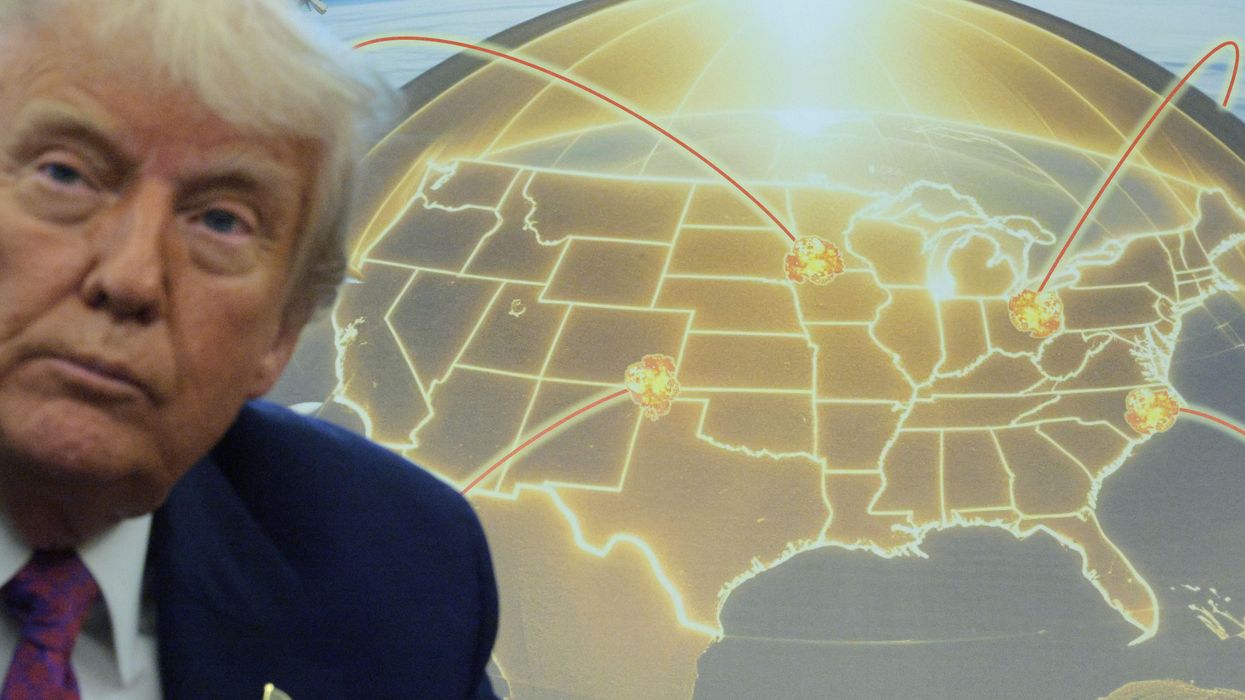
The Congressional Budget Office on Tuesday released a report estimating that President Donald Trump's proposed "Golden Dome" missile defense system would cost $1.2 trillion to create, deploy, and operate over the first 20 years of its existence.
The CBO report projects that acquisition costs for the proposed national missile defense (NMD) system would account for the vast majority of the $1.2 trillion total, including "costs for the system’s major components—namely, the interceptor layers and a space-based missile warning and tracking system."
In fact, the report says that the NMD system's space-based interceptor layer will be so expensive that it "accounts for about 70% of acquisition costs and 60% of total costs."
The CBO also questioned whether this massive investment would successfully protect the US from a foreign missile attack.
"Although the notional NMD system... would be far more capable than defenses the United States fields today," the report states, "it would not be an impenetrable shield or be able to fully counter a large attack of the sort that Russia or China might be able to launch."
"The strategic consequences of deploying an NMD system with the capacity considered here are unclear," the report continues, "because they hinge on an adversary’s perception of the defense's capability and how that adversary chose to respond."
The CBO's estimate on the missile system's cost was nearly seven times the projection Trump made last year, when he said it would cost just $175 billion.
And because the US Department of Defense still hasn't delivered key details about the proposed system, the CBO wrote, it is currently "impossible to estimate the long-term cost" of the initiative.
Sen. Jeff Merkley (D-Ore.), a longtime critic of the "Golden Dome" proposal, said the CBO report shows the Trump-backed project is "nothing more than a massive giveaway to defense contractors paid for entirely by working Americans."
"Just like the president’s symbolic renaming of the Department of Defense or deploying National Guard troops to our cities," added Merkley, who is the ranking member of the Senate Budget Committee, "this move to fund the ‘Golden Dome’ will be far more effective at squandering money than protecting American lives."
The Oregon Democrat vowed to "continue to work with my colleagues in the Senate to prevent another dime from flowing to this racket."
Sen. Ed Markey (D-Mass.), also a longtime critic of the president's proposed missile system, wrote in a social media post that "Trump’s Golden Dome is a $1.2 trillion golden sieve that won’t stop a nuclear attack, but will balloon the deficit and boost the bottom lines of billionaires."
Tommy Vietor, former National Security Council staffer under President Barack Obama and current co-host of Pod Save America, was even blunter in his criticism of the "Golden Dome" plan.
"$1.2 TRILLION for this dumb fucking Golden Dome missile defense system," he wrote in a social media post. "The initial estimate was $175 billion! Madness. No one wants this."
Daniel Larison, contributing editor at Antiwar.com and former senior editor at The American Conservative magazine, wrote that the CBO report exposed Trump's dome as a "trillion-dollar boondoggle."
Trump has said that he was inspired to develop such a missile system after being impressed by Israel’s “Iron Dome," despite the fact that Israel has a vastly smaller landmass to defend compared to the US and has historically faced far more danger from missile and rocket attacks.
“Private equity firms have increasingly brought their playbook to essential care industries," warns Sen. Jeff Merkley, by rolling local childcare centers nationwide "into large chains, and prioritizing investor profits over the well-being of the families.”
US Sen. Jeff Merkley announced the launch of a new investigation into the role of private equity firms in making childcare increasingly unaffordable for American families.
Merkley, the Oregon Democrat who serves as ranking member of the Senate Budget Committee, sent letters to KinderCare Learning Companies and Learning Care Group (LCG), the two largest childcare companies controlled by private equity firms, seeking information about the impact of the relentless profit-seeking of their owners on day-to-day business decisions.
Among other things, Merkley wants the companies to provide insight into the influence that their private equity owners exert over facility acquisition, expansion plans, staffing levels, employee wages and benefits; and capital investments.
Merkley is also asking the companies to "describe how tuition increases... are determined and whether financial obligations to lenders or owners are considered in pricing decisions." He also noted that both KinderCare and LCG faced serious accusations of mismanagement in multiple states.
KinderCare, which is owned by Switzerland-based private equity firm Partners Group, has been cited by state regulators in Indiana and Wisconsin for maintaining facilities with "inadequate supervision, staff-to-child ratio violations, unsafe or unsanitary conditions, and failures to report or respond appropriately to alleged abuse," Merkley wrote.
LCG, which is owned by private equity firm American Securities, operates facilities that have been reported for health and safety violations in numerous states, including Georgia, Missouri, and Texas, Merkley noted, "with incidents involving children left unattended on buses, supervision failures, and alleged physical abuse by staff."
Merkley said he was concerned that the failings at these facilities were being driven by the profit considerations at Partners Group and American Securities.
"Private equity firms have increasingly brought their playbook to essential care industries," said Merkley, "buying up independent providers, rolling them into large chains, and prioritizing investor profits over the well-being of the families and communities that depend on these services."
The senator urged both the childcare companies and their private equity owners to "fully cooperate with this investigation."
"Trump cares more about playing politics than making sure kids don't starve," said Sen. Jeff Merkley. "Kids and families are not poker chips or hostages. Trump must release the entirety of the SNAP funds immediately."
After President Donald Trump's administration announced Monday that it would partially fund the Supplemental Nutrition Assistance Program for November to comply with a federal court order, a Republican senator blocked congressional Democrats' resolution demanding full funding for the SNAP benefits of 42 million Americans during the US government shutdown.
"Trump is using food as a weapon against children, families, and seniors to enact his 'Make Americans Hungry Agenda,'" declared Sen. Jeff Merkley (D-Ore.), who is spearheading the measure with Senate Minority Leader Chuck Schumer (D-NY).
"It's unbelievably cruel, but Trump cares more about playing politics than making sure kids don't starve," he continued. "Kids and families are not poker chips or hostages. Trump must release the entirety of the SNAP funds immediately."
Merkley on Monday night attempted to pass the resolution by unanimous consent, but Senate Majority Whip John Barrasso (R-Wyo.) blocked the bill and blamed congressional Democrats for the shutdown, which is nearly the longest in US history.
The government shut down at the beginning of last month because the GOP majorities in Congress wanted to advance their spending plans, while Democrats in the Senate—where Republicans need some Democratic support to pass most legislation—refused to back a funding bill that didn't repeal recent Medicaid cuts and extend expiring Affordable Care Act subsidies.
Then, the Trump administration threatened not to pay out any SNAP benefits in November and claimed it couldn't use billions of dollars in emergency funding to cover even some of the $8 billion in monthly food stamps. Thanks to a pair of federal lawsuits and Friday rulings, the US Department of Agriculture on Monday agreed to use $4.65 billion from the contingency fund to provide partial payments. However, the USDA refuses to use Section 32 tax revenue to cover the rest of what families are supposed to get, and absent an end to the shutdown, there's no plan for any future payments.
"The Trump administration should stop weaponizing hunger for 42 million Americans and immediately release full—not partial—SNAP benefits," Schumer said in a statement, after also speaking out on the Senate floor Monday. "As the courts have affirmed, USDA has and must use their authority to fully fund SNAP. Anything else is unacceptable and a half-measure. The Senate must pass this resolution, and Trump must end his manufactured hunger crisis by fully funding SNAP."
The resolution states that the Trump administration "is legally obligated" to the use of the contingency fund for the program, "has the legal authority and the funds to finance SNAP through the month of November," and should "immediately" do so.
The resolution—backed by all members of the Senate Democratic Caucus except Sen. John Fetterman of Pennsylvania—stresses that "exercising this power is extremely important for the health and wellness of families experiencing hunger, including about 16,000,000 children, 8,000,000 seniors, 4,000,000 people with disabilities, and 1,200,000 veterans."
Congresswomen Suzanne Bonamici (D-Ore.) and Jahana Hayes (D-Conn.) planned to introduce a companion resolution in the House of Representatives. Hayes noted Monday that "never in the history of the program has funding for SNAP lapsed and people been left hungry."
Bonamici said that "the Trump administration finally agreed to release funding that Congress set aside to keep people from going hungry during a disruption like this shutdown, but it should not have taken a lawsuit to get these funds released. Now the House Republicans need to get back to Washington, DC and work to get the government back open."
This article was updated after an unsuccessful attempt to pass the resolution.