

SUBSCRIBE TO OUR FREE NEWSLETTER
Daily news & progressive opinion—funded by the people, not the corporations—delivered straight to your inbox.
5
#000000
#FFFFFF
To donate by check, phone, or other method, see our More Ways to Give page.
Daily news & progressive opinion—funded by the people, not the corporations—delivered straight to your inbox.
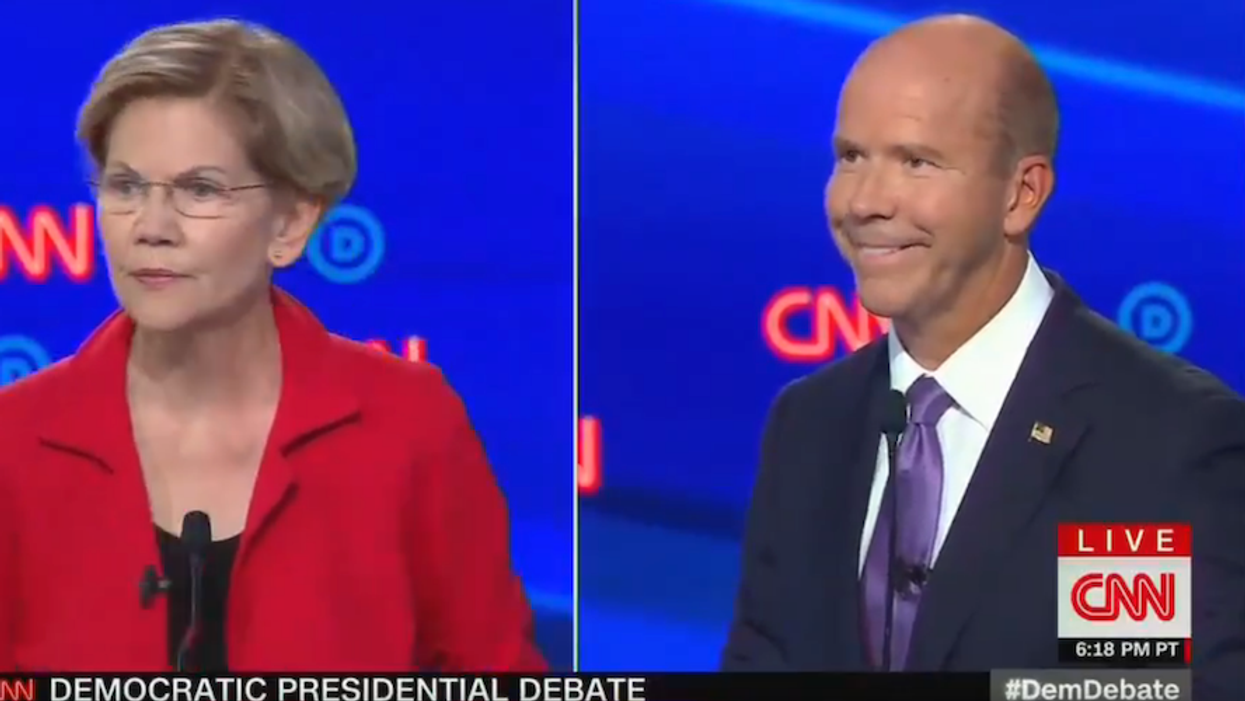
In one line during Tuesday's CNN Democratic primary debate, Sen. Elizabeth Warren made a distinction between her vision of the Democratic Party and that of her more conservative opponents.
Replying to former John Delaney, a former congressman from Maryland polling at around one percent who has made opposing left-leaning policy ideas the centerpiece of his quixotic run for the nomination, Warren wondered aloud what use it was trying to lead the American people without a vision.
"You know, I don't understand why anybody goes to all the trouble of running for president of the United States just to talk about what we really can't do and shouldn't fight for," said the Massachusetts Democrat.
A split screen showed Delaney with a large, but awkward, smile.
Elizabeth Warren: "I don't understand why anybody goes to all the trouble of running for president of the United States just to talk about what we really can't do and shouldn't fight for."pic.twitter.com/ciQUEwNQkU
-- Keith Boykin (@keithboykin) July 31, 2019
"Extremely rude of Elizabeth Warren to murder John Delaney on national television like this," tweeted social media manager Erick Fernandez.
Warren has based her primary campaign on a list of policy ideas backed up with detailed proposals: "I've got a plan for that" has become a mantra of sorts for the senator's presidential campaign.
Delaney, on the other hand, has struggled to gain traction with voters and has stuck mostly to attacking the candidates to his left for their plans to expand Medicare and tackle the climate crisis.
Both Warren and Sen. Bernie Sanders (I-Vt.) hit Delaney on Tuesday, prompting a celebration from Twitter user @non_bona_dicta.
"Gotta say though, I'm really loving watching Delaney get pummeled by Sanders and Warren," said @non_bona_dicta, "they're burying the motherfucker."
After the applause from her one-line cutdown of Delaney died down, Warren made clear that the real issue at hand was a corrupt political system that, along with corporations, is taking the government and "holding it by the throat."
"We need to have the courage to fight back against them," said Warren. "Until we're ready to do that, it's just more of the same."
"Well, I'm ready to get in this fight," said Warren. "I'm ready to win this fight."
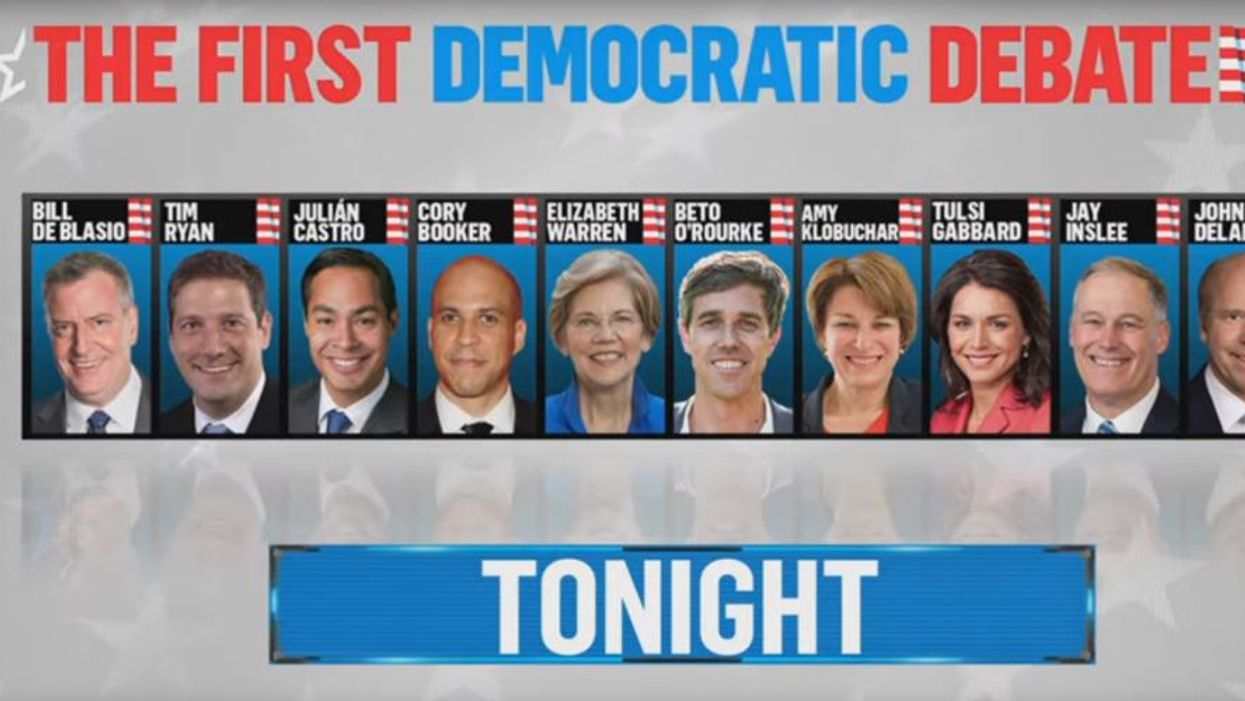
The first in a pair of kick-off round Democratic debates taking place in Miami, Florida will air Wednesday at 9:00pm E.T. and feature 10 of the party's top candidates vying for the 2020 presidential nomination.
Hosted by NBC News, MSNBC, and Telemundo, the debate at the city's Adrienne Arsht Center will be shown on each of the respective networks' cable channels as well as be streamed online on their websites.
The candidates who will be on the stage for Wednesday's debate are: Sen. Elizabeth Warren; Sen. Cory Booker; former Rep. Beto O'Rourke; Sen. Amy Klobuchar; former Rep. John Delaney; Rep. Tulsi Gabbard; former Housing Secretary Julian Castro; Rep. Tim Ryan; New York City Mayor Bill de Blasio; and Washington Gov. Jay Inslee.
On its website, NBC News posted the rules and additional details about the scheduled two-hour debate. Savannah Guthrie, Lester Holt, Chuck Todd, Rachel Maddow, and Jose Diaz-Balart will moderate the debates in Miami.
On Thursday night, the rules and moderators will be the same, but will feature the other 10 candidates who met the threshold put forth by the Democratic National Committee. They are: Sen. Bernie Sanders; Former Vice President Joe Biden; Sen. Kamala Harris; South Bend, Indiana Mayor Pete Buttigieg; Sen. Michael Bennet; Marianne Williamson; Rep. Eric Swalwell; Sen. Kirsten Gillibrand; Andrew Yang; and former Colorado Gov. John Hickenlooper.
Watch Wednesday night's debate live below (or visit this link for additional viewing options in your area):
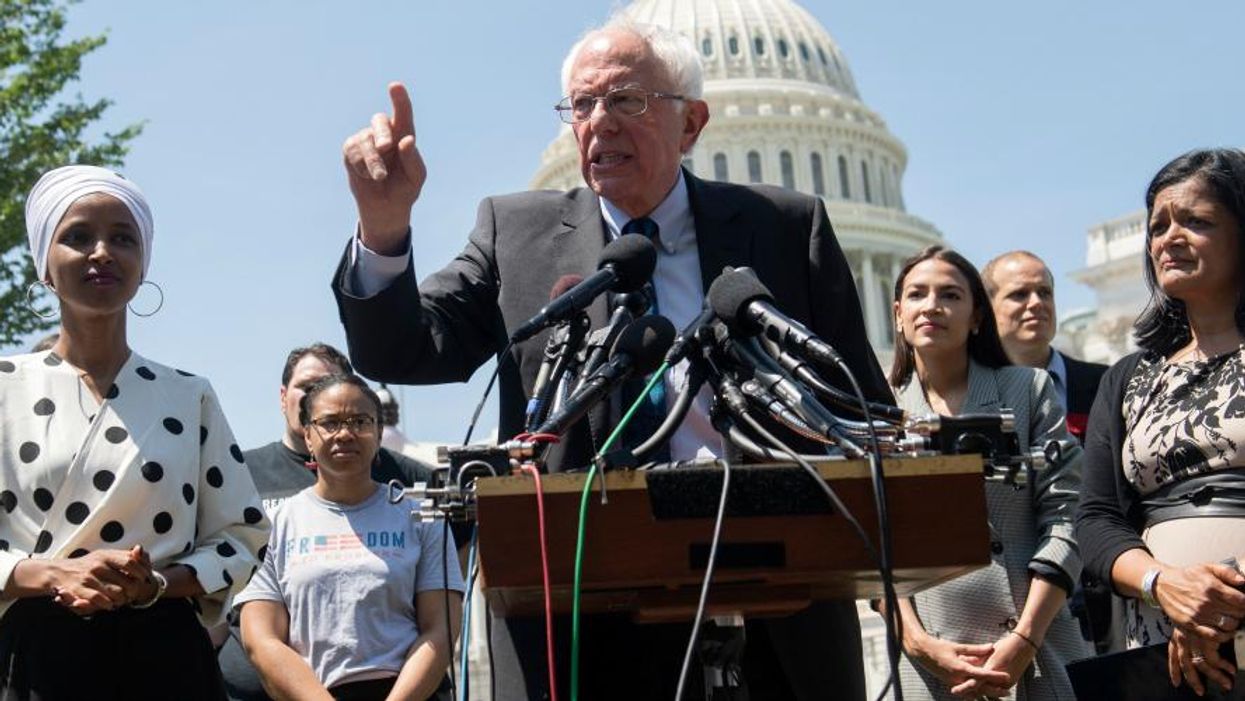
During a press conference unveiling his plan to eliminate all $1.6 trillion of student debt in the United States and make public colleges tuition-free, Sen. Bernie Sanders on Monday clearly staked out his position in a debate that has revealed stark political divisions among 2020 Democratic presidential candidates.
"Bernie understands that means-tested policies crumble under political pressure from right-wingers (and moderates) who attack them as going to 'undeserving' people."
--Briahna Joy Gray, Sanders's national press secretary
"I believe in universality," Sanders said when asked whether his free college plan would also apply to the rich. "That means if [President Donald] Trump wants to send his grandchildren to public school, he has the right to do that."
Sanders's remarks brought into sharp focus an "internal rift" among Democratic presidential contenders over the most economically and politically effective way to design government programs, the Washington Post's Jeff Stein reported Wednesday.
While Sanders has long been a proponent of universal programs like free public college and Medicare for All--which benefit everyone regardless of income--other Democratic White House hopefuls have displayed a preference for means-tested policies that are tailored toward low-income or middle-class Americans, while disqualifying those in higher income brackets.
\u201cWe are saying that all public colleges and universities should be tuition-free and debt-free for ALL Americans. \n\nAll Americans are entitled to Social Security.\nAll Americans are entitled to health care.\nAll Americans are entitled to education as a right.\u201d— Bernie Sanders (@Bernie Sanders) 1561411879
As Stein reported, some "experts and Democratic presidential candidates note universal programs tend to be more expensive, often by dramatic margins, and offer help to those who may not need it."
During the Black Economic Alliance's presidential forum last month, South Bend, Indiana Mayor Pete Buttigieg said he opposes tuition-free public college and across-the-board student debt cancellation because he doesn't "believe all of us should be paying for the children" of billionaires.
Presidential candidate John Delaney backed this position in an interview with the Post. "Programs to provide relief to people with student debt," Delaney said, "should be targeted for those who are actually struggling."
Sen. Elizabeth Warren (D-Mass.), meanwhile, has advocated a mixture of universal and means-tested policies. In April, Warren unveiled a debt forgiveness plan that would wipe out $50,000 in student debt for every person with household income under $100,000.
Those who earn between $100,000 and $250,000 would see more limited debt relief under Warren's plan, while those who earn more than $250,000 would not qualify for any relief.
But supporters of universal programs argue that means-tested plans like Warren's debt forgiveness proposal are inherently divisive, and thus more politically fragile, than policies that benefit everyone regardless of income.
"Bernie understands that means-tested policies like Warren's tend to crumble under political pressure from right-wingers (and moderates) who attack them as going to 'undeserving' people who don't work hard enough. Think food stamps, Section 8, and 'welfare,'" tweeted Briahna Joy Gray, national press secretary for Sanders's presidential campaign.
"By contrast, policies like Social Security have real staying power because all Americans are bought in," Gray added. "Universal policies create strong coalitions which benefit us all. You can't just have a plan for policy. You need a plan to enact and preserve it."
\u201cMoreover, Bernie\u2019s plan isn\u2019t a give away to the rich. The rich don\u2019t have debt. \n\n80% of student debt is held by folks earning less than $127k. And many with higher salaries work those jobs not because they want to, but bc they must to keep up with 2k monthly payments.\u201d— Briahna Joy Gray (@Briahna Joy Gray) 1561476524
As New York Magazine's Eric Leviz wrote Wednesday, the "strongest argument for a clean, across-the-board student-debt jubilee" over means-tested proposals "is a political one."
While it's clear that a large portion of Sanders's progressive base would mobilize behind the proposal, Levitz suggested there are also electoral benefits when it comes to voting blocks who might otherwise feel that Bernie's policies are hostile towards them.
"Canceling all student debt is simple to execute, and easy to understand," explained Levitz. "The policy's substantive drawbacks may double as political benefits--upper-middle-class professionals vote and donate to political campaigns at higher rates than less privileged people. It's conceivable that cutting doctors and lawyers in on the deal will make it easier to get major student-debt relief enacted."
As Sanders spokesperson Keane Bhatt put it in an interview with Vox earlier this week, "There is something to be said about simple, intelligible policies that build broad constituencies."