

SUBSCRIBE TO OUR FREE NEWSLETTER
Daily news & progressive opinion—funded by the people, not the corporations—delivered straight to your inbox.
5
#000000
#FFFFFF
To donate by check, phone, or other method, see our More Ways to Give page.
Daily news & progressive opinion—funded by the people, not the corporations—delivered straight to your inbox.
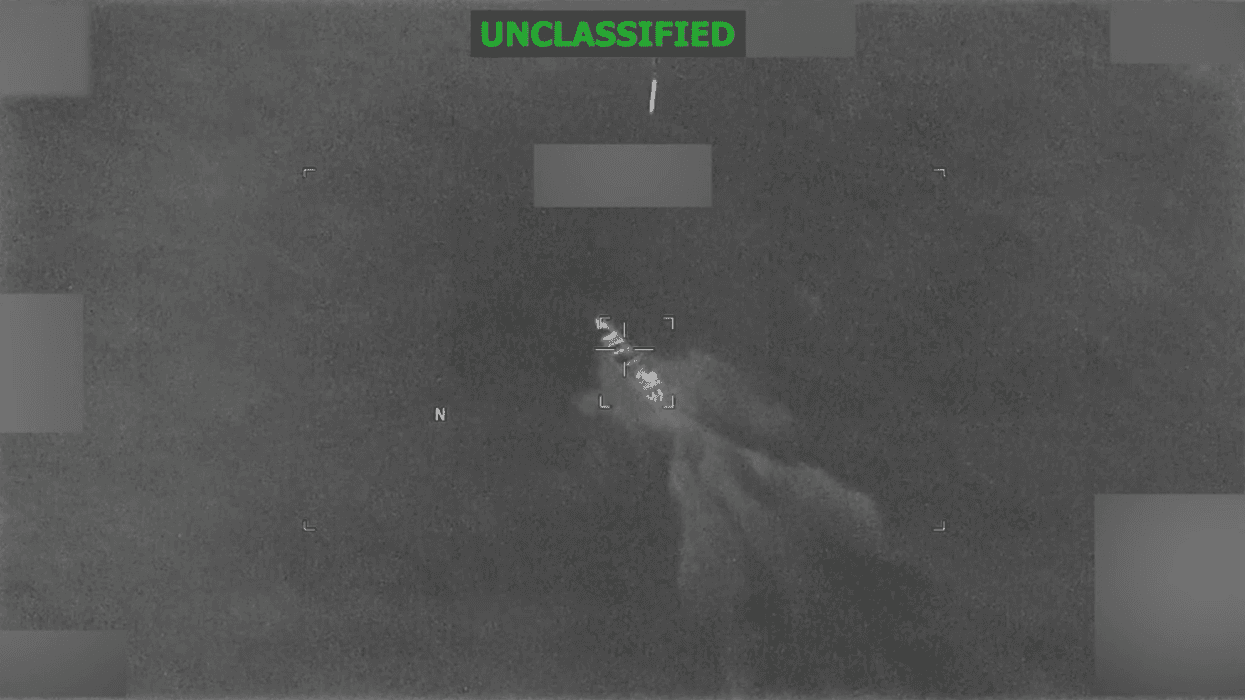
"The summary execution of two more in an alleged drug boat brings the number of murders ordered by Trump to more than 210," noted one human rights defender.
Two people were killed, and six others survived, a strike on Sunday that the US military claimed—without providing evidence—targeted a boat full of "narco-terrorists," but that human rights defenders called another summary execution worthy of prosecution.
"On June 21, at the direction of the commander of US Southern Command, Gen. Francis L. Donovan, Joint Task Force Southern Spear conducted a lethal kinetic strike on a vessel operated by Designated Terrorist Organizations," USSOUTHCOM said in a statement. "Intelligence confirmed the vessel was transiting along known narco-trafficking routes in the Caribbean and was engaged in narco-trafficking operations."
"Two male narco-terrorists were killed during this action, and there were six male survivors," the statement added. "Following the engagement, USSOUTHCOM immediately notified US Coast Guard to activate the Search and Rescue system for the survivors."
More lawless killing in the Trump administration’s boat bombing campaign.Real killing in a phony armed conflict with “narco-terrorists.”This strike reportedly left 6 survivors.US record for rescuing survivors alive is…not great.
[image or embed]
— Brian Finucane (@bcfinucane.bsky.social) June 21, 2026 at 11:28 PM
According to The Intercept's Nick Turse, who has tracked all of the reported US boat bombings in the Caribbean Sea and Pacific Ocean, there have now been 66 such strikes, which have killed 215 people and left 12 survivors, based on USSOUTHCOM data.
The fate of previous boat strike survivors is not completely clear. After one April bombing, the US Coast Guard told UPI that search-and-rescue operations were called off after no signs of survivors were found. Last October, President Donald Trump said two strike survivors were repatriated to their home countries of Ecuador and Colombia, where they faced prosecution.
Survivors of some of the strikes have accused US forces of torturing them.
Relatives of people killed in previous US boat bombings, as well as officials in Venezuela and Colombia, have said that numerous victims were fishers who were not involved in the illicit drug trade.
In January, relatives of two Trinidadian fishers killed in the strikes filed a federal wrongful death lawsuit in Massachusetts.
"The summary execution of two more in an alleged drug boat brings the number of murders ordered by Trump to more than 210," former Human Rights Watch executive director Kenneth Roth said on social media. "There will come a day when he faces prosecution for these crimes."

“I have lost my faith in the integrity of how we do our work and our commitment to principled reporting on the facts and application of the law,” said resigning staffer Omar Shakir.
Two Human Rights Watch employees—the group's entire Israel-Palestine team—resigned after senior staffers blocked a report calling Israel's denial of Palestinian refugees' right of return to their homeland a crime against humanity.
Jewish Currents' Alex Kane reported Tuesday that HRW Israel-Palestine team lead Omar Shakir and assistant researcher Milena Ansari are stepping down over leadership's decision to nix the report, which was scheduled for release on December 4. Shakir wrote in his resignation email that one senior HRW leader informed him that calling Israel's denial of Palestinian right of return would be seen as a call to “demographically extinguish the Jewishness of the Israeli state.”
“I have lost my faith in the integrity of how we do our work and our commitment to principled reporting on the facts and application of the law,” Shakir—who is also member of Jewish Currents' advisory board—wrote in his resignation letter. “As such, I am no longer able to represent or work for Human Rights Watch.”
In an interview published Tuesday by Drop Site News, Shakir—who was deported from Israel in 2019 over his advocacy of Palestinian rights—said: “I’ve given every bit of myself to the work for a decade. I’ve defended the work in very, very difficult circumstances... The refugees I interviewed deserve to know why their stories aren’t being told."
Ansari said that "whatever justification" HRW leadership "had for pausing the report is not based on the law or facts."
The resignations underscored tensions among HRW staffers over how to navigate a potential political minefield while conducting legal analysis and reporting of Israeli policies and practices in the illegally occupied Palestinian territories.
As Kane reported:
The resignations have roiled one of the most prominent human rights groups in the world just as HRW’s new executive director, Philippe Bolopion, begins his tenure. In a statement, HRW said that the report “raised complex and consequential issues. In our review process, we concluded that aspects of the research and the factual basis for our legal conclusions needed to be strengthened to meet Human Rights Watch’s high standards.” They said that “the publication of the report was paused pending further analysis and research,” and that the process was “ongoing.”
Kenneth Roth, a longtime former HRW executive director, defended the group's decision to block the report, asserting on social media that Bolopion "was right to suspend a report using a novel and unsupported legal theory to contend that denying the right to return to a locale is a crime against humanity."
However, Shakir countered that HRW "found in 2023 denial of a return to amount to a crime against humanity in Chagos."
"This is based on [International Criminal Court] precedent," he added. "Other reports echoed the analysis. Are you calling on HRW to retract a report for its first time ever, or it just different rules for Palestine?"
Polis Project founder Suchitra Vijayan said on X Tuesday that "the decision by Human Rights Watch’s leadership to pull a report on the right of return for Palestinian refugees, after it had cleared internal review, legal sign-off, and publication preparation, demands public reckoning."
"This was not a draft in dispute and the explanation offered so far evades the central issue of 'institutional independence' in the face of political pressure," added Vijayan, who is also a professor at Columbia and New York universities. "Why was the report stopped, and what does this decision signals for the future of its work and credibility on Palestine?"
Offering "solidarity to Omar and Milena" on social media, Medical Aid for Palestinians director of advocacy and campaigns Rohan Talbot said that "Palestinian rights are yet again exceptionalized, their suffering trivialized, and their pursuit of justice forestalled by people who care more about reputation and expediency than law and justice."
Sarah Leah Whitson, HRW's former Middle East and North Africa director and currently executive director at Democracy for the Arab World Now, told Drop Site News on Tuesday that “We have once again run into Human Rights Watch’s systemic ‘Israel Exception,’ with work critical of Israel subjected to exceptional review and arbitrary processes that no other country work faces."
The modern state of Israel was established in 1948 largely through a more than decadelong campaign of terrorism against both the British occupiers of Palestine and Palestinian Arabs and the ethnic cleansing of the latter. More than 750,000 Palestinians fled or were expelled from their homeland, sometimes via massacres or the threat thereof, in what Arabs call the Nakba, or catastrophe.
More than 400 Palestinian villages were destroyed or abandoned, and their denizens—some of whom still hold the keys to their stolen homes—have yet to return. Today, they and their descendants number more than 7 million, all of whom have been denied the right of return affirmed in United Nations General Assembly Resolution 194.
Many Palestinians and experts around the world argue that the Nakba never ended—a position that has gained attention over the past 28 months, as Israel has faced mounting allegations of genocide for a war that's left more than 250,000 Palestinians dead, maimed, or missing in the coastal strip and around 2 million people forcibly displaced, starved, or sickened.
Bolopion told Kane Tuesday that the controversy over the blocked report is “a genuine and good-faith disagreement among colleagues on complex legal and advocacy questions."
“HRW remains committed to the right of return for all Palestinians, as has been our policy for many years," he added.

One former Navy lawyer said the Trump administration "might not want to get into the messy issues involving detention and habeas corpus lawsuits.”
Pentagon officials asked about sending survivors of US boat strikes in the Caribbean Sea and Pacific Ocean to a notorious maximum security prison in El Salvador in a bid to keep them out of American courts—where the Trump administration's high seas extrajudicial killing spree would be subject to legal scrutiny.
New details published Tuesday by the New York Times revealed that attorneys at the US Department of Defense inquired about whether two survivors of an October 16 strike on a boat allegedly smuggling drugs in the southern Caribbean could be sent to El Salvador’s Terrorism Confinement Center (CECOT), where the Trump administration has shipped hundreds of mostly Venezuelan victims of its mass deportation campaign.
The prison—the centerpiece of right-wing Salvadoran President Nayib Bukele’s war on crime—has been plagued by allegations of torture and other abuse.
One Trump administration official speaking on condition of anonymity told the Times that State Department lawyers were "stunned" by the query. The two boat strike survivors were ultimately returned to Colombia and Ecuador, their home countries.
Other unnamed officials told the newspaper that repatriations—either to survivors' home countries or to third nations—would become the administration's default plan for dealing with anyone who lived through the US attacks.
The goal, the officials said, was to avoid trying boat strike survivors in US courts, where the discovery process would compel the Trump administration—which has offered no concrete evidence to support its claims that the targeted vessels were carrying drugs—to provide legal justification for attacks that experts say are illegal.
The Pentagon's inquiry followed a September 2 "double-tap" strike on a vessel carrying 11 passengers. Two men survived the initial bombing but were killed in a second strike. Since then, at least 76 other people have been killed in 23 boat strikes reported by the Trump administration.
In addition to the two men who initially survived the September 2 strike and the two repatriated survivors of the October 16 attack, one other person who lived through a boat bombing was left adrift at sea and is presumed dead.
Some observers have noted similarities between the Trump administration's goal of keeping boat strike survivors out of US courtrooms and War on Terror policies and practices—first implemented during the George W. Bush administration—such as extraordinary rendition, the use of Central Intelligence Agency "black sites," and imprisonment of terrorism suspects at Guantánamo Bay in Cuba—designed to circumvent the law.
While the Trump administration previously sent migrants captured during its crackdown to Guantánamo, sending boat strike survivors to the lockup allow their lawyers to sue for habeas corpus, a right granted by the US Supreme Court in its 2008 Boumediene v. Bush decision.
The Trump administration has revived the term "unlawful enemy combatant"—which was used by the Bush administration to classify people caught up in the War on Terror in a way that skirts the law—to apply to boat strike survivors. The Pentagon has also called such survivors "distressed mariners," a term that normally applies to civilians stranded at sea.
“If we’re in a war, they should be using the term ‘shipwrecked survivors,’” Mark Nevitt, a former Navy lawyer who is now a law professor at Emory University, told the Times. “My theory is they might not want to get into the messy issues involving detention and habeas corpus lawsuits.”
Relatives of men killed in the strikes, as well as officials in Venezuela and Colombia, say that at least some of the victims were fishermen who were not linked to the illicit drug trade. One expert said last month that even in cases of vessels that were involved in drug trafficking, the bombings were "the equivalent of straight-up massacring 16-year-old drug dealers on US street corners.”
Even if the men targeted in the boat strikes were running drugs, "the appropriate response is to interdict the boats and arrest the occupants for prosecution," former Human Rights Watch executive director Kenneth Roth said Wednesday.
"The rules governing law enforcement prohibit lethal force except as a last resort to stop an imminent threat of death or serious bodily injury," he added, "which the boats do not present."