

SUBSCRIBE TO OUR FREE NEWSLETTER
Daily news & progressive opinion—funded by the people, not the corporations—delivered straight to your inbox.
5
#000000
#FFFFFF
To donate by check, phone, or other method, see our More Ways to Give page.
Daily news & progressive opinion—funded by the people, not the corporations—delivered straight to your inbox.

A spokesperson for Iran's Foreign Ministry slammed the leadership of the European Union for "blaming Iran for exercising its right to self-defense against US aggression launched from bases in neighboring countries."
Iran's government on Monday condemned the European Union's response to Iranian attacks on US military installations in the Middle East as "a masterclass in selective moral outrage" as the Trump administration launched new strikes against Iran over the weekend, with peace talks still at an impasse.
Esmaeil Baqaei, a spokesperson for the Iranian Foreign Ministry, accused EU leaders of "blaming Iran for exercising its right to self-defense against US aggression launched from bases in neighboring countries," referring to Iran's attacks on US air bases in Kuwait. Baqaei said Iran's strikes "against those bases and assets that are used to launch unlawful attacks against Iran are a lawful exercise of self-defense."
"The EU must remain faithful to the rule of law and the principles of the UN Charter that it has long claimed to uphold. It must stop appeasing aggressors while blaming those who respond to unlawful attacks," Baqaei added. "States have an established legal obligation not to allow their territory or assets to be used for invading other countries."
Baqaei's statement came in response to remarks from a European Commission spokesperson condemning an Iranian attack on a US air base in Kuwait last week, calling it a violation of Kuwait's sovereignty. The attack reportedly injured at least four US servicemembers and several American contractors.
The Iranian military said it targeted another US air base on Sunday in response to new attacks by the Trump administration, which launched its illegal war against Iran in late February. While Iran did not specify the location of its target, Kuwait said late Sunday that its "air defenses are currently confronting hostile missile and drone attacks."
The Iranian attacks followed the US military's announcement that it carried out strikes on "Iranian radar and command and control sites for drones" over the weekend. The US Central Command (CENTCOM) described the attacks as "self-defense strikes" and as a "measured and deliberate response" to "aggressive Iranian actions."
Brian Finucane, a senior adviser to the US Program at the International Crisis Group, wrote in response to CENTCOM's statement that "this administration’s use of the terms 'aggression' and 'self-defense' [is] thoroughly in 'war is peace' territory."
The US military also attacked a Gambia-flagged commercial ship in the Gulf of Oman over the weekend, enforcing a Trump administration naval blockade that Iran has condemned as illegal and said must be lifted as part of any peace agreement.
CBS News reported Saturday that "the broad strokes" of a peace deal under consideration "include a 60-day cessation of violence, along with clauses that call for reopening the strait and a framework to reopen negotiations on Iran's nuclear program."
"Multiple sources told CBS that the arrangement also involves the potential of waivers or sanctions relief to Iran that could allow it to access billions in frozen assets depending on the progress of the diplomacy," the outlet added.
Mohammad Bagher Ghalibaf, Iran's top negotiator, said early Monday that the Trump administration's naval blockade and Israel's "escalation of war crimes in Lebanon" represent "clear evidence of US noncompliance with the ceasefire."
"Every choice has a price, and the bill comes due," he added. "It will all fall into place."
US President Donald Trump, meanwhile, wrote on his social media platform that "Iran really wants to make a deal, and it will be a good one for the USA and those that are with us."
"Just sit back and relax, it will all work out well in the end," Trump declared.

The head of the Committee to Protect Journalists has called Shihab-Eldin's arrest for social media posts about the Iran war part of a trend of “increasing restrictions on freedom of expression” in the Gulf states.
US-Kuwaiti journalist Ahmed Shihab-Eldin is expected to be released after more than seven weeks in jail following his acquittal by a Kuwaiti court on Thursday.
The 41-year-old Shihab-Eldin, an award-winning reporter and documentarian who has worked at HuffPost, The New York Times, and Al Jazeera English, was detained by Kuwaiti authorities on March 2, just days after the US and Israel launched the opening salvos of their aggressive war against Iran, which was met with retaliatory strikes against US military bases across the Persian Gulf, including in Kuwait.
Shihab-Eldin, a US and Kuwaiti citizen who was in Kuwait to visit family, frequently commented on his public Substack account about news related to the war. One of his recent posts included a geolocated video, which was already public, of an American F-15 Strike Eagle jet falling from the sky near a US air base.
CNN later confirmed the video's authenticity, while the US military confirmed it was one of three American planes downed that day in what was described as a "friendly fire incident."
But shortly after posting the video, Shihab-Eldin found himself detained by Kuwaiti authorities on charges of "spreading malicious information online" and "harming national security."
The Committee to Protect Journalists (CPJ) called these "vague and overly broad accusations that are routinely used to silence independent journalists."
Legal counsel hired by Shihab-Eldin's sisters said on Thursday that he had been declared innocent of the charges by a Kuwaiti court and was expected to be released imminently, though some details were still being finalized.
“We are relieved that Ahmed Shihab-Eldin has been found innocent after 52 days in detention,” said Jodie Ginsberg, CEO of the CPJ. “Ahmed’s freedom and safety remain our topmost priority, and we will continue to closely monitor his case.”
Kuwait has come under heavy fire from Iran since the war began. In addition to attacks against American air bases, which have killed at least six US soldiers, Iran has targeted Kuwait's main airport and facilities at the Kuwait Petroleum Corporation.
Shihab-Eldin's arrest came as the Kuwaiti government began an aggressive clampdown on the sharing of video and other information related to Iranian attacks.
On May 2, Kuwait's Ministry of Information warned the public "not to photograph or publish any clips or information related to missiles or relevant locations."
Days later, the ministry announced that it was referring several "media law violators" for prosecution. It said, "Freedom of opinion and expression is guaranteed within the framework of the law and is coupled with professional responsibility, accuracy, credibility, and obtaining information from official sources."
On March 15, Kuwait introduced a censorship law stating that companies and individuals were "obligated to preserve the supreme interests of the military authorities." It imposed prison sentences of up to 10 years for anyone who “disseminates news, publishes statements, or spreads false rumors related to military entities” with the intent to undermine confidence in them.
The verdict in Shihab-Eldin's case was just one of 137 handed down on Thursday by a new court meant to oversee crimes related to national security and terrorism. Those defendants have been accused of “inciting sectarian strife on social media platforms,” according to Drop Site News, which cited Jordan's Al-Rai newspaper.
Shihab-Eldin was just one of nine defendants to be acquitted, though in 109 of the cases, no criminal punishment was handed down. Seventeen defendants received three years in prison, while another 10 received one year.
Ginsberg said Kuwait's repressive clampdown is part of a trend of "increasing restrictions on freedom of expression” that has been observed across the wider Middle East, and particularly the autocratic Gulf states that host American military bases, since the war's outbreak.
The governments of Qatar, Bahrain, and the United Arab Emirates have each arrested hundreds of people for filming or sharing content relating to Iranian strikes or other information related to the war or protests against the government, according to a report by Democracy for the Arab World Now (DAWN).
"This wave of repression reflects a deeper trend among Arab regimes: growing public frustration with US policy in the region and their governments' alignment with Washington," said Yara Bataineh, an editorial associate at DAWN's Democracy in Exile. "This crackdown did not begin with the war on Iran. Across several Arab states, authorities had already moved to suppress pro-Palestinian activism during Israel's genocide in Gaza—a pattern that has since intensified."
Israel's genocide in Gaza and expansionist military campaign into Lebanon have also proven historically deadly to journalists—including the Lebanese journalist Amal Khalid, who died under a pile of rubble on Wednesday from an attack by Israeli forces, who also attacked Red Cross workers attempting to rescue her. She is among hundreds of journalists and media workers who have been killed by Israeli attacks since 2023, according to the International Federation of Journalists.
“Almost inevitably, during a war, we see countries try to impose restrictions in the name of national security, and almost always that doesn’t just target genuine national security issues, but ends up covering a broad range of issues that are essential for us to understand what is happening,” Ginsberg told MS NOW. “That’s why we need journalists. We need journalists on the ground who can be our eyes and ears when we can’t get into these places and see for ourselves, so that we can understand what’s happening.”
She added, "It is an incredibly challenging time to be a journalist, and Ahmed’s case is emblematic of that."
"To me, it was not just the worst-case scenario," said one economic analyst. "It was an unthinkable scenario."
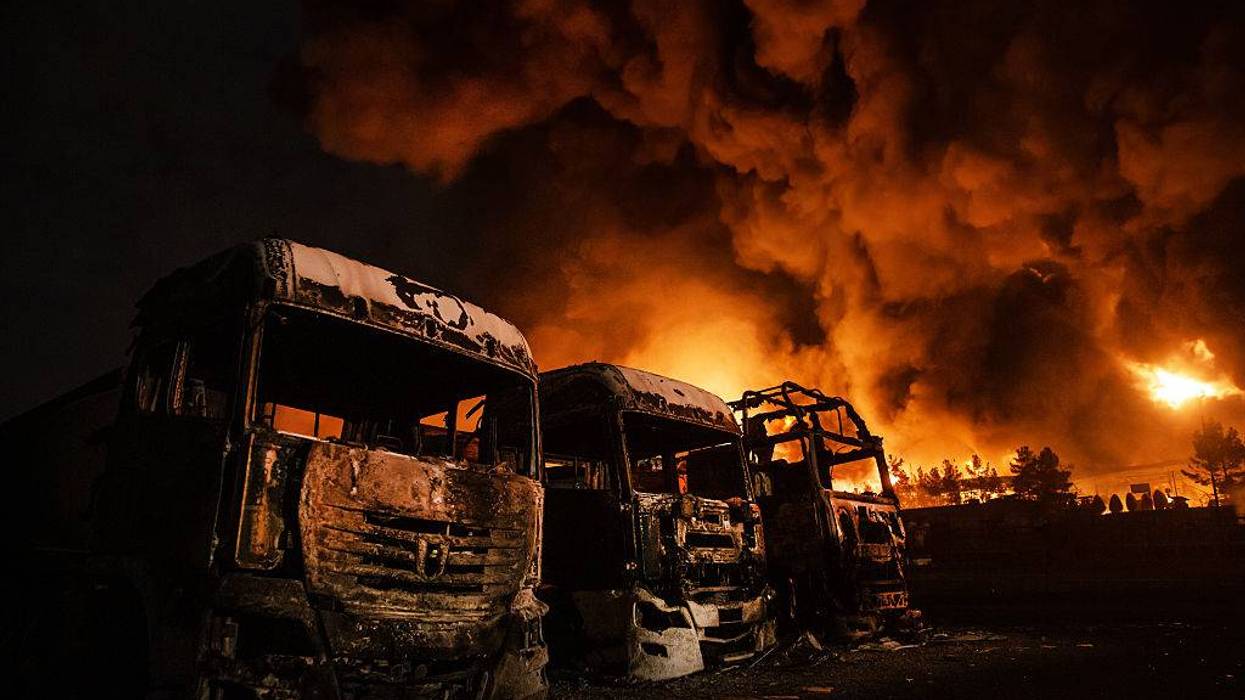
President Donald Trump's unprovoked and unconstitutional war against Iran is sending shockwaves across the global economy in the form of skyrocketing oil prices and diving financial markets.
The prices of both Brent crude oil and WTI crude oil futures on Monday surged past $100 per barrel, as countries across the Middle East announced production cuts in the wake of chaos and destruction caused by the Iran war.
The impact of the price surge on the US stock market was immediate, as the Dow Jones Industrial Average opened Monday trading down by more than 600 points, while the Nasdaq dropped by 300 points.
According to a Monday report from the Wall Street Journal, both Iraq and Kuwait have announced oil production curbs because they have been unable to ship their supply through the Strait of Hormuz and have thus run out of space to store excess petroleum.
JPMorgan Chase analyst Natasha Kaneva noted to the Journal that this is the first time in recorded history that the Strait of Hormuz has ever been completely closed off for shipping, and warned the economic consequences would be severe.
"To me, it was not just the worst-case scenario," Kaneva said of the strait's closing. "It was an unthinkable scenario."
The Journal wrote that Trump's decision to launch a war with Iran has already sparked "the most severe energy crisis since the 1970s," which is now "threatening the global economy."
Petroleum industry analyst Patrick De Haan wrote in a Monday analysis that US drivers should expect to feel the impact of this oil shock in the coming days.
"Gasoline prices in many states could climb another 20 to 50 cents per gallon this week, with price-cycling markets potentially seeing increases as early as today," De Haan projected. "Diesel may rise even more sharply, with increases of 35 to 75 cents per gallon possible as global distillate markets react."
In a Monday analysis posted on his Substack page, Nobel Prize-winning economist Paul Krugman dove into the logistics of stopping and restarting oil production, and argued that the impact of the strait's closure will grow significantly as time goes on.
"As the Strait remains closed, producers are shutting down, and this isn’t like turning off a tap that can be quickly restarted," Krugman explained. "There’s apparently a real nonlinearity here: a two-week closure of the Strait has much more than twice the adverse impact on global oil supply as a one-week closure. If this goes on for multiple weeks... oil prices, which retreated slightly off their highs early this morning, could go much higher."
Krugman said that the shock was not yet bad enough to make an economic crisis inevitable because the US is much less dependent on oil than it was in the 1970s.
Nonetheless, Krugman cautioned, "the situation is scary."
Punchbowl News reported on Monday that the politics of the Iran war "have to worry" incumbent Republicans who were already in real danger of losing their majority in the US House of Representatives even before Trump launched an illegal war.
"With the Strait of Hormuz closed, oil prices have soared to more than $100 per barrel (from just under $70 per barrel 10 days ago)," wrote Punchbowl News. "There’s been a huge spike in gas prices nationally."
The report added that Trump has not been helping his party by expressing indifference bordering on hostility to Americans' concerns about how his war will impact their personal finances.
"Short term oil prices, which will drop rapidly when the destruction of the Iran nuclear threat is over, is a very small price to pay for U.S.A., and World, Safety and Peace," Trump wrote in a Sunday Truth Social post. "ONLY FOOLS WOULD THINK DIFFERENTLY!"