SUBSCRIBE TO OUR FREE NEWSLETTER
Daily news & progressive opinion—funded by the people, not the corporations—delivered straight to your inbox.
5
#000000
#FFFFFF
To donate by check, phone, or other method, see our More Ways to Give page.


Daily news & progressive opinion—funded by the people, not the corporations—delivered straight to your inbox.
"Trump will send the military into DC to pick up litter and arrest homeless people, but won't do a damn thing to end the gun violence epidemic killing our kids," said one healthcare advocate.
Another horrific mass shooting that left multiple children dead and injured has once again ignited a wave of fury at Republican lawmakers who refuse to take action to stop gun violence.
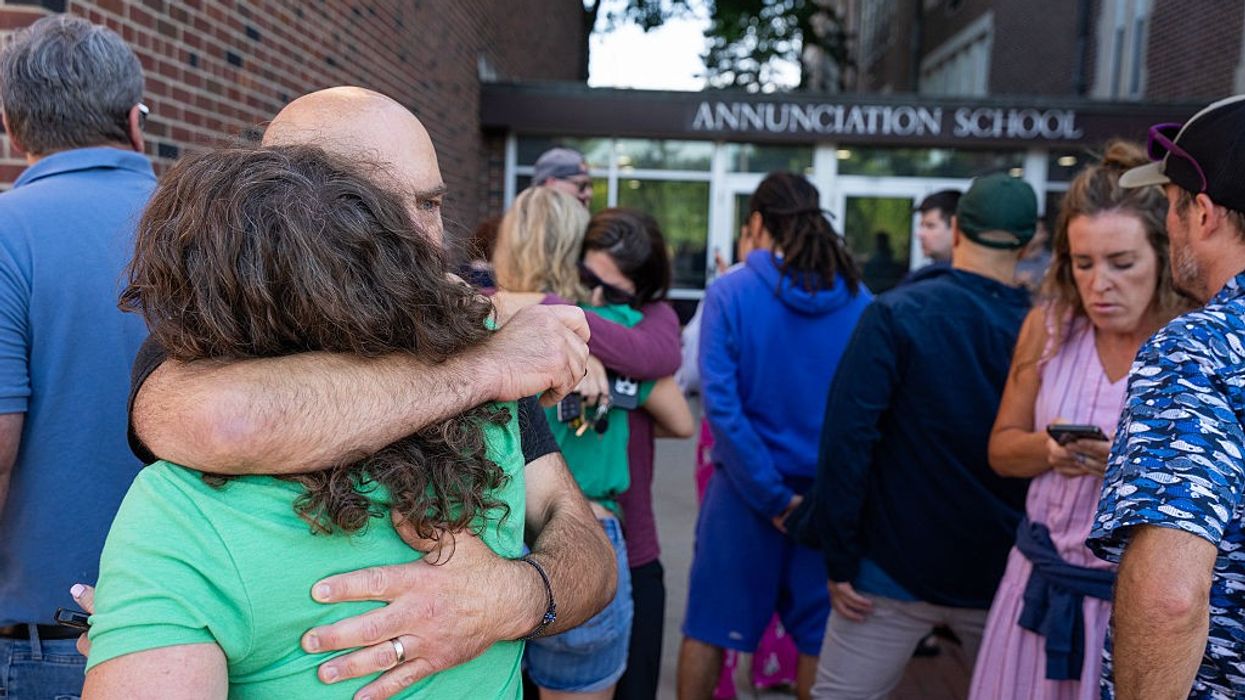
Two children—ages 8 and 10—were killed when a shooter fired through the windows of a church at the Annunciation Catholic School in Minneapolis on Wednesday morning. Another 17 people, including 14 more children, were also injured in the attack before the shooter died of a self-inflicted gunshot wound.
Minneapolis police say the shooter carried out the attack, which is now being investigated as an act of domestic terrorism, using three weapons: a rifle, a shotgun, and a pistol.
According to the Gun Violence Archive, not even eight months into 2025, there have already been 286 mass shootings—defined as cases in which four or more people are shot or killed—in the United States just this year, averaging more than one per day.
Gun violence is the number-one killer of children in the US, causing more deaths each year than car accidents, poisonings, and cancer. The victims of the shooting in Minneapolis join the more than 800 children killed and more than 2,200 injured by firearms this year.
Like dozens of mass shootings before it, Wednesday's deadly attack has stoked calls in Minnesota and around the country from Democratic lawmakers and gun control advocates for stricter gun laws, which have been repeatedly shot down by Republicans in Congress.
"We need better laws on the books nationally," said Minnesota's Democratic senator, Amy Klobuchar. "When you have so much access to guns right now and so many guns out there on the streets, you're going to continue to see these kinds of mass shootings."
"Don't just say this is about thoughts and prayers right now," said Minneapolis Mayor Jacob Frey. "These kids were literally praying. It was the first week of school. They were in a church."
"They should be able to go to school or church in peace without the fear or risk of violence, and their parents should have the same kind of assurance," Frey said. "These are the sort of basic assurances that every family should have every step of the day, regardless of where they are in our country."
Congress has not passed a significant piece of gun legislation since 2022, when it passed the Bipartisan Safer Communities Act in the wake of the horrific school shooting in Uvalde, Texas.
That law, which was supported by just 15 Republicans, introduced some modest reforms—including extended background checks for firearm purchasers under 21, funding for state red flag laws, and the closure of gun purchasing loopholes.
However, then-Senate Majority Leader Mitch McConnell (R-Ky.) only agreed to negotiate the bill if Democrats abandoned more ambitious reforms, such as bans on high-capacity magazines and universal background checks.
Since its passage, even this watered-down piece of legislation has been fought aggressively by Republican lawmakers backed by the gun industry's lobbying arm, the National Rifle Association, who have attempted to have it repealed.
Earlier this year, President Donald Trump ordered Attorney General Pam Bondi to present an action plan to reverse any law that the Department of Justice determines has "impinged on the Second Amendment rights of our citizens."
Through executive orders, Trump has rolled back efforts under the Biden administration to regulate ghost guns and enhance background checks.
The administration has also choked off more than $800 million in grants to local gun violence prevention groups and pushed for "concealed carry reciprocity" legislation, which would require all states to honor concealed carry permits issued by other states.
Instead of stricter gun control measures, Trump has personally advocated for schools to arm teachers and focus on improving mental healthcare—even as he's rolled back rules ensuring Americans have access to that care.
"Until we have more elected officials willing to place gun safety over allegiance to the gun lobby, more and more families will face unbearable suffering from random acts of violence," said Rep. Lloyd Doggett (D-Texas) on Wednesday. "Congress could—and should—pass stricter gun safety laws, but continues to cave to the gun lobby."
Rep. Pramila Jayapal (D-Wash.) added: "The United States continues to be the only country where school shootings are a regular occurrence. We must stop this epidemic of gun violence and finally put the lives of our kids first."
Other advocates noted the contrast between Trump's response to the imaginary "crime wave" in Washington, DC, where he has initiated a militarized takeover, and his lack of interest in fighting America's endless wave of gun violence.
"Guns are the leading cause of death for kids in the US," said Melanie D'Arrigo, the executive director of the Campaign for New York Health. "Trump will send the military into DC to pick up litter and arrest homeless people, but won't do a damn thing to end the gun violence epidemic killing our kids."
Charles Idelson, a former communications director for National Nurses United, said: "If Trump wants to pretend he is 'fighting crimes,' stop protecting the pro-gun violence cabal."
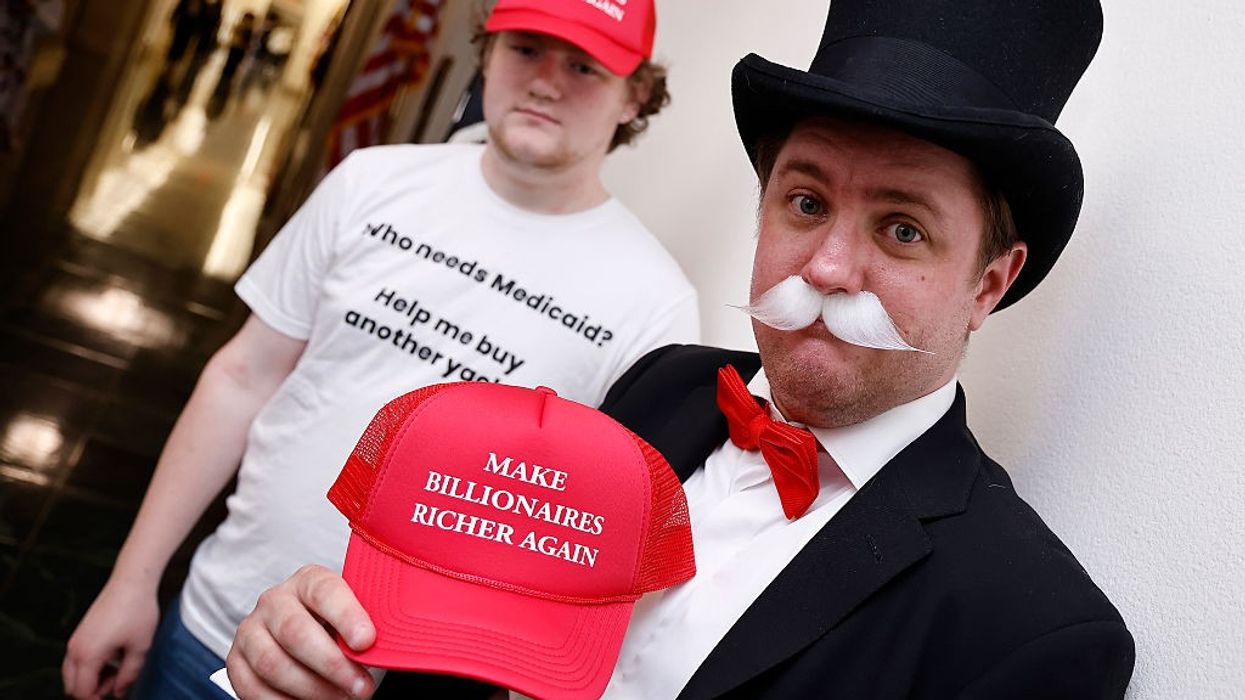
Well-off Americans have quietly conspired for over 40 years to transfer the riches to themselves, leading to a state of inequality that leaves the entire bottom half of our country with only about 2.5% of total national wealth.
The Trump administration wants us to believe that lower-income Americans, especially Medicaid recipients, are the biggest drain on the country's wealth. That couldn't be further from the truth.
Well-positioned Americans have quietly conspired for over 40 years to transfer the riches to themselves, leading to a state of inequality that leaves the entire bottom half of our country with only about 2.5% of total national wealth.
Whatever wealth exists among America's poor should not be taken away because of some ignorant prejudice of the rich. Following are some of the insidious effects of greed and blame-passing.
A Time report, referring to a Rand study, estimated that "the cumulative tab for our four-decade-long experiment in radical inequality... crossed the $50 trillion mark by early 2020."
To put $50 trillion in perspective, total U.S. wealth at the end of 2023 was about $150 trillion.
Elon Musk is leading the prospective trillionaires with over $400 billion at the end of June, 2025.
Yet with all this wealth rising to the top, American billionaires, according to economist Gabriel Zucman, have an effective tax rate of 8%.
In a blatant example of a system exploited by the wealthy, the tax code includes a so-called stepped-up provision which allows the super-rich to leave much of their multi-trillion-dollar stock market fortunes to their children with all the accumulated gains magically erased, and thus, in many instances, without a single dollar in taxes coming due.
It is estimated that by the middle of this century anywhere from $84 to $124 trillion in assets will be transferred to heirs, much of which will qualify for the tax-free stepped-up provision. So much for our meritocracy.
A Redfin report explains: "The combined value of nearly 100 million U.S. homes reached $49.7 trillion at the end of 2024, while the combined net worth of America's wealthiest 1% has grown to a record $49.2 trillion."
Oxfam summarizes: "The richest 1% of the world's population produced as much carbon pollution in 2019 than the 5 billion people who made up the poorest two-thirds of humanity."
After 40 years of growing inequality, the "Big Beautiful Bill" is about to make it even worse.
Almost 12 million Americans are expected to lose healthcare coverage with the trillion-dollar Medicaid cuts. Major health research cuts are planned for the National Institutes of Health and the Centers for Disease Control and Prevention.
Most damaging could be the impact on the kids. Even though nearly 1 out of 5 households with children in America experiences food insecurity, the administration is cutting the Supplemental Nutrition Assistance Program (SNAP) by a quarter-trillion dollars over the next decade. A Propublica report states: "The staff of a program that helps millions of poor families keep the electricity on, in part so that babies don't die from extreme heat or cold, have all been fired. The federal office that oversees the enforcement of child support payments has been hollowed out. Head Start preschools, which teach toddlers their ABCs and feed them healthy meals, will likely be forced to shut down en masse.."
And at a time when young students are struggling to deal with the pressures of a social networking society, the administration is cutting over a $1 billion in youth mental health funding.
The poor seem to have nowhere to turn. A Vera report explains: "Almost every state has at least one law that bans activities people experiencing homelessness engage in simply to survive. Laws that prohibit panhandling, loitering, living in vehicles, or sharing food and water in public spaces all discriminate against people experiencing homelessness, as authorities eject them from public spaces, confiscate and destroy their property, and transport them to mass shelters and jails."
U.S. Vice President JD Vance shrugged off the "minutiae of the Medicaid policy." President Donald Trump agreed that Republicans were "not doing any cutting of anything meaningful."
But just in case the cuts turn out to be meaningful for Americans, Sen. Mitch McConnell (R-Ky.) assures us that they'll "get over it."
In Trump's world of wealth and status, tolerance for poor Americans has turned into an ugly sense of disdain.
"If you're zip-tying grandmas protesting losing healthcare maybe you're not the good guys in the story?" quipped one critic.
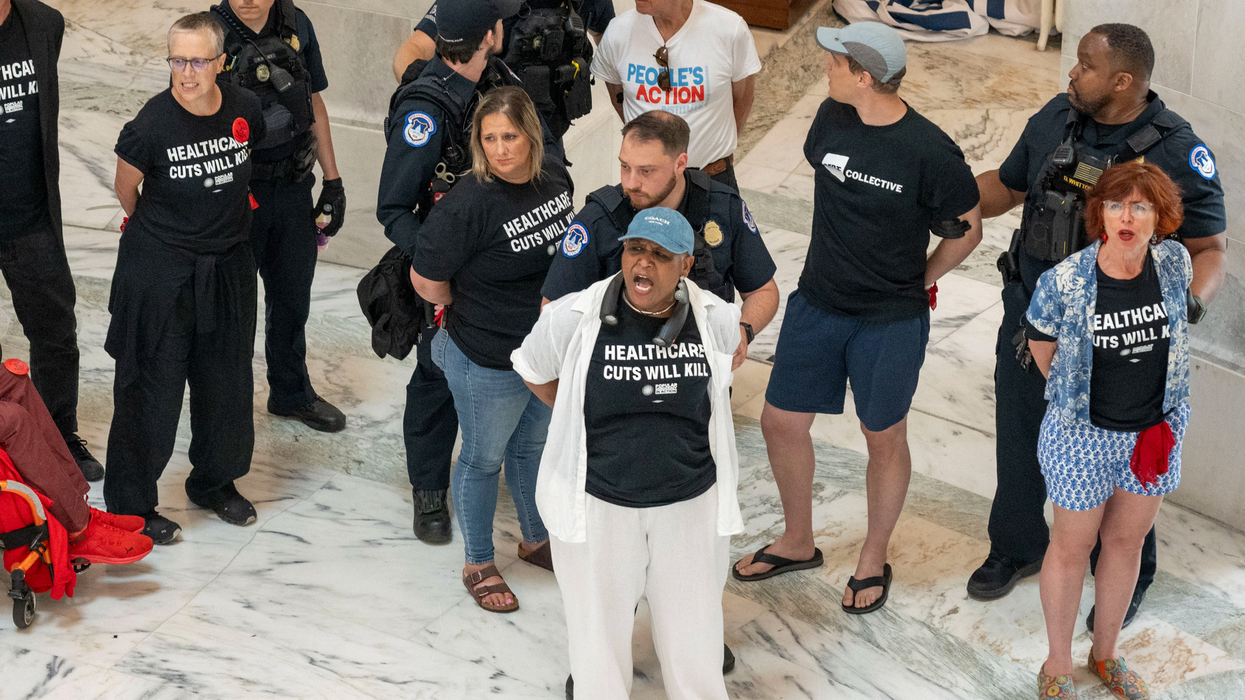
Dozens of peaceful protesters including people in wheelchairs were arrested inside a U.S. Senate building in Washington, D.C. on Wednesday while protesting Republicans' proposed cuts to Medicaid spending in the budget reconciliation package facing votes on Capitol Hill in the coming days.
The group Popular Democracy in Action said that "today, over 60 people were arrested in the Russell Senate Building Rotunda in a powerful act of nonviolent civil disobedience" against "cuts to essential social programs like Medicaid" and the Supplemental Nutritional Assistance Program, or SNAP.
Protesters were zip-tied and dragged from the building by police after demonstrators unfurled three large banners inside the rotunda with messages calling on lawmakers to protect Medicaid and other essential social programs. One of the banners read, "Senate Republicans Don't Kill Us, Save Medicaid."
If you’re zip-tying grandmas protesting losing health care maybe you’re not the good guys in the story?
[image or embed]
— The Tennessee Holler (@thetnholler.bsky.social) June 25, 2025 at 2:51 PM
The so-called One Big Beautiful Bill Act being pushed by U.S. President Donald Trump would slash federal Medicaid spending by billions of dollars, introduce work requirements for recipients, and impose other conditions that critics say would result in millions of vulnerable people losing their coverage in order to pay for a massive tax cut that would disproportionately benefit wealthy households and corporations.
"Nearly 80% of Americans support preserving and expanding Medicaid, yet this bill would do the opposite—slashing $880 billion from care to fund $4.5 trillion in tax breaks for billionaires," Popular Democracy in Action said in a statement. "Over 16 million people could lose coverage over the next decade if the proposed spending bill passes, and new work requirements threaten to strip lifesaving care from those who need it most."
Popular Democracy in Action said Wednesday's press conference, which preceded the civil disobedience, "underscored the urgent need for Congress to divest from endless wars abroad and invest in our communities at home. Participants have one clear message for Senators currently debating the bill: 'We need to kill this bill, before it kills us all.'"
"Nearly 80% of Americans support preserving and expanding Medicaid, yet this bill would do the opposite."
In addition to Popular Democracy in Action, groups including the Service Employees International Union, Planned Parenthood Federation of America (PPFA), Debt Collective, Stand Up Alaska, Action NC, Arkansas Community Organizations, and American Disabled for Attendant Programs Today (ADAPT) took part in Wednesday's protest, which followed similar past actions in defense of Medicaid.
"Yesterday was the three-year anniversary of the deadly, disastrous Dobbs decision that has literally put our lives on the line," PPFA president and CEO Alexis McGill Johnson said at the protest. "In this big, bad betrayal of a bill there is a provision to defund Planned Parenthood."
"Half of our patients rely on Medicaid to get access to care. What they would do, is put at risk a third of all of our health centers, and there's nowhere for our patients to go to be absorbed into the system," she continued. "That puts at risk access to contraception, breast exams, cancer exams, wellness exams, access to STI testing and treatment—just to give billionaires a tax break."
"And here's a kicker, for the 1 million patients who rely on that care, 90% of those health centers are in states with abortion access," McGill Johnson added. "So we need to call this what it is: a backdoor abortion ban."
Earlier in the day members of these groups were joined at a press conference by U.S. Sens. Chris Murphy (D-Conn.) and Ron Wyden (D-Ore.), who condemned the GOP bill.
"I'm the point person for the Democrats in this fight—and it's the most important fight I've ever been in, because this battle this week is going to determine the future of American healthcare," said Wyden. "Are you for caviar or kids? Mar-a-Lago or the middle class? Hedge funds or healthcare? I know what side you're on—now we have got to make sure that a whole lot of Senate Republicans make the right choice too."
While it is uncertain how many—if any—upper chamber Republicans will oppose the bill, more than a dozen House GOP lawmakers claimed Tuesday that they would not back the Senate's version of the legislation due to Medicaid cuts.
Both chambers of Congress are scheduled to recess for the July 4th holiday next week. Trump is pushing lawmakers to vote on the package before the break. Under reconciliation rules, both chambers must pass identical versions of the legislation.
Most proponents of the bill are determined to pass it with the Medicaid cuts. Sen. Mitch McConnell (R-Ky.) said Tuesday that "failure is not an option."
"I know a lot of us are hearing from people back home about Medicaid," McConnell noted. "But they'll get over it."
#WeWontGetOverLosingMedicaidRepublicans don’t GAF about us…📌 Today, Capitol Police are threatening to arrest people in wheelchairs.📌 Yesterday, McConnell said “failure is not an option” and this…
[image or embed]
— Christopher Webb (@cwebbonline.com) June 25, 2025 at 11:59 AM
Participants in Wednesday's protest vowed to keep battling to preserve Medicaid.
"The stuff we're fighting for, the kind of healthcare, long-term services, housing, well-paid work with paid days off and benefits—those are the things we've fought for for 50 years," said Mike Oxford of ADAPT. "We've been fighting for years... we're not backing down."
Democrats "should be blowing past McConnell-level obstruction in a way that makes it look like business as usual," said one commentator.
Democrats took turns speaking on the floor of the U.S. Senate into the early hours of Thursday morning in a show of opposition to President Donald Trump's pick to lead the White House budget office and the new administration's lawless broadside against key federal agencies—an assault led by unelected billionaire Elon Musk.
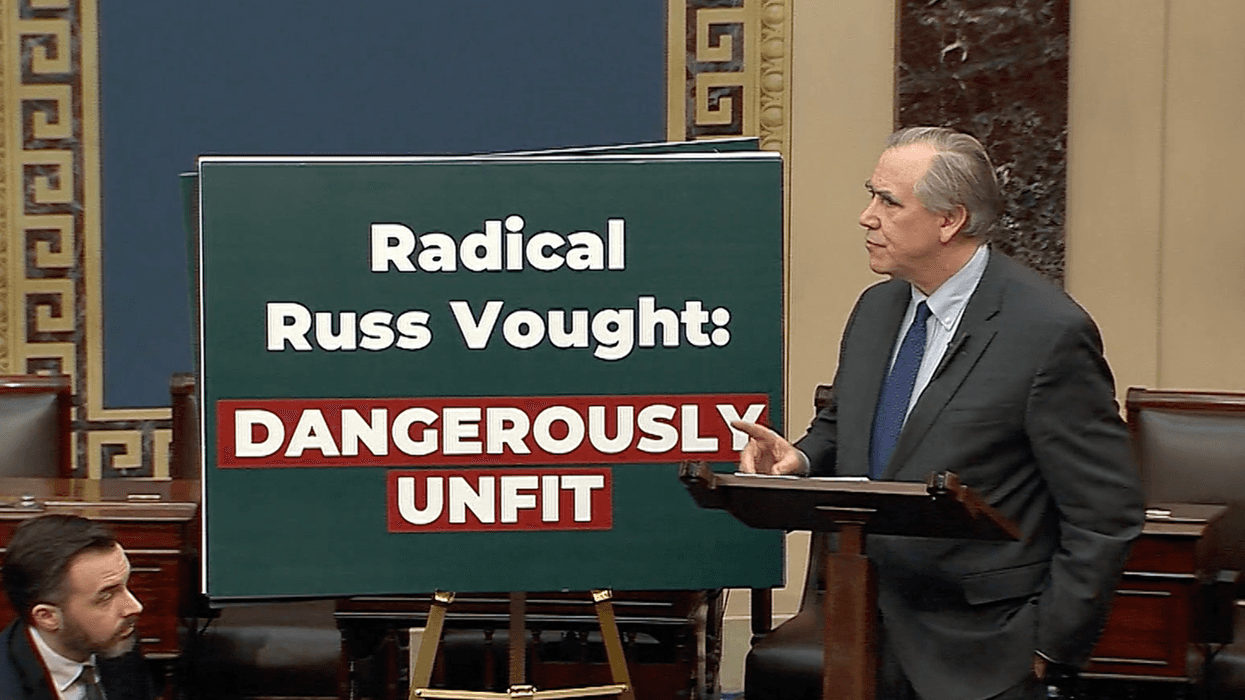
Facing growing pressure to use every tool available to obstruct an administration that they have characterized as authoritarian, Democratic senators are expected to take up all 30 hours of debate on Russell Vought, a right-wing extremist and Project 2025 architect who is poised to take charge of the Office of Management and Budget.
Unless Democrats give in and grant unanimous consent (UC) to end debate—as they've done with other Trump nominees in recent days—a vote on Vought's confirmation won't take place until Thursday evening. As of this writing, the Democratic speeches are still going.
"Americans voted each of us into office to fight for them," Sen. Elizabeth Warren (D-Mass.) said after speaking on the Senate floor for an hour late Wednesday. "They do not expect us to roll over and play dead."
Sen. Jeff Merkley (D-Ore.) used his floor speech to spotlight what he described as Vought's plan to "gut programs for working families" and "give massive tax giveaways to billionaires."
Watch @SenJeffMerkley lay out Project 2025 Architect and OMB Director nominee Russell Vought’s three-step plan to:
Gut programs for working families
Borrow trillions and run up debt
Give massive tax giveaways to billionaires pic.twitter.com/2oasfZJvfv
— Senate Democrats (@SenateDems) February 5, 2025
For experts and activists who have been urging the minority party to put up a fight in the face of Trump and Musk's destructive rampage through the federal government, the marathon protest against Vought's nomination was a positive sign—but not at all sufficient.
"This is a start but, to be clear, still nowhere close to maximum obstruction," Andy Craig, an election policy fellow at the Rainey Center, wrote on social media. "No UC, on anything. No unrecorded votes, on anything. No waiving rules, on anything. Fight even on adjournments. Quorum calls every time you can. Make every dilatory motion in the books and new ones you just made up."
"If you're not miserable every day with long hours and tedious constant votes, you're not making them miserable, either," Craig added. "Make them miserable."
While Democrats don't have the votes in the Senate to tank Trump nominees, they can severely derail the chamber's day-to-day functions in many ways. The progressive advocacy group Indivisible lists a number of them:
"The easy way to think about this is when you're going and talking to your Democratic senator, you say 'Hey, imagine you are Mitch McConnell in the minority, and then do what that asshole would do,'" Indivisible co-executive director Ezra Levin said at a rally earlier this week.
But Craig argued late Wednesday that Democrats "should be blowing past McConnell-level obstruction in a way that makes it look like business as usual," including by breaking Senate rules.
"Mitch didn't do even 1% of what could be done by a minority determined to keep the Senate grinding in circles getting absolutely nothing done," Craig wrote.
"He won't have to worry about medical bills or skipping tests because he has high-quality, government-funded healthcare—the thing he's fought to deny the rest of us," said one single-payer campaigner.
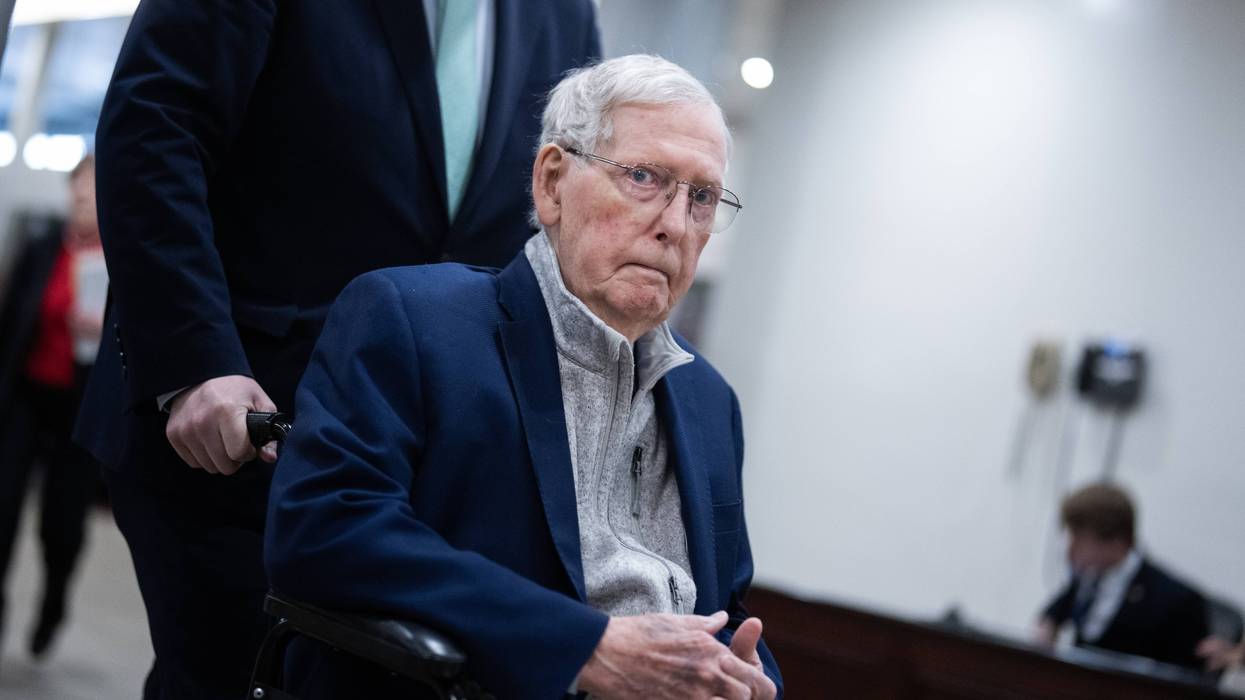
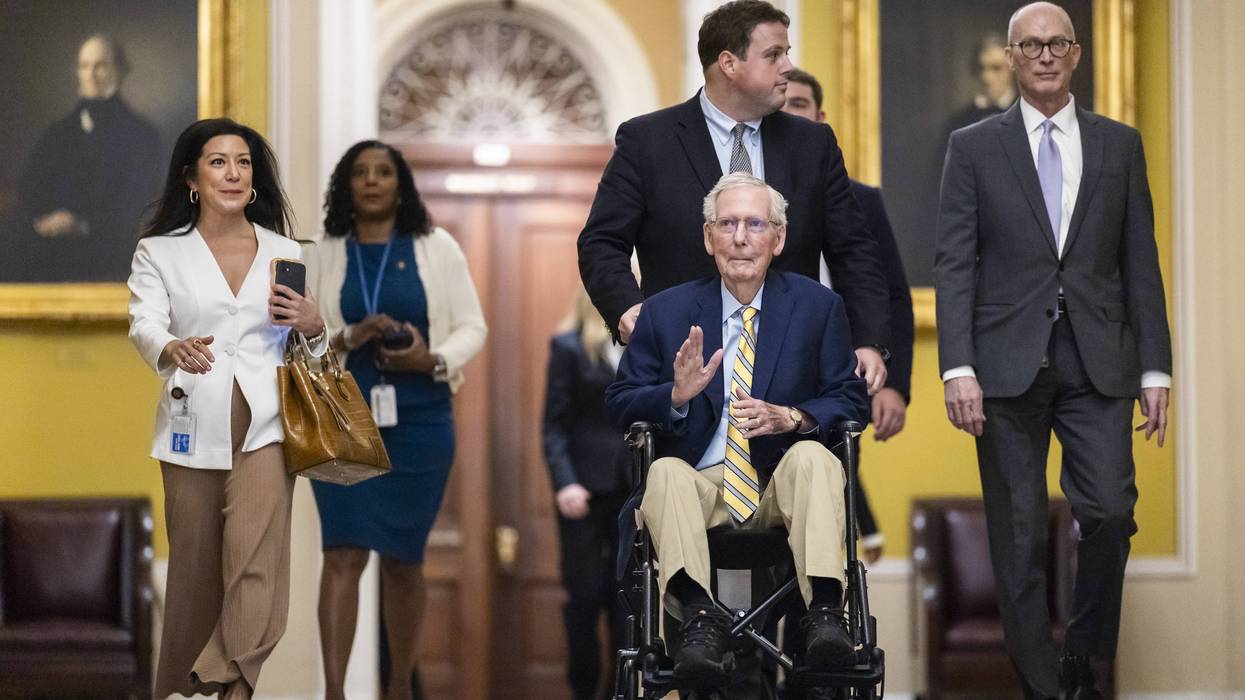
U.S. Sen. Mitch McConnell reportedly fell twice on Capitol Hill Wednesday, but as one healthcare advocate highlighted, the 82-year-old Kentucky Republican—who's called Medicare for All a "radical scheme" that "would be serious bad news for America's hospital industry"—won't struggle to get any needed treatment.
"Mitch McConnell fell again and is obviously not well," said Melanie D'Arrigo, executive director of the Campaign for New York Health—which fights for universal, single-payer healthcare—on social media.
"But he won't have to worry about medical bills or skipping tests because he has high-quality, government-funded healthcare—the thing he's fought to deny the rest of us," D'Arrigo added. "We need Medicare for All."
Punchbowl News' John Bresnahan and Max Cohen reported Wednesday that McConnell fell while exiting the Senate chamber, then fell again while entering a Republican lunch.
A spokesperson for the former majority leader told Bresnahan—and various other journalists—that "Sen. McConnell is fine. The lingering effects of polio in his left leg will not disrupt his regular schedule of work."
McConnell contracted polio as a toddler in 1944, according to The Associated Press. His leg was paralyzed, but after two years of treatment, he was ultimately able to walk without a brace.
After the senator's Wednesday falls, Bresnahan said that "McConnell is using a wheelchair as a precautionary measure, we're told."
The Affordable Care Act (ACA) requires members of Congress to obtain coverage via the D.C. Health Link Small Business Market, according to the U.S. Office of Personnel Management, the federal government's human resources agency. For lawmakers with Medicare, the federal health program for American seniors serves as a "secondary payer."
The federal government covers up to three-quarters of the premium for lawmakers' primary health plans, according to a Congressional Research Service report from 2017. Another CRS report from last June points out that "in addition, the Office of the Attending Physician provides emergency medical assistance for members of Congress, justices of the Supreme Court, staff, and visitors. Additional services are offered to members who choose to enroll for an annual fee ($650.00 in 2023)."
Meanwhile, tens of millions of Americans don't have adequate health plans or lack coverage altogether. Citing the U.S. Census Bureau, the Commonwealth Fund's November 2024 report on its biennial health insurance survey notes that "an estimated 26 million Americans, or 8% of the U.S. population, lacked health insurance in 2023," and although the United States is still behind countries with universal coverage, before the ACA, 49 million, or 16% of the population, didn't have any coverage.
The U.S.-based Commonwealth Fund found that "nearly a quarter of working-age adults have insurance that leaves them underinsured," and two-thirds of those individuals had coverage through an employer plan. The survey also shows that people who were uninsured or underinsured often did not fill prescriptions, get recommended care, or visit a needed doctor or specialist.
Another survey, released Tuesday by Emory University's Rollins School of Public Health and Gallup, highlights that healthcare access and affordability is a leading priority for the American public, and a majority wants the federal government to act.
"Americans ranked improving healthcare access and affordability as the highest public health priority for government leaders to address out of 15 options," states a report from the pollsters. "One in four in the U.S. selected this issue as their highest priority and more than half (52%) rated it as their first, second, or third priority."
"Majorities of both Republicans and Republican leaners, and Democrats and Democratic leaners, chose the federal government over state government as the more effective force for addressing each of the issues that emerged as a top priority for them," adds the report—which comes as the Trump administration and billionaire Elon Musk attack the federal government.
Despite public opinion polling, President Donald Trump and the Republican majorities in Congress—who have long tried to restrict or fully roll back the ACA—aren't expected to work to expand health coverage, particularly via progressive proposals like Medicare for All, which has been championed on Capitol Hill by Sen. Bernie Sanders (I-Vt.) and Rep. Pramila Jayapal (D-Wash.).
Still, advocates of Medicare for All
continue to call for it. As Sanders said Monday on Musk-owned X: "The U.S. spends 2x more per capita on healthcare than any other nation. Yet 85 million are uninsured or underinsured, 68,000 die because they can't afford a doctor, and we pay the highest prices in the world for Rx drugs. Healthcare is a human right. We must pass Medicare for All."
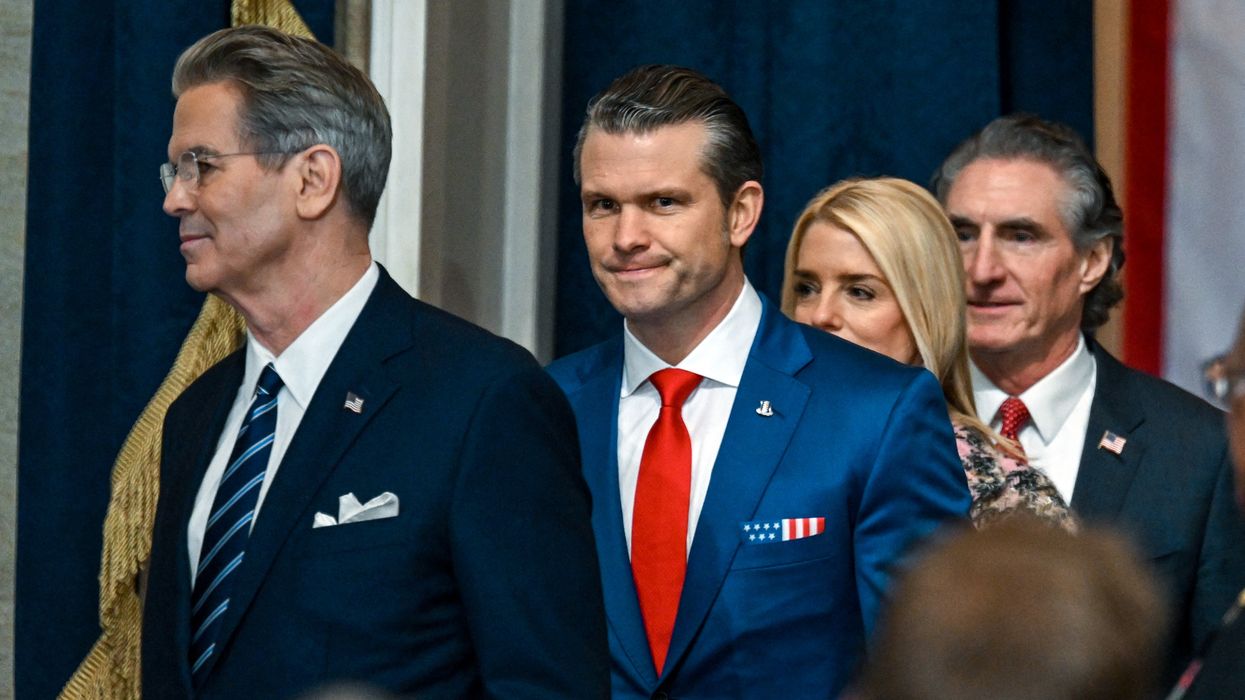
Pete Hegseth was confirmed as secretary of defense by the Senate on Friday, with all but three Republican senators—Susan Collins of Maine, Lisa Murkowski of Alaska, and Mitch McConnell of Kentucky—voting him through.
Pete Hegseth—U.S. President Donald Trump's controversial pick to lead the Pentagon—was narrowly confirmed as secretary of defense late Friday, despite a confirmation process that was rocked by allegations of sexual assault, sexist behavior, and more that critics warned made him unqualified and unfit to lead the country's largest federal agency.
"Hegseth is such a monster—just depressing for us all," wrote David Duhalde, the chair of the Democratic Socialists of America Fund on X following the Senate's confirmation of Hegseth, an army veteran and former Fox News co-host.
Hegseth was sworn in to the position on Saturday morning.
Vice President JD Vance cast a tie breaking vote to get Hegseth over the line after Sen. Mitch McConnell (R-Ky.), Sen. Lisa Murkowski (R-Alaska), and Sen. Susan Collins (R-Maine) joined all of the body's Democratic and Independent senators in opposing his nomination. This was only the second time that a vice president has broken a tie for a cabinet nominee, according to CNN. The other time was when Betsy DeVos faced her 2017 Senate confirmation for Secretary of Education.
McConnell—who according to NBC News was among a group of GOP members who expressed reservations about Hegseth, but voted for an earlier procedural motion to allow Hegseth's nomination to advance to a final vote—issued a lengthy statement following his confirmation.
"Effective management of nearly 3 million military and civilian personnel, an annual budget of nearly $1 trillion, and alliances and partnerships around the world is a daily test with staggering consequences for the security of the American people and our global interests," McConnell wrote. "Mr. Hegseth has failed, as yet, to demonstrate that he will pass this test. But as he assumes office, the consequences of failure are as high as they have ever been."
Sen. Tammy Duckworth (D-Ill.), who lost both her legs while deployed to Iraq in 2004, issued a statement following the vote, writing, "it is deeply shameful that tonight—despite shouting from the rooftops that they wanted to bring meritocracy back to our military—nearly every Republican chose to confirm someone who so obviously lacks the merits to serve as our Secretary of Defense," according to Fox 32 Chicago.
"Pete Hegseth's confirmation will make our nation less safe," wrote Sen. Elizabeth Warren (D-Mass.) in a statement Friday. "His confirmation is a slap in the face to the quarter of a million active duty women in our military... Too few Republican leaders stood up for them."
"Republican Senators approved an unqualified nominee with a long history of alleged substance abuse, sexual harassment, and assault," she added.
Hegseth was able to secure the nomination despite multiple, explosive allegations that came to light during his nomination process. In November 2024, The Washington Post reported that Hegseth paid a woman who accused him of sexually assaulting her in 2017 as part of a nondisclosure agreement, though according to Hegseth their encounter was consensual. In December, The New Yorker reported that a whistle-blower report and other documents suggest that Hegseth was forced out of leadership positions due to sexist behavior, financial mismanagement, and being drunk on the job. Hegseth's former sister-in-law also provided the Senate Armed Services Committee with an affidavit earlier this week accusing him of being abusive toward one of his ex-wives. Hegseth has denied the allegations in the affidavit.
Hegseth has also come under scrutiny for making comments in the past that women should not serve in combat roles.
Tony Carrk, the executive director of the watchdog group Accountable.US, slammed the GOP senators who voted Hegseth through, writing, "this confirmation shows that most Republican Senators are willing to rubber-stamp the lowest common denominator from the Trump administration even when it puts everyday Americans in harm's way. That’s terrifying."
Defense against dangerous epidemic outbreaks requires constant vigilance. With Robert F. Kennedy Jr. and Donald Trump headed to Washington, D.C., we are entering very troubling territory.
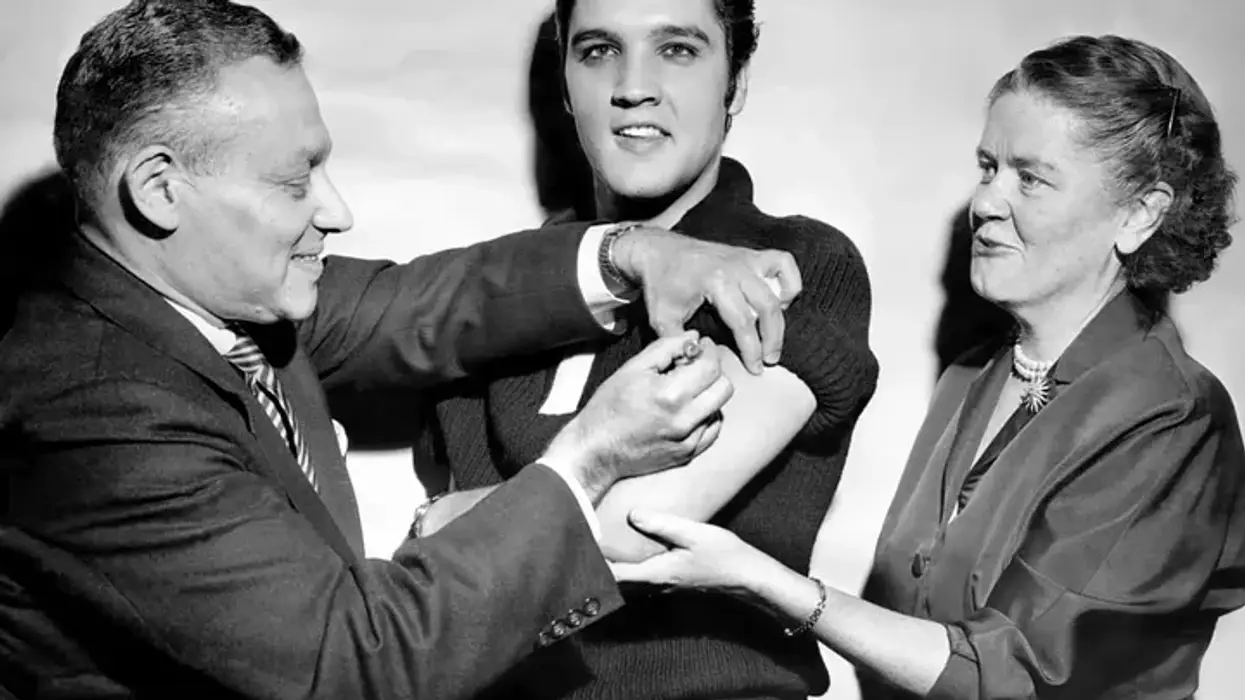
Elvis Presley hardly seems a likely candidate for the pantheon of public health heroes. But in October 1956 the ascending rock idol lent his considerable stardom to helping save lives.
His little remembered role is a cautionary tale as incoming President Trump advances a series of farright and unqualified appointees to major public agencies. The most dangerous is likely to be conspiracy theorist Robert Kennedy Jr. as Secretary of Health and Human Services, augmented by like-minded, perilous public health heads of the Centers for Disease Control and Prevention (CDC), Centers for Medicare and Medicaid Services (CMS), National Institutes of Health (NIH), Federal Drug Administration (FDA), and his choice for Surgeon General.
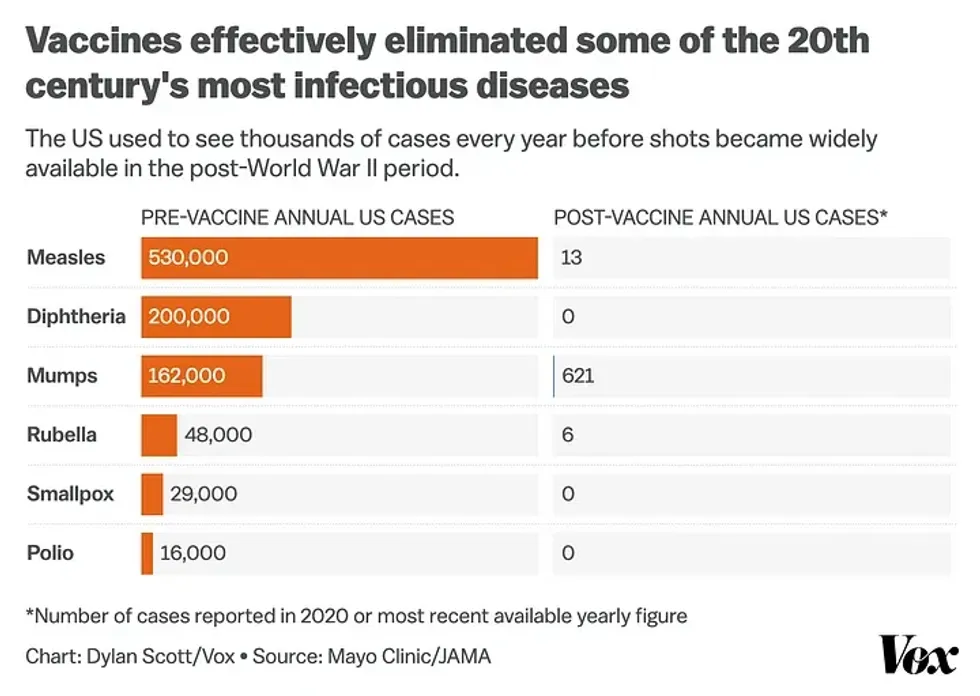
For a century, polio epidemics made it one of the world’s most terrifying diseases. A 1916 outbreak in New York City killed over 2,000 people; another in the U.S. in 1952 claimed over 3,000. Children were especially targeted, over 60,000 infected yearly, facing lifelong severe spinal injuries requiring braces, crutches, and wheelchairs, and the dreaded iron lung, an artificial respirator, or premature death.
Wealth and status proved no barrier, as evidenced by President Franklin Roosevelt who was diagnosed at age 39 in 1921 with polio and endured it the rest of his life. What was a safeguard was the first vaccine, developed by virologist/medical researcher Jonas Salk. The announcement on April 12, 1955 by University of Michigan School of Public Health scientist Thomas Francis, Jr., who declared it “safe, effective, and potent,” was greeted as a national celebration, spread rapidly over radio, television, and wire services.
Parents lined up to vaccinate their young children, plenty did not. Teen immunization levels stagnated at just 0.6 percent. Enter Elvis. He agreed to go on the popular Ed Sullivan TV show, not to sing, but to get publicly vaccinated, viewed by millions. Vaccination rates among American youth soared to 80 percent in just six months. Overall annual cases of polio plummeted within a year from 58,000 to 5,600. By 1961, only 161 cases remained. After an oral vaccine followed, polio disappeared in the U.S. completely.
Yet polio never vanished globally, especially in underdeveloped nations, as in Africa, and in war zones, including in Gaza today—driven by Israel’s decimation of public health protections during its catastrophic and ongoing assault. In 2022, the first U.S. case in decades was reported by the New York State Department of Health.
Defense against dangerous epidemic outbreaks requires constant vigilance, and public support for full embrace of public health safety measures, including vaccinations. The experience of Trump’s first tenure is far from reassuring, especially his abominable failure in the face of Covid-19, the worst global pandemic in a century which ultimately cost the lives of over 1.2 million Americans.
Initial skepticism over the polio vaccine has a long antecedent in the U.S., described early in the Covid pandemic by what Los Angeles Times writer Carolina Miranda aptly termed “toxic individualism” and rugged individualism. It is traceable to a virulent brew of misguided notions of individual liberty that undermine and sabotage the public good, or a commons of national and community interest. Much of its roots are linked to structural racism, as in the resistance to Civil Rights Movement measures, and continuing today in white opposition to reforms such as expansion of health care and other public programs, immigration rights, and other societal benefits.
That history provides context for the eruption of the anti-vax, anti-public health measures that exacerbated and prolonged Covid suffering and death and seeded the ground for opposition to other essential vaccines. It’s true, as medical ethicist Arthur Caplan writes, that much of “the damage to getting Americans to vaccinate has already been done… There are almost no serious state mandates for childhood vaccines. Parents who want to opt out are easily doing so, as can be seen by the resurgence in measles and whooping cough. Nearly 40% of teenagers are not up to date on the HPV vaccine even as Australia and Scotland are on the verge of eliminating cervical cancer thanks to serious immunization campaigns.”
Further, he adds “Democrats avoided vaccination as an issue this election year because they knew that, post Covid, vaccination has become something of a political third rail. Could Kennedy and [CMS nominee Dr. Mehmet] Oz make things worse—absolutely. But are matters already bad—sadly, yes.”
The Kennedy-Trump threat
Yet Kennedy and his coterie of other department heads can make matters much worse. With the imprimatur of a President-elect already lionized by an often-fawning base will likely discourage more resistance to vaccines that can turn schools into major disease vectors and hasten the spread of new epidemics sure to come.
Even in the wake of Covid, Kennedy, with his power as HHS Secretary has said he would pause NIH’s drug development and infectious disease research and shift its focus to chronic diseases that do need attention but not at the expense of combating global epidemics.
Kennedy has also indicated a desire to shutter “entire” FDA departments, which oversee safety and effectiveness of prescription drugs and vaccines. And he has threatened to purge FDA staff for “aggressive suppression” of unsafe products and therapies, such as raw milk, and discredited COVID treatments, including hydroxychloroquine.
There’s his lurid, scientifically refuted linkage of vaccines to autism and other conspiracies, such as his claim that Covid was bioengineered to exempt Chinese people, already targeted by Trump rhetoric that fueled hate crimes, and Ashkenazi Jews of Eastern Europe origin, reinforcing right-wing antisemitic bigotry.
And that’s not including his attack on fluoride in drinking water which promotes oral health, as cited in a letter by 77 Nobel Prize winners opposing Kennedy, or his speculated doubt that HIV causes AIDS and the effectiveness of AZT therapy.
Anti-vax consequences
Still, it is his fanaticism on vaccines that prompts the most alarm.
During the COVID-19 epidemic, Children’s Health Defense, a group Kennedy founded and led, petitioned the FDA to halt the use of all COVID vaccines. In a 2023 podcast, Kennedy proclaimed there is “no vaccine that is safe and effective,” and disputed CDC’s guidelines about if and when kids should get vaccinated.
The implications are alone enough for a mass movement to escalate pressure to block confirmation of Kennedy, and Trump’s nominees to lead the CDC, CMS, FDA, NIH and Surgeon General who mostly share his chilling views on vaccine safety. Multiple studies document what is at stake.
The World Health Organization estimates vaccines have protected 150 million lives over the past 50 years, and that 100 million were infants. About 4 million deaths worldwide are prevented by childhood vaccination every year. More than 50 million deaths can be prevented through immunization between 2021 and 2030. By 2030, it is estimated that measles vaccination alone can save nearly 19 million lives.
In November 2013, University of Pittsburgh researchers issued a similar study. It documented that about 103 million cases of disease had been prevented by vaccination since 1924. The disease with the most cases prevented was diphtheria, 40 million cases. Second was measles, 35 million cases.
Globally, reported Scientific American, measles vaccines, preserved 94 million lives over the past 50 years. It cited a 2024 Lancet study published in October that vaccines against 14 common pathogens protected 154 million people over the past five decades—that's a rate of six lives every minute. They have cut infant mortality by 40 percent globally and by more than 50 percent in Africa. Throughout history vaccines secured more lives than almost any other intervention.
Lancet found that each life defended through immunization contributed to 66 years of full health, without long-term linked to disease. Vaccines impact nearly every measurement of health equity, from improving access to care, to reducing disability and long-term morbidity, to preventing loss of labor and the death of caretakers.
Writing in Forbes, hardly a left-wing Trump critic, earlier this year, ER doctor/health researcher Arthur Kellerman also cited the Pittsburgh study, as well as Johns Hopkins data of nearly 88 million cases of illness. In 1900, he wrote, 30 percent of deaths in the U.S. occurred in children under 5 years of age. In 1999, they accounted for only 1.4 percent. "Vaccines," he concluded, "played a vital role in this progress.”
Measles, a highly contagious childhood disease that can lead to pneumonia and fatal brain swelling, declined rapidly after the first measles vaccine was introduced in 1963. But, the CDC cites 16 measles outbreaks in 2024. Kennedy’s alleged role in promoting vaccine misinformation during a deadly measles outbreak in American Samoa in 2019, which he denies, has also been widely reported. Unvaccinated families, writes Kellerman, “tend to cluster in communities defined by faith, culture or political ideology. When a highly contagious disease gets into such a community, an outbreak can occur. We’ve already seen localized outbreaks of measles, rubella, mumps, and pertussis.”
In 2022, Kennedy’s attorney and close advisor Aaron Siri petitioned the FDA to revoke approval of the polio vaccine for further study despite its long history of success.
Republican Senate Majority Leader Mitch McConnell, who endured polio as a child, has denounced the push “to undermine public confidence in proven cures” like the polio vaccine. Only a “miraculous combination of modern medicine and a mother’s love” saved him from paralysis he said in a statement. “The polio vaccine has saved millions of lives and held out the promise of eradicating a terrible disease. Efforts to undermine public confidence in proven cures are not just uninformed—they’re dangerous,” McConnell said.
Yet McConnell, and similar Republican critics have yet to publicly oppose Kennedy and his similar malefactors of health (to borrow FDR’s “malefactors of wealth” frame).
We can no longer count on Elvis to protect our children, families and communities. It is up to the rest of us.
"I think it's time to tell the military-industrial complex they cannot get everything they want," said Sen. Bernie Sanders. "It's time to pay attention to the needs of working families."
U.S. Sen. Bernie Sanders on Monday derided those of his colleagues who claim it's too expensive for the federal government to take ambitious action on national crises in housing and healthcare while simultaneously supporting a military budget that's approaching $1 trillion a year.
"I find it amusing that any time we come to the floor and members point out that we have a housing crisis, that we have some 600,000 Americans who are homeless, that we have millions and millions of people in this country spending 40, 50, 60% of their limited incomes on housing and that we need to invest in low-income and affordable housing, what I hear is, 'We don't have the money,'" Sanders (I-Vt.) said on the floor of the Senate.
"When we talk about increasing Social Security benefits, well, 'we just can't afford to do that. We just can't afford to expand Medicare to cover dental, hearing, or vision. We just cannot afford to make higher education in America affordable.' That's what I hear every single day. When there's an effort to improve life for the working class of this country, I hear, 'No, no, no, we can't afford it.' But when it comes to the military-industrial complex and their needs, what we hear is 'yes, yes, yes' with almost no debate."
Watch Sanders' full remarks:
Sanders' floor speech came shortly before the Senate—in an overwhelming bipartisan vote of 83-12—advanced the $895 billion National Defense Authorization Act (NDAA) for Fiscal Year 2025. Sanders was among the dozen senators who voted no.
The legislation, which would authorize roughly $850 billion for the Pentagon despite its inability to pass an audit, is expected to pass the Senate as early as Wednesday.
Outgoing Senate Minority Leader Mitch McConnell (R-Ky.), who has openly celebrated the federal government's prioritization of military spending over social programs, wrote for Foreign Affairs ahead of Monday's vote that the roughly $900 billion the U.S. spends annually on its military is "not nearly enough" and urged the incoming Trump administration to "commit to a significant and sustained increase in defense spending."
According to the National Priorities Project, militarized funding such as the Pentagon budget, foreign military aid, and nuclear weapons programs already account for close to two-thirds of all federal discretionary spending, resulting in "consistent under-investment in human needs."
In his floor speech on Monday, Sanders said that "when it comes to the needs of the military-industrial complex and their lobbyists and that industry which makes millions in campaign contributions, we give them what they want, despite the overwhelming evidence of waste and fraud."
"I think it's time to tell the military-industrial complex they cannot get everything they want," the senator added. "It's time to pay attention to the needs of working families."
A previous version of this article misquoted Sen. Bernie Sanders' remarks on homelessness in the United States.
"So if you're wondering if Donald Trump is trying to kill your kids, yes, yes he is," said one critic.
Public health advocates, federal lawmakers, and other critics responded with alarm to The New York Times reporting on Friday that an attorney helping Robert F. Kennedy Jr. select officials for the next Trump administration tried to get the U.S. regulators to revoke approval of the polio vaccine in 2022.
"The United States has been a leader in the global fight to eradicate polio, which is poised to become only the second disease in history to be eliminated from the face of the earth after smallpox," said Liza Barrie, Public Citizen's campaign director for global vaccines access. "Undermining polio vaccination efforts now risks reversing decades of progress and unraveling one of the greatest public health achievements of all time."
Public Citizen is among various organizations that have criticized President-elect Donald Trump's choice of Kennedy to lead the Department of Health and Human Services, with the watchdog's co-president, Robert Weissman, saying that "he shouldn't be allowed in the building... let alone be placed in charge of the nation's public health agency."
Although Kennedy's nomination requires Senate confirmation, he is already speaking with candidates for top health positions, with help from Aaron Siri, an attorney who represented RFK Jr. during his own presidential campaign, the Times reported. Siri also represents the Informed Consent Action Network (ICAN) in petitions asking the Food and Drug Administration (FDA) "to withdraw or suspend approval of vaccines not only for polio, but also for hepatitis B."
According to the newspaper:
Mr. Siri is also representing ICAN in petitioning the FDA to "pause distribution" of 13 other vaccines, including combination products that cover tetanus, diphtheria, polio, and hepatitis A, until their makers disclose details about aluminum, an ingredient researchers have associated with a small increase in asthma cases.
Mr. Siri declined to be interviewed, but said all of his petitions were filed on behalf of clients. Katie Miller, a spokeswoman for Mr. Kennedy, said Mr. Siri has been advising Mr. Kennedy but has not discussed his petitions with any of the health nominees. She added, "Mr. Kennedy has long said that he wants transparency in vaccines and to give people choice."
After the article was published, Siri called it a "typical NYT hit piece plainly written by those lacking basic reading and thinking skills," and posted a series of responses on social media. He wrote in part that "ICAN's petition to the FDA seeks to revoke a particular polio vaccine, IPOL, and only for infants and children and only until a proper trial is conducted, because IPOL was licensed in 1990 by Sanofi based on pediatric trials that, according to FDA, reviewed safety for only three days after injection."
The Times pointed out that experts consider placebo-controlled trials that would deny some children polio shots unethical, because "you're substituting a theoretical risk for a real risk," as Dr. Paul A. Offit, a vaccine expert at the Children's Hospital of Philadelphia, explained. "The real risks are the diseases."
Ayman Chit, head of vaccines for North America at Sanofi, told the newspaper that development of the vaccine began in 1977, over 280 million people worldwide have received it, and there have been more than 300 studies, some with up to six months of follow-up.
Trump, who is less than six weeks out from returning to office, has sent mixed messages on vaccines in recent interviews.
Asked about RFK Jr.'s anti-vaccine record during a Time "Person of the Year" interview published Thursday, the president-elect said that "we're going to be able to do very serious testing" and certain vaccines could be made unavailable "if I think it's dangerous."
Trump told NBC News last weekend: "Hey, look, I'm not against vaccines. The polio vaccine is the greatest thing. If somebody told me to get rid of the polio vaccine, they're going to have to work real hard to convince me. I think vaccines are—certain vaccines—are incredible. But maybe some aren't. And if they aren't, we have to find out."
Both comments generated concern—like the Friday reporting in the Times, which University of Alabama law professor and MSNBC columnist Joyce White Vance called "absolutely terrifying."
She was far from alone. HuffPost senior front page editor Philip Lewis said that "this is just so dangerous and ridiculous" while Zeteo founder Mehdi Hasan declared, "We are so—and I use this word advisedly—fucked."
Ryan Cooper, managing editor at The American Prospect, warned that "they want your kids dead."
Author and musician Mikel Jollett similarly said, "So if you're wondering if Donald Trump is trying to kill your kids, yes, yes he is."
Multiple critics altered Trump's campaign slogan to "Make Polio Great Again."
U.S. Sen. Elizabeth Warren (D-Mass.) responded with a video on social media:
Without naming anyone, Senate Minority Leader Mitch McConnell (R-Ky.), a polio survivor, put out a lengthy statement on Friday.
"The polio vaccine has saved millions of lives and held out the promise of eradicating a terrible disease. Efforts to undermine public confidence in proven cures are not just uninformed—they're dangerous," he said in part. "Anyone seeking the Senate's consent to serve in the incoming administration would do well to steer clear of even the appearance of association with such efforts."
"If the president was intentionally trying to help Trump win, what would be the difference between how he's acting now?" asked one observer, who noted how Biden's saber-rattling drove up the price of oil.
After saying Wednesday that he would not back Israeli strikes on Iranian nuclear facilities, U.S. President Joe Biden on Thursday said his administration and Israel are weighing the possibility of an attack on Iran's oil infrastructure in response to this week's missile barrage targeting the key American ally.
Asked by a reporter outside the White House in Washington, D.C. if he supported an Israeli attack on Iran's oil infrastructure following Tuesday's missile attack on Israel, Biden said, "We're discussing that."
"There's nothing that's going to happen today," he added.
The price of crude oil shot up 5% to $77 per barrel on Thursday following Biden's remarks.
Mulling the possible implications of higher oil prices on next month's U.S. presidential election between Democratic Vice President Kamala Harris and former Republican President Donald Trump, Jacobin's Branko Mercetic said on social media Thursday, "If the president was intentionally trying to help Trump win, what would be the difference between how he's acting now?"
Iran's missile strike, in which no Israelis were killed or seriously harmed, came in response to a series of Israeli assassinations of senior Hamas and Hezbollah leaders in Iran and Lebanon.
Responding to the Iranian attack, Israel Defense Forces spokesperson Rear Adm. Daniel Hagari said Tuesday that there will be "consequences" and that Israel would "will act in the time and place that we choose."
Israeli Prime Minister Benjamin Netanyahuvowed Iran "will pay a heavy price" for its attack.
Iran, meanwhile, warned that any Israeli attack on its territory would result in a "stronger response" than Tuesday's strike.
Some Republican members of U.S. Congress are pushing Biden to attack Iran.
"It is not enough to issue statements," Senate Minority Leader Mitch McConnell (R-Ky.) said on Tuesday.
"The Biden administration has repeatedly threatened Iran with 'severe consequences' for its campaign of terror against Israel and the United States, but failed to impose them," he added. "It has pledged 'ironclad' support for Israel, only to delay and withhold the security assistance that would give this pledge any weight."
Biden's comments came as Israel advised residents of 20 towns and villages in southern Lebanon to evacuate, suggesting that Israeli forces could ramp up their invasion of its northern neighbor, from which Hezbollah has been launching rockets in support of Palestinian resistance against Israel's war on Gaza—for which the key U.S. ally is on trial for genocide at the International Court of Justice.
Thousands of Lebanese have been killed or wounded by Israeli attacks. More than 148,000 Palestinians have been killed or injured by Israeli forces in Gaza.